To avoid these ads, REGISTER NOW!

Show Off Your Antique Ratchet

Private Lugnutz

Well-known member
Joined
Mar 30, 2012
Messages
30,675
Location
The Authentic Jersey Shore
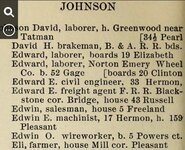
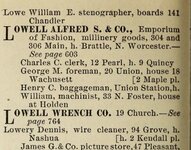
Curious myself, and searching around in Google Books further, I found some things that suggest Mr. E.E. Johnson of Worcester, Mass, may have cut his teeth as a machinist, but he was more aggressive than your average Lowell Wrench Co wage employee. In 1889 he was a member of the New England Water Works Association. In 1894 he and several others were the subject of a "remonstrance" before the state senate against their petition to increase the capital stock of the American Bell Telephone Company to $50,000,000.
 
To avoid these ads, REGISTER NOW!

baldytooltime

Well-known member
Joined
Feb 7, 2024
Messages
64
Just wish we could get some history on the EE stubby as well. The Worcester registry of citizens helps a lot the Coes Bros are in their as well. It was one hell of a “ Tool Town”.
 

Patrick Eubanks

Well-known member
Joined
Mar 15, 2023
Messages
517
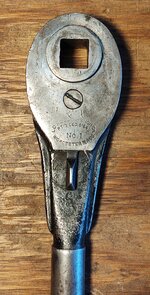
If it was a practice of Lowell Wrench Co. to make and sell ratchets with the name of the machinist it was assembled by stamped into the faceplate, it would be highly unusual, and we would see a lot more of them, and with a multitude of names. There's no precedence for that being the case. Note also that it's stamped exactly where the branding is typically found ("Lowell Wrench Co.", and maybe a patent date arcing across the top of "No. 1" with "Worcester, Mass" underneath). That replacement marking, and that abbreviation ("MAN'F'R") (MANUFACTURER) sure does make it look like it was some kind of strange sideline deal. I'm with baldy on this one.
Yea I’m thinking it’s unique and not a Lowell.
 

Private Lugnutz

Well-known member
Joined
Mar 30, 2012
Messages
30,675
Location
The Authentic Jersey Shore
Yea I’m thinking it’s unique and not a Lowell.
I'm thinking the only unique thing about it is the marking.
It would be interesting to see the inside guts & see if it's the same as Lowell's.
It would. My money is on it being mechanically identical to the Lowell Wrench Co version of the 1864 Moore patent (45,334) in every respect. As baldy pointed out, the Moore patent expired in 1881. At that time, there was nothing legally stopping anyone, including, apparently, E.E. Johnson, from copying them. Given the tool-and-die set-ups and machinery, of course. Which he apparently had at his disposal as a machinist working for the Lowell Wrench Co. What's a little odd, though, is that even though the patent had expired, Lowell Wrench Co. had not yet replaced it. By the time Lowell Wrench Co. started making the 1886 Sinclair pattern, the 1864 Moore pattern would truly be obsolete. Would they still have a line set up for the older pattern? And let a machinist use it to make the older pattern as a side hustle? It's a curious ratchet for sure. Could also just be a one-off.
 

baldytooltime

Well-known member
Joined
Feb 7, 2024
Messages
64
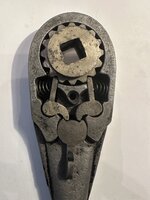
Had to use 1. PB blaster. 2. Tap on screwdriver. and finally 3. Apply heat to finally free that head screw. Success. Cleaning it with evaporust. Will show pics soon. Spoiler alert - identical to Lowell 1864 guts.
 

baldytooltime

Well-known member
Joined
Feb 7, 2024
Messages
64
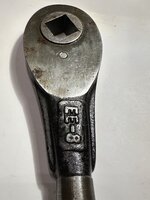
Found 1889 registry still shows Edwin E Johnson as machinist, (not at church st) and now show 1886 ratchet in advert. So between 1881 and 1886 are the Edwin E or EE Johnson years. I have a EE-8 stubby ratchet (Lowell No. 1) I’m betting it has 1864 guts as well. I believe the Lowell EE stubbles were the first ratchet stubbies ever made. So far I’ve seen an EE-1 and EE-8. One with Lowell Wrench Co. on it one without. Now wouldn’t it be interesting if in fact EE Johnson’s Stubbies prompted the 1886 ratchet design because of his dangerous stubby. The hands not only selecting position but were actually in close proximity to the work and ratcheting. I’m sure some fingers were lost. Prompting customers to request a selector farther away. Necessity is the mother to invention. No only did Lowell go back to the long arm but designed selector on the end which in my mind was a very ingenious patent. Now hands never got close to the work. If you look closely to EE long ratchet there a no. 2 on bottom. While the EE-8 stubby still shows a No. 1
 

Attachments

  • IMG_9833.jpeg
    IMG_9833.jpeg
    392.7 KB · Views: 59
  • IMG_9834.jpeg
    IMG_9834.jpeg
    338.3 KB · Views: 29
  • IMG_9835.jpeg
    IMG_9835.jpeg
    538.8 KB · Views: 17
OP
A

AntiqueBen

Well-known member
Joined
Aug 4, 2021
Messages
1,438
Had to use 1. PB blaster. 2. Tap on screwdriver. and finally 3. Apply heat to finally free that head screw. Success. Cleaning it with evaporust. Will show pics soon. Spoiler alert - identical to Lowell 1864 guts.
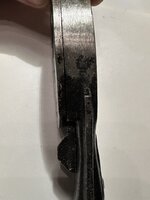
After looking closer at the pics of your ratchet, I've noticed, what looks to be, a difference in construction compared to one of my 1864 Lowell ratchets. The pic of the side of your ratchet shows what appears to be a ridge or forge line on the back part of the ratchet opposite the face side (pic 1 below ). The side edges of mine is smooth that faces the back of the ratchet & you can see the line that faces the front because the face plate is obviously removable (pic 2 below). The other pics are of the same 1864 Lowell. It would surprise me that Lowell would allow someone to use their machinery to stamp a ratchet with whatever they want on it, whether the patent was expired or not.
 

Attachments

  • Screenshot_20241226-124251~2.png
    Screenshot_20241226-124251~2.png
    1.5 MB · Views: 13
  • IMG_20241226_124731136~2.jpg
    IMG_20241226_124731136~2.jpg
    450.4 KB · Views: 13
  • IMG_20241226_124903264.jpg
    IMG_20241226_124903264.jpg
    736 KB · Views: 15
  • IMG_20241226_124912975.jpg
    IMG_20241226_124912975.jpg
    726.7 KB · Views: 16
  • IMG_20241226_125013655.jpg
    IMG_20241226_125013655.jpg
    527.9 KB · Views: 18

baldytooltime

Well-known member
Joined
Feb 7, 2024
Messages
64
Yes I saw that as well it looks pretty solid so either sloppy machinery in grinding down the edge or just japaning eroded earlier than yours and joint will show up over time. It appears this part of the process was too time intensive as when the stubby came out the front screw secures the back. Thus EE-8 is on it’s way to me I’ll be sure to take pictures, but yes it appears Lowell allowed its stamp on the stubby. So that theory or argument is shot.
 

Attachments

  • IMG_9837.jpeg
    IMG_9837.jpeg
    436.3 KB · Views: 13
  • IMG_9838.jpeg
    IMG_9838.jpeg
    234.1 KB · Views: 12
  • IMG_9839.jpeg
    IMG_9839.jpeg
    788.4 KB · Views: 20

baldytooltime

Well-known member
Joined
Feb 7, 2024
Messages
64
By the way I’m an engineer so I get more joy looking at the evolution of tools vs the actual tool itself. I know it frustrates lots of folks but the little changes make me ask why.
 
OP
A

AntiqueBen

Well-known member
Joined
Aug 4, 2021
Messages
1,438
By the way I’m an engineer so I get more joy looking at the evolution of tools vs the actual tool itself. I know it frustrates lots of folks but the little changes make me ask why.
I'm the same way. I always notice the smallest details. Especially when comparing variants of the same style of ratchet. Usually the small details tell a lot of the story.
 

Private Lugnutz

Well-known member
Joined
Mar 30, 2012
Messages
30,675
Location
The Authentic Jersey Shore
By the way I’m an engineer...
Something I replied to someone else who said the same thing awhile ago on a different thread...
Me too, I just don't like to admit it! (For some reason we seem to rank just below "Management", crooked eBay/CL/FBMP/etc sellers, and left lane loafers on GJ!
:)
Not only did Lowell go back to the long arm but designed selector on the end which in my mind was a very ingenious patent.
For your situational awareness, we have an older thread dedicated exclusively to Lowell Wrench Co. On that thread you will find many other Lowell ratchets, discussion, history, ads, patent info, etc, and much appreciation, especially for the selector at the end of the handle! Something you have not yet mentioned that you will find me also extolling on the Lowell thread is the virtue of its middle neutral position, actuating neither the CW or the CCW pawl, effectively converting the ratchet into a wrench with a service opening.
So between 1881 and 1886 are the Edwin E or EE Johnson years.
Which just happens to be the period exactly between when the first utility patent expired and when the second was granted.
It would surprise me that Lowell would allow someone to use their machinery to stamp a ratchet with whatever they want on it, whether the patent was expired or not.
And yet that is precisely the undeniable empirical evidence before us! A Lowell Wrench Co. Moore pattern ratchet in every respect except for none of the usual Lowell markings on the faceplate and the name of one of Lowell's employees - a machinist!, on the faceplate instead, accentuated by an abbreviation ("MAN'F'R") that can only be interpreted as "MANUFACTURER."

There are several explanations for it being a one-off. He could've just been goofing around with a QC reject (boys in a shop will be boys in a shop and it has happened before, even back then!), practicing, or he did it surreptitiously. This angle is one that smacks of vainglorious possibility for me, given the other data we have on him after he left Lowell. He was a very ambitious young man and traveled in elevated circles. I can totally see him grabbing an unfinished product off the line and putting his name on it as the Mfgr, with no other purpose than to look at it with dreams of being one of his own one day.

But the side-hustle is not as crazy as it seems. After hours. Giving Lowell a cut. For me to get behind this theory more, I would need to see more than one of them. I am not wholly convinced by Baldy's "EE" marked examples.

The question is, though, do you have a more logical explanation? That's not a challenge. I would love to hear any other ideas from anyone. Before you or anyone else answers, however, consider the alternatives. I certainly did. In my opinion, they are far less plausible!

Where else would an employee have access to the required machinery to construct a stamping die and use it? His home? (Note that his quarters was presumably the plant for awhile.) A rival Mfgr's plant? Those are the only other possibilities. He either stamped it without Lowell's knowledge or with their knowledge, but it seems to me the Lowell plant would've been the only place to construct a special stamping die, mount it in a machine, grab a near-finished ratchet off the line, and stamp it. For me, only why is fuzzy.
 

baldytooltime

Well-known member
Joined
Feb 7, 2024
Messages
64
If you could please send me the link to the older thread I’m very interested in the evolution on the Lowell ratchet from 1864 to 1886. Are there any EE stubbies in that thread?
 

baldytooltime

Well-known member
Joined
Feb 7, 2024
Messages
64
It looks like the census would put your address at where you worked before your home address. So EE Johnson who did not show up on 1880 rolls but did for next available rolls 1882 & 1885 is shown as WORKING at working 19 Church St. (Lowell factory) living at 8 Chatham; then next available ( that I could find) census 1889 shows him working at 17 Hermon (Taylor & Farley Organ Company) So he had moved on as far as work went, but was a machinist at Lowell during the critical years between patent expiration 1881 and new patent 1886. The EE stubby ratchet IS stamped with Lowell Wrench Co. ( no patent date - because not really relevant) yet STILL stamped No. 1. If the guts are the same as 1864 patent. I would logically assume it was made / Manf’r in these EE years 1881-1886 and it would be the first stubby ratchet (that I have seen) date wise so far. I also logically assume that the EE on these ratchets was some form of token of appreciation to their machinist or his direct involvement.
 

Attachments

  • IMG_9849.jpeg
    IMG_9849.jpeg
    1.7 MB · Views: 25

Private Lugnutz

Well-known member
Joined
Mar 30, 2012
Messages
30,675
Location
The Authentic Jersey Shore
If you could please send me the link to the older thread I’m very interested in the evolution on the Lowell ratchet from 1864 to 1886. Are there any EE stubbies in that thread?
There is an A-Z Index of Threads in the Sticky called READ B4 POSTING! at the top of the vintage forum. The purpose of the Index is to defeat the descending chronology of the forum. It provides easy access to ALL MAJOR THREADS regardless of where they are between page 2 and page x. Going to the Index and reviewing it will be good for you as a relatively new member. You may see and be interested in many other threads that aren't currently active on page 1 of the forum.
 

baldytooltime

Well-known member
Joined
Feb 7, 2024
Messages
64
Here are the guts of EE Johnson ratchet “2”. I will post pics of EE-8 stubby when I can. I’ll let y’all make your own decisions.
 

Attachments

  • IMG_9856.jpeg
    IMG_9856.jpeg
    871.5 KB · Views: 27
  • IMG_9857.jpeg
    IMG_9857.jpeg
    597.3 KB · Views: 28
OP
A

AntiqueBen

Well-known member
Joined
Aug 4, 2021
Messages
1,438
Here are the guts of EE Johnson ratchet “2”. I will post pics of EE-8 stubby when I can. I’ll let y’all make your own decisions.
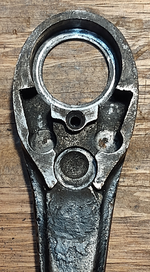
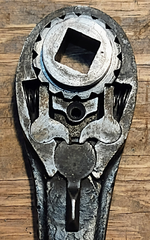
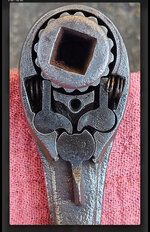
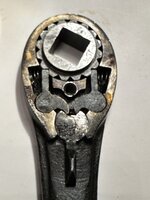
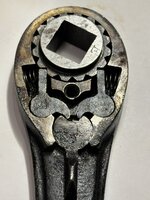
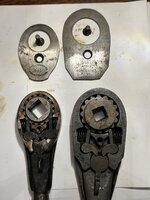
I noticed a difference in the machining on the inside of your ratchet compared to the inside of mine. Look at the outside wall of the slots that hold the pawls. The wall of mine is straight down until you reach the round spot for the pawls (pics 2 & 3). Yours has a protrusion coming off the wall right before the round section starts (1st pic). It's not a big difference, but enough of a difference that the machining is different.
 

Attachments

  • Screenshot_20241227-184151~2.png
    Screenshot_20241227-184151~2.png
    2.5 MB · Views: 18
  • Screenshot_20241227-190141~2.png
    Screenshot_20241227-190141~2.png
    3.2 MB · Views: 14
  • Screenshot_20241227-190151~2.png
    Screenshot_20241227-190151~2.png
    2.4 MB · Views: 16

baldytooltime

Well-known member
Joined
Feb 7, 2024
Messages
64
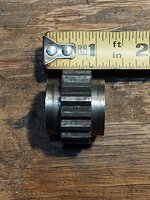
The biggest and most significant change I see is the main gear is now machined vs cast. The head is either bigger or beefier as well. From pawls to edge of case is thicker. It’ll be interesting to to the EE-8 stubby. I’m thinking it has a machined gear as well.
 
To avoid these ads, REGISTER NOW!

baldytooltime

Well-known member
Joined
Feb 7, 2024
Messages
64
In that one you have a machined gear I was comparing it to your other 1864. This one. So the EE should have a machined gear. If the walls are thin like yours then we will know this came after the stubby.
 

Attachments

  • IMG_9858.jpeg
    IMG_9858.jpeg
    2.3 MB · Views: 16
OP
A

AntiqueBen

Well-known member
Joined
Aug 4, 2021
Messages
1,438
In that one you have a machined gear I was comparing it to your other 1864. This one. So the EE should have a machined gear. If the walls are thin like yours then we will know this came after the stubby.
This is the gear of the one I posted above, the one we're talking about.
 

Attachments

  • IMG_20241227_193247307~2.jpg
    IMG_20241227_193247307~2.jpg
    613 KB · Views: 15
  • IMG_20241227_193222660~2.jpg
    IMG_20241227_193222660~2.jpg
    737.7 KB · Views: 15

baldytooltime

Well-known member
Joined
Feb 7, 2024
Messages
64
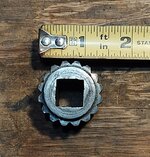
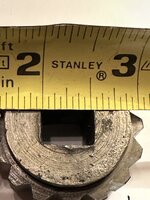
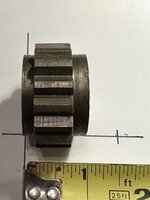
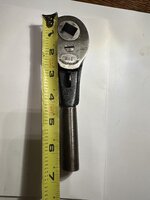
The head must be bigger on EE the gear is 1 5/8 wide but only an inch in height. The housing is 2 3/8 wide by 5 3/4 long at lower bar ridge.
 

Attachments

  • IMG_9865.jpeg
    IMG_9865.jpeg
    500.7 KB · Views: 10
  • IMG_9866.jpeg
    IMG_9866.jpeg
    355.4 KB · Views: 9
  • IMG_9867.jpeg
    IMG_9867.jpeg
    377 KB · Views: 14
  • IMG_9869.jpeg
    IMG_9869.jpeg
    1.1 MB · Views: 15
OP
A

AntiqueBen

Well-known member
Joined
Aug 4, 2021
Messages
1,438
The head must be bigger on EE the gear is 1 5/8 wide but only an inch in height. The housing is 2 3/8 wide by 5 3/4 long at lower bar ridge.
This is the one I'm measuring (pic below). The pic above you posted, if that's a pic I posted before, it could be one of several I've got.
 

Attachments

  • IMG_20241227_201456570~2.jpg
    IMG_20241227_201456570~2.jpg
    317.3 KB · Views: 12
  • IMG_20241227_200936084~3.jpg
    IMG_20241227_200936084~3.jpg
    657 KB · Views: 20

MR.X

Well-known member
Joined
Dec 13, 2010
Messages
1,799
Probably won’t help with your E.E. dive but this is the insides of a Moore patent Lowell ratchet when they were still making them in Lowell before the Worcester move.
 

Attachments

  • IMG_6140.jpeg
    IMG_6140.jpeg
    1.2 MB · Views: 19

Private Lugnutz

Well-known member
Joined
Mar 30, 2012
Messages
30,675
Location
The Authentic Jersey Shore
Guys, FWIW, I see at least three (3) differences in the machining of the cavities housing the springs for the pawls and the pawls.

/ The ratchet in post #621 (one of Ben's, if I am following correctly) has a very small, thin, but sharp protrusion separating the cavity where the pawl rotates from the cavity holding the springs.

/ The ratchet in post #617 (Baldy's "E.E. JOHNSON" / "MAN'F'R" ratchet) has a more pronounced but rounded protrusion performing the same function

/ The ratchets in post #619 (pics 2 & 3) and in post #625 (@MR.X 's) have no protrusions.

If there is a sequence to these differences, and if the sequence goes from no protrusion to some kind of protrusion, which @MR.X 's rat sourced from Lowell certainly helps suggest, I suspect it was to prevent the base of the spring from slipping down and putting pressure on the pawl in contact.

I'm not sure if any of these differences are big enough to necessitate a deliberate change in the blueprint in the drafting department and a change order for the milling of that piece on the line or just a milling variance. It's "negligible" (a common engineers' term, believe it or not, usually associated with tolerances! ;)) from the perspective of an overall manufacturing or marketing perspective. No wholly new dies, jigs, processes, or machines required. Also negligible in the context of patents and patent inspectors.

Having said that to emphasize sufficient caution for what I say next..., IF there is any credence to the protrusion, it actually helps suggest that @four.cycle could be right, after all. Not in the way he intended (common practice), but certainly accurate. Several (or at least more than one) machinists may have made a few pre-production variants. Or maybe it was just one, the irrepressible E.E. Johnson, and his "good idea" pre-production variant was marked with him as the MAN'F'R to separate it from other variants. Unnecessarily wordy, and flighty, but functional. His. And that plays into Baldy's theories about E.E. having an even larger pre-production role in deliberate variance (internal R&D and experimentation). Also jibes with mine about these being side-projects or one-offs.

If you guys looked long and hard enough, I suspect you might find other small differences, not just in the presence and shape of the protrusion, but other features. Empirically, it's possible for you to reconstruct a precise sequence of all the 1864 ratchet production variants, but very difficult. It would require a statistically relevant number of examples - many dozens, before you could be satisfied that you're not missing any.

None of this impinges on ALL the ratchets above, including Baldy's, being unquestionably made on a line in a Lowell plant on Lowell machinery set up to manufacture a ratchet of the 1864 Moore patent design.
 

baldytooltime

Well-known member
Joined
Feb 7, 2024
Messages
64
Ok here’s the EE-8. It appears to be before the EE Johnson long ratchet. It mirrors the guts of your Ben it has. 5/8 opening in gear vs 1/2 the walls by the pawls are narrow. So the EE Johnson “2” really was after the No. 1. The Stubby appears to be in the 1881-1886 (EE JOHNSON Years) and befor the “2” variant. The stubby has EE-8 on it and that is pretty coincidental that tha machinist was EE JOHNSON.
 

Attachments

  • IMG_9902.jpeg
    IMG_9902.jpeg
    465.7 KB · Views: 12
  • IMG_9903.jpeg
    IMG_9903.jpeg
    725.4 KB · Views: 12
  • IMG_9904.jpeg
    IMG_9904.jpeg
    524.9 KB · Views: 13
  • IMG_9905.jpeg
    IMG_9905.jpeg
    552.7 KB · Views: 13
  • IMG_9906.jpeg
    IMG_9906.jpeg
    519.2 KB · Views: 12

baldytooltime

Well-known member
Joined
Feb 7, 2024
Messages
64
The insides
 

Attachments

  • IMG_9907.jpeg
    IMG_9907.jpeg
    504.7 KB · Views: 11
  • IMG_9908.jpeg
    IMG_9908.jpeg
    804.3 KB · Views: 11
  • IMG_9909.jpeg
    IMG_9909.jpeg
    373 KB · Views: 9
  • IMG_9910.jpeg
    IMG_9910.jpeg
    405.4 KB · Views: 10
  • IMG_9911.jpeg
    IMG_9911.jpeg
    463 KB · Views: 19

baldytooltime

Well-known member
Joined
Feb 7, 2024
Messages
64
I am confident the EE stubby was made by EE Johnson as a machinist at Lowell Wrench Co. in the 1881-1886 period. And that the EE Johnson”2” was made after the stubby but wasn’t mass produced. It might have been a proto type to compete with the Sinclair patent.
 

baldytooltime

Well-known member
Joined
Feb 7, 2024
Messages
64
The EE Johnson Era 1881-1886 ( mass produced stubby and proto type)
 

Attachments

  • IMG_9921.jpeg
    IMG_9921.jpeg
    731.8 KB · Views: 19

Private Lugnutz

Well-known member
Joined
Mar 30, 2012
Messages
30,675
Location
The Authentic Jersey Shore
The stubby has EE-8 on it and that is pretty coincidental that tha machinist was EE JOHNSON.
FWIW to you in your continued analysis of these Lowell rats, Baldy, the "-8" implies a "-1" through "-7", at the very least, to me. More importantly, note that the marking is forged. Unlike the marking on the faceplate, which was stamped, that represents a considerable expense. It implies the making of a die and the use of a die to forge them in multitudes. And it implies the same for "EE-1" through "EE-7," whatever they may be. It may be a coincidence, and the "EE" might just as well stand for Erecting Equipment, for buildings, bridges, or transmission towers, etc, for which Lowell Wrench Co consistently advertised their wares. Which I find more plausible than the idea of forging a machinists' first and middle initials.

As for the "stubby" moniker, whether that short handle is hollow or solid, it looks to me like it is meant to fit either over or inside a longer handle. Like a ratchet head.
It might have been a proto type to compete with the Sinclair patent.
Similarly, FWIW to you in your continued analysis of these Lowell rats, I find that counterintuitive. It can't fundamentally look and function like the Moore patent and be sufficiently novel to be considered a different ratchet design at the same time. And it's clearly representative of the Moore patent. There is no way the Lowell front office would find that to be a new or improved ratchet, let alone the patent examiners.
 

baldytooltime

Well-known member
Joined
Feb 7, 2024
Messages
64
If you followed thread there is a same size as the EE-1 I referenced earlier. The handle is secure and does not twist off like today’s large ratchets (ie snap-on) I have seen several of these. They prolly saved forging costs by hammer drop forging head part only, then attaching machined handle. Some I have seen with Lowell stamp faceplate some without. I have only seen the two numbers EE-1 and EE-8. ( they are the same size) I can’t get past a EE-1 & EE-8 forge numbers and a EE Johnson “2” ratchet with the guts they have being made at the time Machinist EE Johnson was at Lowell factory. I never knew any thing about EE Johnson til a couple weeks ago - til I found him in the Worcester citizen registry. You can rain on the EE Johnson parade, but I have shown 2 NEW ratchets during a period of time the Machinist EE Johnson worked at the Factory. I have tied a lot of facts together. My discussion is now over. Make up your own minds.
 

Private Lugnutz

Well-known member
Joined
Mar 30, 2012
Messages
30,675
Location
The Authentic Jersey Shore
You can rain on the EE Johnson parade,
I don't see how it's possible for you to read me voicing skepticism about only a first and a last initial forged into a part indicating that it stands for our mutually admired Mr. Johnson to be intentionally aimed at ruining you entire E.E. Johnson theory, Baldy, especially not after so many of my posts not only concurred but so colorfully augmented the E.E. Johnson angle and your theory of his role as a machinist as it relates to the ratchet with his full name and MAN'F'R stamped on it.
The handle is secure and does not twist off like today’s large ratchets
If you're calling that short piece the handle, I can see that it's secure. And I can now see that it's solid. It's also machined exactly in the shape of a perfectly cylindrical pin or rod. And it's smooth, like a pin or rod. There is no sign of any knurling. What I am suggesting is that the actual handle would be hollow and slide over that. Many detachable ratchet heads had both male and female designs. It's where the cheater pipe (vs bar) comes from. In this case the mechanism to secure the handle to the ratchet head, probably a set screw or a collar with pressure plates, etc, would be on the female handle.

I have to admit I was so enchanted by the ratchet with the E.E. JOHNSON and MAN'F'R stamping, and generally unable to focus on two things at once, I really wasn't paying too much attention to what you were calling a "stubby" or the use of it to mean how we use it in modern parlance, for ratchets with extraordinarily short handles. I see that you've actually been calling it a "stubby" since the previous page, and I can see that you posted a link to a previous thread in which bigcaddy called an EE-1 with a similar design a stubby. I see that he initially though it was also an early ratchet head, but changed his mind because of it being solid, like a stubby. I'm assuming he is also unaware of the male designs. In addition to it looking like an early ratchet head for a long female handle, I am skeptical of it being a stubby because the idea of a stubby just doesn't jibe with the size of the ratchet or the marketplace they were in.

FYI, there is an EE-1 Lowell ratchet head with a female receptacle for a long male handle - the opposite design of bigcaddy's EE-1, on the Lowell thread. First post, in fact. It has a customer's name stamped on the face. Probably a construction company, if I had to guess.
 
Last edited:
OP
A

AntiqueBen

Well-known member
Joined
Aug 4, 2021
Messages
1,438
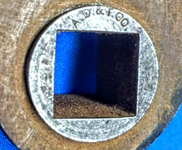
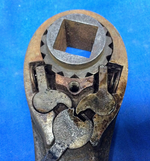
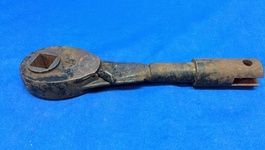
Here is the pics of the ratchet Lugz is talking about in the above post. Looks like the short "stubby" was designed to have a longer handle attached by means of the piece you see in the pics below. I've also seen a few that even had a handle that attached horizontally at the end of the vertical handle almost creating like a speed or crank handle. I believe Lowell made something similar for military applications. Baldy's looks like the one pictured below, just missing the female handle attachment.

I also noticed this one from the Lowell thread is stamped A.D. & T. Co. on the outside of the gear. I haven't researched it yet, but this could be a clue to better understanding this ratchet type.
 

Attachments

  • Screenshot_20241229-102327~2.png
    Screenshot_20241229-102327~2.png
    1.5 MB · Views: 10
  • Screenshot_20241229-102010~2.png
    Screenshot_20241229-102010~2.png
    994.2 KB · Views: 8
  • Screenshot_20241229-102026~2.png
    Screenshot_20241229-102026~2.png
    940.4 KB · Views: 9
  • Screenshot_20241229-102019~2.png
    Screenshot_20241229-102019~2.png
    913.1 KB · Views: 11
Last edited:

Private Lugnutz

Well-known member
Joined
Mar 30, 2012
Messages
30,675
Location
The Authentic Jersey Shore
...by means of the piece you see in the pics below.
At first I wasn't sure what you were talking about, because I was thinking the "piece" was integral to the ratchet head, as an alternate female design. I concur that this sleeve, if you will, fitting over the pin/rod that is integral to the ratchet head is actually part of the missing handle or at least a part that is pinned onto it. Good catch.
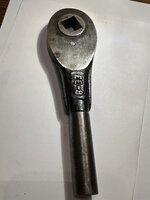
Note that I have x-linked the last couple pages of this more generalists' thread to the end of the Lowell thread for continuity.
 
OP
A

AntiqueBen

Well-known member
Joined
Aug 4, 2021
Messages
1,438
I know Baldy's ratchet says E.E. Johnson on the faceplate, but if you had one of these short versions with Lowell Wrench Co on the faceplate & the "EE" forged into the back side, there could be another scenario to consider.

D.M. Moore had another patent in 1870 for a universal square, patent # 102,957. I noticed one of the witnesses on this patent was a man named E.E. Lamson. I haven't researched him yet, but could be worth looking into. Using the initials E for your first name & E for your middle initials is not very common. Plus, since Johnson is the last name on Baldy's ratchet, why would you mark your tool only EE & leave off the J for your last name. In other words, if you had a Lowell marked faceplate with the EE forged into the other side, you would have no idea who Johnson was.
 

Attachments

  • Screenshot_20241229-110219~2.png
    Screenshot_20241229-110219~2.png
    157.1 KB · Views: 9
OP
A

AntiqueBen

Well-known member
Joined
Aug 4, 2021
Messages
1,438
Lugz, I thought it was A.T. & D. Co for American Tap & Die Co, not American Die & Tap?
 

Attachments

  • Screenshot_20241229-115110~2.png
    Screenshot_20241229-115110~2.png
    714.5 KB · Views: 3
To avoid these ads, REGISTER NOW!
Top Bottom