To avoid these ads, REGISTER NOW!

Show Off Your Antique Ratchet

Private Lugnutz

Well-known member
Joined
Mar 30, 2012
Messages
30,666
Location
The Authentic Jersey Shore
if you had one of these short versions with Lowell Wrench Co on the faceplate & the "EE" forged into the back side,
Not sure why you used "if" here, Ben. That's exactly the case with all the Lowell ratchet heads. No hypothetical if. They all have the typical Lowell marking on the faceplate and "EE-1" or "EE-8" forged into the frame.
there could be another scenario to consider.

D.M. Moore had another patent in 1870 for a universal square, patent # 102,957. I noticed one of the witnesses on this patent was a man named E.E. Lamson.
Moore lived in Vermont, he was not an employee of Lowell Wrench Co., and his patent wasn't assigned to Lowell Wrench Co. They either bought the rights or licensed the rights. E.E. Lamson was associated with many enterprises, including Windsor Mfg, in Windsor, VT. Highly doubtful there is any affiliation with Lowell, let alone one in which his first and middle initial would be placed on a Lowell tool with a number like a model number.
Using the initials E for your first name & E for your middle initials is not very common.
Alliteration ("J.J.") itself is a popular naming convention, and E.E. is more popular than you might think. (Ironically, in fact, if you search "E.E. Johnson" on Google Books you will see that you have to wade through several other examples before getting to our beloved Lowell machinist! :))
Plus, since Johnson is the last name on Baldy's ratchet, why would you mark your tool only EE & leave off the J for your last name. In other words, if you had a Lowell marked faceplate with the EE forged into the other side, you would have no idea who Johnson was.
The idea of any company using any employee's first and middle initials as a prefix for a model number is highly implausible.
 
To avoid these ads, REGISTER NOW!
OP
A

AntiqueBen

Well-known member
Joined
Aug 4, 2021
Messages
1,438
Not sure why you used "if" here, Ben. That's exactly the case with all the Lowell ratchet heads. No hypothetical if. They all have the typical Lowell marking on the faceplate and "EE-1" or "EE-8" forged into the frame.
One of my Lowell marked examples doesn't have the EE forged into the handle. So not all Lowell's from this era have a forged EE in the handle. I also have another 1864 example with no EE forged into the handle. Unless you're only talking about the short stubbies like Baldy's.
 

Attachments

  • IMG_20241229_121719775~2.jpg
    IMG_20241229_121719775~2.jpg
    540.3 KB · Views: 33
  • IMG_20241229_121734050~2.jpg
    IMG_20241229_121734050~2.jpg
    597.3 KB · Views: 23

Private Lugnutz

Well-known member
Joined
Mar 30, 2012
Messages
30,666
Location
The Authentic Jersey Shore
Unless you're only talking about the short stubbies like Baldy's.
Yes, hence my reference to "ratchet heads." "Detachable ratchet heads" in catalogs. A stubby ratchet means something completely different, in my lexicon, anyway. They were special ratchets made with extraordinarily short handles for their drive size. Some guys enjoy making their own (with a grinder, and a polishing wheel) from regular ratchets. Classically, 3/8-drive for lower profile but higher range of service openings. They are access/obstacle clearance ratchets. That's not an extra short handle on the EE-1 or the EE-8. It's just a pin or rod for attaching a much, much longer handle for torque. Also why I think the EE in the model numbering scheme likely has something to do with its use case.
 
OP
A

AntiqueBen

Well-known member
Joined
Aug 4, 2021
Messages
1,438
Yes, hence my reference to "ratchet heads." "Detachable ratchet heads" in catalogs. A stubby ratchet means something completely different, in my lexicon, anyway. They were special ratchets made with extraordinarily short handles for their drive size. Some guys enjoy making their own (with a grinder, and a polishing wheel) from regular ratchets. Classically, 3/8-drive for lower profile but higher range of service openings. They are access/obstacle clearance ratchets. That's not a short handle on the EE-1 of the EE-8. It's just a pin or rod for attaching a longer handle.
Gotcha 👍 So really, Baldy's stubby really isn't a stubby. Technically speaking, it's missing it's handle.
 
OP
A

AntiqueBen

Well-known member
Joined
Aug 4, 2021
Messages
1,438
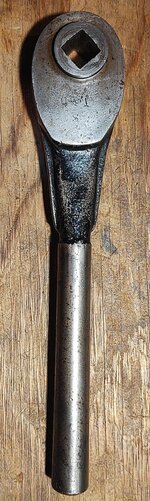
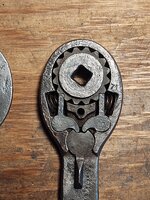
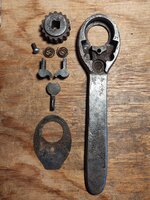
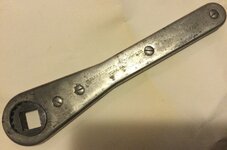
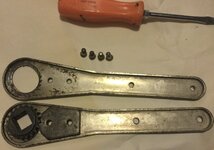
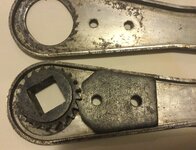
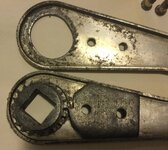
This whole discussion of Baldy's Lowell ratchet got me interested in figuring out again the first version of DM Moore's ratchet. In the past I've talked about the flat & round handle versions, the flat handle being what is pictured in the original patent drawing. My flat handle example is the only one I've seen that doesn't have a location stamped on it. The first couple of years they were stamped Lowell Mass & then Worcester Mass when they made the move there in 1871 or so. Not only is the location not on my faceplate, but it's also the only one I've seen that ,"doesn't" have a recessed screw for the faceplate. All my other DM Moore ratchets have a much thicker faceplate due to the recessed hole for the screw.

I don't think Lowell Wrench Co would start out putting their location on the faceplate, then stop doing it, only to start doing it again at a later time. IMO, it would seem more logical that early on Lowell didn't stamp the location & then decided to do it from then on out.

Another clue on my flat handle example is the overall length. All of my 1864 Lowell ratchets are 9-1/2" long. My flat handle is 8-1/2" long. I'm sure this is a clue to place it in the timeline but the original patent doesn't give any specs or measurements on the original ratchet. My guess was it was 8-1/2" long & when they changed to the round handle design they went to a 9-1/2" long handle.

Below are several pics including how thin the faceplate is on the flat handle compared to the round handle examples.
 

Attachments

  • IMG_20241229_160129753~2.jpg
    IMG_20241229_160129753~2.jpg
    754.3 KB · Views: 15
  • IMG_20241229_150827607.jpg
    IMG_20241229_150827607.jpg
    1 MB · Views: 11
  • IMG_20241229_151239011~2.jpg
    IMG_20241229_151239011~2.jpg
    1.1 MB · Views: 11
  • IMG_20241229_151504613~3.jpg
    IMG_20241229_151504613~3.jpg
    1.4 MB · Views: 10
  • IMG_20241229_150205472~2.jpg
    IMG_20241229_150205472~2.jpg
    966 KB · Views: 12
  • IMG_20241229_150611884.jpg
    IMG_20241229_150611884.jpg
    1.1 MB · Views: 13

Private Lugnutz

Well-known member
Joined
Mar 30, 2012
Messages
30,666
Location
The Authentic Jersey Shore
I was just going to suggest trading notes with MR.X. His is the only early specimen I have seen with the internal parts bearing part numbers, and matching part numbers, in a handsome antique font, to boot!
 
OP
A

AntiqueBen

Well-known member
Joined
Aug 4, 2021
Messages
1,438
I was just going to suggest trading notes with MR.X. His is the only early specimen I have seen with the internal parts bearing part numbers, and matching part numbers, in a handsome antique font, to boot!
Yes. Here is a pic of Mr. X's No. 2 1864 Lowell ratchet stamped Lowell Mass. This is the only other example I've seen without the recessed faceplate screw like mine. Not sure why mine has no location stamped. That's one of my reasons for thinking the very first examples didn't have a location stamped yet.
 

Attachments

  • Screenshot_20241229-163738~2.png
    Screenshot_20241229-163738~2.png
    3.2 MB · Views: 12

Private Lugnutz

Well-known member
Joined
Mar 30, 2012
Messages
30,666
Location
The Authentic Jersey Shore
Could be. Easy to fall into traps, though, without a statistically relevant sample size, as I alluded to above. It's why I usually avoid being too declarative about any theory. We've seen one (MR.X's) with internal pieces stamped with assembly numbers. It wouldn't be beyond the pale to suggest that all the ratchets without numbered internal pieces came later, when they decided that they no longer needed to do that for the guys on the manufacturing line. And maybe no location was an anomaly. Empirical sequencing is really hard. That's why it's often satisfying enough to classify and speak in variants or periods or eras. Lowell Moore. Worcester Moore. etc.
 
OP
A

AntiqueBen

Well-known member
Joined
Aug 4, 2021
Messages
1,438
Could be. Easy to fall into traps, though, without a statistically relevant sample size, as I alluded to above. It's why I usually avoid being too declarative about any theory. We've seen one (MR.X's) with internal pieces stamped with assembly numbers. It wouldn't be beyond the pale to suggest that all the ratchets without numbered internal pieces came later, when they decided that they no longer needed to do that for the guys on the manufacturing line. And maybe no location was an anomaly. Empirical sequencing is really hard.
I agree without having a good selection to compare, it makes it difficult to understand the truth behind it all. A couple of my examples are stamped with numbers inside. My flat handle is stamped "71" on the inside & on the back of the faceplate.
 

Attachments

  • IMG_20241229_150205472.jpg
    IMG_20241229_150205472.jpg
    1.2 MB · Views: 12
OP
A

AntiqueBen

Well-known member
Joined
Aug 4, 2021
Messages
1,438
I also have another 1864 Moore that is stamped "11" on the inside & on the back of the faceplate.
 
OP
A

AntiqueBen

Well-known member
Joined
Aug 4, 2021
Messages
1,438
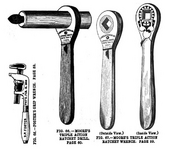
Here is an ad from 1870 showing Lowell's (Moore's) triple action ratchet. It shows the Lowell Mass stamping. I could only assume, if they didn't put the location on early models & they started putting Lowell Mass on the ratchet in 1870, that only leaves 1869 they would have left it off. Coincidentally, the same year Lowell started business. But once again, we don't have "hard" evidence of this yet outside of my example.
 

Attachments

  • Screenshot_20241229-161856~3.png
    Screenshot_20241229-161856~3.png
    508.2 KB · Views: 12
OP
A

AntiqueBen

Well-known member
Joined
Aug 4, 2021
Messages
1,438
I think I remember seeing a few with numbers here and there. And I think that's ballpark. But I was referring to post #625. Is the "11" example like that?
Mine is stamped 11 on the body inside & on the back of the faceplate. Not on the pawls. I wander if Mr X's is stamped behind the faceplate? I'm curious to know the overall length of his. This could tell some of the story.
 
To avoid these ads, REGISTER NOW!

3baygarage

Well-known member
Joined
Sep 1, 2013
Messages
11,978
Location
SW Florida/from Buffalo,NY
Butler Elliptical Wrench
York,PA
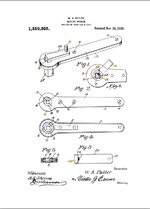
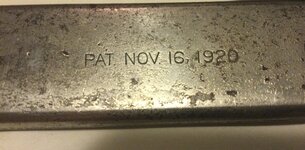
Patented November 16, 1920 (1,359,325)
Inventor William A. Butler
11/16” drive
847DFFC1-6610-427B-A212-CBE01D34C1AF.jpeg
Pretty cool concept. The gear rides in an oblong hole, allowing it to disengage so it can be turned speedily with a separate crank handle inserted in the sockets. If anyone knows of a crank hit me up.

The simplicity of the mechanism really surprised me.
716B87F8-83E5-4944-B0D8-D6EFA6220D3D.jpeg
Engaged
CBD65E87-8368-4510-AAEF-9D0C5D290637.jpeg
Disengaged
BA3ADD2E-AD66-4D1C-9B08-2504514E5E39.jpeg

227D0FCE-53BE-404A-B2AA-CAC0B960EBFF.jpeg
Teeth still look perfect.
CA216DD6-55A0-436D-B908-6CE383CF8668.jpeg

08711B30-1AB7-45C3-AAC5-B7993E9C1D2D.jpeg
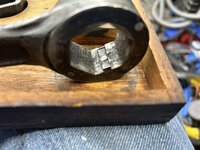
11/16”
5421E9B7-E399-4F96-A8CF-CABCD0ED21DB.jpeg
From Google Patents. Shows crank. Description gives details about its use.
A6952D01-977A-41C5-AB09-D49EFFD4186B.jpeg
 

Private Lugnutz

Well-known member
Joined
Mar 30, 2012
Messages
30,666
Location
The Authentic Jersey Shore
Cool find.

The 11/16" female opening is the outside diameter of standard pressed steel socket drive tangs, as made by Mossberg, Miller, Syracuse and others, allowing them to be turned from the outside, with no plug.

I'm trying to picture the action, though. So you would engage and turn, and then pull it away from that "dog" for the backstroke, then rengage to turn, etc.
 

3baygarage

Well-known member
Joined
Sep 1, 2013
Messages
11,978
Location
SW Florida/from Buffalo,NY
Cool find.

The 11/16" female opening is the outside diameter of standard pressed steel socket drive tangs, as made by Mossberg, Miller, Syracuse and others, allowing them to be turned from the outside, with no plug.

I'm trying to picture the action, though. So you would engage and turn, and then pull it away from that "dog" for the backstroke, then rengage to turn, etc.
Thanks. It is kind if hard to envision. The gear hops right along while ratcheting. It only needs to be pulled away to the upper end of the opening in order to freewheel.

Pretty sure I saw the crank piece with a Mossberg set before.

Some close ups.
2D17B93A-80DF-45AE-9725-6DE0E21D18E9.jpeg
923695AA-7F89-4337-9898-FF57186F8F77.jpeg
 
Last edited:

Private Lugnutz

Well-known member
Joined
Mar 30, 2012
Messages
30,666
Location
The Authentic Jersey Shore
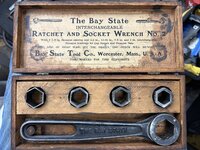
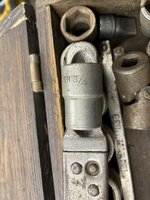
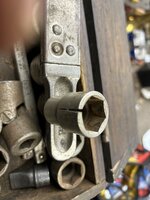
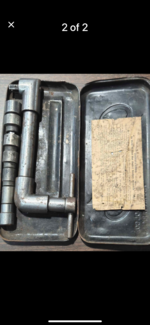
That is an amazing set that I have never seen before, either in person, photos, or catalogs or ads, here on GJ, or AA, or any other site. Nice find!

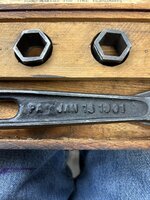
Are there any markings on the flip side of the ratchet handle? Please post a photo.
...an interesting concept; just hexagonal sleeves instead of sockets
An idea borne and morphed out of the late 1880s from industrial applications prior to the invention of the automobile. We've discussed a few sets with similar "adapters" or "reducers" etc on other threads using antique ratchet-drill like tools to turn nut and bolt heads. It's interesting that referred to as both "socket wrenches" and "bushings" on the label.

The ratchet, which is probably based on 666,202, filed by P. Lord in 1900, granted in 1901, can also be thought of as similarly transitional. The Bay State Tool Co made a series of single and double end ratcheting wrenches with various hex and square service openings. Exactly like the kinds of box end ratcheting wrenches we would later see from K-D, Snap-on, etc, still being made today. Like those, these early versions from Bay State had fixed "inserts" with fixed service opening sizes.

At some point between 1900 and 1908, they had the idea of using these ratcheting wrenches, without fixed inserts with fixed service opening sizes, as universal ratchets, to drive detachable pressed steel socket wrenches of various service opening sizes of the kind that Mossberg would come to dominate in the market. I have a small set, linked here. Which eventually led to the bigger and more famous Autokit sets (1908) that Sears eventually offered in their catalog in 1913, example linked here.

I am making an informed hunch that your set came before these.
 
Last edited:

Private Lugnutz

Well-known member
Joined
Mar 30, 2012
Messages
30,666
Location
The Authentic Jersey Shore
Earliest ads I could find for your set were 1906. Example below. Latest ads I could find were 1907. I don't imagine they devoted production to the "bushings" idea after moving to a standard drive opening with a range of detachable pressed steel sockets.
 

Attachments

  • Bay State bushing based Sets ad 1906.jpg
    Bay State bushing based Sets ad 1906.jpg
    124.1 KB · Views: 23

chasinfram

Active member
Joined
Jan 18, 2024
Messages
33
Location
Framingham, Mass
Gentlemen!
Thanks for your dedicated and thoughtful replies!

It was a blessed encounter in Marketplace where this set was made available for a ridiculously low price. Having a keen interest in these early socket sets I realized immediately that this was a rare opportunity.
I speculate that this set was owned by a fastidious mechanic. The set is well used, but the case is exceptionally well taken care of. I imagine the set being used for the occasional hex nuts of the size range, then put away carefully for a century when the newer, more user friendly sets came out.

Case is nearly complete, just a missing circular block of wood to restrain the socket head, perhaps a paper label on the top. Also of interest is the mis-matched holes for the sockets that must be original to the quality of the case.
 

Attachments

  • IMG_8259.jpeg
    IMG_8259.jpeg
    736.1 KB · Views: 14
  • IMG_8258.jpeg
    IMG_8258.jpeg
    710 KB · Views: 8
  • IMG_8257.jpeg
    IMG_8257.jpeg
    1.3 MB · Views: 12
  • image.jpg
    image.jpg
    1 MB · Views: 12

chasinfram

Active member
Joined
Jan 18, 2024
Messages
33
Location
Framingham, Mass
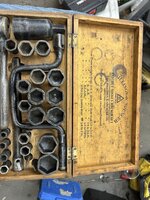
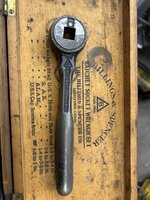
I looked for a reference to a Billings and Spencer set, didn’t find one but may have missed it.
This Ratchet is not particularly unique but I think the drop forged sockets are pretty cool. The case is niceimage.jpgimage.jpgimage.jpgimage.jpgimage.jpg with marked openings and stamped sizes on the shank of the socket. This is also a transitional concept as these are drop forged versions of the stamped steel sockets. I’ll wager it would be hard to split one of these.
 

Private Lugnutz

Well-known member
Joined
Mar 30, 2012
Messages
30,666
Location
The Authentic Jersey Shore
I looked for a reference to a Billings and Spencer set, didn’t find one but may have missed it.
Nice No. 53 set! FYI, we have a Billings & Spencer thread - and a thread for just about every major brand (and many minors!). Easiest way to find them is to use the A-Z Index of Threads in the Sticky at the top of this forum titled READ B4 POSTING! I posted an unusual No. 50 in that thread, linked here. There was nothing odd about the contents, but a PO had replaced the bottom with the lid, which I didn't find until I emptied the tools and discovered hidden underneath.
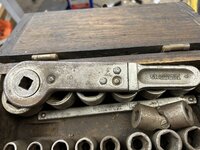
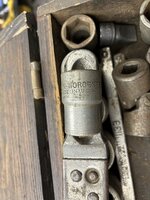
Can’t resist, here’s another set. Walden Worcester Set number 16.
A very nice and complete example. I have a No. 8 and a No. 16 with the engraved brass contents labels still tacked to the lids, linked here, if you've never seen one before. Talk about a classy era. Brass contents labels!
 

chasinfram

Active member
Joined
Jan 18, 2024
Messages
33
Location
Framingham, Mass
Nice No. 53 set! FYI, we have a Billings & Spencer thread - and a thread for just about every major brand (and many minors!). Easiest way to find them is to use the A-Z Index of Threads in the Sticky at the top of this forum titled READ B4 POSTING! I posted an unusual No. 50 in that thread, linked here. There was nothing odd about the contents, but a PO had replaced the bottom with the lid, which I didn't find until I emptied the tools and discovered hidden underneath.

A very nice and complete example. I have a No. 8 and a No. 16 with the engraved brass contents labels still tacked to the lids, linked here, if you've never seen one before. Talk about a classy era. Brass contents labels!
I do have a second set with the brass plate inside.
I was using the search function. Both this thread and everywhere. I’ll look more carefully. Thanks for your replies.
 

Private Lugnutz

Well-known member
Joined
Mar 30, 2012
Messages
30,666
Location
The Authentic Jersey Shore
I do have a second set with the brass plate inside.
Nice!
I was using the search function. Both this thread and everywhere. I’ll look more carefully. Thanks for your replies.
You're quite welcome. I wasn't admonishing you. While this thread has shown some entire sets, as context, or just because, Ben's intention was just ratchets, and just antique ratchets, although people with a more liberal definition of "antique" have posted older modern and vintage ratchets, too. (We have a separate, older thread for 'Ratchets' only, typically vintage.) It seems like you have more than just a few wooden box era socket sets (a shared passion), and I would recommend posting in their respective brand threads. While I like the search function for finding peculiar topics, especially the Advanced options, the A-Z Index in the Sticky is the quickest, easiest way to find dormant threads.

BTW, welcome to GJ!
 

Private Lugnutz

Well-known member
Joined
Mar 30, 2012
Messages
30,666
Location
The Authentic Jersey Shore
No trouble at all. I think you'll enjoy reading the thread. But yes, I am going to deliberately make you use the Sticky to get to it, because I do believe that once you use the Sticky, you'll see at the 50,000' view just how much broader and deeper the GJ Vintage Tools Discussion forum goes beyond what you can see on page 1 or by anyone providing you a singular link. :)
 
To avoid these ads, REGISTER NOW!
Top Bottom