To avoid these ads, REGISTER NOW!

Reinforcing butcher block; screws, dowels, biscuits, etc.

jives

Well-known member
Joined
Jan 4, 2013
Messages
2,811
Location
Central NY
I am collecting salvaged (old furniture) white oak planks to turn into a butcher block workbench top, about 6' long and 30" wide. The planks will be ripped and planed to be strips that 1" or 2" thick (two different sizes) and 2" wide. They will then be edge-laid (face glued) in typical fashion. So, here is the question: It would seem that as each successive strip is clamped up for gluing that a couple of screws -- or dowels or biscuits -- could be added to add strength and prevent coming apart in the future. Screws would be easier. Aside from potentially having to drill through screws to create holes for bench dogs, is there a downside of using such reinforcing? Some butcher block tables had large bolts through the entire block, but that is not what I am looking for. Any thoughts?
 
To avoid these ads, REGISTER NOW!

rlitman

Well-known member
Joined
Oct 18, 2010
Messages
24,651
Location
Long Island
Short of the long bolts, I don't think you can do anything to improve on a well jointed long-grain glue line. Drilling for bolts after assembly isn't practical. Drilling 3/8" holes ahead of time in a jig for a post-tension rod is your best bet.
 

slowtwitch73

Well-known member
Joined
Apr 18, 2019
Messages
5,876
Location
Hellgate
I make a jig and drill each piece for a dowel on each end. Glue the whole thing up, then trim and plane.


Think I'd sooner glue and brad than use screws.
 

rocksnstumps

Well-known member
Joined
Mar 20, 2024
Messages
157
When I built a bench top out of hardwood maple strips for my brother went and got a router biscuit kit. Was pretty affordable with the one bit and a bag of wood biscuits. The router short slots were a bit uneven up and down but knew a local wood place had a very wide heavy duty belt sander they could flatten the whole top.
Some guy at work told me he had them sand his benchtops previously. Guess a dedicated biscuit joiner would have made better alignment but for the few I eventually built it was cheaper to go this way
 

paulsomlo

Well-known member
Joined
Jul 16, 2013
Messages
3,907
Location
Northern Colorado
No screws, no metal fasteners - I've got a bench top that was a slab from a bowling alley. It's peppered with blind nails between successive boards, and it's a royal pain in the *** when it comes to drilling through the top, especially if you're thinking dog holes. Don't bother with dowels or biscuits, just glue, and put your efforts into aligning the boards during glue up.
 

tarbellb

Well-known member
Joined
Apr 17, 2011
Messages
5,773
Location
Oregon
A proper wood glue joint like this is actually stronger then the wood itself!

Do not run unnecessary hardware or joints

If you have:
Clean square pieces
Titebond wood glue (take your pick)
Proper clamps

It's a waste of time AND you'll regret ever hitting metal hardware buried in that top down the road
 

tool_scrounge

Well-known member
Joined
Jul 20, 2010
Messages
4,211
Location
Southern California
In some older commercial maple butcher block work bench tops, they drilled holes and used threaded rod with nuts + fender washers. Holes were counterbored for the fasteners and then covered with a maple plug. The tops had the hardest maple wood I have ever seen.
 

mike93lx

ALLIANCE MEMBER
Joined
Dec 9, 2013
Messages
37,858
Location
Richmond, VA
On long grain joints, wood glue is plenty.

Separately, biscuits are for alignment during glue up and add little to no strength.
 

txvwnut

Well-known member
Joined
Jan 1, 2015
Messages
7,649
Location
Bedford, Texas
I did a maple butcher block top for one of my benches and all I did was plane everything flat and smooth on the glue faces then glued it all up. After the glue was dry I ran it through the thickness planer to get it even, been eight years and its still holding up well for being in shop with climate control until a month ago.
 
OP
J

jives

Well-known member
Joined
Jan 4, 2013
Messages
2,811
Location
Central NY
Okie dokie, I think only glue it will be. This project won't happen until summer, but I'm still in the process of collecting raw materials. Hate buying new, when good stock can be found and repurposed!
 

rocksnstumps

Well-known member
Joined
Mar 20, 2024
Messages
157
On long grain joints, wood glue is plenty.

Separately, biscuits are for alignment during glue up and add little to no strength.
Norm disagrees with you but do think on really thick boards glue alone is fine. I used it mainly to keep alignment on multiple long boards from sliding around on glue up.
 

mike93lx

ALLIANCE MEMBER
Joined
Dec 9, 2013
Messages
37,858
Location
Richmond, VA
Norm disagrees with you but do think on really thick boards glue alone is fine. I used it mainly to keep alignment on multiple long boards from sliding around on glue up.
Norm who? ;)

Biscuits can add strength when doing a joint that is end grain to long grain (like a face frame), but in a long grain joint, its pretty universally accepted today that they don't add strength but are very helpful for alignment.

Norm is a very skilled craftsman and I don't want to attempt to take any of that away. He used a lot of biscuits and made a lot of beautiful things.
 
To avoid these ads, REGISTER NOW!

rocksnstumps

Well-known member
Joined
Mar 20, 2024
Messages
157
Yes I'm sure we all remember the commercials from back in the 1970s or maybe early 80s with two Caterpillar dozers trying to tear apart a couple wood blocks glued together. Forget if Elmers wood glue or whatever and the announcer proudly stating about latest in glue tech that the bond was stronger than the wood itself. So that has been out there for almost 50 yrs. But just telling you what Norm said....lol
 

mike93lx

ALLIANCE MEMBER
Joined
Dec 9, 2013
Messages
37,858
Location
Richmond, VA
Yes I'm sure we all remember the commercials from back in the 1970s or maybe early 80s with two Caterpillar dozers trying to tear apart a couple wood blocks glued together. Forget if Elmers wood glue or whatever and the announcer proudly stating about latest in glue tech that the bond was stronger than the wood itself. So that has been out there for almost 50 yrs. But just telling you what Norm said....lol
Remember the 70's?? We aren't all old farts here.

😁
 

SMOKEYBEAR

Well-known member
Joined
Jan 3, 2016
Messages
466
I am collecting salvaged (old furniture) white oak planks to turn into a butcher block workbench top, about 6' long and 30" wide. The planks will be ripped and planed to be strips that 1" or 2" thick (two different sizes) and 2" wide. They will then be edge-laid (face glued) in typical fashion. So, here is the question: It would seem that as each successive strip is clamped up for gluing that a couple of screws -- or dowels or biscuits -- could be added to add strength and prevent coming apart in the future. Screws would be easier. Aside from potentially having to drill through screws to create holes for bench dogs, is there a downside of using such reinforcing? Some butcher block tables had large bolts through the entire block, but that is not what I am looking for. Any thoughts?
I just built one, in the final finishing stages now. No fasteners, planned/ joined all the mating faces, Tite Bond Type III. I tested some of the scraps after trimming and sizing it, not one piece split on the glue seam.
 

rlitman

Well-known member
Joined
Oct 18, 2010
Messages
24,651
Location
Long Island
In some older commercial maple butcher block work bench tops, they drilled holes and used threaded rod with nuts + fender washers. Holes were counterbored for the fasteners and then covered with a maple plug. The tops had the hardest maple wood I have ever seen.
I've got one. Keep in mind these used NO glue at all. The pieces had a sliding dovetail arrangement, so the rods were necessary to keep everything from moving. Same ones made today are fully glued.
 

tool_scrounge

Well-known member
Joined
Jul 20, 2010
Messages
4,211
Location
Southern California
I've got one. Keep in mind these used NO glue at all. The pieces had a sliding dovetail arrangement, so the rods were necessary to keep everything from moving. Same ones made today are fully glued.
The 24x96” table tops were glued and had the threaded rods also. I purchased 4 of them and 2 were good enough to use as-is. The other 2 were weathered and the glue joints split at the ends. I ended up cutting them down and gluing them back together for tool box tops. That’s how I discovered the threaded rods, fortunately before I cut anything.
 
OP
J

jives

Well-known member
Joined
Jan 4, 2013
Messages
2,811
Location
Central NY
The question is less about pure strength or the glue-wood interface, but the strength over time and repeated cycles of expansion-contraction cycles. I've got a couple of old maple tables -- not sure how old -- in which warping has split the glue joint. lt would seem that fasteners could help prevent?
 

PCustoms

Well-known member
Joined
Jul 23, 2011
Messages
23,407
Location
VT
Who uses biscuits these days?

You need one of these:


I'd say 100% glue only. Personally I'd use poly glue as it's softer on the planer blades when I run it through
 

SMOKEYBEAR

Well-known member
Joined
Jan 3, 2016
Messages
466
The question is less about pure strength or the glue-wood interface, but the strength over time and repeated cycles of expansion-contraction cycles. I've got a couple of old maple tables -- not sure how old -- in which warping has split the glue joint. lt would seem that fasteners could help prevent?
You could always use West System epoxy. I doubt any humidity or temp change will split the glue joint.

You may be overthinking this a smidge.
 

rocksnstumps

Well-known member
Joined
Mar 20, 2024
Messages
157
If you want belt and suspenders approach, biscuits or whatever fancy dowel system out there does work for prolonged results.

My maple bench top has over 25 yrs in non conditioned shop/pole barn. Moisture too darn high in summer as always battling rust and winter use is wood stove heat only. As in dry heat. Table has splits in some of board ends but nothing near the glue joint. 1-5/8" thick boards with biscuits. Are they necessary? Ummm maybe not but.... can say with good quality biscuits no problem for long term in lotta moisture cycling conditions. YMMV
 

PCustoms

Well-known member
Joined
Jul 23, 2011
Messages
23,407
Location
VT
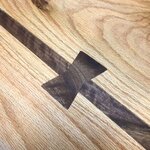
This could be interesting, strategically placed along the top:

1737335393427.jpeg

(Align the grain correctly to actually hold the joint though)
 

dffay

Well-known member
Joined
Jul 9, 2015
Messages
435
Similar situation I used Titebond 3 and then I glued and biscuited Breadboards at the ends. It’s rock solid.
 
To avoid these ads, REGISTER NOW!
Top Bottom