To avoid these ads, REGISTER NOW!

What makes a durable house?

jives

Well-known member
Joined
Jan 4, 2013
Messages
2,807
Location
Central NY
I enjoy Matt Risinger's "Build" videos, but this one I could not agree with. The point being made is that a well built house -- a 100+ year house -- must have 3 things: 1) water mitigation, 2) HVAC in the conditioned space, and 3) control air infiltration.

I disagree on their importance, but I'm curious what y 'all think. I believe that the 100 year old house is; 1) built and engineered strong with top components and quality craftsmanship. Water mitigation would be central to this, such as in basements, roofing, gutters, etc. This is particularly true if environmental elements continue to increase in severity. 2) Adaptability and flexibility. In 100 years the HVAC and electrical and other systems will change. Can the house keep up? I shudder to think about closed cell foam adaptability. Homes will be remodeled, so will they be easy to modify from a design standpoint? Central to this is timeless design. Houses build 1-200 years ago that are still in use are 'timeless'. 3) User friendliness and cost effectiveness. Can the house be repaired by the homeowner, can the systems be easily and reliably fixed by most professionals, or are the system so complex and over the top that only the richest folks can afford to keep them up? A "This Old House" from a couple of years ago had an HVAC system so complex that it required an addition to the basement be built. Who can afford to replace that when the time comes?

What are your top 3?

 
To avoid these ads, REGISTER NOW!

lolaetype

Well-known member
Joined
Dec 11, 2019
Messages
2,092
Location
North Western Arkansas
A solid foundation, by that I mean well engineered and constructed to mitigate premature failure.

Proper design and construction techniques. Avoid "fad" design details that qiickly "date" the house, and I'd tend to over specify and overbuild as opposed to under specifying and under building.

Use quality materials. It seems that the additional cost of premium materials are often cheaper in the long run.
 

Aaron_W

Well-known member
Joined
Feb 6, 2018
Messages
2,919
Location
Northern California
We live in a 110 year old house. What we were looking for is what we got, solid bones to work with. Good foundation, roof in good condition, upgraded electrical and HVAC. Required work was mostly cosmetic, with the exception of the plumbing which was honestly a bit of a hot mess (a jumble of iron pipe, galvanized, PVC and copper).

With a house that is a century + old, you have some assurances.

#1 that house has been standing a long time. It has apparently survived the local natural disasters (here multiple earthquakes and wildfires) helping to ensure that it was probably well designed for the area's special needs.

#2 there will usually be signs of past issues, water damage, repairs etc which can be a clue to issues, even if they have been mitigated.

#3 it has probably been modified multiple times in its life. The general quality of work gives a clue as to the care of the house. Similarly work that hasn't been done may provide some clues as to the general use and upkeep.
Old systems left in place after replacement, or needed modifications not done may suggest corner cutting was done.
 

HoosierBuddy

Well-known member
Joined
May 9, 2006
Messages
2,925
Location
Southern Indiana
My house was built in 1918 so I know the answer to this.

1. Good fortune with respect to disasters. A single tornado, catastrophic fire, or flood and it's all over regardless.

2. Good fortune with respect to owners. To make it 100 years, our home had many owners. Between our family, the family before, and the family before that I can trace the ownership back to WWII. Before that, I'm not sure, but it's possible it only had one other owner. All of us have stayed on top of issues, performed modernizations and kept the home in good repair. It only takes a few years of a careless, negligent, absentee, or spendthrift owner to destroy a nice house.

3. Good fortune with respect to health. The owner who bought our house in WWII spent the last few years of his life in a nursing home, with the home remaining vacant. I can see water damage to the rafters in spots that I guarantee occurred during that time. If you get an owner that can't keep up with home maintenance due to health or such.....again it only takes a few years for a home to go downhill.
 

cannuck

Well-known member
Joined
Nov 30, 2021
Messages
4,639
Location
Rural SK
Site preparation and foundation to start with, but I am thinking our next (last) home will be all concrete. 10% neat cement mix, air for aggregate so probably 18" walls to insulation values. Plaster finish on inside walls, as cast in place mortar exterior. Possibly in tilt up panels bolted together with post tensioning tendons.
 

NUTTSGT

Super Moderator
Staff member
Joined
Sep 14, 2009
Messages
50,979
Location
Northern Central Ohio
A solid foundation, by that I mean well engineered and constructed to mitigate premature failure.

Proper design and construction techniques. Avoid "fad" design details that qiickly "date" the house, and I'd tend to over specify and overbuild as opposed to under specifying and under building.

Use quality materials. It seems that the additional cost of premium materials are often cheaper in the long run.
I'll agree with this and add to the foundation part is proper drainage for the home and property.

I used to watch Matt Risinger until he became, IMHO, to unrealistic for the average person. Yeah sure, build it the best you can but I believe his builds are beyond the average American dream. . . Over budget, over extended for a 30 year mortgage.

Once he bought the house in his neighborhood with the intent to remodel it. They began by gutting a vast majority of it. Next episode, the house is gone, nothing left but the slab. I was pretty much done at that point.


Unrealistic for the average American home owner/buyer.
 

Joe Reed

Well-known member
Joined
Aug 31, 2005
Messages
916
Location
Cordova TN
100 years is a long, long time. I think even an average well built home will last that long if it is well maintained. I've seen houses older than that where they were well maintained and presented no structural issues to speak of. Technology, though, changes rapidly....plumbing, electric, electronics and HVAC will likely change to a far greater degree in the next century than in the last one.

When my current house was built it was important to have telephone jacks in every room. Those are all unused now. Cat5 cables to multiple locations for our home PCs was a given. Now that's all wireless.

I'm certainly no architect but If one could design a house with relatively easy access to those various systems so the house could be updated as needed/desired would be nice. Maybe design in one or more small mechanical rooms where you could have simple access to bathroom and kitchen plumbing, for example, so you wouldn't have to rip out walls to update fixtures to whatever better solutions came along. Those areas could also be used for storage for stuff you'd probably put in the attic otherwise. In all of history no one has ever made the statement "my house has entirely too much storage space."
 

zendriver

Well-known member
Joined
Dec 10, 2014
Messages
29,936
Location
Indiana
A 100+ year old house can be built like a tank and easily be a nightmare to maintain and upgrade to more modern function.

It's a 100 year old house. The basements leak, bricks shift, the steep roofs leak and they were built for very basic heating, not much more. get out the big checkbook, when they need repainted.

They were built very "durable" not necessarily to last forever, with very expensive maintenance.

to me it's a basic ranch with the three things the video author mentioned. Mine seems pretty durable. at 70 years old.
 

cannuck

Well-known member
Joined
Nov 30, 2021
Messages
4,639
Location
Rural SK
10 0 years is a relatively short time for sustainable building materials - and wood is NOT that material. I have spent time wifth a friend in Morocco who's house is 600 years old. Some of the walkways and buildings go back to Roman times. Heck, Rome is full of buildings from Roman times - most of which are concrete.
 

gtae07

Well-known member
Joined
Mar 6, 2015
Messages
2,972
Location
Fayetteville, GA
I'm going to go out there a bit and suggest a viable long-term surrounding community.

The best-built house in the world will start falling apart if it's abused or left untended. If you build in what turns out to be tomorrow's rust belt and the population moves away as all the local industry evaporates... what good is the sturdy house if nobody (who cares) is left to live in it?

That's what's concerning me with modern construction more so than quality itself. We get a boom somewhere and start slamming densely-packed housing in with no consideration given to community, long-term planning, or daily function beyond "how many houses can we fit in this space"? You wind up with gigantic developments full of houses almost touching each other, no community among the residents, no bike- or foot-accessible destinations. And then ten years down the road when the next recession hits and the big employer collapses or outsources and everyone leaves... what then?
 

LopezBart

Well-known member
Joined
Oct 13, 2023
Messages
2,540
Location
Lopez Island, WA
And then ten years down the road when the next recession hits and the big employer collapses or outsources and everyone leaves... what then?
Friends of ours in the 80s had a house in Houston... they moved to the SF Bay Area during the oil price crash, but could not sell their old place. Finally they explained that if the bank didn't make a deal on the mortgage, the bank was going to get a set of keys in the mail... problem solved.

Location, location, location is a real estate mantra for a reason.
 

908Jim

Well-known member
Joined
Aug 1, 2013
Messages
556
I have come to believe that the key to home longevity is maintenance. I've lived in homes dating back to the 1910s and the real secret is that small problems get addressed before they become big problems. Homes from the 1800s have questionable framing and painted wood siding. No fancy home wrap, no strong-ties, and no LVLs, but they're still standing. Drafty, creaky, out of square, and unlevel, but certainly still standing.

Keep water out from where it shouldn't be and away from your foundation, keep painted surfaces painted, fix things as they become loose or worn out, and take preventative maintenance seriously. If you keep the exterior protected (roof, flashing, gutters, siding etc) there's no reason the home shouldn't last.
 

LopezBart

Well-known member
Joined
Oct 13, 2023
Messages
2,540
Location
Lopez Island, WA
Keep water out from where it shouldn't be and away from your foundation, keep painted surfaces painted, fix things as they become loose or worn out, and take preventative maintenance seriously. If you keep the exterior protected (roof, flashing, gutters, siding etc) there's no reason the home shouldn't last.
This is why we decided on a substantial porch all around the house, and had it sided with local (dense) island fir. Walking around during storms helps identify areas that are having trouble and need attention.

1738208959336.png
 

DGersic

Well-known member
Joined
Mar 12, 2017
Messages
6,326
Location
DeKalb, IL
Water management. That’s from top to bottom, to include roof (flashing, shingles, boots, etc.), gutters, downspouts, grading, basement, sump pumps, and drain tile.

Downspouts need to exit and drain somewhere, not just dump it all next to the foundation. Grading has to slope the land away from the house, not direct water toward it. Driveways and walks, similar, have to slope away, not toward the house and garage. Sump pumps and drain tile have to drain to somewhere. And all of that water needs to be managed.

After that, I’d say maintenance and upkeep. Fix little problems while they’re little.
 

wantedabiggergarage

Member Emeritus
Joined
Feb 25, 2006
Messages
3,897
Location
Independence, MO, USA.
Monolithic dome.

Slab foundation, so less chance of basement water issues (but could be built underground), no roof per se, concrete structure that has survived wildfires in CA, Hurricanes in FL, tornado's in the midwest, and earthquakes in different area's.
Combined with better windows and doors, have a separate shop dome instead of a basement.
 
To avoid these ads, REGISTER NOW!

MushCreek

Well-known member
Joined
Jan 14, 2015
Messages
9,782
Location
Upstate South Carolina
The house I grew up in in CT was built around 1760, and it's still in good shape. No insulation, so it wasn't the most comfortable house, but it was solid.

I built our house out of ICF, which is very strong and energy efficient. I went to a lot of trouble to control water, starting with the metal roof, very large overhangs, gutters, proper grading, peel 'n stick waterproofing, dimple board, and a french perimeter drain to move any water away. There's 8" of reinforced concrete in the walls. I used fiber cement siding. It should be a VERY durable house, especially compared to what they're tossing together these days.
 

Fixr

Well-known member
Joined
Dec 23, 2012
Messages
9,702
Location
SW VA
Most modern houses are built to a Price rather than to a Quality
Tell me sir,

In what year, century or millenium were most houses built to a Quality instead of to a Price?

I have never heard of such.
 

cannuck

Well-known member
Joined
Nov 30, 2021
Messages
4,639
Location
Rural SK
Water management. That’s from top to bottom, to include roof (flashing, shingles, boots, etc.), gutters, downspouts, grading, basement, sump pumps, and drain tile.

Downspouts need to exit and drain somewhere, not just dump it all next to the foundation. Grading has to slope the land away from the house, not direct water toward it. Driveways and walks, similar, have to slope away, not toward the house and garage. Sump pumps and drain tile have to drain to somewhere. And all of that water needs to be managed.

After that, I’d say maintenance and upkeep. Fix little problems while they’re little.
One son of my business partner in NY bought an exceptionally nice, large old wood frame house on the shore of the Hudson. Years later someone got the permits to develop some property directly behind him - and the site water management plan called for storm drains dumping into the river. Somehow nobody noticed or bothered to verify that the storm drain system from the development ended in a creek behind and above kid's house. Over the few years the development has existed, the increase in flow and time of retention in the creek let water from their discharge flow through the subsoil under the house and has eroded voids under the foundation and created sink holes all over the yard and driveway.

Where we live, soils can be rich in radon. Cracks in foundations and basements from poor water management can allow enough radon into the enclosed space of a basement to be a serious health hazard (lung cancer). You want to believe water management is critical.
 

PoorUB

Well-known member
Joined
Mar 29, 2021
Messages
11,652
Location
Fargo, ND
Posts mention on how well built 100 year old house may be, but I have been in many that make me wonder how they are still standing. Many were built by people that had no clue and just got lucky. Keep in mind there was not inspections, no codes.

It isn't much different today. You can buy a brand new, slapped together home, or one of better quality.
 

Metal-Marc

Well-known member
Joined
Aug 31, 2009
Messages
7,192
Location
Foothills of the Adirondacks
Posts mention on how well built 100 year old house may be, but I have been in many that make me wonder how they are still standing. Many were built by people that had no clue and just got lucky. Keep in mind there was not inspections, no codes.
LoL

My house is 150 years old. It's built on a somewhat small moat so I have no water issue. However it sure is not square. Nothing is square or level. The house has six "identical windows", but none one has the same dimension; an extra 1/2" here, another extra 1/4" there, etc, but that's part of the charm. I hate cookie cutter houses built with low grade big box store material.
 

dcg9381

Well-known member
Joined
Jun 20, 2018
Messages
11,767
Location
Austin, TX
Most modern houses are built to a Price rather than to a Quality
Mostly true of "spec" homes. But even custom homes, I don't have an unlimited budget. More "quality" often means less SQFT and there simply isn't a perfect answer? I do I need triple pane inert gas windows? They're the best. But adding those, I don't have as much money for insulation.

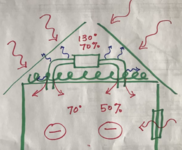
One point I absolutely 100% agree with him on, and the vast majority of homes in the south are doing it wrong: HVAC / Heat units outside the envelope of insulation. It makes no sense to me to put air handlers and vents in spaces that can exceed 130+ degrees. He has a good drawing on it:

1738337786362.png


Another interesting thing that I see him do with zip / zip-R is seal that siding to the foundation. There are other products that do this, but around here this can make a huge difference in allow pest intrusion.
1738337765272.png

Water management to me is critical.. But it starts with proper grade and making sure that water moves away from the home. I prefer Hardie cement products, they look great, and just don't degrade like wood.


Not withstanding, there are many many old houses not built to Risinger spec that are still standing and doing well. Maintained? Sure, but they were not built with Zip-R and modern materials and if you stay on top of things, they hold up longer than I'll be alive.
 

ToolsRCool

Well-known member
Joined
Dec 28, 2024
Messages
231
Location
Plymouth, MI
Water mitigation at roof, lower edges of walls, and in through basement walls if present. Maintenance like replacing roof, keeping trees cut back so branches don't rub through and animals can't easily access roof and wall openings. Gutters clean and flowing so ice can't back up, ice shield under shingles, tubs and showers caulked, etc.....
 

pcmeiners

Well-known member
Joined
Aug 13, 2009
Messages
7,908
Location
In the only town in Pennsylvania, Bloomsburg.
"In what year, century or millennium were most houses built to a Quality instead of to a Price?"
In the 1950s in NYC generally the wood was exceptional, workmanship very good, building department gave a ****.

What makes a good house ?..... properly excavated foundation, concrete basement, sloping away from house ground, roof with few dormers, decent roof over hang, 3/4" roof or plank roof, 3/4" plywood sheathing, on older homes clear knot free, straight framing lumber (believe it or not it actually existed in the 50s-60s).

Homes to ignore..... homes built for industrial need (coal, steel etc towns), generally homeowner self built homes, mansions, homes built in the 30s and 40s. Homes built where the self builder cut corners every chance, kind of like mine.
 

johnre

Well-known member
Joined
Dec 1, 2016
Messages
1,051
Location
Portland, OR
Every house needs maintenance, and even one built with inexpensive materials can usually be maintained at least to the level that it's habitable. What I've seen happen often, though, is that other factors can enter into the picture, wherein the homeowner loses the motivation to maintain it, even when they have the skills or economic means to do so. It then might be turned into a rental, flipped often, or just abandoned outright, and the technical reason it's not going to last isn't really the technical reason we might come with here - fire, water damage, generally getting trashed, etc. - that's just a matter of whichever one claims it first - but why this motivation was lost in the first place.

So I usually turn a question like this around to "what pushes a homeowner to allow it to get into this state?". What I've seen as contributing factors:
  1. Location on (or close to) a busy highway, next to commercial, industrial, or intensive agricultural sites, airport approach / takeoff corridors, noise, noxious dust or fumes, etc.
  2. Crime, public safety concerns, loss of employment base, depopulation.
  3. Nearby higher density suddenly entering the picture (although the flip side of this, upzoning, may allow the homeowner to cash out, without anyone caring what condition the house is in).
  4. Nearby significantly higher value houses entering the picture, wherein this house becomes a target for teardown (same cash out benefit as above).
  5. Wacky exterior design, often the architect making a "statement", sometimes homeowner addition caused.
  6. Wacky interior floorplans that don't fit present lifestyles.
 

sjvicker

Well-known member
Joined
Aug 9, 2014
Messages
602
Location
SW Washington
The #1 thing to make a durable house is anything related to water mitigation. Better roofing materials, better drainage around the structure, better windows, flashing, siding material. Beyond that the focus should be on any touch point such as flooring, fixtures, doors to ensure the products hold up. I'm not concerned as much about mechanical systems durability over 100 years as I am about designing in a way that they are easy to repair and replace as they will fail in that time.

I've lived in balloon framed houses from the late 1800's that held up to a rotation of college kids just fine. The "engineering" back then and the engineering today all resulted in structurally adequate homes. The houses leaked air and either had a forced air furnace in the cold basement or a boiler for heat so I dont see a good argument that a sealed house that requires an ERV that can fail is a durable solution.

I like Matt's videos and they're a good way to learn about new products but there is definitely more than one way to build a durable home.
 

Wakefield

Well-known member
Joined
Aug 26, 2010
Messages
5,132
Location
Arlington VA (but would like to get out to country
10 0 years is a relatively short time for sustainable building materials - and wood is NOT that material. I have spent time wifth a friend in Morocco who's house is 600 years old. Some of the walkways and buildings go back to Roman times. Heck, Rome is full of buildings from Roman times - most of which are concrete.
Masonry ? "Brick and Block" ? (not "cinderblock"?)
 

cannuck

Well-known member
Joined
Nov 30, 2021
Messages
4,639
Location
Rural SK
Masonry ? "Brick and Block" ? (not "cinderblock"?)
Some bricks have relatively short life in moist air. My preference is for PFCC (pre-formed foam cellular concrete) as can be good insulator (that the Romans didn't need). Most of their stuff cast concrete - that casual observers assume is carved stone but seldom is so. Block shear walls between structural columns a much newer tech.
 
To avoid these ads, REGISTER NOW!
Top Bottom