To avoid these ads, REGISTER NOW!

Tool rests on bench grinder?

quilty

Well-known member
Joined
Mar 31, 2022
Messages
82
I recently picked up a Baldor 612 bench grinder off of marketplace. Unfortunately, both tool rests are missing.

What are the main functions of the tool rests? I noticed that a lot of them are usually missing/removed.

Do you still use a tool rest with a wire wheel application, or typically only for use with grinding wheels?

Does anyone know where I might be able to find replacement tool rests for my grinder?

Screenshot 2025-01-28 113910.png
 
To avoid these ads, REGISTER NOW!

lilredex

Well-known member
Joined
Apr 29, 2006
Messages
5,956
Location
Toronto
Try these if you want to make some.


Ditchdigger

Well-known member
Joined
Jan 22, 2010
Messages
297
Location
Eugene, Oregon
If the grinder will be used in a work environment OSHA requires the rests to be set to a minimum of 1/8" gap to the wheel.

Other than that, the rest aids in guiding things against the wheel. Some rests have grooves to help sharpen drill bits. Obviously it helps things not get sucked in and thrown back out at high velocity
 
Last edited:

JradM

Well-known member
Joined
Sep 4, 2019
Messages
1,816
Location
Alberta
I don't use them with wire wheels - but I'm lazy and might not always be bothered to remove them. I do at least adjust them farther out.

I always use them with grinding wheels though. Could you freehand? Probably. Seems safer and more controllable to have something to rest your work against though.
 

GeoBruin

Well-known member
Joined
May 5, 2018
Messages
3,738
I don't use them with wire wheels - but I'm lazy and might not always be bothered to remove them. I do at least adjust them farther out.

I always use them with grinding wheels though. Could you freehand? Probably. Seems safer and more controllable to have something to rest your work against though.
I take mine off the wire wheel side. I find small things get "sucked in" by the wire wheel.
 
OP
Q

quilty

Well-known member
Joined
Mar 31, 2022
Messages
82
Understood - so the rest is only meant for grinding wheels (not wire wheels)

I might give this eBay offering a try and see how it is:


Seems cheaper than trying to track down the genuine Baldor part numbers...
 

RMERR

Well-known member
Joined
Mar 22, 2017
Messages
429
Location
Northern CA
I don't use stones on my grinders ( I find belt sanders fit my needs better). If I did I'd definitely want a tool rest for support and control of the workpiece. I do have 3 wire wheels on grinders and I don't use a table with them as I'm often holding an odd or irregular piece and the table just gets in the way. The set you linked on Ebay looks pretty decent though, much cheaper than baldor replacement parts.
 

dscheidt

Well-known member
Joined
Apr 26, 2017
Messages
2,893
If the grinder will be used in a work environment OSHA requires the rests to be set to a minimum of 1/8" gap to the wheel.

Other than that, the rest aids in guiding things against the wheel. Some rests have grooves to help sharpen drill bits. Obviously it helps things not get sucked in and thrown back out at high velocity

i'm sure it's a typo, but it's a maximum gap of 1/8", not a minimum. The justification for the small gap is to keep things from being trapped between the rest and the wheel, which tends to result in undesirable wheel explosions. Amusingly, at least for the grinders I've had to work with, OSHA also requires the grinder to have enough power you can't stall it.
 
OP
Q

quilty

Well-known member
Joined
Mar 31, 2022
Messages
82
I don't use stones on my grinders ( I find belt sanders fit my needs better). If I did I'd definitely want a tool rest for support and control of the workpiece. I do have 3 wire wheels on grinders and I don't use a table with them as I'm often holding an odd or irregular piece and the table just gets in the way. The set you linked on Ebay looks pretty decent though, much cheaper than baldor replacement parts.

What do you mean stones?
 

MushCreek

Well-known member
Joined
Jan 14, 2015
Messages
9,780
Location
Upstate South Carolina
I got a 12" Baldor cheap at an auction, and one of the massive cast iron rests was broken. Baldor still makes the parts, but they wanted more for the rest than I paid for the grinder, so I fabbed one up out of 1" thick steel. I'm pretty sure you can get them from Baldor, but you're better off making better ones yourself. As seber said, stout angle iron will be better than the original 'sheet metal' ones.
 
To avoid these ads, REGISTER NOW!
OP
Q

quilty

Well-known member
Joined
Mar 31, 2022
Messages
82
I got a 12" Baldor cheap at an auction, and one of the massive cast iron rests was broken. Baldor still makes the parts, but they wanted more for the rest than I paid for the grinder, so I fabbed one up out of 1" thick steel. I'm pretty sure you can get them from Baldor, but you're better off making better ones yourself. As seber said, stout angle iron will be better than the original 'sheet metal' ones.

Okay, how do you make them and still retain the adjustability function (pivoting the degree of angle up and down)?
 

MushCreek

Well-known member
Joined
Jan 14, 2015
Messages
9,780
Location
Upstate South Carolina
Mine was missing altogether, so I had to make both parts. One is slotted, and bolts to the side of the cover; the other is L-shaped, and bolts on to the first piece. It helps that I have a machine shop at home.
 
OP
Q

quilty

Well-known member
Joined
Mar 31, 2022
Messages
82
So it looks like I've found a couple vendors on eBay that appear to carry authentic Baldor (ABB) parts at very reasonable prices.

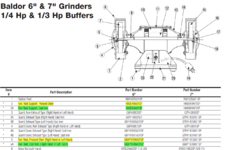
With that being said, I noticed on a Baldor parts list/diagram that they offer these tool supports/rests in both "pressed steel" versions as well as "cast iron". Any preferences on these two materials?
 

Attachments

  • Screenshot 2025-01-30 114242.png
    Screenshot 2025-01-30 114242.png
    233.3 KB · Views: 86

Firebrick43

Well-known member
Joined
May 12, 2015
Messages
14,039
Location
West central Indiana
Cast iron are more precise and substantial compared to the lighter pressed steel.

I would always take cast iron rest over pressed steel ones if you are grinding more precise things like lathe tool bits, chisels, and so forth.

If you just grinding broken screwdriver to use as prybars or lawn mower blade then a press steel rest is fine.

Never operate a grinding wheel without a rest.

If you use a wire wheel you need to take the guard off around the wheel so absent of the rest you don’t get your fingers or hand pulled in.

A coworker about 10 years ago lost the end of his thumb to the first joint. It wasn’t pretty
 
OP
Q

quilty

Well-known member
Joined
Mar 31, 2022
Messages
82
If you use a wire wheel you need to take the guard off around the wheel so absent of the rest you don’t get your fingers or hand pulled in.

Are you saying to remove just the tool rest when using a wire wheel, or the entire guard that surrounds the wheel?
 

JradM

Well-known member
Joined
Sep 4, 2019
Messages
1,816
Location
Alberta
That's a great point.

It's better to use the wire wheel without the guard anyway. The wires can sometimes drag against the guard - not just when the wheel is too large, but because they can be pushed to the side when you push your workpiece against them. Plus it's nice to be able to use the wire at different angles (I often use the bottom so I can see what's happening, debris is deflected away and there's less risk of the wheel grabbing the part and flinging it toward me).

The tool rest helps you get a consistent grind angle - but that's just not something that applies to wire-wheeling.

In my case I got annoyed always swapping wheels and guards for different grits, to polish or wire-wheel, so I have one grinder with coarse and fine wheels, another with two wire wheels (straight and twisted), a buffer with loose and sewn wheels and a belt grinder.
 

rustedgoat

Well-known member
Joined
Jul 6, 2008
Messages
96
Location
central NJ
Understood - so the rest is only meant for grinding wheels (not wire wheels)

I might give this eBay offering a try and see how it is:


Seems cheaper than trying to track down the genuine Baldor part numbers...
They sure provided a nice diagram with all the measurements if you wanted to make your own. You could easily adjust things if you want to use thicker stock. I just saved images for future use if needed.
 

jawstight

Well-known member
Joined
Feb 10, 2025
Messages
155
I bought a set of the Oneway Wolverine jigs for use on my Palmgren Buffer/Grinder that I keep my CBN wheels on. They are made of 1/4" steel, while the adjustment mechanism for forward and back that the steel tubes the rests are attached to is aluminum. They don't mount to the machine, rather I built mountpoints for them on top of the plywood base I made for the grinder. They are very robust.

Mine look like this, with a rest like this one mirrored on the right side. I created the mountpoint similarly to this one also. I don't turn wood so I only needed rests on both sides as opposed to the turning jig that is usually on the right.


Attachments

  • OnewayWolverine.jpg
    OnewayWolverine.jpg
    19.6 KB · Views: 42

Brazen Bull

Well-known member
Joined
Apr 3, 2024
Messages
114
If you can find some 2 1/2" angle iron you can make tool rests much sturdier than those bent sheet metal ones and no welding required.
Not to **** in, but that is what I'm fixing to do with my bench grinder. The tool rests on my particular Wolf brand vintage grinder apparently don't hold up well and tend to break. My grinder has both holders and the switch assembly, but before any of these break I'm going to beef them all up as I've seen others do.
 
To avoid these ads, REGISTER NOW!
Top Bottom