To avoid these ads, REGISTER NOW!

Cellulose settling question

bluedog225

Well-known member
Joined
Jan 31, 2012
Messages
3,323
Location
Texas
does anyone know the deal with cellulose settling? I read it’s going be 15 to 20%. That’s fine. In fact, I’m counting on the it to settle some to preserve some air circulation above.

but all the sources I’m looking at are speaking pounds of insulation per cubic foot. And I’ve got some pretty good information about how this density will affect settling.

my question is how am I supposed to know how many pounds per cubic foot of insulation I put in? Whether it’s done by me or a contractor. How in the heck do you know?

I’ve blown in insulation before and heck if I know how dense it was.

Any ideas? Thanks
 
To avoid these ads, REGISTER NOW!

KenC

Well-known member
Joined
Dec 20, 2009
Messages
2,598
Location
oklahoma
Well, it' pretty easy to figure out when you're done, but really difficult as you are installing. Once done, measure the depth in feet (in decimal, .5, 1.5etc) multiply by the area and calculate using the weight on the bags you emptied.

You can do the same beforehand to determine the depth needed to arrive at the target desired, but it's really hard to actually blow it in place to that standard.
 

PCustoms

Well-known member
Joined
Jul 23, 2011
Messages
23,552
Location
VT
Well, it' pretty easy to figure out when you're done, but really difficult as you are installing. Once done, measure the depth in feet (in decimal, .5, 1.5etc) multiply by the area and calculate using the weight on the bags you emptied.

You can do the same beforehand to determine the depth needed to arrive at the target desired, but it's really hard to actually blow it in place to that standard.

Even easier

Lbs/sqft x sqft=total pounds you need to install.

Buy that, blow it in even and let it settle.
 

Firebrick43

Well-known member
Joined
May 12, 2015
Messages
14,228
Location
West central Indiana
There is a chart on the side of the bag that tells you exactly how many bags per 1000 square feet are needed to achieve the specified settled R value. If you want a weight then multiply the number of bags by the weight per bag. It’s going to be around 2.2-2.3 pounds per cubic foot for loose blown

I have found them to be spot on of the half a dozen buildings I have done. Usually buy 10 extra and have always returned 8 to 10 of them. I mark all trusses before starting using a sharpie and story stick to get very accurate depth across the attic.
 
OP
B

bluedog225

Well-known member
Joined
Jan 31, 2012
Messages
3,323
Location
Texas
Unfortunately, my situation is a little more complicated.

I’m trying to fill all these 16 inch bays. And I want to preserve two or 3 inches of space above to allow my ventilation system to work. I’m going to install hardware cloth with spacers down the middle of each bay. Then I’m going to staple up the insulation netting on the bottom of the 16 inch LVL’s.

Then the one by four stringers on 16” centers that will ultimately support my tongue and groove ceiling.

My plan is to fill each compartment fully, but not pack it in. Between the hardware cloth and the settling, I should be assured of an adequate space for airflow.

Fingers crossed, this is the best plan I can come up with.

I’m going to put a moisture and humidity sensor or three attached to the underside of the plywood deck. That way I will know if I have a problem. These things have batteries that can last a year and download their data through Bluetooth. I’ve got one installed as a test right now and it’s working great.

IMG_3039.jpeg
 

PCustoms

Well-known member
Joined
Jul 23, 2011
Messages
23,552
Location
VT
Unfortunately, my situation is a little more complicated.

I’m trying to fill all these 16 inch bays. And I want to preserve two or 3 inches of space above to allow my ventilation system to work. I’m going to install hardware cloth with spacers down the middle of each bay. Then I’m going to staple up the insulation netting on the bottom of the 16 inch LVL’s.

Then the one by four stringers on 16” centers that will ultimately support my tongue and groove ceiling.

My plan is to fill each compartment fully, but not pack it in. Between the hardware cloth and the settling, I should be assured of an adequate space for airflow.

Fingers crossed, this is the best plan I can come up with.

I’m going to put a moisture and humidity sensor or three attached to the underside of the plywood deck. That way I will know if I have a problem. These things have batteries that can last a year and download their data through Bluetooth. I’ve got one installed as a test right now and it’s working great.

IMG_3039.jpeg

Cellulose seems like the worst choice for that....
 

billconner

Well-known member
Joined
Jul 20, 2021
Messages
6,971
Location
Thousand Islands NYS
I understand concepts, vent space etc., but I don't understand why hardware cloth and not sure why you don't want it dense packed.

I believe you should have rigid foam or plywood or something that stops wind wash of the cellulose. I used 1/8" ply (I had a lot and still do) and 1x2s nailed to rafters against roof decking. I recommend not leaving the cellulose, especially if not dense packed, exposed to exterior air.

Loose - not dense packed - will only work if those rafters are level. I can't tell but if sloped - as rafters often are - it will settle down slope. Dense packed it will stay in place.
 
OP
B

bluedog225

Well-known member
Joined
Jan 31, 2012
Messages
3,323
Location
Texas
Cellulose seems like the worst choice for that....
Why? I believe it has the best moisture absorption and release characteristics in terms of managing seasonal fluctuation.

And after it settles, it is reported to block airflow, better than fiberglass. Therefore, it will also prevent the flow of moist air.

I’ll have the ceiling air sealed so indoor moisture won’t get into the insulation. And I’ve got the area above the insulation ventilated. Like a traditional roof, but a lower slope.

Ideally, I would’ve had an inch of foam on top of the deck. That didn’t happen because I was injured and had to get a roof on the place.

One option is to take off the very expensive double lock standing seam, metal roof, install foam above the deck, and redo the whole thing. That’s going to run about 15,000.

What would you suggest?


.
 
OP
B

bluedog225

Well-known member
Joined
Jan 31, 2012
Messages
3,323
Location
Texas
I understand concepts, vent space etc., but I don't understand why hardware cloth and not sure why you don't want it dense packed.

I believe you should have rigid foam or plywood or something that stops wind wash of the cellulose. I used 1/8" ply (I had a lot and still do) and 1x2s nailed to rafters against roof decking. I recommend not leaving the cellulose, especially if not dense packed, exposed to exterior air.

Loose - not dense packed - will only work if those rafters are level. I can't tell but if sloped - as rafters often are - it will settle down slope. Dense packed it will stay in place.
I’m not sure I’m following. Are you suggesting sealing all the cavities completely and simply dense backing?

I believe under some circumstances, particularly when there’s a cold morning roof on a warm, humid day, there may be condensation under the deck. I am attempting to preserve a space for the soffit vents to allow airflow. Just as I would in a traditional 5/12 slope roof with soffit vents.

Could you tell me more about what you’re thinking?
 
To avoid these ads, REGISTER NOW!
OP
B

bluedog225

Well-known member
Joined
Jan 31, 2012
Messages
3,323
Location
Texas
I would put up 2x2 and plywood and dense pack it
That’s definitely an option. I think it ends up at the same place, though, right? Insulation with a space above it.

What would be the advantage of dense packing underneath the plywood versus simply blowing it down and letting it settle ? I’m interested in all ideas before I pull the trigger on this.
 

Firebrick43

Well-known member
Joined
May 12, 2015
Messages
14,228
Location
West central Indiana
That’s definitely an option. I think it ends up at the same place, though, right? Insulation with a space above it.

What would be the advantage of dense packing underneath the plywood versus simply blowing it down and letting it settle ? I’m interested in all ideas before I pull the trigger on this.
Density stops air currents even better and absolutely no settling. And you are assured that the hardware cloth doesn't collapse, and you maintain positive ventilation.

16" on center I might even be tempted to use 1/4 osb. I did it 24" on center
 

PCustoms

Well-known member
Joined
Jul 23, 2011
Messages
23,552
Location
VT
Why? I believe it has the best moisture absorption and release characteristics in terms of managing seasonal fluctuation.

And after it settles, it is reported to block airflow, better than fiberglass. Therefore, it will also prevent the flow of moist air.

I’ll have the ceiling air sealed so indoor moisture won’t get into the insulation. And I’ve got the area above the insulation ventilated. Like a traditional roof, but a lower slope.

Ideally, I would’ve had an inch of foam on top of the deck. That didn’t happen because I was injured and had to get a roof on the place.

One option is to take off the very expensive double lock standing seam, metal roof, install foam above the deck, and redo the whole thing. That’s going to run about 15,000.

What would you suggest?

For one, I don't see how you have any airflow in there, regardless of insulation.

I assume the silver is the bottom of the roof deck? Is that blocking full depth?

A better picture or sketch would sure help. Looking at what I see now I would just pack the whole cavity. I can't see how your going to install a ceiling and blow that from below while maintaining airflow that you think you need.
 
OP
B

bluedog225

Well-known member
Joined
Jan 31, 2012
Messages
3,323
Location
Texas
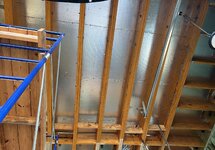
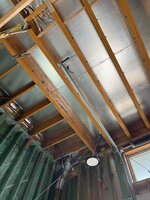
The foil faced plywood is the roof deck. I left 2 inches above my blocking. In the picture, you’ll see the framer’s smaller blocking as well.

I’ve got 360° of hardy soffit vent. I took their calculation on area of the ventilated surface and put holes in my exterior blocking they were larger than the surface area of the hardy soffit for the area between the lvls. Every space up there has an entry and an exit for airflow. In theory, air can flow throughout.

I’m not going to get comfortable with an unventilated at space absent 2 inches of foam on top of the deck.

I’ve been on the fence whether to put up some kind of plywood barrier. That would address the issue with certainty. And let me dense back the stink out of it. Quite a bit more work but I’m in this so deep already what’s a few more weeks.

IMG_3051.jpegIMG_3052.jpeg
 

billconner

Well-known member
Joined
Jul 20, 2021
Messages
6,971
Location
Thousand Islands NYS
I’m not sure I’m following. Are you suggesting sealing all the cavities completely and simply dense backing?

I believe under some circumstances, particularly when there’s a cold morning roof on a warm, humid day, there may be condensation under the deck. I am attempting to preserve a space for the soffit vents to allow airflow. Just as I would in a traditional 5/12 slope roof with soffit vents.

Could you tell me more about what you’re thinking?
I'm saying don't use hardware cloth. Use something solid.
 

billconner

Well-known member
Joined
Jul 20, 2021
Messages
6,971
Location
Thousand Islands NYS
Good luan would probably work. Its more expensive here than 1/4"($11) or 7/16($14) osb by 5 dollars a sheet ($19). I was surprised that 1/4 luan here is the same price as 1/8" here.
I converted garage to living space and p.o. had lined it with plywood. I have quite a bit of plywood stored. I think if I didn't have it I would have bought the foam vent baffles.
 
OP
B

bluedog225

Well-known member
Joined
Jan 31, 2012
Messages
3,323
Location
Texas
I converted garage to living space and p.o. had lined it with plywood. I have quite a bit of plywood stored. I think if I didn't have it I would have bought the foam vent baffles.
I got some of those foam vent baffles to check them out. I don’t think they would hold up too much compression if I were to pack the celllulose more densely.
 
To avoid these ads, REGISTER NOW!
Top Bottom