To avoid these ads, REGISTER NOW!

Air hose running uphill?

wantacoe

Well-known member
Joined
Apr 28, 2015
Messages
653
Location
Sycamore, il
Someone in another forum said that if you run your air hoses slightly uphill that you won't get water in the lines. I have never heard this before and don't think I believe it. Opinions?
 
To avoid these ads, REGISTER NOW!

PCustoms

Well-known member
Joined
Jul 23, 2011
Messages
22,934
Location
VT
Someone in another forum said that if you run your air hoses slightly uphill that you won't get water in the lines. I have never heard this before and don't think I believe it. Opinions?

You'll get water, but it will pool in the low spots.
 

larry_g

Well-known member
Joined
Apr 28, 2007
Messages
16,881
Location
oregon
It's a bit more than just having the lines sloped. At the end of the slope you have to have a catch for the water. If done right that is the receiver tank. If just a low spot in the line then the water will pool in the low spot and then be picked up by the moving air when the end of the line is opened causing flow. One other help is to make sure that you tap off the top of the mainline and go up a bit before turning and going down to the connection, assuming that you run the feed line overhead. Getting super dry air is a bunch of small incremental steps. How dry do you want it and what is your budget?

I'm pretty sure 10 cfm @ 90 psi will carry water with it.
That is dependent on the size of the air line. A small line with high velocity Yes, a large line with low velocity then not so much.

no neat sig line
 

545_days

Well-known member
Joined
Oct 30, 2016
Messages
583
Location
Texas
When the low spot fills and it does finally come down the line, it will be in a big slug. It should be pretty exciting.

Have a decent sized low spot with a drain and drain it periodically to avoid this. The low spot won't eliminate water, but it will help to reduce it.
 

jblnut

ALLIANCE MEMBER
Joined
Jan 17, 2015
Messages
7,027
Location
In the Middle of MN
The only way to get all the moisture out is to run it through a dryer of some kind. One can home brew a decent dryer on the cheap if you understand the basics of how they work. You can run as much hose as you want uphill and there will still be moisture coming out the other end unless it’s dried.

I built a simple decadent dryer with a 6’ chunk of 4” steel pipe filled with beads. When I want dried air I switch a few valves around and it goes through the dryer. I’ve a valve at the bottom to drain it when done. Simple and quite effective.
 
To avoid these ads, REGISTER NOW!

Chris_Hamilton

Well-known member
Joined
Dec 2, 2012
Messages
1,023
Industry standard is a 4" drop every 50 feet of piping. Air pressure will push the water towards the area of lower pressure (outlet/regulator when in use).

A properly designed piping system should include drain legs prior to your outlet and afterwards. Any water coalescer. oil coalescer or desiccant filter should be at a minimum 35 feet from the air compressor outlet, ideally a 50 foot minimum.

The harder a compressor has to work (i.e. smaller lower cfm compressors) the more water they will make. It is not instantaneous though. It condensates in the line as the air cools and returns to ambient pressure. One reason why having a water/oil filter 5 feet from the compressor is useless.

If one plans to use the compressor for anything more than very limited use, a proper air piping system should be considered mandatory.

Ideally if you are using your compressor a lot a refrigerated dryer is the best choice. Harbor Freight actually makes a decent quality affordable one.
 

Chris_Hamilton

Well-known member
Joined
Dec 2, 2012
Messages
1,023
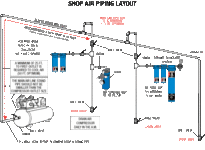
Here is a good example of a basic air piping layout. Note how the drain legs and outlet legs are assembled. Your outlet leg should always be run that way to help with water issues.

pipe-layout-1.gif
 
OP
W

wantacoe

Well-known member
Joined
Apr 28, 2015
Messages
653
Location
Sycamore, il
I don't claim to know anything about this but I was going to set mine up like the one in this diagram.
 

Attachments

  • blog222.jpg
    blog222.jpg
    54.8 KB · Views: 32

American Locomotive

Well-known member
Joined
Jan 8, 2017
Messages
10,960
Location
Rhode Island
What pcmeiners said. In a compressed air system, the water vapor is physically mixed into the air. What makes it drop out is the air cooling down.

You slope your pipes to stop water from pooling and standing, which can rust steel pipes or end up sending slugs of liquid water into your tools. Sloping the pipes does nothing to remove the water vapor that's mixed into the air.
 

NUTTSGT

Super Moderator
Staff member
Joined
Sep 14, 2009
Messages
50,968
Location
Northern Central Ohio
If your shop air is dry and air intake is in the shop, not pulling from the outside, it will help with controlling moisture in the air system.
 

racecougar

Well-known member
Joined
Jan 26, 2021
Messages
5,106
Location
Missouri
If your shop air is dry and air intake is in the shop, not pulling from the outside, it will help with controlling moisture in the air system.
Yep. That makes a notable difference. One of the reasons to keep the compressor in the shop (assuming the shop is climate controlled) instead of outside.
 
To avoid these ads, REGISTER NOW!
Top Bottom