To avoid these ads, REGISTER NOW!

Low profile socket and ratchet vs ratcheting wrench...

impactims

Well-known member
Joined
Nov 24, 2011
Messages
1,168
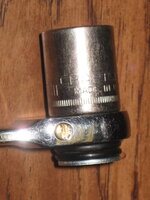
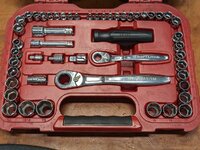
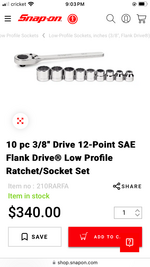
Been seeing some Snap-on low profile socket sets that come with a special ratchet that is made specifically for the sockets. The sockets and ratchet are made for each other and are not usable with other sockets and ratchets.

But then I got to thinking, how is this set up any better than a simple ratcheting wrench? This is a ratchet and socket assembly that is 1/2inch or so shorter than a standard ratchet and standard shallow socket.

The sockets are 8mm-18mm and 12 point. There is also an SAE version of similar sizes. A ratcheting wrench would accomplish anything that this assembly would accomplish and more due to it being even more low profile. Right?

What am I missing?
 
To avoid these ads, REGISTER NOW!

Achilleus

Well-known member
Joined
May 30, 2011
Messages
160
For one thing you get a lot thinner around the socket than a gear wrench. And what if you want to put a pipe on the end for more leverage?
 

Achilleus

Well-known member
Joined
May 30, 2011
Messages
160
Sometimes the nut will lift up and go into the wrench and get stuck and you won't be able to wiggle it out. You're better off with an open-ended wrench for really tight spots.
 
Last edited:

AEAdam

Well-known member
Joined
May 27, 2023
Messages
2,785
Location
SE PA
I have the 3/8 drive metric set and never use it. I also almost never use my ratchet wrenches. For non automotive, I could see them being more useful. Use my bluepoint non reversing ratchet stubby wrenches in interiors. Save your money for something like extensions. I have a ton of extensions and use all of them.
 

KnurledNut

Well-known member
Joined
Jan 28, 2011
Messages
8,190
Location
n/a
I have the older RAF80 version.
-The BACK-DRAG is incredibly low, much less than most of my ratcheting wrenches.
-It is REVERSIBLE and its a FIXED 90°, which the nano ratchets are not. A lot of ratcheting wrenches with zero offset are not reversible either.
-These low profile sockets are a little DEEPER and will reach recessed fasteners that perhaps the nano socket/ratchet and Kabo style ratcheting wrenches with protruding ring will not.
-The Snap-on handle is THINNER than the nano ratchet which has a round profile.
-The Snap-on handle is SHORTER which can be advantageous or detrimental depending on application.
-Snap-on is known for THIN-WALL sockets. Plus being 12-point, these would likely go where neither the 6-point impact nanos nor the thicker wall of Kabo ratcheting wrench rings will go, and by far thinner than a standard ratcheting wrench wall thickness.
-OPTIONS. Can be used with other sockets, accessories, extensions, universals, crowsfeet.
 
Last edited:

Bigblue&Goldie

Well-known member
Joined
Mar 12, 2009
Messages
10,713
Location
AZ
I have the older RAF80 version.
-The BACK-DRAG is incredibly low, much less than most of my ratcheting wrenches.
-It is REVERSIBLE and its a FIXED 90°, which the nano ratchets are not. A lot of ratcheting wrenches with zero offset are not reversible either.
-These low profile sockets are a little DEEPER and will reach recessed fasteners that perhaps the nano socket/ratchet and Kabo style ratcheting wrenches with protruding ring will not.
-The Snap-on handle is THINNER than the nano ratchet which has a round profile.
-The Snap-on handle is SHORTER which can be advantageous or detrimental depending on application.
-OPTIONS. Can be used with other sockets, accessories, extensions, universals, crowsfeet.

So would you buy the set again with all of the various alternatives on the market?

For what the SnapOn goes for, you can buy a lot of the various options.
 

charbar

Well-known member
Joined
Feb 6, 2021
Messages
1,997
Location
Midwest
Ratcheting wrench is often too fat to get on some fasteners. And on recessed fasteners there is no way you are getting anything but a socket on it.

The other day I had to do injectors on a 4.5 Deere engine and the nuts that hold the valve cover on are recessed. The front of the valve cover has a bracket that sits barely above it......unless I wanted to spend another 30 minutes (time is money!) to remove that bracket a low pro socket was my only option.
 

bonneyman

Well-known member
Joined
Apr 22, 2010
Messages
8,852
Location
Desert SW
I've taken some cheapie sockets and grind down the front ends to eliminate the chamfer so I can grab thin nuts. I'm at the point now of cutting the ends off of some other sockets till there's just enough broaching left to grab a fastener but I lose the extra length. On the end of a ratcheting box wrench with an adaptor such a socket would make the shortest tool I can think of for tight spots.

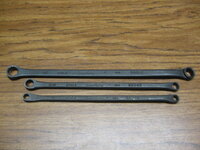
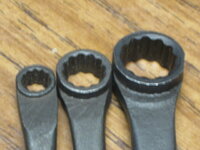
For recessed fasteners I use my Utica aerospace wrenches, or those super long double flex head ratcheting box wrenches from EZ Red.
 

Attachments

  • IMG_1928.JPG
    IMG_1928.JPG
    113.5 KB · Views: 42
  • IMG_1932.JPG
    IMG_1932.JPG
    94.6 KB · Views: 38
  • IMG_8282.JPG
    IMG_8282.JPG
    107.3 KB · Views: 31
  • IMG_7118.JPG
    IMG_7118.JPG
    112.1 KB · Views: 30
  • IMG_7121.JPG
    IMG_7121.JPG
    60.2 KB · Views: 32

Ohio Andy

Well-known member
Joined
Jul 31, 2024
Messages
2,343
Location
Columbus, Ohio
Ratcheting wrench is often too fat to get on some fasteners. And on recessed fasteners there is no way you are getting anything but a socket on it.

The other day I had to do injectors on a 4.5 Deere engine and the nuts that hold the valve cover on are recessed. The front of the valve cover has a bracket that sits barely above it......unless I wanted to spend another 30 minutes (time is money!) to remove that bracket a low pro socket was my only option.
I hauled my ratcheting wrenches out and realized I could not use them because they just wouldn't get into the spot. And ironically I had no problems with my sockets getting in. The problem was just that it was recessed too deep. I hadn't even noticed they were recessed until I went to use my ratcheting wrench and then I realized nope that is not going to work. Also understand it means that a standard wrench wouldn't have worked either.

Sadly, the set of wrenches that would have worked I gave to a friend. Luckily the sockets I had on hand worked.
 
To avoid these ads, REGISTER NOW!

bonneyman

Well-known member
Joined
Apr 22, 2010
Messages
8,852
Location
Desert SW
I hauled my ratcheting wrenches out and realized I could not use them because they just wouldn't get into the spot. And ironically I had no problems with my sockets getting in. The problem was just that it was recessed too deep. I hadn't even noticed they were recessed until I went to use my ratcheting wrench and then I realized nope that is not going to work. Also understand it means that a standard wrench wouldn't have worked either.

Sadly, the set of wrenches that would have worked I gave to a friend. Luckily the sockets I had on hand worked.
Yeah, deep recessed, restricted access fasteners are tough to get to. Why do manufacturers do this?
 

AEAdam

Well-known member
Joined
May 27, 2023
Messages
2,785
Location
SE PA
Yeah, deep recessed, restricted access fasteners are tough to get to. Why do manufacturers do this?
usually because the flat area surrounding a bolt head has no section properties. So to make something like a valve cover nice and stiff, to ensure even pressure distribution, you want the recesses for the fasteners as small as possible/as close to the adjacent vertical wall as possible.

When we design products, a lot of times, we are designing around specific tools. We always try to avoid specialty tools. Our shop and customers all have Snap On tools, so we feel free to design around those specific tools. We don't try to make parts exclusive to any brand, of course, but we also don't go out of our way to let a mechanic use a ratcheting wrench in lieu of a box wrench. That extra clearance can cost our customers something.

We sometimes have customer requirements to perform a repair or replace in a certain amount of time. In those cases, we may make that part really easy to work on, but that can often cost the customer maintenance or performance etc. Point is, there is no free lunch
 

Black300zx

Well-known member
Joined
Apr 8, 2019
Messages
782
Location
Elkton, Md
usually because the flat area surrounding a bolt head has no section properties. So to make something like a valve cover nice and stiff, to ensure even pressure distribution, you want the recesses for the fasteners as small as possible/as close to the adjacent vertical wall as possible.

When we design products, a lot of times, we are designing around specific tools. We always try to avoid specialty tools. Our shop and customers all have Snap On tools, so we feel free to design around those specific tools. We don't try to make parts exclusive to any brand, of course, but we also don't go out of our way to let a mechanic use a ratcheting wrench in lieu of a box wrench. That extra clearance can cost our customers something.

We sometimes have customer requirements to perform a repair or replace in a certain amount of time. In those cases, we may make that part really easy to work on, but that can often cost the customer maintenance or performance etc. Point is, there is no free lunch
Thank you for nicely explaining the tradeoffs and constraints that us designers need to do our best to balance 😎
 

M635_Guy

Well-known member
Joined
Dec 5, 2019
Messages
4,336
Location
NC
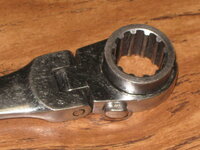
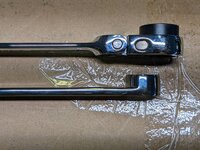
For when my super-shallow sockets from PowerTorque (1/4" - O'Reilly's) and Ko-ken (3/8") Z-series, my answers have generally been the Icon flex head ratcheting wrenches that have what amounts to a super-shallow socket on one side:
5m7i58.jpg
(the bottom one is the non-flex wrenches, on the non-ratcheting end that also offers a bit of a shoulder for clearance, but hasn't come in as handy as the flex set)

The other one has been my (6-point) pass-thru sockets, which add up to be pretty darn shallow.
anobgE.jpg
 
OP
I

impactims

Well-known member
Joined
Nov 24, 2011
Messages
1,168
Are you aware of nano sockets with the hex shaped base?
Aware of them, yes.

Have I used them ever, no.

So, how would they, lets say the VIM nano sockets with their driver, compare to the snap on low profile set pictured above?
 

Bigblue&Goldie

Well-known member
Joined
Mar 12, 2009
Messages
10,713
Location
AZ
Aware of them, yes.

Have I used them ever, no.

So, how would they, lets say the VIM nano sockets with their driver, compare to the snap on low profile set pictured above?
I have measurements on the comparable Astro Nano products.


The 3/8" Astro set goes from 1/4" to 3/4", just like the referenced SnapOn set. The total thickness from the back of the ratchet to the mouth of the socket is .928". The ratchet tip to tip is right at 10.5".

If you got to the 1/4" Astro set that includes 3/16" to 9/16" the total thickness is .740" with a ratchet length of 10.125".

Keep in mind, all sockets in their sets are the same height/thickness, so it doesn't vary from one size to the other.

The ratchets themselves aren't bad with regards to backdrag; somewhere in-between a Dual 80 and a Matco 88. They're 90T (if I properly recall), so that's good in my book. Flex is a plus, but non-reversing is a drawback. Matco sells one that is reversible, but at Matco prices.
 

bonneyman

Well-known member
Joined
Apr 22, 2010
Messages
8,852
Location
Desert SW
usually because the flat area surrounding a bolt head has no section properties. So to make something like a valve cover nice and stiff, to ensure even pressure distribution, you want the recesses for the fasteners as small as possible/as close to the adjacent vertical wall as possible.

When we design products, a lot of times, we are designing around specific tools. We always try to avoid specialty tools. Our shop and customers all have Snap On tools, so we feel free to design around those specific tools. We don't try to make parts exclusive to any brand, of course, but we also don't go out of our way to let a mechanic use a ratcheting wrench in lieu of a box wrench. That extra clearance can cost our customers something.

We sometimes have customer requirements to perform a repair or replace in a certain amount of time. In those cases, we may make that part really easy to work on, but that can often cost the customer maintenance or performance etc. Point is, there is no free lunch
Thanks for the explanation. I was poo-pooing manufacturers (of cars, lets say) who cram bolts and such into unreachable areas.
 

AEAdam

Well-known member
Joined
May 27, 2023
Messages
2,785
Location
SE PA
Out of curiosity, what do you design?
aerospace. and I've done a little bit (or more) of just about everything you could think of.
Thanks for the explanation. I was poo-pooing manufacturers (of cars, let's say) who cram bolts and such into unreachable areas.
Yep I got it. And to be fair, my customers say all the same things about my products.

The conventional wisdom that restricted access issues happen because engineers **** or that we spec out hardware you don't have tools for to stop you from repairing your product is (mostly) false. (there are always exceptions). There are reasons why things are the way they are. That I can look at a part or an engine bay, and understand why it is the way it is, doesn't stop me from being frustrated and blaming those "darned engineers".
 

Achilleus

Well-known member
Joined
May 30, 2011
Messages
160
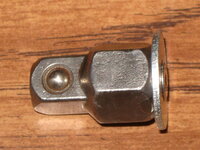
I received this today and it looks like it could be usefully low-profile - you can put an open wrench on the base if there's no room for a ratchet


1742013659757.png1742013925587.png
 
To avoid these ads, REGISTER NOW!
Top Bottom