BernzOmatic is a NYS company, manufactured in Rochester, the third-largest city in a state of 19 million+ people. At least that one was. When I was a kid, in the morning, getting ready to go to school, the parents would have the radio on, and they would listen to the financial news. Xerox, Eastman Kodak, Bausch & Lomb and GM_Rochester Products were local companies which were doing well then. For some reason I recall the commodity of 'pork belly futures' being one of the things mentioned.
Bob, like the lady doing the punctuation corrections on your manuals, I detect a 'scrivener's error' in the above paragraph. The model car company is
AMT and not
AMC. The AMC is, of course, the abbreviation used after the Ramblers stopped rolling-off the assembly line and were replaced by American Motors Corporation. The AMX and the Rebel Machine were two of my favorite AMC cars. Roger Penske ran Javelins in Trans-Am, I believe, at one point.
From
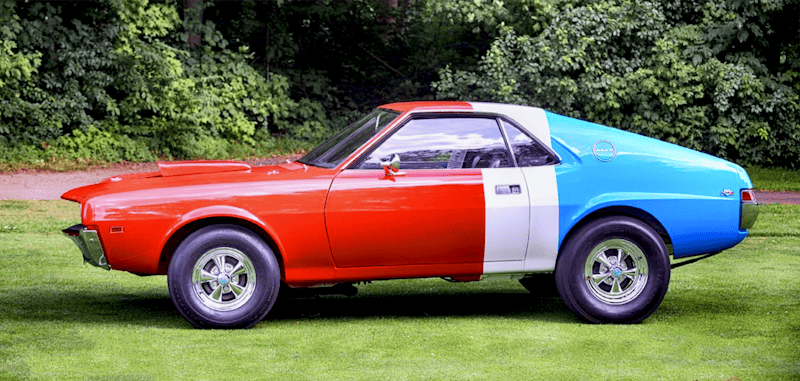
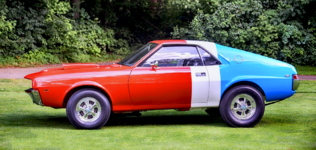
This month's Rare Rides offers an in-depth look at AMC's apex predator, the exceedingly rare 1969 AMC Hurst AMX 390 Super Stock.

www.streetmusclemag.com
in italics, below:
The engines were removed from the cars and sent to Crane Cams in Hallandale Florida, where Shahan modified them with JE pistons, Crane cylinder heads with 2.080-inch intake, and 1.740-inch exhaust valves, a Crane R2741393 solid roller camshaft, an Edelbrock STR-11 Cross-ram intake, dual four-barrel Holley 650 cfm carbs, Thorley headers, and an aftermarket exhaust. The engines were sent back to Hurst and installed in the cars.
Upon the Super Stock’s announcement, AMC stated that its engine was good for 340 horsepower. In reality, though, the modified 390s churned out something more akin to 420 ponies.
AMC listed the Super Stock for sale to the public at $5,994 without any form of warranty – a hefty premium over a base car’s price. Nonetheless, all 52 cars were sold and were soon tearing up the streets and strips of America with 11-second quarter-mile times at over 120 mph. Insane numbers for 1969, and certainly respectable even today.
In NHRA SS/D and SS/C classes of drag racing, the cars began to slay all comers with mid ten-second runs, and track records began to fall to AMX Super Stock runners on a weekly basis.
Today, only 40 of the 52 cars are accounted for and rarely hit the auction block.
Ed. note: I knew Harvey Crane, and his kids. One of his former machinists is a friend of mine, whom I use as the need arises.
The Mark Donohue/Roger Penske AMC connection:
I made many AMT and Revell models, one other company I really enjoyed, was Monogram. They made 1/8 scale cars, and I made a Jaguar XK-E towards the end of my model-building time, and I really liked the job I did on it. I kept it for many years, but it finally succumbed to a porch leak here in FL. I suspect it was 30 years old by that time, and had survived moves to three different states.
Monogram also made many space models, and the space advocate Willy Ley who was a consultant to Monogram had a club you could subscribe to, which of-course I did.
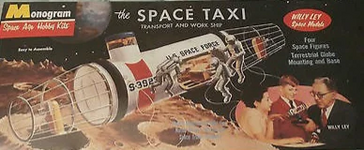

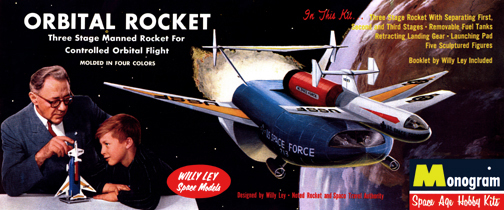
Here are two of my favorite models from the Willy Ley influenced space model kits. You can see that he's prominently featured in the box art.
A 1:192 scale plastic model of the Willy Ley Orbital Rocket by Monogram

fantastic-plastic.com
Willy Ley was an engineer who fled Nazi Germany in the 1930's and he never stopped championing the exploration of outer space. His biography is very interesting. Just reading these posts I found, makes me recall all the fun I had in building these models and many more. I'd call Revell, AMT, Aurora and Monogram to be the Big Four in models of cars, planes, ships, spacecraft, and even classic Universal Studios models of horror film creatures like Frankenstein, the Phantom of the Opera, Dracula, Wolfman, and others.
Korvette, JM Fields, Woolworths, Grants Neisners, K-Marts, Kresge's, and the stamp redemption stores are all fond memories for me. There was a Katz in Chicago I shopped at for a copy of the Beatles
White Album, and it had a serial number on it, I recall it was a six-digit number. I still have it, along with probably another 2,500 LP's of rock, R & B, soul, jazz, and at least one copy of
Sounds of Sebring, which I used to play while racing my Aurora
Model Motoring HO-
scale slot cars. I had a hot plate which was from a set for making powdered ceramic pieces of copper. I used to put a few drops of castor oil on the hot plate to replicate the aroma of it coming across the racetrack at Watkins Glen, during the F1 races I attended there in the 1960's. The cars would be on the track, and when they came in, they would drain the oil out of the delivery system (I think most of the cars used a dry-sump system) because it would get gummy, if allowed to cool in the engines, and the engine would destroy itself on a re-start.
I've posted before about my unique work experience. I fought a fire in the snow on that day in Florida, south of you by county. I bet I'm one of the few surviving fire-rescue members in Florida who did that. It was a Dade County pine frame/siding building, and as the fire burned hot, the sap would come to the surface of the wood, and pop and spit, exploding onto your bunker coat and pants.
I recall helping Mom fill the S&H stamp books. There was a redemption store < 1 mile from me in FL, and I forget what I got, some small countertop kitchen appliance I think. I'd read that S&H was closing, so I redeemed what books I had, and the store closed soon.
Bob, do you have any experience buying groceries at the NYS chain,
Red and White? For us, they were across the street from the IGA, another NYS chain. Both stores were within a frisbee-throw of the Erie Canal, where the village was, next-to which we lived. The following history lesson I've posted before.
The Erie Canal, was a big gamble in the first quarter of the 19th Century, when we were still paying-off as a country our Revolutionary War debt. States other than NYS lobbied in Congress not to support the building of "
Clinton's Ditch," but once it was built, the cost of shipping goods from the Great Lakes dropped by something like 500%. Produce from the western NYS farmers was able to reach the population centers of the East Coast and it opened the Midwest to settlement, allowing the growth of Chicago and Detroit, and other communities which were relatively small settlements before the Erie Canal.
"Johnny Appleseed" whose real name was Chapman (a
Jeopardy question last week), planted fruit trees along the path of the Erie Canal under construction. He wasn't interested in "an apple a day keeps the doctor away." He was interested in fermenting the apples into applejack, and in selling the alcohol to the canal workers, making him very wealthy. That, and an apocryphal folk hero in the history of the USA.
An international trip comes to an end in Rochester NY, via the last leg of the trip for these brewery tanks and it was on the Erie Canal.