To avoid these ads, REGISTER NOW!

Insurance Surprise

PCustoms

Well-known member
Joined
Jul 23, 2011
Messages
22,803
Location
VT
Go see an "independent" broker who works with multiple carriers.

Read the OP again, I think his agent is independent and dealing with multiple carriers.

The issue I see is that the OP approached with

I gave her dimension,cost,estimated value,ect. and the fact that I would be GC'ing the project with 4 subs.

This smells like commercial or construction insurance, while the OP claims they won't insure the finished building. I think something is getting lost in translation
 
To avoid these ads, REGISTER NOW!

zendriver

Well-known member
Joined
Dec 10, 2014
Messages
29,886
Location
Indiana
A homeowners insurance policy is a written contract.

Shouldn't something like this, be spelled out somewhere in a contract. :dunno:
 

PCustoms

Well-known member
Joined
Jul 23, 2011
Messages
22,803
Location
VT
A homeowners insurance policy is a written contract.

Shouldn't something like this, be spelled out somewhere in a contract. :dunno:

What do you mean? Based on the op there isn't a current policy, and the insurance carrier is not willing to enter into a contract ( policy ).
 

finn

Well-known member
Joined
Mar 27, 2005
Messages
16,247
Location
The UP, God's country
Maybe if it happened all the time.

Insurance companies pay out all the time for mistakes of the owner and/or residents.
Which is why it sounds like they are now on a path to minimize the risk of that happening. They won’t go apter the property owner who screwed up, but they can and will go after a general contractor who screwed up.

The easiest way to protect them from shouldering the risk is to just not insure an owner built structure who has no business record or contractor insurance.

Things have changed in the insurance industry, and will continue to evolve. Look at the issues in California and Florida, specifically the building collapse of a couple years ago near Miami. Lots of people there can’t even get insurance, through no fault of there own.
 
OP
M

Mr onetwo

Well-known member
Joined
Apr 6, 2011
Messages
2,009
Location
Coastal Maine
Thanks for all the comments guys. Don't lose sight of the fact that this request was for insurance after construction is done. I may not be a "general contractor" but I have a lot of experience in commercial and residential construction. I am not your typical inexperienced DIY'er attempting their first house.Construction starts in June so I have time to do some calling and get to the bottom of this.As stated, this may be insurance carriers limiting risk and is something very recent.I will report back as I get more information or get a new agent.
 

PCustoms

Well-known member
Joined
Jul 23, 2011
Messages
22,803
Location
VT
Thanks for all the comments guys. Don't lose sight of the fact that this request was for insurance after construction is done. I may not be a "general contractor" but I have a lot of experience in commercial and residential construction. I am not your typical inexperienced DIY'er attempting their first house.Construction starts in June so I have time to do some calling and get to the bottom of this.As stated, this may be insurance carriers limiting risk and is something very recent.I will report back as I get more information or get a new agent.
If construction starts in June, why are you calling in March for insurance on a completed house?
 

Prospecter

Well-known member
Joined
May 16, 2015
Messages
2,403
Location
Maine
I am in the late planning stages of building a new 32x40 shop building and house on 30 rural acres. Since I had a homeowners policy payment due on my current home I thought I would call my agent and get a quote to start the process.I gave her dimension,cost,estimated value,ect. and the fact that I would be GC'ing the project with 4 subs.Same thing I did when I built my present house.Keep in mind that I have had the same agent since I got my first car 48 years ago and the same carrier on my house for 17 years.She got back to me a couple of days later and informed me if I GC'ed or built the building myself none of the carriers they deal with (which is all of the ones operating in the state of Maine) would insure it even after an inspection upon completion.I was SHOCKED :shocking: . She told me about another customer that replaced the siding on his house himself and when the insurance carrier found out they immediately canceled the policy. I am going to get around this problem by hiring my site contractor as the GC on paper, but I will still do the coordinating, ordering and scheduling. This is all despite the fact that there is no general contractor or builder licensing of any kind in Maine. Insurance companies are the WORST greedy, scummy bas#ards ever! :poop: Has anyone else run into this farce...I suspect it is a very recent thing.
We use State Farm on one property and Farm Family on the other. Both excellent to deal with. Seems like one or the other could deal with this.
 

reader2580

Well-known member
Joined
Dec 31, 2014
Messages
14,524
Location
Minneapolis, MN
It is just a construction project until it is completed. There are insurance companies that deal with policies to cover that. All those boards, nails, fixtures etc., are personal property until the structure is complete. A shower door kit in your pick up is personal property until it is installed and the project is signed off. Why would USAA want to insure it as a structure until then? The insurance company wanted insurance on personal property (renter's insurance) in an amount to cover the cost if there was a loss.
My garage is not yet complete. My insurance company is insuring the building under my normal homeowner's policy. I was very clear to the agent that the building is not yet complete. Right now, the siding and electrical are the only things not complete. The siding starts tomorrow. Electrical will get done as soon as the ground is thawed enough to dig a six foot long trench over to my other garage.

To be clear, the garage is totally framed, sheathed, roofed, and the doors are installed. I parked my motorhome in there over the winter,
 
Last edited:

firebirdparts

Well-known member
Joined
Jun 8, 2016
Messages
10,618
Location
Kingsport, TN
Every time a building colllapses, or a bridge falls down, who does the insurance company go after?

Answer: without question, it’s the builder. That’s why builders have their own liability insurance.

An insurer never goes after their own policy holder.

The insurance company is within its rights to refuse to cover home built buildings.
That makes sense if there wasn't the obvious paradox in the actual data. I would argue that of all the collapsed buildings we could find on the news, none of them are DIY built. I don't mean few, I mean none. The company should have some loss data. Would be interesting to me at least to know the facts. I would have assumed that there simply isn't any protection to be had. If my shop falls, I guess I'll let y'all know.

I just have not observed at all DIY buildings that are structurally inferior. I just haven't seen it. Seen a lot of DIY buildings where the owner went above and beyond. I've seen that.
 
OP
M

Mr onetwo

Well-known member
Joined
Apr 6, 2011
Messages
2,009
Location
Coastal Maine
If construction starts in June, why are you calling in March for insurance on a completed house?
I did not say it was a house in post #1. I am just getting my ducks all in a row. Found out my agent does not write with State Farm so that will be an avenue to explore.I have MMG right now and they are getting very picky and pricey. Agent explained that the reason is due to the fact that you can't sue yourself in case of defective construction such as in a roof collapse from snow and ice. I would say this is just an excuse from the insurance co., but whatever.Part of the problem is that there is no existing house or homeowners policy to base this off of.

Untitled.jpg
 

finn

Well-known member
Joined
Mar 27, 2005
Messages
16,247
Location
The UP, God's country
That makes sense if there wasn't the obvious paradox in the actual data. I would argue that of all the collapsed buildings we could find on the news, none of them are DIY built. I don't mean few, I mean none. The company should have some loss data. Would be interesting to me at least to know the facts. I would have assumed that there simply isn't any protection to be had. If my shop falls, I guess I'll let y'all know.

I just have not observed at all DIY buildings that are structurally inferior. I just haven't seen it. Seen a lot of DIY buildings where the owner went above and beyond. I've seen that.
Collapsed pole barns that failed under snow loads aren’t an uncommon sight in Northern Wisconsin and the UP.

Many are owner built.
 

reader2580

Well-known member
Joined
Dec 31, 2014
Messages
14,524
Location
Minneapolis, MN
Just because I am acting as GC for my building doesn't mean the building is some sort of death trap. I hired reputable subcontractors to install the slab, frame the building, and install most of the siding. I have a building permit, and the subcontractors all passed their inspections.

I installed the metal roof, fascia/soffit, the trim for the siding, the panel siding on the first four feet (wainscoating), and both garage doors. I will be doing the electrical too, with a electrical permit.
 

dcg9381

Well-known member
Joined
Jun 20, 2018
Messages
11,753
Location
Austin, TX
Collapsed pole barns that failed under snow loads aren’t an uncommon sight in Northern Wisconsin and the UP.
Many are owner built.
I would assume that "not built to snow load code" would be a valid exclusion on a claim in this situation.

I'm with others, I suspect that "design or construction defect" probably isn't what is burning holes in the insurance industry right now.
 
Last edited:

finn

Well-known member
Joined
Mar 27, 2005
Messages
16,247
Location
The UP, God's country
Just because I am acting as GC for my building doesn't mean the building is some sort of death trap. I hired reputable subcontractors to install the slab, frame the building, and install most of the siding. I have a building permit, and the subcontractors all passed their inspections.

I installed the metal roof, fascia/soffit, the trim for the siding, the panel siding on the first four feet (wainscoating), and both garage doors. I will be doing the electrical too, with a electrical permit.
You’re totally correct.

The issue isn’t whether you can do a good job.

It’s just that the insurance company has no way of knowing that you can do a good job, and no recourse if you tell them you can do a good job, but something goes wrong anyway.. Again, I’m not defending their actions or policies, just trying to understand why, potentially, that policy is in place.

And I do understand it.

The neighborhood taxidermist may be able to remove my appendix successfully if he watches enough YouTube videos, but my health insurance company isn’t going to pay him for the operation.

It, in some ways, comes down to professional standards and chain of liability. The insurance company wants a chain of responsibility to recover costs in the event of something going wrong, so apparently they determined that having a professional contractor involved in the construction process fulfills that otherwise missing link.
 

finn

Well-known member
Joined
Mar 27, 2005
Messages
16,247
Location
The UP, God's country
I've never had a insurance company ask who built anything I've insured. For a rural shop building with no house on the property, try a farm insurer. They are used to that scenario. Most home insurance companies would decline just because there is no house.

Nor ha I, or the OP, or, apparently the OP’s broker.

Sounds like it’s something new, and who knows how widespread.

My insurance company inspected the exterior of my property last winter, when we were in the South.

Got a letter saying I had to replace a couple of rail panels on the deck for safety. The railing has three removable panels that come off for the winter so the snow can be shoveled off the 4’ high deck. By January you’re still shoveling snow up, so there’s no danger of falling off the deck…duuh! The rails are pinned so they’re easy to put back in the spring when it stops snowing.

Similarly, who ever heard of an insurance company refusing to cover buildings with solid fuel heaters, in flood plains, or in wildfire or earthquake zones.

What was once commonly covered by insurance is now grounds for policy cancellation or refusal.

Just because you never heard of it doesn’t mean that it where the industry might be headed.

I hope not, but the OP’s story makes me wonder.
 
To avoid these ads, REGISTER NOW!

sjvicker

Well-known member
Joined
Aug 9, 2014
Messages
602
Location
SW Washington
I've never had a insurance company ask who built anything I've insured. For a rural shop building with no house on the property, try a farm insurer. They are used to that scenario. Most home insurance companies would decline just because there is no house.
I think I just went through a similar situation to the OP's. I had Allstate and it was great as long as my property was vacant but as soon as I put a structure on it they would no longer cover the property under my policy. The agent didn't seem willing to do any more research on the matter. It was a nightmare (for my wife) to find an insurance company that would insure a structure on a property that wasn't a residence. She eventually found an agent at Farmers who worked with a 3rd party to get the coverage we wanted.

It was surprising this wasn't a common occurrence. How do people with cabins insure the structures on their properties?
 

PCustoms

Well-known member
Joined
Jul 23, 2011
Messages
22,803
Location
VT
I apologize for not being clearer...the shop is this year and house next year.The conversation I had with the agent was in terms of shop only.

56 posts in and I think we finally got to the root of the issue. I suspect that building the shop without a house on the property is the issue
 

PugetDude

ALLIANCE MEMBER
Joined
Mar 13, 2013
Messages
22,383
Location
Superstition Mountains, AZ
That makes sense if there wasn't the obvious paradox in the actual data. I would argue that of all the collapsed buildings we could find on the news, none of them are DIY built. I don't mean few, I mean none. The company should have some loss data. Would be interesting to me at least to know the facts. I would have assumed that there simply isn't any protection to be had. If my shop falls, I guess I'll let y'all know.

I just have not observed at all DIY buildings that are structurally inferior. I just haven't seen it. Seen a lot of DIY buildings where the owner went above and beyond. I've seen that.
Google the Korean Shed of Doom in British Columbia....
 

andyvh1959

Well-known member
Joined
Feb 15, 2020
Messages
2,598
Location
Green Bay WI
Thinking about it, it’s not as stupid as it sounds. If the insured is also the GC, and something goes horribly wrong, and there’s a major structural failure, roof failure, fire, etc, who does the insurance company go after if the insured was also the GC?

I’m not going to get much agreement on this forum populated by diy’ers, but I think the insurance company may be within their rights to protect their assets.
"rights to protect their assests"? Perhaps I misunderstand, but the "asset" is not owned by the insurance company. The only asset to them is the likelyhood of not having to pay out more than they have collected, Yes, if the insured property suffers a claim that is more than the policy is worth, that is their mistake and misfortune. Which does happen, but yet most insurance companies survive and thrive, making profits, not being the benevolent caretakers they portray themselves to be.
 

Eric Brown

ALLIANCE MEMBER
Joined
Jun 14, 2024
Messages
678
My house insurance (Travelers) went from $246 a month to $344 a month. I called Geico (I am on a bundle plane). They checked and switched me to Assurant for $100 a month. I thought great. They will be sending out an inspector to take pictures. OK. Now it gets interesting. Another company that works with Assurant offers a "bonus" if I download an app to my phone and take the pictures myself.
Cautious I sent them an e-mail asking about how they use my phone number, location data etc. They said I have to download the app.
I called and talked with Geico. They said the other service is optional and would result in a $7 credit. I checked some more and discovered that the app company is in Columbia. No way. Keeping all financial info off my phone.
 

BurtEggley

Well-known member
Joined
Oct 8, 2024
Messages
864
I read your first post again. A shop on rural acreage is a shop, it is not a residence so it cannot be covered under a residential policy. When you build your home on the same acreage, then you can call it an accessory building, detached garage etc., and it will be covered as such. I have a 10 x 12 shed with permitted electricity that I store everything in next to the house here. USAA would laugh at me if I called them and said I wanted to insure it as a small 2nd residence. If it was 100' x 120' it would still be an accessory building. If the zoning allowed 2 on 1, and it was built to code with kitchen, bath, bedrooms, etc., as a second house on the lot, then I could ask for it to be insured as a second home - granny flat etc.. Once I tell them by the way I store gasoline in it, do welding, run saws, build cabinets, work on tractors in it too, or they see it from an overhead shot, they are going to have a problem with what I am telling them it is. Don't forget that in this day and age, they can see any property they want from Google Earth, or drones they can fly to take photos. Also, not all the insurance USAA offers is USAA. Some of it is brokered where another company underwrites it, and USAA collects premiums for the convenience of the policy holder.
 

finn

Well-known member
Joined
Mar 27, 2005
Messages
16,247
Location
The UP, God's country
"rights to protect their assests"? Perhaps I misunderstand, but the "asset" is not owned by the insurance company. The only asset to them is the likelyhood of not having to pay out more than they have collected, Yes, if the insured property suffers a claim that is more than the policy is worth, that is their mistake and misfortune. Which does happen, but yet most insurance companies survive and thrive, making profits, not being the benevolent caretakers they portray themselves to be.
The insurance company’s assets in this case that they have invested as collateral to pay off the cost to repair or replace the property owner’ building in the event of a loss.

The insurance company thus does have assets at risk. Significant assets at that.

Most insurance companies are not, as you assert making outlandish profits.

If they were, why would they be pulling out of high risk markets like costal areas and wildfire prone areas.
 

Modern Garage

Well-known member
Joined
Mar 26, 2015
Messages
583
Location
Southern Minnesota
We may all be looking at this from the wrong angle. The insurance company refused since the owner was also the GC. They may be worried about fraud, not incompetence.
Joe
 

andyvh1959

Well-known member
Joined
Feb 15, 2020
Messages
2,598
Location
Green Bay WI
Most insurance companies are not, as you assert making outlandish profits.
I think I'd believe that more if every insurance company headquarters were asture simple strutures. But nearly all that I've seen are large, opulent, campuses. Like Acuity just north of Sheboygan WI. Its impressive I'll say that. From I-43 it looks like a cross between a huge mega-church and a premier college campus. A soaring central cathedral like section, makes me wonder how that is not made from profits.

 
Last edited:

finn

Well-known member
Joined
Mar 27, 2005
Messages
16,247
Location
The UP, God's country
I used to drive past that facility about a dozen or more times per year.

Remember, that training facility is a corporate asset, one that’s appreciating, and also a tax write-off..

I noticed that the original post in this thread has disappeared.
 

cgrutt

Well-known member
Joined
Mar 4, 2016
Messages
8,269
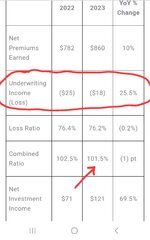
Not sure when it became a bad thing for companies to make a profit. According to link you posted, which presumably is industry wide, the industry actually lost money through underwriting and all of the "profits" were generated via investment income on its reserves, which are largely held to pay future claims. Underwriting loss means their core business, writing policies and paying claims, is not priced adequately to support future operations. Insurance is cyclical, there are good years without significant catastrophes, and bad years. Insurance companies won't stay in business over the long haul if they price risks below what it costs in claims eventually it all comes out in the wash.

ETA combined ratio over 100 indicates it cost more to write policies and service claims than companies made through policy premiums. In this case indusstry lost approximately 1.5% more then they earned selling policies. Combined ratio excludes investment income and just reflects company's core operations. The industry overall lost $18B in 2023 and $25B in 2022 through underwriting according to this chart. Claims generally are not paid same year the loss occurred. Companies set aside reserves, which are invested and generate investment income, to pay these claims in future (there is also policyholder surplus which is invested if company is solvent). Problem is the claims will eventually be paid and will no longer generate investment income. If company continues to write at underwriting loss they will eventually become insolvent.

Screenshot_20250326_075417_Chrome.jpg
 
Last edited:

LOW1

Well-known member
Joined
Jul 20, 2018
Messages
2,642
Location
ontario
Something doesn't sound right about this story.
I suspect that it is all about subrogation. When insurance pays out on a claim they want to be able to recover what they paid out if at all possible. They can’t subrogate back against their own policy holder. But if the OP’s building collapses they may have a subrogation claim against the OP’s contractor. For example if the contractor does not put on hurricane clips and the roof blows off the OP‘s insurance company will pay the OP and then may try and recover from the OP’s contractor.
 

cgrutt

Well-known member
Joined
Mar 4, 2016
Messages
8,269
profit is fine....RECORD profit while increasing premiums 26 to 40% is not
Not sure if you're aware or not but insurance is Highly regulated. Most companies can't just charge whatever they want their rates have to be approved based upon historical experience, among others, by state regulators, who often are unwilling to approve requested rate increases for a variety of reasons, most of which can't be discussed here. This is especially true with personal lines. Moreover, if regulators refuse to approve adequate rates many company's are forced to continue insuring unprofitable business, so we often hear about companies refusing to write new policies in certain locations or lines of business. It's one way for insurers to manage their risk exposure. You may have been caught up in that. Looks like industry generated about 12% overall. I'm guessing that's no more than 5% if calculated on invested assets rather than premiums earned because insurers are also heavily restricted in the types of investments they are able to make. Either way, record profits or not, premiums are still priced in adequately if they are losing money on underwriting. I happen to have alot of experience with this particular issue. Anyway I'm done good luck with your project.
 

PugetDude

ALLIANCE MEMBER
Joined
Mar 13, 2013
Messages
22,383
Location
Superstition Mountains, AZ
Not sure if you're aware or not but insurance is Highly regulated. Most companies can't just charge whatever they want their rates have to be approved based upon historical experience, among others, by state regulators, who often are unwilling to approve requested rate increases for a variety of reasons, most of which can't be discussed here. This is especially true with personal lines. Moreover, if regulators refuse to approve adequate rates many company's are forced to continue insuring unprofitable business, so we often hear about companies refusing to write new policies in certain locations or lines of business. It's one way for insurers to manage their risk exposure. You may have been caught up in that. Looks like industry generated about 12% overall. I'm guessing that's no more than 5% if calculated on invested assets rather than premiums earned because insurers are also heavily restricted in the types of investments they are able to make. Either way, record profits or not, premiums are still priced in adequately if they are losing money on underwriting. I happen to have alot of experience with this particular issue. Anyway I'm done good luck with your project.
Facts? We don't need no stinkin' facts!
 

njk4o5

Well-known member
Joined
Dec 9, 2015
Messages
116
Location
Boston, MA
Insurance companies are scum of the earth, most will take your money for years and years then when you need a claim they do everything they can to deny it. The less they know the better and remember all phone calls are recorded. They are in the business of making money and lots of it, they dont care about you in the least. Best thing you can do is shop around for insurance yearly
 

hobie18

Well-known member
Joined
Apr 29, 2024
Messages
1,181
Profit on insurance used to be highly regulated. In and out had to match. Making money only on investments.
 
To avoid these ads, REGISTER NOW!
Top Bottom