To avoid these ads, REGISTER NOW!

Pipefitting question

Beerhippie

Well-known member
Joined
Oct 13, 2023
Messages
10,014
Location
Far NE Oregon
I need to add a 2 1/2" union to a 2 1/2" Nom. iron pipe--and I need it to come out the same length is was before I cut it.

How deep do I figure for thread engagement? I'll be borrowing a power threader to cut the threads.
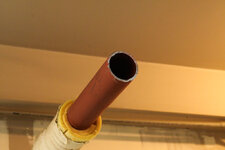
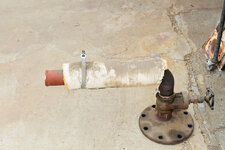
54445429104_75b04ec8f9_b.jpg

54444378397_363f638370_b.jpg
 
To avoid these ads, REGISTER NOW!
OP
B

Beerhippie

Well-known member
Joined
Oct 13, 2023
Messages
10,014
Location
Far NE Oregon
I used to know thread allowances from Plumbing shop in high school, but I forget that .
try searching IPS thread allowance , you should be able to find a chart
Thanks!

I used to know this stuff too, but it's been a while... and this fit is pretty critical if I want the plumbing to match up.
 
OP
B

Beerhippie

Well-known member
Joined
Oct 13, 2023
Messages
10,014
Location
Far NE Oregon
I need to add a 2 1/2" union to a 2 1/2" Nom. iron pipe--and I need it to come out the same length is was before I cut it.

How deep do I figure for thread engagement? I'll be borrowing a power threader to cut the threads.

54445429104_75b04ec8f9_b.jpg

54444378397_363f638370_b.jpg
Looking back on that cut, it's amazingly straight for a Bosch recip and a 65-year-old dude.
 
To avoid these ads, REGISTER NOW!
OP
B

Beerhippie

Well-known member
Joined
Oct 13, 2023
Messages
10,014
Location
Far NE Oregon
That chart looks accurate. I don't think I've ever put threads on 2 1/2", but the other sizes sound about right.
I figure if I round that 15/16" up to one inch, X 2, I'll make up for the 1/8" kerf of the recip saw. Unless I have that backwards... draw a picture first....
 
OP
B

Beerhippie

Well-known member
Joined
Oct 13, 2023
Messages
10,014
Location
Far NE Oregon
Wow, that's a blast from the past. Back when high school still taught tangible skills that could be used to earn a living.
You mean like reading, writing and 'rithmatic?

Try and get a job without those.

But, yeah, shop classes should still be on the curriculum. Wood, Metal, Automotive, HVAC, Electrical, etc.
 
Last edited:

Shiftless

Well-known member
Joined
Mar 9, 2014
Messages
14,588
Location
East Bay SFO
But, yeah, shop classes should still be on the curriculum. Wood, Metal, Automotive, HVAC, Electrical, etc.
I took woodshop when I was in the 7th grade back in the early 60’s
Then the next year I took print shop and learned typesetting with little individual pieces of lead for each letter, number, and symbol.
Sadly that was the end of shop because I graduated and went to an all academic high school.

I had to wait until later in life to rekindle my love for mechanical stuff.
 

david3921

Well-known member
Joined
Apr 22, 2014
Messages
443
Location
Wyoming, Michigan
This is the best I've found:

https://www.hosemaster.com/resources/technical-information/thread-allowance

I seem to recall it being more like 1/2 the OD of the pipe... but I'll trust the chart.
I'm doing some stuff with 3/4" black pipe and needed to know how far a cap would screw on. I screwed the cap on, marked the pipe, took off the cap, and measured. I came up with .5485 on my caliper. I should have realized there was a chart for this. The above link shows .55 for 3/4". Not bad for these old eyes! Thanks for the link. It will be useful for other sizes.
 

rlitman

Well-known member
Joined
Oct 18, 2010
Messages
24,663
Location
Long Island
...I seem to recall it being more like 1/2 the OD of the pipe... but I'll trust the chart.
Seeing how the NPT seal is designed around a specific number of turns, and the NPT thread pitches repeat a lot, it makes more sense to me that the allowance would be mostly based on the thread pitch, and not so much the OD. Seeing the way 1/4" & 3/8" are almost the same, as are 1/2" & 3/4" and 1" all the way through 2" clump up when dies are shared makes sense to me. Though I'll admit I've never done any NPT work that required this level of precision.
 
OP
B

Beerhippie

Well-known member
Joined
Oct 13, 2023
Messages
10,014
Location
Far NE Oregon
Seeing how the NPT seal is designed around a specific number of turns, and the NPT thread pitches repeat a lot, it makes more sense to me that the allowance would be mostly based on the thread pitch, and not so much the OD. Seeing the way 1/4" & 3/8" are almost the same, as are 1/2" & 3/4" and 1" all the way through 2" clump up when dies are shared makes sense to me. Though I'll admit I've never done any NPT work that required this level of precision.
Which is why I've decided to do the fitting with the boiler and pipes in place. The best way I've found to eliminate math errors is to eliminate math.
 
Last edited:
To avoid these ads, REGISTER NOW!
Top Bottom