To avoid these ads, REGISTER NOW!

Stick Built Roof—Supporting Wall Question

WordMan

ALLIANCE MEMBER
Joined
Jul 4, 2018
Messages
3,772
Location
Harriman, Tennessee
Okay guys and gals, I'm confuzzled. My living room is divided off from my kitchen/dining area by a wall I assume to be a supporting wall.

I want to remove said wall, and I called in a structural engineer to tell me what sort of beam I'll an 3 1/4”X 18” LVL beam need to span 18-20 feet.

Here's the wall (silly stuffed critters: Hedgehog in memory of young lady I taught (who loved hedgehogs) who died in a car accident at 17, and the bunny was my mother's before she died of a horrid disease).

1744736013482.jpeg

There are no support footers under that wall.

Also, there is this section that has no wall and no additional support in the attic.

1744736123832.jpeg

So, I have the basic stick-built roof sitting on a stick built, full brick veneer house.

1744736289840.png

Ignore the dimensions, it's just the basic house cross section that I drew.

Roof and ceiling joists are 2X6.

As I understand it, the roof is self supporting, you just need to have cross ties (ceiling joists?) to keep it from spreading. Is that correct?

Do I really need the beam from hell to hold the ceiling joists up?

Apologies for my ignorance on this one, and thanks for any help or advice you might give!
 
To avoid these ads, REGISTER NOW!

Innovate1

Well-known member
Joined
Jul 28, 2014
Messages
4,288
Location
Illinois near St. Louis, Missouri
I don't see a span dimension but if it is scaled correctly I used the grid squares and came up with 31'. That's a huge span, especially for a 2 x 6. Are you sure there aren't any other supports. Particularly the floor would be VERY bouncy with that kind of span. Seems like there is something missing. I would also expect some more ties between the ceiling joists and the rafters. If there were ties in the center from the peak down that might be good on the ceiling (not saying it is, just it might be). But the floor must have some other supports you haven't described.
 

Kaizen

Well-known member
Joined
Jan 9, 2015
Messages
6,948
Location
New England
Yes you need support. Not sure why you are asking us after asking a professional though? If your attic floor beams were say 2x10 or something then maybe.
Look at a modern truss compared to your drawing. You'll see the web that transfers loads that you don't have.
 

billconner

Well-known member
Joined
Jul 20, 2021
Messages
6,963
Location
Thousand Islands NYS
You need to support the ceiling joists which function as rafter tie as you note. Also whether there is any attic storage affects it. Possible to put beam in attic if you don't want "bump" on ceiling. Old timers used to support ceiling joists from the rafters but I don't believe codes would allow that today. And I can't imagine deeper joists would make sense or cost less than the LVL. By instinct I'd say your engineer is right.

Do you have a way to get the beam into the attic?
 

jack stand

Well-known member
Joined
Feb 29, 2012
Messages
3,331
Location
Lakes Region Maine
What's above the ceiling? Just insulation or a floor with storage?
What I'm thinking is how to turn the roof and ceiling structure into an actual self supporting truss. A much simpler resolution than a monster beam and uninterrupted ceiling below as well. I'm assuming that's where the engineer would put it.
That area that's not supported by a wall is a clue to the added support may not be what we're thinking. Did this engineer visit your home?
 
OP
W

WordMan

ALLIANCE MEMBER
Joined
Jul 4, 2018
Messages
3,772
Location
Harriman, Tennessee
Okay, I did some more looking...

I was incorrect, there is a "beam" under the center of the house. It consists of 3 2X10s running down the center of the house with the floor joists attached to it.

I don't see a span dimension but if it is scaled correctly I used the grid squares and came up with 31'. That's a huge span, especially for a 2 x 6. Are you sure there aren't any other supports. Particularly the floor would be VERY bouncy with that kind of span. Seems like there is something missing. I would also expect some more ties between the ceiling joists and the rafters. If there were ties in the center from the peak down that might be good on the ceiling (not saying it is, just it might be). But the floor must have some other supports you haven't described.

It's not to scale. The actual floor span is around 26'6"


Yes you need support. Not sure why you are asking us after asking a professional though? If your attic floor beams were say 2x10 or something then maybe.
Look at a modern truss compared to your drawing. You'll see the web that transfers loads that you don't have.

I get that... but my "professional" never went under the house. He only went into the attic.

You need to support the ceiling joists which function as rafter tie as you note. Also whether there is any attic storage affects it. Possible to put beam in attic if you don't want "bump" on ceiling. Old timers used to support ceiling joists from the rafters but I don't believe codes would allow that today. And I can't imagine deeper joists would make sense or cost less than the LVL. By instinct I'd say your engineer is right.

Do you have a way to get the beam into the attic?

I do have a way to get a beam into the attic, but it will be a pain in the ***.

What's above the ceiling? Just insulation or a floor with storage?
What I'm thinking is how to turn the roof and ceiling structure into an actual self supporting truss. A much simpler resolution than a monster beam and uninterrupted ceiling below as well. I'm assuming that's where the engineer would put it.
That area that's not supported by a wall is a clue to the added support may not be what we're thinking. Did this engineer visit your home?

Just insulation.

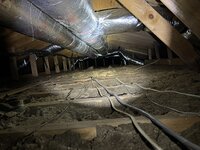
Here's what the ceiling looks like from the attic.

IMG_2028.jpeg


The section where there is no support underneath just has the joists overlapped by around 3'. The rest just overlaps by a foot.

IMG_2033.jpeg

The rest just overlaps by a foot.

IMG_2034.jpeg


I have no issue with the monster beam except it's a pain in the *** to get up there (but it can be done).

Otherwise, it's just a stick-roof with a knee wall on each side.

As I stated above, under the house is a beam consisting of 3 2X10s.

The engineer visited, but didn't go under the house, and only went into the attic.


To All: if three 2X10s are enough to hold up the floor and the ceiling, it just seems to me a 3 1/4”X 18” LVL is overkill. Maybe I'm wrong. It's not like me being wrong is uncommon or anything.

I was just wondering if there was another way to go about all this.

My thought was something along the lines of this:

1744758297214.png

Obviously, if this is just dumb, I'm back to the monster beam.

P.S. I was thinking, if I have to go with the beam, I would put temporary supports on both sides of the existing wall, tear it down, cut the ceiling joists, and install it by pushing it up from underneath and hanging the ceiling joists with joist hangers. Would that work?

Thanks guys!!
 

PCustoms

Well-known member
Joined
Jul 23, 2011
Messages
22,686
Location
VT
I get that... but my "professional" never went under the house. He only went into the attic.

Why would he need to go under the house? You asked about supporting the roof, and they knew that a beam would actually be removing load from the 1st floor, not adding any
 

billconner

Well-known member
Joined
Jul 20, 2021
Messages
6,963
Location
Thousand Islands NYS
I suspect the beam under the floor has some intermediate supports. The new one seems it has to span further?

I'm a little skeptical of the " truss like" solution. A lot of pieces and all that duct work to get around. Plus it's loading the rafters and unless over designed originally - not usual - you'd have to sister those.

Obviously the beam under is probably the easiest install, with the disadvantage of the bump. Any possibility of a column in living area to keep beam in attic smaller? 1/2 the span makes beam 1/4 the size.
 
OP
W

WordMan

ALLIANCE MEMBER
Joined
Jul 4, 2018
Messages
3,772
Location
Harriman, Tennessee
Why would he need to go under the house? You asked about supporting the roof, and they knew that a beam would actually be removing load from the 1st floor, not adding any

To see how it was supported originally?

I would think that would tell on how it needs to be supported now. But hey, I'm a writer, a former mechanic, and a former tools truck owner, not a home builder or an engineer!
 
OP
W

WordMan

ALLIANCE MEMBER
Joined
Jul 4, 2018
Messages
3,772
Location
Harriman, Tennessee
I suspect the beam under the floor has some intermediate supports. The new one seems it has to span further?

I'm a little skeptical of the " truss like" solution. A lot of pieces and all that duct work to get around. Plus it's loading the rafters and unless over designed originally - not usual - you'd have to sister those.

Obviously the beam under is probably the easiest install, with the disadvantage of the bump. Any possibility of a column in living area to keep beam in attic smaller? 1/2 the span makes beam 1/4 the size.

No, no place for a column. And I'll either have to flush the beam (as I described) or put the beam on top.

The space marked out as 17'1 3/4" (in the middle) is where the beam would span.

So, how did the original builder get away with the 4-1/2' to 5' span where they just overlapped the ceiling joists and that was enough? Igh, I wish I really understood this stuff!

1744761162292.png

This is what I'm starting our with...

1744761233083.png

Anything wrong with my idea of cutting the ceiling joists, inserting the beam, and hanging the joists from that with hangers?

Thanks!!
 

C-S-H

Well-known member
Joined
Jan 18, 2024
Messages
145
Anything wrong with my idea of cutting the ceiling joists, inserting the beam, and hanging the joists from that with hangers?
Yes. The ceiling joists are rafter ties. They are tension members. Do not cut them.

You were on the right track with the hangers from ridge to the middle of the rafter tie span. See if your engineer can get that to work. If not, I would just leave it as is.
 
OP
W

WordMan

ALLIANCE MEMBER
Joined
Jul 4, 2018
Messages
3,772
Location
Harriman, Tennessee
Yes. The ceiling joists are rafter ties. They are tension members. Do not cut them.

You were on the right track with the hangers from ridge to the middle of the rafter tie span. See if your engineer can get that to work. If not, I would just leave it as is.

As is ain't an option. Too much wasted space. Putting the beam on top of the ceiling joists will work fine. I don't like it, but...

Thanks!
 

Innovate1

Well-known member
Joined
Jul 28, 2014
Messages
4,288
Location
Illinois near St. Louis, Missouri
So, how did the original builder get away with the 4-1/2' to 5' span where they just overlapped the ceiling joists and that was enough? Igh, I wish I really understood this stuff!

That's a good question. No way that should work without some sagging. I'm guessing there are some supports across that section.

You could make a truss but you need to arrange a full truss not just a few braces in the middle. Then plywood gussets and a ton of nails.

No way I would be cutting those ties. With all the changes you are doing putting a hole in the gable end to insert the beam isn't that much more work. And don't forget you need to have good solid supports for the ends of that beam.
 
OP
W

WordMan

ALLIANCE MEMBER
Joined
Jul 4, 2018
Messages
3,772
Location
Harriman, Tennessee
That's a good question. No way that should work without some sagging. I'm guessing there are some supports across that section.

You could make a truss but you need to arrange a full truss not just a few braces in the middle. Then plywood gussets and a ton of nails.

No way I would be cutting those ties. With all the changes you are doing putting a hole in the gable end to insert the beam isn't that much more work. And don't forget you need to have good solid supports for the ends of that beam.

Well, I figured it was worth asking about. Thanks for the info, looks like the LVL beam is still the way to go!
 

readhead

Well-known member
Joined
Dec 8, 2012
Messages
6,177
Location
Durango, Co.
The ceiling joists are in tension but they could be cut and approved steel straps could be installed to replace the tension path.
I would talk to the engineer about installing a flush flitch beam from the bottom. A lot easier to handle smaller components.
 

carlaisle

Well-known member
Joined
May 14, 2022
Messages
373
You said you need to span 20' max and there is no load above - only load is the ceiling below, correct? I have not been on site, but the beam you were told you need sounds like overkill. 12" should be entirely adequate. A follow up conversation with the engineer may prove constructive. Remember, engineers are problem solvers. Framing the problem to solve as how to clear span the space while wrestling the smallest beam possible into place may help steer the conversation in a more palatable direction.
 

billconner

Well-known member
Joined
Jul 20, 2021
Messages
6,963
Location
Thousand Islands NYS
It's a big beam but supports a lot of drywall ceiling, which cracks of the beam sags, like when you service HVAC or run a wire. Initially I thought it was big but an inch per foot of span is not out of line.

Put it in attic before removing wall would be easiest.
 

Innovate1

Well-known member
Joined
Jul 28, 2014
Messages
4,288
Location
Illinois near St. Louis, Missouri
You said you need to span 20' max and there is no load above - only load is the ceiling below, correct? I have not been on site, but the beam you were told you need sounds like overkill. 12" should be entirely adequate. A follow up conversation with the engineer may prove constructive. Remember, engineers are problem solvers. Framing the problem to solve as how to clear span the space while wrestling the smallest beam possible into place may help steer the conversation in a more palatable direction.
I agree. It's only holding up the ceiling and not the roof. I think I would ask the engineer some questions on how this was calculated and the loading or get someone else to review the numbers. Do you need load calculations and engineer stamped drawings for your permit? Maybe they thought you would be using the attic for storage or included the roof load. Or I would calculate it myself - but I am an engineer (electrical) and have done a bit of that. It wouldn't be too difficult to estimate the ceiling weight and there are tables for allowable loading of the beams. Might even be able to find a program to make it a bit easier.
 

CraigStu

Well-known member
Joined
May 22, 2014
Messages
4,027
Location
Blacksburg, Va
In post #10 which floor plan is your house? The two have a very vague similarity but I don't understand why there are two different plans. If you put the lvl in the attic how do the existing ceiling joists attach to it? If you put the lvl across the 17'1-3/4 position you will need to upgrade the support under each end. And I think that support will need to extend down into the basement or crawl space. Our living room has a Metwood beam spanning 20ft in the living room. It sits on, I think, 5 studs in the wall. Those studs sit on 3-4 2x6 studs in the basement which are incorporated into a support wall sitting on the concrete slab.
 
To avoid these ads, REGISTER NOW!

theoldwizard1

Well-known member
Joined
Feb 22, 2011
Messages
43,138
Location
SE MI
I want to remove said wall, and I called in a structural engineer to tell me what sort of beam I'll an 3 1/4”X 18” LVL beam need to span 18-20 feet.
.
.
.
There are no support footers under that wall.
You need to have an engineer confirm that last statement ! If there is not support under the wall and there is no beam in the ceiling (which would be required to span that opening) then it is probably not a supporting wall,
 
Last edited:

Hooked

Well-known member
Joined
Sep 24, 2010
Messages
432
Location
League City, Texas
I'm hesitant to post this as it goes against what the braintrust here is advising and I'm sure all engineers would cringe at what I did.
My garage is 26x40 clear span. The joists are butted together in the middle with straps nailed on each side. To support the joists I added 2x4s in a similar fashion to those in your drawing in post #6 but the angled boards are spaced further toward the sides. In my case those boards are about midway between center and wall. I don't have the two vertical boards shown in your picture.
I don't have drywall on the ceiling but most of the attic is floored with 3/4" boards and lots of material/stuff stored up there. I've had no sagging in over 45 years.
I'm not suggesting this would work for your situation but just my experience with a similar span.
 

manwithtools

ALLIANCE MEMBER
Joined
Aug 24, 2015
Messages
13,799
Location
Lebanon, TN
That beam seems like massive overkill for just supporting the ceiling joists and drywall dead load, no live load at all. Are you sure about the recommended LVL size? 3-1/4" thick is not common to my understanding. Typical is 1-3/4" and many times they are doubled or tripled = 3-1/2" or 5-1/4"

A quick rough calculator on the internet brought back a single ply 1-3/4" x 14" LVL for 18'. I would want to double check those numbers though.

I also now understand why you question why the engineer didn't look at the crawl space. The beams ends will need multiple studs to carry the weight down to the first floor beam and footings.

I think the engineer was being overly conservative with his calcs, which many times they are. It's a CYA thing.
 
Last edited:

manwithtools

ALLIANCE MEMBER
Joined
Aug 24, 2015
Messages
13,799
Location
Lebanon, TN
So, how did the original builder get away with the 4-1/2' to 5' span where they just overlapped the ceiling joists and that was enough?
It's interesting to see how older construction methods sometimes hold up very well despite what today's engineering tables tell us. Much of today's calculations have plenty of safety factor built in to accomodate for material quality and workmanship issues. The original opening is not that wide and is not supporting tremendous weight. If you used that method for the entire ceiling, you would likely see sagging over time.

I like @readhead post #15 suggestion.
 
Last edited:

manwithtools

ALLIANCE MEMBER
Joined
Aug 24, 2015
Messages
13,799
Location
Lebanon, TN
Whar was deflection? Needs to be at least 1/360.
Actually for gypsum ceiling, maximum allowed deflection is L/240. L/360 is for plaster finishes. I'm not sure what the calculator used, but it did ask if if was a celling or floor, so I'm assuming at least 240.
 
OP
W

WordMan

ALLIANCE MEMBER
Joined
Jul 4, 2018
Messages
3,772
Location
Harriman, Tennessee
@manwithtools @billconner @Hooked @theoldwizard1 @CraigStu @Innovate1 @carlaisle @readhead @C-S-H @PCustoms

After giving it some thought, I suppose there's nothing wrong with having the beam under the ceiling joists. I can even put a column or two in the middle for support. The totally open idea is a remnant of an earlier iteration of the remodel, but in its current form, they would present little issue.

So... if i add a beam under the ceiling joists, and added two columns to support it (the dark grey structure as seen in the top drawing), would the usual couple of 2x8s or lvls be good for covering such spans?

1744842415444.png
 

billconner

Well-known member
Joined
Jul 20, 2021
Messages
6,963
Location
Thousand Islands NYS
Actually for gypsum ceiling, maximum allowed deflection is L/240. L/360 is for plaster finishes. I'm not sure what the calculator used, but it did ask if if was a celling or floor, so I'm assuming at least 240.
I think the deflection will be noticable. 1/240 of 18' is nearly an inch. I personally wouldn't risk it. But I'd also put a whole new layer of drywall on rather than patch where I removed a wall.
 

CraigStu

Well-known member
Joined
May 22, 2014
Messages
4,027
Location
Blacksburg, Va
In a previous house we had a 10ft opening in a 1st floor standard 2x4 wall. The opening allowed passage from dining area to living room so plenty of traffic. The beam that supported the ceiling must have been made of 2x12s plus a 1/2" piece of plywood judging by how far down from the ceiling it protruded. I mention this because we lived there for about 20 years and that beam hanging below the ceiling was something that we never even noticed. So, for me at least, the idea of going through whatever plan you might decide on to hide the beam in the ceiling just isn't worth it.
 

manwithtools

ALLIANCE MEMBER
Joined
Aug 24, 2015
Messages
13,799
Location
Lebanon, TN
So, for me at least, the idea of going through whatever plan you might decide on to hide the beam in the ceiling just isn't worth it.
If you look at the planned changes to the floor plan in post #10, I could never live with the fact that I made all those other changes and then let an ugly beam reduce the ceiling height by a foot or more.
 

BurtEggley

Well-known member
Joined
Oct 8, 2024
Messages
862
"someone on the Internet told me so I decided not to hire a structural engineer." What could possibly go wrong?
 

Hank11

Well-known member
Joined
Aug 19, 2019
Messages
1,149
Location
Tennessee
I’d have the engineer back out and have him draw me or at least tell me a complete plan. It seems to me that he only looked at part of the problem. You can have the area completely open, but like others have said don’t give up yet. But if you have an engineer, get them to do their job.
 
To avoid these ads, REGISTER NOW!
Top Bottom