Shiftless
Well-known member
Looks like you are right. My mistakeShift: I don't believe Pennypinchers ever had a swivel base, you know, to keep the pennies needed to a low figure.


Looks like you are right. My mistakeShift: I don't believe Pennypinchers ever had a swivel base, you know, to keep the pennies needed to a low figure.
as far as I have seen, A & B part model number suffixes was a Parker Union only.Parker vise - What makes a Parker vise model number become suffixed with an A or B?
Will the answer be: Everything post-Union acquisition (1957), or it depends on the specific model?
Has is been determined (by you experienced) that the A suffix was not introduced until Union began to assemble the Parker vises — and the B was introduced after a significant casting or significant design change by Union?
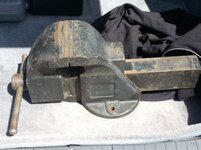
I'm going to send the mastercraft off to recycling, it did serve its purpose, but barely. It hasn't aged well.ottrunner:
Nice find! And welcome to the group after 7 years of no posts. Go ahead and post more pics. We love pics.
Easy question…
Which is a better vise? Hollands or Mastercraft?



note the additional bolt hole at the rear, five bolt holes to secure down, suggests victorian era, pre 1890, more than likely an early parkinson.@ranger08 I noticed while doing some research you had a similar one and a query on what it is in another forum -did you find out any more on this ?
looks like a dead ringer to a Marples, does it weight the same ? and makes sense as I've come across a lot of Marples and assuming NZ would be the same.
1909 catalogue,
Vices – William Marples and Sons, Ltd.
williammarplesandsons.com
just updated it, had not quite got my post right, twas a work in progress, you were just too quicknote the additional bolt hole at the rear, five bolt holes to secure down, suggests victorian era, pre 1890, more than likely an early parkinson.

Let me be the first to award you the coveted GJ “you ****”.I picked up this Starrett 015 with 5” jaws today for $50.

If you have multiple tool boxes as your work surfaces, I assume you have some kind of enclosed area in which to work and store tools. Do you have room to have a work bench at least, let’s say 4 feet wide and 2 feet deep? I built one like that on locking casters.I don't have a vice yet, but really need/want one. The issue is where to mount it.
If Starrett calls it a Utility vise, that’s OK with me. But as we all know, Starrett has some pretty high standards so their “utility” vise is probably more precise than lots of other maker’s alleged “machinist” vises. I bet once fishwatcher gets that one tuned up, it will be a great vise.According to this 1982 catalog, it is a utility vise.
I can make some room. I think a dedicated workbench like you say is the best bet. I'm just need to stop being lazy/cheapskate and just need to do it right.If you have multiple tool boxes as your work surfaces, I assume you have some kind of enclosed area in which to work and store tools. Do you have room to have a work bench at least, let’s say 4 feet wide and 2 feet deep? I built one like that on locking casters.
If you don’t have room for that kind of thing, go ahead and bolt a small lightweight vise to the top of one of your roll around tool boxes. If you don’t want to drill holes in a nice box, you could get a piece of plywood to fit onto the top and then bolt a vise to that. Use carriage bolts with the heads down and recess those a bit into the wood.
Another approach is to make or find somewhere a stand so you can have a free standing vise. Keep your eyes open for a home made one at a low price. Lots of guys start with a steel wheel and weld a heavy pipe with a steel plate on top. With or without some concrete for ballast.
Yours looks like it's between 1897 - 1909
note the additional bolt hole at the rear, five bolt holes to secure down, suggests victorian era, pre 1890
fishwatcher: According to this 1982 catalog, it is a utility vise. Also, you ****!
I just have tool boxes as my work surface for now.
go ahead and bolt a small lightweight vise to the top of one of your roll around tool boxes. If you don’t want to drill holes in a nice box, you could get a piece of plywood to fit onto the top and then bolt a vise to that. Use carriage bolts with the heads down and recess those a bit into the wood.
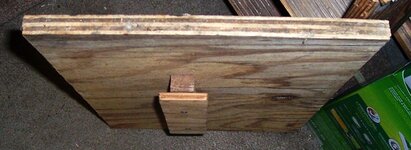
You can also combine the tool box top idea with a mounting plate and get a B&D Workmate for a temporary stand. use an "inverted Tee" on the bottom pf the mounting plate for the WorkMate to grip:Another approach is to make or find somewhere a stand so you can have a free standing vise. Keep your eyes open for a home made one at a low price. Lots of guys start with a steel wheel and weld a heavy pipe with a steel plate on top. With or without some concrete for ballast.

Ditto!Starrett has some pretty high standards so their “utility” vise is probably more precise than lots of other maker’s alleged “machinist” vises. I bet once fishwatcher gets that one tuned up, it will be a great vise.
I think a dedicated workbench like you say is the best bet. I'm just need to stop being lazy/cheapskate and just need to do it right.
I don't have a vice yet, but really need/want one. The issue is where to mount it. I just have tool boxes as my work surface for now. Could you also include alternative mounting places for us without a proper workbench? I know I could "google" it, but I value your opinions/thoughts more.

Thank you @Shiftless! You’re an invaluable resource for me on vise pursuits.Let me be the first to award you the coveted GJ “you ****”.
A 5 inch Starrett in decent condition for anything near that price is a steal. AFAIK, the red color i see is original paint. I would not consider that vise to be “utility grade” at all.
I agree that a Black and Decker Workmate is a great way to get started with both a small, portable work bench and a vise platform. You can find them used easily for $50 on Craigslist or Facebook marketplace without looking too hard.You can also combine the tool box top idea with a mounting plate and get a B&D Workmate for a temporary stand. use an "inverted Tee" on the bottom pf the mounting plate for the WorkMate to grip:
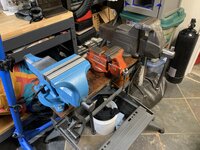
You could make a stand:I don't have a vice yet, but really need/want one. The issue is where to mount it. I just have tool boxes as my work surface for now. Could you also include alternative mounting places for us without a proper workbench? I know I could "google" it, but I value your opinions/thoughts more.

Anyone recognize a possible manufacturer for this combination bench and pipe vise? Advertised in an estate sale listing as "super heavy duty" but with no visible brand markings. The styling is so angular and squared off that I'm thinking maybe a cheap Asian import. Except that it has inverse tee-style jaw inserts fitted (would that be called a u-jaw insert then?) which would normally be associated with something a bit more high-end. Would it be worth checking out?
Thanks, Tom
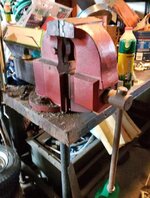


This vice may not look like much, but it was my dad's, and it carries a lifetime of memories. I used it for everything; from building model rockets as a kid to crafting PTFE AN fittings as an adult.
It's mine now, and every time I use it, I feel a connection to the past and the work that shaped who I am.
Yeah, for sure. Those old tools stick with you. Cool that your daughter's using the anvil, feels like a full-circle kind of thing.Something like that is a definite keeper.
I have my dads small pipe vise, I busted his swivel jaw vise in HS, and I passed on his 1 lb anvil to my jewelry making daughter. I wish I'd kept the busted vise as decades later I know how to repair ****. long gone...
Nice, I'm going to go that route for sure.I think a home made workbench is almost always more sturdy and less expensive than anything you can buy. Unless you want to show the world your fine woodworking skills with fancy joinery etc., just use 4x4s and 2x4s with deck screws and bolts to fabricate a custom bench to fit into your available space with a height you can most easily be comfortable using. 36 niches is the norm, but if your are shorter or taller than average, just build it to suit. One of my benches is 24 inches deep and the other is 30 inches deep. Build it to fit your space and what you anticipate doing there. For a top, use Masonite or snap together strip flooring or ???
If you’re gonna weld there, use steel.
There are threads on GJ about workbenches.


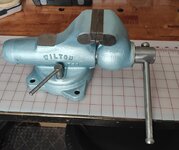


Yes, IIRC, they are flatThat type of pipe jaw can be made - generally needs a mill to do it right.


