To avoid these ads, REGISTER NOW!

Crazy HVAC compressor question

theoldwizard1

Well-known member
Joined
Feb 22, 2011
Messages
43,319
Location
SE MI
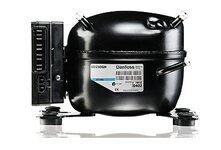
Many people have never heard of DC power refrigerant compressors, but they have existed for a long time. Most run on (nominal) 12VDC or 24VDC.

Technically, the motor does not run DIRECTLY on DC current. There is an inverter box bolted to the side that converts the DC to 3 phase AC (Not sure what voltage. The inverter could also do variable frequency/speed.) OR BLDC motor.

There are only a few companies that make these "DC" compressors (Danfoss, Secop) as there is low demand for them. Does any one know of one of these types of refrigerant compressors that run on (nominal) 48VDC ?
 
Last edited:
To avoid these ads, REGISTER NOW!

bonneyman

Well-known member
Joined
Apr 22, 2010
Messages
8,857
Location
Desert SW
Don't know anything about 48VDC comps.

The only 12VDC compressors I've heard about are for RV refrigerators. Though I think the real old ammonia systems that run off of propane are simpler and work better.

I once looked into a 12VDC inverter to run 110VAC power tools out of my truck. Saw it at a trade show, and it was impressive. Don't know if the vehicle had a second battery to run that. But I hesitated so long that the new Li-ION battery tools came out and that would have been the way I went.
Long story short I'm sure someone would make an inverter with those specs if the demand was high enough.
 

fitter30

Well-known member
Joined
Jun 23, 2019
Messages
2,994
Location
Peace Valley,mo
Can see using a one for a little fridge not for comfort cooling.
48 vdc is used for solar
12vdc 1000watts= 83.3 amps
 
Last edited:

dscheidt

Well-known member
Joined
Apr 26, 2017
Messages
2,909
They exist for the off-grid solar market.
Instead of converting from battery voltage to 120VAC to run a compressor, run it directly. No inverter losses, and slightly higher running efficiency, as everything other than the compressor and blower in a normal AC run on DC already. Downside is you have to run more wire, which can be spendy.

I haven't been keeping up to date with the field, but it's a growing market, so they should be available.
 

jlv03

Well-known member
Joined
Jan 19, 2020
Messages
349
Location
SE IA
There are hybrid mini-splits available on the market that run off both AC and solar panels. I would guess that if you didn't have solar panels you could just use the 48VDC directly on the solar input.

Example (no experience):


Edit: Just looked at the spec sheet, the solar input needs at least 90VDC.
 

Bert_

Well-known member
Joined
Dec 24, 2016
Messages
9,778
Location
NW Iowa
Don't know anything about 48VDC comps.

The only 12VDC compressors I've heard about are for RV refrigerators. Though I think the real old ammonia systems that run off of propane are simpler and work better.

I once looked into a 12VDC inverter to run 110VAC power tools out of my truck. Saw it at a trade show, and it was impressive. Don't know if the vehicle had a second battery to run that. But I hesitated so long that the new Li-ION battery tools came out and that would have been the way I went.
Long story short I'm sure someone would make an inverter with those specs if the demand was high enough.
I put a 1500w inverter in two service trucks. I keep battery chargers plugged in. Once in a while I still take the chargers out at a job but never at the shop anymore. Runs a microwave most days and I recently ran my big rotohammer. To start the rotohammer I had to pull the trigger slowly.
 

Bert_

Well-known member
Joined
Dec 24, 2016
Messages
9,778
Location
NW Iowa
I have heard of people making a homebrew 12v DC compressor fridge. Wire the 120v compressor directly to the inverter and use the thermostat switch the inverter on and off.
 

bonneyman

Well-known member
Joined
Apr 22, 2010
Messages
8,857
Location
Desert SW
Simpler, yes. Work better, NO !! You are not going to make ice or keep ice cream solid when the ambient temp is 90F !
Hmm. I worked on several old Arkla-Servall ammonia home A/C's that ran off of natural gas and they were simple and worked well in the Arizona heat. I guess high-temp A/C was doable but lo-temp freezing was not.
 
OP
T

theoldwizard1

Well-known member
Joined
Feb 22, 2011
Messages
43,319
Location
SE MI
They exist for the off-grid solar market.
Instead of converting from battery voltage to 120VAC to run a compressor, run it directly. No inverter losses, and slightly higher running efficiency,
You hit the nail on the head ! About a 10% loss in converting DC to AC. Big gain in 3 phase or BLDC motor over standard 60Hz AC !

If you invert 48VDC WITHOUT increasing the voltage (i.e. no transformer, 100% transistor), you get about 30 VAC. Believe it or not, the cost of 3 phase inverter over 1 phase inverter without the transformer is next to nothing !
 
To avoid these ads, REGISTER NOW!
OP
T

theoldwizard1

Well-known member
Joined
Feb 22, 2011
Messages
43,319
Location
SE MI
I have heard of people making a homebrew 12v DC compressor fridge. Wire the 120v compressor directly to the inverter and use the thermostat switch the inverter on and off.
The square box on the side IS an inverter ! Not sure if the motor is 3 phase or brushless DC.

Untitled.jpg
 

bonneyman

Well-known member
Joined
Apr 22, 2010
Messages
8,857
Location
Desert SW
You hit the nail on the head ! About a 10% loss in converting DC to AC. Big gain in 3 phase or BLDC motor over standard 60Hz AC !

If you invert 48VDC WITHOUT increasing the voltage (i.e. no transformer, 100% transistor), you get about 30 VAC. Believe it or not, the cost of 3 phase inverter over 1 phase inverter without the transformer is next to nothing !
Geez, I knew there were power losses but 10% is significant.
 

TRWham

Well-known member
Joined
Aug 11, 2017
Messages
1,977
Location
East Cobb County, Georgia
Hmm. I worked on several old Arkla-Servall ammonia home A/C's that ran off of natural gas and they were simple and worked well in the Arizona heat. I guess high-temp A/C was doable but lo-temp freezing was not.
Well, those were absorption systems rather than vapor compression, so they just need a heat source and there is no compressor. Ammonia does exceptionally well at low temp in vapor compression systems.
 

pembol

Well-known member
Joined
Feb 13, 2014
Messages
276
The square box on the side IS an inverter ! Not sure if the motor is 3 phase or brushless DC.

Untitled.jpg
Brushless DC and 3 Phase are generally the same. There are several topologies for Brushless DC, but delta and wye (like a 3 phase motor) are the most common. The only difference is the Brushless DC has hall sensors to trigger the energization of each winding at just the right time, whereas 3 phase they just trigger when they trigger and you hope the rotor can keep up.
 

bonneyman

Well-known member
Joined
Apr 22, 2010
Messages
8,857
Location
Desert SW
Well, those were absorption systems rather than vapor compression, so they just need a heat source and there is no compressor. Ammonia does exceptionally well at low temp in vapor compression systems.
10-4, the ones I worked on had little natural gas "boilers" to provide the heat to make the system work. I never had to do any R&R on them just periodic maintenance, so I never got into the fine workings. But as I recall they cooled the homes well. Lack of repair parts finally killed them locally.
 
OP
T

theoldwizard1

Well-known member
Joined
Feb 22, 2011
Messages
43,319
Location
SE MI
Brushless DC and 3 Phase are generally the same.
Please explain that statement !

I am no expert on motor design, but I would not even call them "similar". Brushless DC motors utilized (rare earth) magnets, mounted to the rotor (typically outside the stator/coils). The coils are "pulsed" so as to push/pull the magnets away. They are very powerful for their size, but also spin at very high RPM frequently require one or more sets of gear reduction (and loosing some of that power to friction in the gears). The number of coils and magnets varies quite a bit depending on size and torque requirements.

A 3 phase motor has three sets of windings in the stator. Basically, it is 3 AC motors on one shaft. The big advantage is that the PHASES overlap each other almost completely eliminating any "coast down". (A single phase AC motor goes through "ramping up" and then "coasting down".)
 

pembol

Well-known member
Joined
Feb 13, 2014
Messages
276
Please explain that statement !

I am no expert on motor design, but I would not even call them "similar". Brushless DC motors utilized (rare earth) magnets, mounted to the rotor (typically outside the stator/coils). The coils are "pulsed" so as to push/pull the magnets away. They are very powerful for their size, but also spin at very high RPM frequently require one or more sets of gear reduction (and loosing some of that power to friction in the gears). The number of coils and magnets varies quite a bit depending on size and torque requirements.

A 3 phase motor has three sets of windings in the stator. Basically, it is 3 AC motors on one shaft. The big advantage is that the PHASES overlap each other almost completely eliminating any "coast down". (A single phase AC motor goes through "ramping up" and then "coasting down".)

There is not too much to explain. A brushless DC motor also has three sets of windings in the stator, and a rotor with permanent magnets - the only difference in the construction of the motor is that a BLDC motor typically (but not always) has a feed back mechanism for the rotor position, normally Hall sensors. A BLDC motor without feedback can be identical to a 3 phase motor. The rotor on either type of motor can be an 'in runner' where it is surrounded by the stator or an 'out runner' where the rotor surrounds the stator. BLDC motors can spin at any speed -and the speed is regulated by the controller, which is one of their advantages. Some 3 phase ac motors are induction motors and don't have permanent magnets on the rotor, but this is not a requirement and these are cheaper/less efficient.

In other words, a brushless DC motor is just an electronically commutated 3 phase motor.
 
Last edited:

dscheidt

Well-known member
Joined
Apr 26, 2017
Messages
2,909
Some 3 phase ac motors are induction motors and don't have permanent magnets on the rotor, but this is not a requirement and these are cheaper/less efficient.

In other words, a brushless DC motor is just an electronically commutated 3 phase motor.

Three phase induction motors are by a large margin the only 3 phase AC motor most people have any familiarity with. They're ubiquitous in industry, and for most of the history of electric motors, the only sort anyone could afford. That's of course changed, and I have household appliances with 3 phase motors driven by VFD (and single phase input, of couse, too...). But I don't think of them when I think 3phase motors, and if you'd asked me yesterday if I had any three phase stuff, I'd probably said no, even though I knew about my sewing machine.
 

86turbodsl

Well-known member
Joined
Jul 1, 2005
Messages
6,558
Location
Michigan
There may be something available in the 48V hybrid vehicle market. My daughter works for one of the largest Auto AC compressor manufacturers and they are making hermetic DC compressors for something out there.
 
To avoid these ads, REGISTER NOW!
Top Bottom