To avoid these ads, REGISTER NOW!

lift hydraulic line leak

jpcjguy

Well-known member
Joined
Jan 6, 2014
Messages
1,480
Location
Richmond, VA
Hey all,

So I have an Atlas 10k lift that I bought used about a year ago and installed in my garage - works fine but I noticed small leak at the "T" connector on the top bar. I folded a blue shop towel to put underneath to monitor and when I periodically checked, it was soaked - hmmmm....
So I cleaned it up and put another shop towel up there and ran the lift up and down empty and the towel was fine - took another towel and rubbed the fitting and got a tiny bit of spotting. Ok - so very slow leak? but this lift goes up and down maybe once a month if that right now (busy with other things).
This was a while back so about a month or two ago I took it all apart, cleaned the fittings with brake clean and also applied Loctite 545 on the threads. Put another shop towel underneath and thought I would be good. (let it sit for a week before using - was out of town).
Have used the lift a couple of times since and decided to go check - damn towel was soaked through again! WTF??!?
So I cleaned it up and had my son run it up and down empty while I watched it (benefit of a Jeep with full cage on 40s so I can stand on the cage and top bar is chest height!)
Turns out leaking at the swivel - not the threads!
But it is literally tiny spotting if that on 2 up and downs.
So how do I fix this? or just replace the stupid towel periodically?
Attached are pics of the spot, soaked towel and where it is leaking - and my setup
.
To be fair - I *might* have cranked on the fitting to "stop the leak" at one point - so maybe this is on me?

Here is my lift: https://atlasautoequipment.ca/atlas...c-adjustable-height-2-post-overhead-car-lift/
but mine is older - gray/red combo from 2019
new lines are $150-$165 each (or should I have them made locally?) - no experience with hydraulic lines!

Thoughts?
 

Attachments

  • hydraulic connector - circled.jpg
    hydraulic connector - circled.jpg
    233.6 KB · Views: 68
  • spotting.jpg
    spotting.jpg
    197.8 KB · Views: 67
  • soaked towel.jpg
    soaked towel.jpg
    193.3 KB · Views: 41
  • lift - jeep.jpg
    lift - jeep.jpg
    376.8 KB · Views: 66
Last edited:
To avoid these ads, REGISTER NOW!

PCustoms

Well-known member
Joined
Jul 23, 2011
Messages
23,457
Location
VT
This was a while back so about a month or two ago I took it all apart, cleaned the fittings with brake clean and also applied Loctite 545 on the threads.

That's a flare fitting, it seals on the face of the tee.

You would have to clean it up and inspect for damage on the tee or inside the swivel. If that's the "leak" I'd consider leaving it
 

garfunkle24

Well-known member
Joined
Mar 18, 2008
Messages
3,429
Location
Saskatoon, Canada
That's a flare fitting, it seals on the face of the tee.

You would have to clean it up and inspect for damage on the tee or inside the swivel. If that's the "leak" I'd consider leaving it

How can you tell that's a JIC or other flare fitting and not a female NPT swivel? Not enough thread taper?


I mean it probably is, just curious.

If a flare, probably a scratched or cracked flare seat.
 
Last edited:

PCustoms

Well-known member
Joined
Jul 23, 2011
Messages
23,457
Location
VT
How can you tell that's a JIC or other flare fitting and not a female NPT swivel? Not enough thread taper?


I mean it probably is, just curious.

If a flare, probably a scratched or cracked flare seat.

Guess I assumed, as I've never seen an NPT swivel on hydraulic line. Looking now I don't see any taper.

I guess if OP takes it apart and it's not a flare then the hose is probably shot
 

garfunkle24

Well-known member
Joined
Mar 18, 2008
Messages
3,429
Location
Saskatoon, Canada
Agreed. I see quite a few NPT swivels. Just used one on a pressure transducer that was made in Switzerland but is NPT for some unknown reason.
 

charbar

Well-known member
Joined
Feb 6, 2021
Messages
2,001
Location
Midwest
That's a flare fitting, it seals on the face of the tee.

You would have to clean it up and inspect for damage on the tee or inside the swivel. If that's the "leak" I'd consider leaving it


^^^^This


I'd take a good look though.....if the T or the flare of the hose has a crack I'd replace it personally. If it's just a nick it's your call then.


If I had to make a bet I'd say there is probably a crack in the flare of the hose assuming the red circle is where it's leaking.
 

andyvh1959

Well-known member
Joined
Feb 15, 2020
Messages
2,598
Location
Green Bay WI
The connection is most likely JIC 37 flare. If the flare seal in the hose end is cracked, it can hold pressure, but fluid can seep out of the flare seal area and show at the back of the swivel nut. If the flare size is -6, it was probably WAY over-tighened at some time, so now the flare is shot. A -6 JIC torque is only 20 ft-lb at most. Or, using "flats" from first wrench resistance, is only 2-flats. Way too often a JIC is over tightened to the point of cracking the flare seat or cone. May need to replace the leaking hose ends with new quality assemblies. May also need to replace the flare tees.
 

CraigStu

Well-known member
Joined
May 22, 2014
Messages
4,056
Location
Blacksburg, Va
Is there any slack in the hoses? You could have new ends put on them locally but would probably lose and inch or so length.
 

andyvh1959

Well-known member
Joined
Feb 15, 2020
Messages
2,598
Location
Green Bay WI
Is there any slack in the hoses? You could have new ends put on them locally but would probably lose and inch or so length.
You'll loose at least 3" to 6" of length for a hydraulic hose shop to cut off an end and crimp on a new end. That is IF the shop will even consider the liability of modifying a hose assembly. After 30 years in the hydraulic hose market, I've always said hyd hoses are easy to make up and easy to screw up. Then it also depends if the hose shop carries the same brand hose end for the hose. If the hoses are Chinese sourced, good luck, then you are into new hoses.

Many Tractor Supply, Fleet Farm, Farm & Fleet stores stock premade hose assemblies. A 3/8" -6 x 24" hose assembly at Tractor Supply is only $18. I can't vouch for their quality, but for a simple car lift system they'll do the job as there is no impact/duty cycle load factor to consider. You'll pay at least that much per hose end to get your hoses modified.

Next option; you could do it yourself with reusable hose ends. Get the reusable hose end to match the hose manufacturer. Cut the faulty hose end off within 1/2" of the end of the shell crimp (many hose end internal stub projects past the end of the crimp). Best to use a cutoff wheel, a hacksaw can get the wires really messed up, but if you have to use a hacksaw, get a fine tooth metal blade for it. Clean the cut hose out before applying the new end. Then you turn the new shell onto the hose CCW. When it bottoms out, turn it back 1/4 turn. Put the shell on the hose in a vise. Lube the mandrel liberally. Then turn the mandrel into the hose shell till it bottoms out. Even a -6 hose end takes some good force to get it done. Once you start turning the mandrel into the shell do not stop until it bottoms out. If you stop half way you may not get it going again. Clean the hose out again and youre good to go.

However you replace the faulty connection, do not over tighten it again. Flare JIC is easily over torqued in the smaller sizes and once over torqued you'll have another seeper/weeper on your hands. -4 is only 13 ftlb, -6 is only 18 ftlb, even a -8 is only 22 ftlb. Parker products also give you the option of using "flats" for positional tightening:


CraigStu

Well-known member
Joined
May 22, 2014
Messages
4,056
Location
Blacksburg, Va
You'll loose at least 3" to 6" of length for a hydraulic hose shop to cut off an end and crimp on a new end. That is IF the shop will even consider the liability of modifying a hose assembly. After 30 years in the hydraulic hose market, I've always said hyd hoses are easy to make up and easy to screw up. Then it also depends if the hose shop carries the same brand hose end for the hose. If the hoses are Chinese sourced, good luck, then you are into new hoses.

Many Tractor Supply, Fleet Farm, Farm & Fleet stores stock premade hose assemblies. A 3/8" -6 x 24" hose assembly at Tractor Supply is only $18. I can't vouch for their quality, but for a simple car lift system they'll do the job as there is no impact/duty cycle load factor to consider. You'll pay at least that much per hose end to get your hoses modified.

Next option; you could do it yourself with reusable hose ends. Get the reusable hose end to match the hose manufacturer. Cut the faulty hose end off within 1/2" of the end of the shell crimp (many hose end internal stub projects past the end of the crimp). Best to use a cutoff wheel, a hacksaw can get the wires really messed up, but if you have to use a hacksaw, get a fine tooth metal blade for it. Clean the cut hose out before applying the new end. Then you turn the new shell onto the hose CCW. When it bottoms out, turn it back 1/4 turn. Put the shell on the hose in a vise. Lube the mandrel liberally. Then turn the mandrel into the hose shell till it bottoms out. Even a -6 hose end takes some good force to get it done. Once you start turning the mandrel into the shell do not stop until it bottoms out. If you stop half way you may not get it going again. Clean the hose out again and youre good to go.

However you replace the faulty connection, do not over tighten it again. Flare JIC is easily over torqued in the smaller sizes and once over torqued you'll have another seeper/weeper on your hands. -4 is only 13 ftlb, -6 is only 18 ftlb, even a -8 is only 22 ftlb. Parker products also give you the option of using "flats" for positional tightening:

Thanks for straightening me out. A ton of great info in your post.
 
To avoid these ads, REGISTER NOW!

ericm

Well-known member
Joined
Apr 17, 2016
Messages
1,963
Location
Southern Oregon
I agree those look like JIC. Don't use tape or dope on JIC threads. Unlike NPT the threads don't seal, the taper does.
Surplus Center and DiscountHydraulicHose both carry reasonably priced hoses. One of them does custom lengths, I can't remember which. Getting hoses made usually costs significantly more, at least in my area.
 

PCustoms

Well-known member
Joined
Jul 23, 2011
Messages
23,457
Location
VT
I agree those look like JIC. Don't use tape or dope on JIC threads. Unlike NPT the threads don't seal, the taper does.
Surplus Center and DiscountHydraulicHose both carry reasonably priced hoses. One of them does custom lengths, I can't remember which. Getting hoses made usually costs significantly more, at least in my area.

I believe discount has the custom lengths. Whichever one I bought from a few years ago let's you pick hose, length, and each fitting. Great of you have a general idea what you want
 

nadogail

Well-known member
Joined
Jan 23, 2009
Messages
32,049
Location
Coronado, CA
I have been told by a person whom I respect for their knowledge and experience, that the only hydraulic systems that don’t leak are those that have run out of fluid.
Minor leaks are an expected condition of every system I have encountered.
 

PCustoms

Well-known member
Joined
Jul 23, 2011
Messages
23,457
Location
VT
I have been told by a person whom I respect for their knowledge and experience, that the only hydraulic systems that don’t leak are those that have run out of fluid.
Minor leaks are an expected condition of every system I have encountered.
Minor leaks at high pressure can cause serious injury.

They should not be an expected condition
 
OP
J

jpcjguy

Well-known member
Joined
Jan 6, 2014
Messages
1,480
Location
Richmond, VA
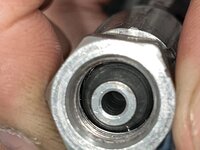
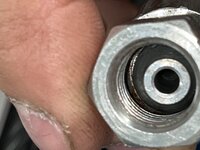
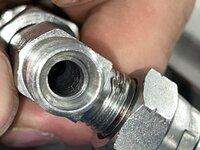
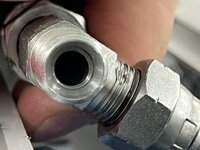
Hi all - sorry for delay in reporting back as I was out of town. Got up there tonight and took it apart and snapped some pics - no obvious cracks. What do you all think?
 

Attachments

  • connector_right.jpg
    connector_right.jpg
    290.2 KB · Views: 19
  • connector_top.jpg
    connector_top.jpg
    214.8 KB · Views: 18
  • connector_left.jpg
    connector_left.jpg
    227.3 KB · Views: 17
  • connector_bottom.jpg
    connector_bottom.jpg
    245 KB · Views: 17

andyvh1959

Well-known member
Joined
Feb 15, 2020
Messages
2,598
Location
Green Bay WI
I have been told by a person whom I respect for their knowledge and experience, that the only hydraulic systems that don’t leak are those that have run out of fluid. Minor leaks are an expected condition of every system I have encountered.
Can only agree with this as most leaks are the cause of improper assembly and tightening. My 30 years in the hydraulic hose market, working on everything from mini-skid steers to large combines and heavy trucks, if I had leaks as often as you suggest, I'd have lost a LOT of customers. I've done hundreds of hours of hydraulic assembly training, and nearly all issues are assembler faults. Not blaming, just the facts. Many assemblers think they just have to crank them together, more crank the better, not always so. Most often the smaller sizes (-4, -6, -8) are often over-torqued. The larger sizes (-10 up to -24) are most often under-torqued.

Also, all hose and tube end connections onto fittings require two wrenches; one to hold the hose end from turning and one to turn/tighten the swivel nut. If you don't do this, insufficient tightening is applied to the connection and it can also preload/twist the hose. Without the right tightening effort onto the swivel nut, they can loosen and leak.

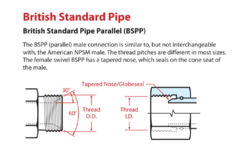
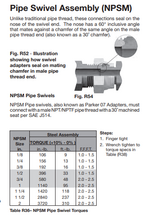
All that said, those connections you show are most likely National Pipe Swivel or possibly BSPP swivel. The seal is metal to metal made in the cone/seat and not in the threads. The cone/seat is thicker and more resistant to over-torque/cracking. Check for debris in the cone/seat or scratches in the cone/seat. You can assemble it dry or lubed, no thread sealant or dope is used. If everything checks out, then apply the right tightening. Assemble it hand tight until you feel definite metal to metal seal contact, then one wrench to support the hose end (near the shell crimp) and another wrench to turn the swivel nut. For -6 0r -8 pipe swivel connections its usually 1-1/2 hex flats to tight.
1746070546009.png
 
Last edited:

firebirdparts

Well-known member
Joined
Jun 8, 2016
Messages
10,670
Location
Kingsport, TN
Those fittings don't look that awesome.. There's been a little abuse.

Ultimately it doesn't matter that you keep that original, but normally you expect fittings like that to be superior. Maybe in my experience there are some rounds of "tighten it more" before you give up.
 

PCustoms

Well-known member
Joined
Jul 23, 2011
Messages
23,457
Location
VT
Those fittings don't look that awesome.. There's been a little abuse.

Ultimately it doesn't matter that you keep that original, but normally you expect fittings like that to be superior. Maybe in my experience there are some rounds of "tighten it more" before you give up.
Tighten it more is how you make a fitting look like that
 

andyvh1959

Well-known member
Joined
Feb 15, 2020
Messages
2,598
Location
Green Bay WI
That type of hose end connection with the cone inside the swivel nut is much more sturdy than a JIC Flare hose end. That type of connection is fairly close to the DIN style metric connection which is very durable and the least susceptible to over-tightening damage and leaks. The BSPP swivel nut design does not deform open when over-tightened like a JIC Flare swivel nut. As the BSPP swivel nut internal cone is tightened into the female seat, expansion of the seat/cone diameter as the two parts seal actually pushes the threads into tighter engagement rather than just stretch the swivel nut open like JIC Flare.

You can attempt a remake of the current connection to see if it gets tight enough to seal, this way:
1. make sure the seat and cone are both clean, no debris, no damage (scrathes, gouges, dents) and that the connection faces look to be round and not distorted.
2. align the connection fully so you feel the seat/cone meet up, and then turn the swivel nut by hand or light wrench effort just until you feel the first real resistance.
3. with a Sharpie, draw a line across one flat of the swivel nut hex and onto the body of the joining fitting.
4. with two wrenches, one on the hose end fixed hex and one on the swivel nut hex, hold the hose end from turning and wrench the swivel nut until that Sharpie mark has rotated around 1-1/2 to 2 flats offset. If you only use one wrench you are not applying total tightening effort into the swivel nut connection. If you prefer to use a torque wrench then the two wrench technique applies even more.

Torque wrenches can only respond to resistance. If you only use the torque wrench and no wrench to hold the fixed hex on the hose end the torque wrench will likely "click out" before the effective holding force is applied to the connection swivel nut.

That's it. If the seat and cone were in good shape you should have acheived an effective holding seal. If it still leaks/seeps/wets, then there is some seal surface damage. A connection that simply wets may hold pressure with no issue as long as power is applied until the lift travels onto the support stops. Note on that chart attached earlier the effective torque applied on a -6 connection at 1-1/2 flats is 16 ft-lbs, on a -8 connection 1-1/2 flats is 33 ft-lbs. If your connection easily goes to two flats or more, than the hose end and the fitting have been WAY over torqued and no amount of tightening will ever keep them from seeping/wetting. At that point it time for new parts.
 
OP
J

jpcjguy

Well-known member
Joined
Jan 6, 2014
Messages
1,480
Location
Richmond, VA
I took it all apart and cleaned it and flipped the "Tee" and put it back together being careful not to overtighten. I went up and down with my CJ7 on the lift twice and so far so good - I guess time will tell.
Worst case I will just just put a small piece of oil absorbent pad up there and replace it periodically if it is just a few drops per up and down....
 
To avoid these ads, REGISTER NOW!
Top Bottom