To avoid these ads, REGISTER NOW!

Wrought Iron Fence And Gate

dsan

Well-known member
Joined
Feb 15, 2010
Messages
111
Hey GJ family,

Planning on replacing 50' long redwood fence with a 8' tall same length wrought iron fence. Fairly simple design to teach myself some basic welding skills and my Jack Russell terrier from wreaking havoc on the squirrel and cat population. My question to the GJ experts is what kind of welder should I get. Home Depot has a Lincoln lineup of mig welders. Would this work for fences and gates? The one I was looking at is this one:

http://www.homedepot.com/webapp/wcs...4-_-100596739-_-N&locStoreNum=603&marketID=48

Any input would be appreciated. I will also use this to add reinforcement to my harbor freight trailer and other home hobby stuff. I will also consult my brother that knows how to weld for welding advice.
 
To avoid these ads, REGISTER NOW!

gtivr4

Well-known member
Joined
Nov 5, 2008
Messages
455
Location
Vermont
What material are you making it out of? Pretty much any mig welder will do the trick for medium sized stuff. It gets a little harder to control as you get small (under 16ga).
 
OP
D

dsan

Well-known member
Joined
Feb 15, 2010
Messages
111
What material are you making it out of? Pretty much any mig welder will do the trick for medium sized stuff. It gets a little harder to control as you get small (under 16ga).

Wrought Iron.
 

danski0224

Well-known member
Joined
Jan 29, 2005
Messages
13,523
Location
Near Naperville, IL
You will be pushing the limits of the 110v model, but it will do the trick if it is on a 20A circuit and no extension cord.

I would get the 220v model.

You will want to use flux core wire if any welding is happening outside.
 
OP
D

dsan

Well-known member
Joined
Feb 15, 2010
Messages
111
You will be pushing the limits of the 110v model, but it will do the trick if it is on a 20A circuit and no extension cord.

I would get the 220v model.

You will want to use flux core wire if any welding is happening outside.

My Dad has a 220 volt plug at his house. I could make the sections and bring them to my home for install. Any more input is appreciated. Thanks for the replies
 

Heavy Metal Doctor

Well-known member
Joined
May 26, 2010
Messages
5,417
Location
Mason Dixon Line
Form the little bit that I've learned, wrought Iron fince is really just mild steel with any number of variations on the channel, bar-stock, tubing, and ornametal accessories.
Welds are usually just heavy tacks - to short beads - places where the upright bars meet the channels at top and bottom - that sort of thing. I would bet you can get away with something as small as the biggest 110V machine you can get -- duty cycle will be low - but that's okay for this type of work.
 

danski0224

Well-known member
Joined
Jan 29, 2005
Messages
13,523
Location
Near Naperville, IL
The 220V model is much less portable... unless you pigtail off a breaker panel (using the correct breaker, of course).

Portability will be an issue unless you design your fence sections so they can be installed without welding onsite.

The bigger 110V models will do the trick, but you need a 10ga extension cord that is as short as possible, or you need a nice 5kw generator. Performance of the 110v models drops quickly on a 12ga or smaller extension cord.

Forget about trying to use shielding gas on wrought iron either outdoors or on a 110v machine.

Flux core is a must. It is a bit messier than welding with shielding gas.

An added benefit is that flux core is hotter than welding with shielding gas (reverse polarity). That little bit extra helps with the smaller machine.

The 220v machine will do a little more for you.

The 110v machine will be good enough to get the job done. You can take it more places easily.

If your setup is good and you can weld big chunks at a time, duty cycle will shut down the machine. Not much you can do about it. Little welds here and there probably won't matter a whole lot.

If you have a Lincoln dealer nearby, go and try one out.
 
OP
D

dsan

Well-known member
Joined
Feb 15, 2010
Messages
111
Form the little bit that I've learned, wrought Iron fince is really just mild steel with any number of variations on the channel, bar-stock, tubing, and ornametal accessories.
Welds are usually just heavy tacks - to short beads - places where the upright bars meet the channels at top and bottom - that sort of thing. I would bet you can get away with something as small as the biggest 110V machine you can get -- duty cycle will be low - but that's okay for this type of work.

So maybe the first welder in my op? BTW what is duty cycle? I will search and if someone informs me before hand I would appreciate it. For now I got to tend to my disabled brother. Playing nurse and babysitter this afternoon.
 
OP
D

dsan

Well-known member
Joined
Feb 15, 2010
Messages
111
The 220V model is much less portable... unless you pigtail off a breaker panel (using the correct breaker, of course).

Portability will be an issue unless you design your fence sections so they can be installed without welding onsite.

The bigger 110V models will do the trick, but you need a 10ga extension cord that is as short as possible, or you need a nice 5kw generator. Performance of the 110v models drops quickly on a 12ga or smaller extension cord.

Forget about trying to use shielding gas on wrought iron either outdoors or on a 110v machine.

Flux core is a must. It is a bit messier than welding with shielding gas.

An added benefit is that flux core is hotter than welding with shielding gas (reverse polarity). That little bit extra helps with the smaller machine.

The 220v machine will do a little more for you.

The 110v machine will be good enough to get the job done. You can take it more places easily.

If your setup is good and you can weld big chunks at a time, duty cycle will shut down the machine. Not much you can do about it. Little welds here and there probably won't matter a whole lot.

If you have a Lincoln dealer nearby, go and try one out.

Lots of info. Thanks.
 
Last edited:

danski0224

Well-known member
Joined
Jan 29, 2005
Messages
13,523
Location
Near Naperville, IL
Duty cycle is how long you can continuously use the machine at its rated capacity.

It is measured in 10 minute blocks of time.

60% duty cycle means 6 minutes on and 4 minutes off.

Six minutes of arc time at one time for what you want to do is a lot.

Now, 20% or 40% duty cycle is another matter.


Edit: Note that the 140A MIG machines in Red or Blue have a 20% duty cycle. Probably not going to get any better in this class of machine.
 
Last edited:

GarageEnvy

Well-known member
Joined
Nov 17, 2009
Messages
1,282
Location
Fresno
As others have commented I think it's less of a power problem than a duty cycle problem. I have a 110 volt Hobart 135 welder that I use for ornamental iron fencing. Presumably you aren't really using solid bar stock but rather some thin wall tubing. What happens to me on occassion is that you really get rocking with little 1" welds and you're basically on the trigger 70%+ of the time. You can get away with that for a very short while but eventually the machine will ask for a breather. I use a jig that allows me to lay in 8' of vertical pieces at a time. Building it assembly line style saves a lot of time if the welder can keep up.
 

Jack Olsen

Super Moderator
Staff member
Joined
Mar 22, 2009
Messages
6,678
Location
Los Angeles
Pretty much no one makes wrought iron out of wrought iron anymore. Mild steel is much more common, although it is not the same as wrought iron. You should shop around for the square tubing. 16 ga is fine for non-structural pieces -- probably heavier for uprights -- but it depends on your design.

King Architectural Metals is a great source for the decorative pieces (finials, caps, etc). The Lincoln link isn't working for me, but a beefy 110v unit will work. I'd get one that does actual MIG with gas -- not just flux core. There'll be less clean up that way. You'll also want to be able to run it as flux core for joining the sections on the location.

A small wrought iron fence was my first welding project. Here's what I learned: if you have a tendency to fudge things or cut corners or get bored, don't do it. It's a LOT of labor, and you have to stay focused and keep doing a very thorough and careful job right up to the end. My little fence has something like 2000 individual welds, and painting a wrought iron fence is very slow and tedious work.

You'll need to learn how to make a good jig. You're going to do a lot of grinding -- partly because you're new to welding; partly because there are going to be a lot of welds and the fence will look lousy if you don't clean them up.

I documented my fence, which might be helpful for you. Here's the link:

http://weldingweb.com/showthread.php?t=33064

And I'll add it one time, just to be clear: you're looking at many, many days of work on this thing. The labor is what you're paying for when you buy a fence, not the steel.

Where are you located?
 
To avoid these ads, REGISTER NOW!

jhn9840

Well-known member
Joined
Mar 11, 2007
Messages
1,189
Location
Northern Panhandle of WV
The duty cycle of a machine is how long it can be run at maximum setting continually in a ten minute period. 20% duty cycle means you can run the machine at maximum setting for two minutes continuous in a ten minute time frame.

jhn9840
John
 
OP
D

dsan

Well-known member
Joined
Feb 15, 2010
Messages
111
As others have commented I think it's less of a power problem than a duty cycle problem. I have a 110 volt Hobart 135 welder that I use for ornamental iron fencing. Presumably you aren't really using solid bar stock but rather some thin wall tubing. What happens to me on occassion is that you really get rocking with little 1" welds and you're basically on the trigger 70%+ of the time. You can get away with that for a very short while but eventually the machine will ask for a breather. I use a jig that allows me to lay in 8' of vertical pieces at a time. Building it assembly line style saves a lot of time if the welder can keep up.

My Dad built a jig for the fencing at my brother's house and some for his house. I will see if the old man is up for some welding. He used an arc welder and a lot of grinding wheels. BTW there is no rush as the Terrier and beagle are "locked up" in a pen and attached workshop.
 

Jack Olsen

Super Moderator
Staff member
Joined
Mar 22, 2009
Messages
6,678
Location
Los Angeles
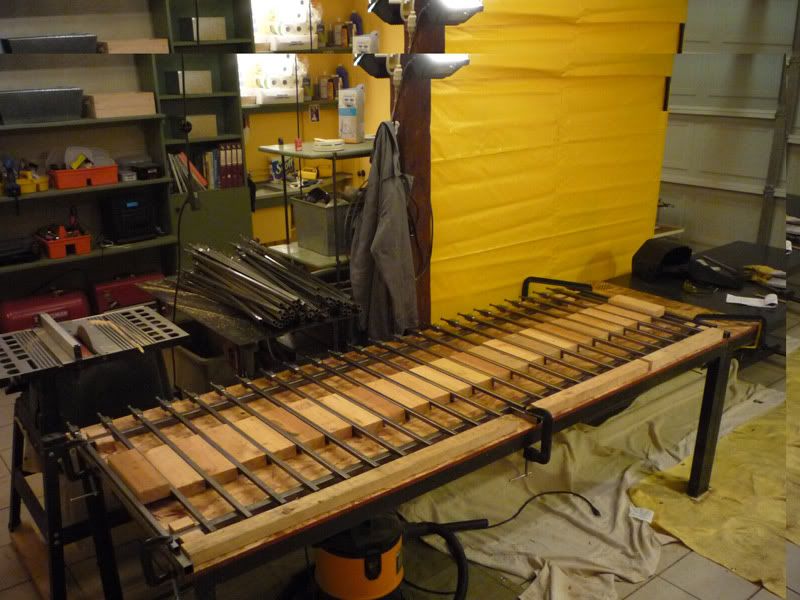
A jig can be pretty simple:

Jig.jpg
 
OP
D

dsan

Well-known member
Joined
Feb 15, 2010
Messages
111
Pretty much no one makes wrought iron out of wrought iron anymore. Mild steel is much more common, although it is not the same as wrought iron. You should shop around for the square tubing. 16 ga is fine for non-structural pieces -- probably heavier for uprights -- but it depends on your design.

King Architectural Metals is a great source for the decorative pieces (finials, caps, etc). The Lincoln link isn't working for me, but a beefy 110v unit will work. I'd get one that does actual MIG with gas -- not just flux core. There'll be less clean up that way. You'll also want to be able to run it as flux core for joining the sections on the location.

A small wrought iron fence was my first welding project. Here's what I learned: if you have a tendency to fudge things or cut corners or get bored, don't do it. It's a LOT of labor, and you have to stay focused and keep doing a very thorough and careful job right up to the end. My little fence has something like 2000 individual welds, and painting a wrought iron fence is very slow and tedious work.

You'll need to learn how to make a good jig. You're going to do a lot of grinding -- partly because you're new to welding; partly because there are going to be a lot of welds and the fence will look lousy if you don't clean them up.

I documented my fence, which might be helpful for you. Here's the link:

http://weldingweb.com/showthread.php?t=33064

And I'll add it one time, just to be clear: you're looking at many, many days of work on this thing. The labor is what you're paying for when you buy a fence, not the steel.

Where are you located?

I appreciate the honesty in your post. I was thinking of starting the back yard fence with a very simple design to keep my dogs in and learn welding at the same time. My Dad used an arc welder and I thought about getting one but it looks like MIG is what a lot of folks are using. BTW I live in El Sereno which is close to Cal State Los Angeles.

p.s. nice jig in your post
 
OP
D

dsan

Well-known member
Joined
Feb 15, 2010
Messages
111
That is amazing Michel. How do you feel the 180 did?
 
OP
D

dsan

Well-known member
Joined
Feb 15, 2010
Messages
111
So any comments on arc welding for fencing, gates little projects around the house?
 

Jack Olsen

Super Moderator
Staff member
Joined
Mar 22, 2009
Messages
6,678
Location
Los Angeles
I have both and I would use MIG for most of the work on a fence. Less clean-up.

But either can work. It really depends on what you're most comfortable with.
 

michel

Well-known member
Joined
Jul 9, 2009
Messages
230
Location
St-Joseph du lac Québec
That is amazing Michel. How do you feel the 180 did?

Thanks, I guess it did allright lol,

I like it, bought it last year and I use it a lot more than I tought so it's not a bad investment.

My son is a welder and of course compared to the equipment he's used to work with, it's a small welder but for what I do with it, it's more that good enough.

Next on the list is a plasma cutter and a TIG.
I want to try TIG.
 

smooth72

Well-known member
Joined
Jul 26, 2005
Messages
354
Location
Newcastle, Oklahoma
Jack pretty well summed it up. I have a Lincoln 180c with gas. Build you a jig it makes thing much easier. King rules. If you want to do it simple you may want to use king pre-punch railing, just slide the square tubing in and weld. I used it on my pool fence. I used a 140 welder on the pool fence, it will do the job, just works harder. As Jack said not much true wrought iron around, now days called decorative metal, I still call it wrought Iron.
Here is some of mine.
http://www.garagejournal.com/forum/showthread.php?t=58140
 
Last edited:
To avoid these ads, REGISTER NOW!
Top Bottom