To avoid these ads, REGISTER NOW!

Senior has Question on mounting screws into cement or or leveling cement

oldpops

Well-known member
Joined
Feb 23, 2018
Messages
303
Location
Southern California
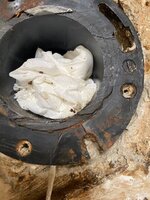
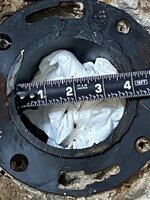
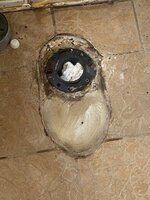
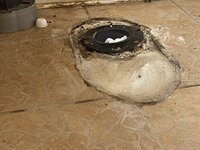
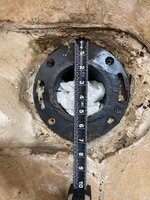
Hello all. I've got a question for folks here who might know: What is the strongest leveling cement, or other compound such as epoxy mortar, that I can drill into to screw in bolts to hold a toilet flange? Had a leaky toilet and finally decided to see what's up. Found the toilet flange cracked. Seems like an easy fix EXCEPT that whoever worked on this before, really did a cluster of a toilet flange install. From what I can tell, they installed an "Outside the pipe" closet flange around the waste/soil pipe coming out of the ground. To do this they gouged out a LOT of the concrete floor that was around the waste pipe - down about an average of 2-1/2 inches. They also cut and/or grinded the top of the soil/waste pipe and this out-the-pipe flange in an attempt to make it level (they didn't succeed). So now I'm trying to fix this once and for all

Also, the guy who installed the ceramic tile, did so AROUND the toilet silhouette, INSTEAD of lifting the toilet, putting the tile down under where the toilet would sit. (Maybe he lifted the toilet and saw the way the toilet flange is and decided he didn't want any part of that mess. So he just put the toilet back down and tiled around it)

Anyway, there are numerous toilet flange repair kits out there but they all require that you mount the flange by screwing down into the concrete slab. Since the guy who install the outside-the-pipe flange gouged out the concrete, I can't find enough of the concrete down (below where mounting screws would go) to grab hold of.

So my choices are: A) I can get some tapcon screws for mounting but I have to either pour in some kind of leveling cement, or epoxy mortar, or maybe something else around the waste soil pipe, that is strong enough to hold the toilet with people on board. Is there such a cement or epoxy mortar or something else strong enough to do this?

or B) Find some kind of extra large toilet flange that extends out far enough where I can be over hard concrete. If so, does anyone have any sources or links?

Please let me know. I will try and attach some pictures of the mess I'm dealing with

Oh, since we want to put in a new toilet, I am probably going to use some kind of leveling cement to bring the level of the floor (inside the old toilet silhouette in the floor tile)
 

Attachments

  • IMG_3402.jpg
    IMG_3402.jpg
    110.9 KB · Views: 50
  • IMG_3403.jpg
    IMG_3403.jpg
    90.4 KB · Views: 43
  • IMG_3406.jpg
    IMG_3406.jpg
    88.6 KB · Views: 38
  • IMG_3408.jpg
    IMG_3408.jpg
    71.2 KB · Views: 40
  • IMG_3410.jpg
    IMG_3410.jpg
    88.1 KB · Views: 46
  • IMG_3411.jpg
    IMG_3411.jpg
    84.6 KB · Views: 45
  • IMG_3417.jpg
    IMG_3417.jpg
    127.6 KB · Views: 41
  • IMG_3420.jpg
    IMG_3420.jpg
    54.8 KB · Views: 47
To avoid these ads, REGISTER NOW!

OccupantRJ

Well-known member
Joined
May 15, 2009
Messages
11,278
Location
Eastern North Carolina
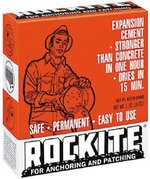
I use this for voids and patches in concrete. There are similar products available.
DeWalt makes a concrete grinding wheel to fit a 4-1/2” grinder for precise forming and blending if needed. Makes a hell of a lot of dust though.
 

Attachments

  • FC4C1E78-EB40-44CF-9B5F-FB34CE3C1569.jpeg
    FC4C1E78-EB40-44CF-9B5F-FB34CE3C1569.jpeg
    89.7 KB · Views: 50
OP
O

oldpops

Well-known member
Joined
Feb 23, 2018
Messages
303
Location
Southern California
I'm looking for something that is STRON when dried - strong enough that I can drill into it and put in a Tapcon screw to hold the toilet. My wife's got a couple of sisters who are "calorically challenged" and if they swivel while on the toilet (to reach for the TP), we're gonna need a concrete or something else that the tapcons can dig in to and hold. Is the 'Rockite' strong enough for this purpose if it's only going to be about an inch thick?
 

Rusted Nut

Well-known member
Joined
Dec 11, 2022
Messages
1,835
Location
Northern Arizona
Leveling compounds are at most 1/2" thick. You need something way thicker to hold a fastener. Can you add some backing under the floor?
 
OP
O

oldpops

Well-known member
Joined
Feb 23, 2018
Messages
303
Location
Southern California
We're in southern California on a concrete slab ,which I think is about 4 inches thick under the bathroom toilet (I might be wrong-anyone know??). Whoever put the 'outside-the-pipe' toilet closet flange on had to dig down to get enough room for the flange collar to fit down around the waste/soil pipe. So when I stick my screwdriver down through the screw holes in the existing flange, the screwdriver goes down about 2-1/2 to 3 inches. If the slab is 4 inches thick, that only leaves about 1 inch of concrete for the tapcon or other type of anchor to bite into. Don't think that's gonna be enough to secure the toilet flange.
 

no704

Well-known member
Joined
Apr 27, 2016
Messages
5,233
What ever you do, also calk around the base of the toilet (except for a couple inches in the back. This will help to prevent twisting and rocking.
 
To avoid these ads, REGISTER NOW!

Fav Onefour

Well-known member
Joined
Jul 14, 2022
Messages
726
Location
MN cold and hot
I'm looking for something that is STRON when dried - strong enough that I can drill into it and put in a Tapcon screw to hold the toilet. My wife's got a couple of sisters who are "calorically challenged" and if they swivel while on the toilet (to reach for the TP), we're gonna need a concrete or something else that the tapcons can dig in to and hold. Is the 'Rockite' strong enough for this purpose if it's only going to be about an inch thick?
I hate to say it but you are taking a somewhat flawed approach.
The two bolts through the flange and into the toilet are usually over tightened. That's why there are so many broken flanges in so many homes. If the toilet is moving, cranking on those bolts won't stop the problem without causing damage down the road.
Think of those bolts as alignment tools with gentle holding power. Toilets should sit level and flat before you tighten those two bolts. If you need shims to stop rocking, do that before cranking on those bolts. With that thought process your flange repair won't become so overwhelming.

Now onto the flange repair. Remove the old flange so you can see what is underneath. There is absolutely no reason to deal with that flange anymore.
Do you have a small hammer drill or SDS hammer? One of those would speed things up. You can clank away with a hammer and narrow concrete chisel and it will get the job done. You don't really need to go crazy, but you need to remove any loose concrete. I like to get the area down to clean concrete. That gives your patch a good bite and helps long term.
Patching material depends on the size of your void around the flange. That's the area you need anchors. (The rest of the toilet outline can be done later with a simple leveling compound.) If your cleanup made a big hole, there are few products better than plain ol cured concrete to use for repair. Use a binding agent before application and let the concrete cure before drilling anchor holes. For smaller areas, the options are all over. I've used variations of stuff like Rockite and they aren't too bad. I do not recommend the fast cure versions. They have been less durable for anchor holes in my experience.

You can level the remaining area while the flange repair cures.
When you set the new flange, get it to the correct height and make sure it is level etc. It's just the basic stuff, but it matters.

After all that, set the toilet and make sure it's not rocking before lightly tightening the two flange bolts. I like to put a good sealer down around the edge before I tighten the bolts. The sealer is around the toilet to keep it from sliding and turning when the challenged sisters do their deed. That sealer is there to hold the toilet in place. I know people add sealer when they see leaks. It's wrong. Using sealer around the edge to stop leaks means you're headed for bigger repairs down the road.
 
OP
O

oldpops

Well-known member
Joined
Feb 23, 2018
Messages
303
Location
Southern California
Thanks everyone! I've seen some flange repair kits so I was hoping to get away with not having to cut off/remove the old flange. But I can see the sense of removing it to get at the concrete below, then pouring some new concrete. I also thought of using hydraulic cement in the void around the waste pipe, but I've seen some articles saying that stuff expands and could actually break the waste/soil pipe pipe when it does.. Or will it expand upwards? Does anyone know??

"Fav OneFour" I think mentions an important point: that the toilet bowl bolts are mostly there to keep the bowl level. I'm guessing that the bolts/screws that hold the flange down to the floor do the bulk of the work of holding the toilet, via the flange bolts, to the ground. So, I'm thinking I will definitely have to get some infill leveling cement after working out

Of course if I was younger, not disabled & could see, and had the tools like a hammer drill, I think the smart thing WOULD be to cut off the existing flange and dig out any loose concrete, then I could fill in the void properly. Of course - I don't know if that cement would be strong enough to hold an anchor. Either way I do this, I think I will use the I like the closet flange floor support shown in the link above.

So, is there anything I can use to fill in the void around the soil/waste pipe, that can be applied (poured or troweled) in there WITHOUT having to cut off the existing flange? And is this material strong enough to do a reasonable job (in strength) to anchor the toilet flange mounting screws?
 
OP
O

oldpops

Well-known member
Joined
Feb 23, 2018
Messages
303
Location
Southern California
Correction: I meant to say that "Fav OneFour" I think mentions an important point: that the toilet bowl bolts are mostly there to keep the bowl aligned - NOT to keep the bowl from wobbling. Also, "Rusted Nut" mentions EPOXYING in the bolts. Would that hold? What kind of EPOXY?
 

pcmeiners

Well-known member
Joined
Aug 13, 2009
Messages
7,964
Location
In the only town in Pennsylvania, Bloomsburg.
I use this for voids and patches in concrete. There are similar products available.
DeWalt makes a concrete grinding wheel to fit a 4-1/2” grinder for precise forming and blending if needed. Makes a hell of a lot of dust though.
Beat me to it......

This is the anchor cement I used to level cement for steel beam placement for multi story building at the basement level. If it can hold up buildings it sure as hell can anchor a toilet. Be ware it sets up fairly fast, it will set rock solid within minutes, so have everything ready to go, the flange and any bolts you want to set in the wet anchor cement.
Place anchor bolts through flange holes, put nuts on the end of the bolts, mix the anchor cement, place the flange in place, push the bolts with the nut into the wet cement, make last minute adjustments, make sure the toilet bolts can move around the flange freely ( no cement blocking that ability), as you may need the toilet bolts to move around, let set for 20 minutes, install the toilet with a wax ring for other type seal.
 
Last edited:

Fav Onefour

Well-known member
Joined
Jul 14, 2022
Messages
726
Location
MN cold and hot
I like the method @pcmeiners described.
I have not tried that trick with setting bolts into wet anchor cement on toilets. It makes sense.

@oldpops , I know it seems intimidating to take off the old flange and clean up the concrete. It will seem more intimidating to deal with a leaking toilet right away. The current flange is far off level. It wouldn't surprise me if it's from someone cranking on the toilet bolts. That flange might not be on there as tight as you think.

Think of the process somewhat like putting bondo on top of bondo on top of rusted out sheet metal. Those repairs are not really fixes.
I'm assuming you want to be done with this toilet issue. Tearing out the flange and cleaning up the concrete is probably going to be less physical work than setting the toilet. I stress the cleaning part so your repair has a nice solid grab. Take your time and it won't be as bad as imagined.
 

75gmck25

Well-known member
Joined
Jul 21, 2014
Messages
1,328
Location
Alexandria, VA
I think your search for an easy solution is making the job harder.

My suggestion:
- use a Dremel or a blade/cutter on the end of your drill to cut the existing pipe from the inside and remove the old flange
- determine the size of the pipe in the floor, and find a PVC pipe that sits in it or around it firmly, and then tape the junction with masking tape to keep out concrete. Have that pipe stick up from the floor at least 6"

- dig out the old cement down to a firm base and clean off the cement. Treat it with one of the bonding products that are sold for adding new cement over existing cement
- mix up and add hydraulic cement in the area around the flange and make it level with the tile (the toilet flange should sit on top of finished floor tile or the new cement, not in an inset area)

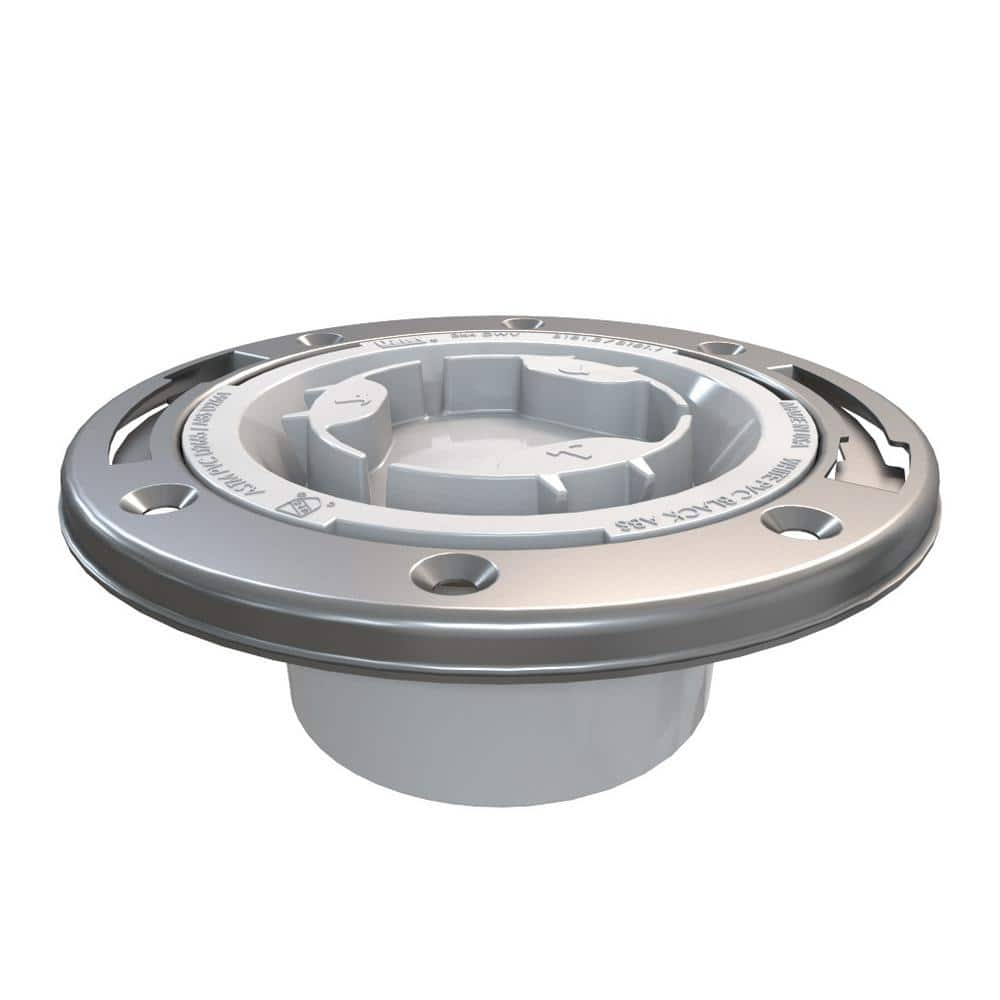
- now get one of the toilet flanges similar this one, which should either fit in or around the existing pipe in the floor. Cement it in place on the pipe with PVC cement, and bolt it to the floor with anchors or tap cons.

- set your toilet on top of the flange and check how it rests on top of the tile. Use plastic toilet shims or other means to ensure it sits level and does not rock when you sit on it and shift your weight. Sometimes the floor is not level, and other times the bottom of the toilet is irregular.
- pull the toilet off and add the wax seal to the flange in the floor. Set in place and use the toilet bolts in the flange to hold it in place (it should already be level, so they only have to compress the seal and hold it firmly down). Don't get carried away with tightening them.

- caulk around the toilet base if necessary to hide the old work, or if gaps are visible. Do not caulk the entire base perimeter. You want a small gap to the back or one side, so water will run out if the flange seal ever leaks. This will tell you that you need a new seal.
 
To avoid these ads, REGISTER NOW!
Top Bottom