“Take a look at power tools from the 50's and 60's. Yeah, they may still plug in and turn on, but they're nowhere near as good as modern stuff. “
This actually varies somewhat.
The electric motors used in corded tools may have gotten better, but not necessarily in all cases, and unless a tool is in use for a couple decades, it’s hard to tell if the motors have actually improved in various ways such as longevity or power, especially without certain testing that most power tool user will never do.
Simply raising the wattage/amperage rating on a motor does not prove the motor is more powerful.
Making a smaller motor, that can accomplish the same task as a larger motor usually is an improvement, and that has happened, but not necessarily in all cases.
Plunge track saws may be an improvement, but Festool charges 5x-10x what a regular circular used to or foes cost for those improvements, and fancy tools with high precision or modular use also existed in the past, just the average consumer didn’t own or use those tools because they were equivalent in cost to Mafell and Festool prices nowadays.
There's always exceptions to the rule, of course, but I would argue that even accounting for survivorship bias, no handheld corded power tool from the days of yore is better than its modern day counterpart. "They don't build them like they used to" is a feature, not a bug in 99% of cases.
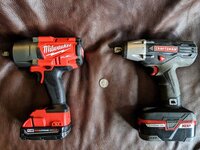
Remember, there's more to a power tool than just the motor. Case/housing materials, ergonomics, weight, efficiency, features, safety, etc. I have an old electric impact wrench, probably from the 60's. It works, but it's so heavy, slow and comparatively weak next to a modern Milwaukee cordless impact I would never even consider trying to use it as a regular tool. Heck, the modern battery impacts are outpacing even the super high quality air tools now, and that was a serious obstacle. Modern cordless drills have fantastic clutches and the chucks are significantly better than the old ones. My Metabo cordless has interchangeable chucks, allowing me to switch between a pilot drill and the main drill, or countersink or whatever. Very handy.
I've used my great grandpa's black and decker 9" grinder side by side with my modern Metabo, the Metabo is better in every measurable way. When's the last time you used a jigsaw from the 70's next to a modern Bosch? No comparison. Even a simple circular saw for example. My buddy was re-building his deck. His Grandpa's gently used 80's era Craftsman let the magic smoke out about an hour into the day, and I promise it had led a very gentle life. The cheap Makita finished the job.
Cordless tools take all the problems that corded tools have and add the complexity and cost of a battery system.
I understand wanting your tools to last forever, but it's just not practical with power tools. Even multi million dollar machine tools have a lifetime expectancy. Even if used gently and with all the appropriate maintenance and care, you'd be surprised by the seemingly short lifespan of some of these machines. We just replaced a laser at work a few months ago, the machine it replaced was only about 8 years old. I asked if that was typical and I was told it was in the expected life cycle of that style machine. Yeah, it costs a million plus to replace it, but it will generate many millions during it's life. And the new laser will cut twice as thick using considerably less power and is about twice or 3x as fast. It's the same with a drill or a sawzall, just on a much smaller scale.
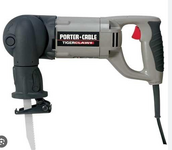
Now, I have some corded power tools that I expect to last me for at least 20 more years, given how often I use them and how little I need the cutting edge tech. But my sawzall is from the 2010s, and it still will do laps around my Dad's Tigersaw from the 90's. I use a sawzall once or twice a month, if that, so I don't really care if it takes a bit longer or is a bit heavier. If I used a sawzall every day for my job, I'd be all over the new tech. Imagine where we'll be in another 20-30 years. Corded tools have the significant advantage of not relying on a battery, which has a ticking clock whether you use it or it sits in a drawer.
"Hard line" hand tools can be expected to last several generations if treated well. Power tools, air tools, machinery and pretty much anything with a battery, motor or circuit board is going to have a lifetime measured in years, not generations.




 )
)