
YesIHaveAHammer
Well-known member
- Joined
- Jun 1, 2025
- Messages
- 848
Been eyeing these up for a while, looking at different ones, reading what people say on here, and watching demonstration videos. So I thought I'd write up an easily consumable overview that might be useful for others in the future.
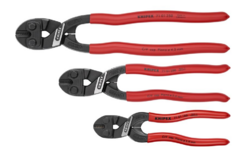
Sizes - 160 "S", 200, 250 "XL". Size determines length and jaw size. The "XL" is a two-handed tool.
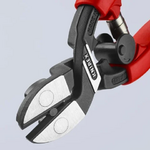
Straight vs. recessed/notched blades - the other key thing to choose. "Straight cutting edges for easier cutting of flat material, also suitable for thin round material", or "blades with recess for easier cutting of round material like hard wires due to better leverage close to the fulcrum". The recessed one can also cut thin round material but you'll have to position it in the straight upper half of the blades. The width of the combined recess gap when closed is 0.6mm (160), 0.8mm (200). Note that the recess is a long diamond shape and is widest at the middle of its height. The consensus on here GJ seems to be in favour of the recessed one.


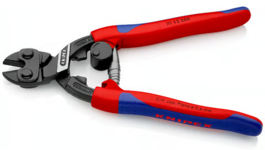
Handles - the usual plastic coated and multi-component options. Only the 200 is available in multi-component. All but one of the multi-component variants are spring loaded to reduce fatigue during long periods of repetitive use (not available on plastic coated handles). The one unsprung multi-component variant is the straight bladed 71 12 200. The latch holds them closed for storage.
Angled head variants - this makes space for your hand in flush cutting situations, just like wrenches are angled. One side of the jaw is flush ground, however note the blade itself is not and will not perform true flush cutting. Angle is 20 degrees for 6cm clearance at ends of handles. For true flush cutting there is the High Leverage Flush Cutter (72) (not pictured below) which from one side can be mistaken for a CoBolt, however those are for soft metal (e.g. copper) and plastic only.
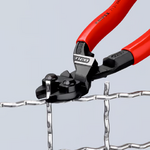
Robust variant (71 31 200 R) - this is designed for fencing applications where the jaw may be used to twist and bend wire. The blades are softer (61 HRC) which makes it less brittle, at the expense of not being suitable for the hardest materials (no cutting capacity is given for piano wire). The HRC hardness scale is not linear, and according to this calculator 61 is 16% softer than the standard 64 HRC.
Tether variants (T suffix) - with tether attachment point.
2nd feature - gripping surface on inner base of head, for pulling and levering.

Performance:
Product codes:
Cutting capacity claims - I thought some contextual numbers may complement the official numbers and display of struggles in demonstration videos. Of course things will vary by specific materials, your own hand strength (and endurance for multiple cuts), conservatism/accuracy of Knipex's specs, and shape of the item being cut relative to your chosen blade profile. Maybe you have different experiences.
Nail sizes taken from this table. Knipex's own definitions of soft, medium hard, and hard taken from the German version of this page (missing on the English one), and translation by Google below:

Sizes - 160 "S", 200, 250 "XL". Size determines length and jaw size. The "XL" is a two-handed tool.
Straight vs. recessed/notched blades - the other key thing to choose. "Straight cutting edges for easier cutting of flat material, also suitable for thin round material", or "blades with recess for easier cutting of round material like hard wires due to better leverage close to the fulcrum". The recessed one can also cut thin round material but you'll have to position it in the straight upper half of the blades. The width of the combined recess gap when closed is 0.6mm (160), 0.8mm (200). Note that the recess is a long diamond shape and is widest at the middle of its height. The consensus on here GJ seems to be in favour of the recessed one.
Handles - the usual plastic coated and multi-component options. Only the 200 is available in multi-component. All but one of the multi-component variants are spring loaded to reduce fatigue during long periods of repetitive use (not available on plastic coated handles). The one unsprung multi-component variant is the straight bladed 71 12 200. The latch holds them closed for storage.
Angled head variants - this makes space for your hand in flush cutting situations, just like wrenches are angled. One side of the jaw is flush ground, however note the blade itself is not and will not perform true flush cutting. Angle is 20 degrees for 6cm clearance at ends of handles. For true flush cutting there is the High Leverage Flush Cutter (72) (not pictured below) which from one side can be mistaken for a CoBolt, however those are for soft metal (e.g. copper) and plastic only.
Robust variant (71 31 200 R) - this is designed for fencing applications where the jaw may be used to twist and bend wire. The blades are softer (61 HRC) which makes it less brittle, at the expense of not being suitable for the hardest materials (no cutting capacity is given for piano wire). The HRC hardness scale is not linear, and according to this calculator 61 is 16% softer than the standard 64 HRC.
Tether variants (T suffix) - with tether attachment point.
2nd feature - gripping surface on inner base of head, for pulling and levering.
Performance:
- Claimed 35-fold manual force increase (200), 40-fold (XL), 25-fold (S)
- Claimed 60% less force required compared to high leverage diagonal cutters of the same length
- The CoBolt 160 straight has similar max cutting capacities to the 200-250 High Leverage Diagonal Cutters (74), but despite those numbers you'd likely still have a much easier and quicker time with the CoBolts.
Product codes:
- 71 - basic model
- 3rd digit - style
- 0 straight blade, unsprung in all handle types (all other styles are sprung in multi-component handles)
- 1 straight blade
- 2 straight blade, angled head
- 3 recessed blade
- 4 recessed blade, angled head
- 4th digit - finish
- 1 plastic coated
- 2 multi-component
Cutting capacity claims - I thought some contextual numbers may complement the official numbers and display of struggles in demonstration videos. Of course things will vary by specific materials, your own hand strength (and endurance for multiple cuts), conservatism/accuracy of Knipex's specs, and shape of the item being cut relative to your chosen blade profile. Maybe you have different experiences.
Nail sizes taken from this table. Knipex's own definitions of soft, medium hard, and hard taken from the German version of this page (missing on the English one), and translation by Google below:
- 16d nail (4.1mm "medium hard")
- 160 straight - 93% of capacity
- 160 recessed - 85%
- 200 straight & recessed - 79% (yes, I double checked the spec; same for both blade types)
- 250 straight - 73%
- 250 recessed - 68%
- Steel rod ("medium hard") 3/16" (4.8mm)
- 160 straight - over capacity at 109% (however, it can be done as shown here in multiple steps)
- 160 recessed - 100% of capacity
- 200 straight & recessed - 92%
- 250 straight - 86%
- 250 recessed - 80%
- Steel wire ("hard") 12 SWG (2.6mm) common fencing smooth wire
- 160 straight - 81% of capacity
- 160 recessed - 72%
- 200 both & 250 straight - 65%
- 250 recessed - 60%
- Steel wire ("hard") gauge maximum possible:
- 160 straight - 11 SWG (2.9mm) at 91% capacity
- 160 recessed - 10 SWG (3.3mm) at 92% capacity
- 200 both & 250 straight - 9 SWG (3.7mm) at 93% capacity
- 250 recessed - 8 SWG (4.1mm) at 95% capacity
Attachments


Last edited: