You are using an out of date browser. It may not display this or other websites correctly.
You should upgrade or use an alternative browser.
You should upgrade or use an alternative browser.
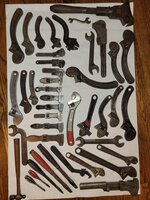
Let's see your Billings and Spencer goodies
- Thread starter LoveSniff
- Start date
Rusty Pickens
Member


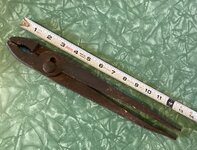
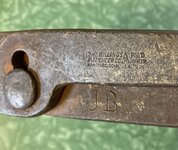
Looking for some identification help. Based on the trademark I believe these are Billings and Spencer. I have searched extensively on line but no luck. The hole in the jaws reminds me of a Wilton Shop King pipe jaws but to my knowledge B&S didn’t make any vises? Thanks in advance!
Attachments

four.cycle
Well-known member

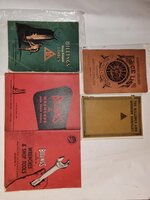
Billings & Spencer LOGO 1913
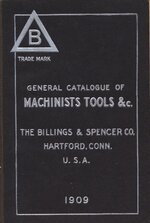
1909 Billings & Spencer catalog front cover
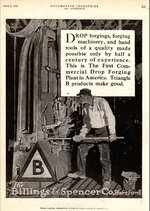
1919 Automotive Industries Magazine Billings & Spencer ad pp 63

Billings & Spencer Improved Ratchet Socket Wrench Sets catalog frontispiece
Private Lugnutz
Well-known member
They made pipe vises. They also forged all kinds of shop tools, toolholders, eye hooks, yokes, etc, and clamps. Those could be from strap clamps.The hole in the jaws reminds me of a Wilton Shop King pipe jaws but to my knowledge B&S didn’t make any vises?
four.cycle
Well-known member
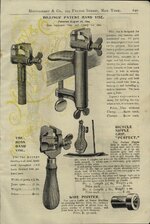
early B&S advertisements show a much broader array of items than just wrenches and sockets and pliers.
Attachments


Mintgrun
Well-known member
I picked up this little 5/16 S 000 SPECIAL wrench yesterday.
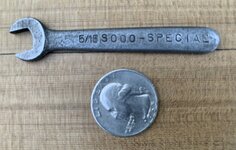
I was excited at first, thinking I may have found Wrench guy's missing Williams wrench, but the flip side has a tiny little B inside a triangle; not a W in a diamond.

I was excited at first, thinking I may have found Wrench guy's missing Williams wrench, but the flip side has a tiny little B inside a triangle; not a W in a diamond.
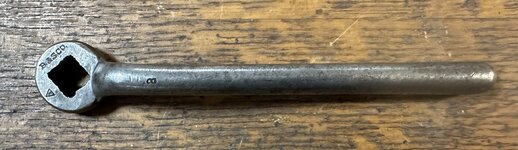
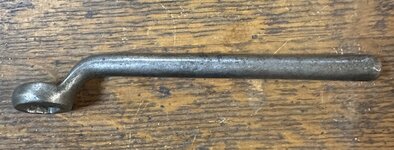
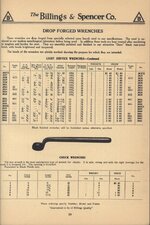
Billings & Spencer #2 chuck wrench, 6 1/2" long with a 7/16" square opening. Not exactly sure what kind of chucks these were for, and I couldn't find an equivalent "chuck wrench" in JH Williams from that period. It's like an offset tool-post wrench. Catalog page is from B&S cat #36 from 1926. Anyhow....something you don't see every day.

Patrick Eubanks
Well-known member
- Joined
- Mar 15, 2023
- Messages
- 517


Patrick Eubanks
Well-known member
- Joined
- Mar 15, 2023
- Messages
- 517
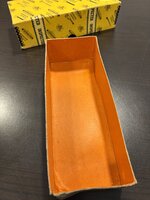
Look at the inside of the box. PerfectHere is a nos Billings and Spencer wrench set for your enjoyment.. “minty”
Attachments


PowderKeg
Well-known member
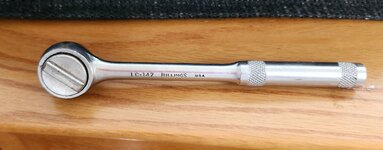
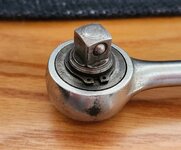
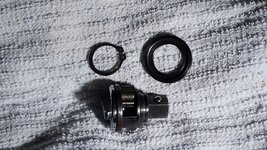
Recently fished this 3/8" Billings ratchet out of the 'bay when I finally realized it' not like any other Billings ratchet I have. In fact it's the same mysterious design that only 2 other ratchets in the "collection" share, both of them being Vi-Chrome (3/8" & 1/2").
I've never found a patent covering this design, it's a real stumper. Other pics are of the 3/8 Vi-Chrome years ago when I had it apart cleaning it up.
I've never found a patent covering this design, it's a real stumper. Other pics are of the 3/8 Vi-Chrome years ago when I had it apart cleaning it up.
Attachments


3baygarage
Well-known member
It’s a neat one and a nice example. Similar situation here. I picked up the Billings to go with the Vi-Chrome. IIRC, those Vi-Chrome round heads have a couple handle variations. Haven’t seen that in the Billings.Recently fished this 3/8" Billings ratchet out of the 'bay when I finally realized it' not like any other Billings ratchet I have. In fact it's the same mysterious design that only 2 other ratchets in the "collection" share, both of them being Vi-Chrome (3/8" & 1/2").
I've never found a patent covering this design, it's a real stumper. Other pics are of the 3/8 Vi-Chrome years ago when I had it apart cleaning it up.
Jay__Dub
Well-known member
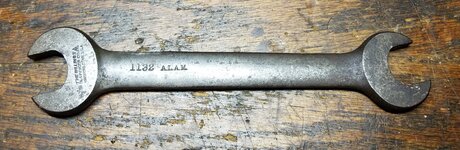
Found this one in a lot I bought today.

Private Lugnutz
Well-known member


Private Lugnutz
Well-known member
^ You'll notice the "A.L.A.M." marking. Of all the B&S wrenches I have in boxes, laying around, or hanging off my two merchandising boards, this is the first one I have ever found in the wild. It had to have been made in the teens. By 1924, B&S catalogs and ads only listed their engineers' wrenches by their model number, the Williams/industry standard number, and U.S.S., hex cap, and S.A.E. standards (which is the same as A.L.A.M.) Typically, you'll see those standards on the flip side jaws, near the fractional sizes. This "A.L.A.M." marking is serving as a suffix for the "1132" model number. Why? Because this is not a B&S model number 1132 wrench, which would have 7/8" x 31/32" milled openings. This wrench has 15/16" x 1" milled openings for "A.L.A.M" standard 5/8" x 11/16" bolts, which is the sizes marked on the jaw faces. Later, this would be an ISN 33C and a B&S 1132X wrench.

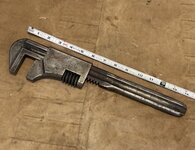
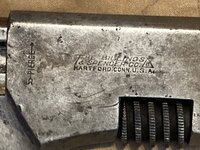
SWEETPicked up this B&S DOE engineers' wrench this morning at the flea.
woodkill
Member
d42jeep
Well-known member
I found this 24 Oz. Billings ball pein hammer at yesterday’s estate sale. The handle is going to need a little work. 
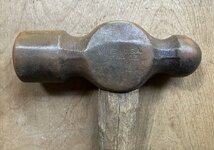
Edit….
I sanded down the handle and filled all of the cracks with a layer of wood glue. After the wood glue dried I sanded off the excess.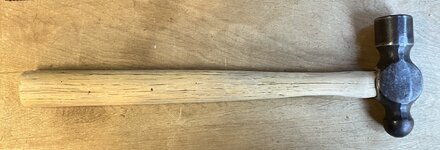

I‘ll probably finish the handle and head with some BLO.
-Don
Edit….
I sanded down the handle and filled all of the cracks with a layer of wood glue. After the wood glue dried I sanded off the excess.
I‘ll probably finish the handle and head with some BLO.
-Don
Last edited:
Old tool guy
Well-known member
- Joined
- Apr 13, 2023
- Messages
- 3,449
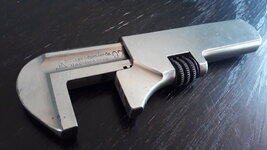
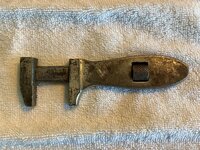
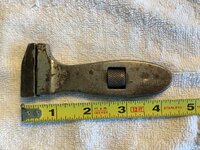
Found this today in an antique store. The typical stores I go to are heavy on dishes, silverware, china and a sprinkling of durable goods. Today i happened into this store in a near-downtown neighborhood. As soon as I walked in i could tell it was my kind of store, not one the wife would appreciate. Lots and lots of side rooms filled with stuff. Organized, but filled. Sawbthis little guy and he was crying out “Adopt me!” … so I did. $20, hope that was reasonable. What is the “A” on the fixed jaw for? Looks factory as opposed to P.L. on the other side. And what is the 89 at the 1/4” mark for?
Attachments

Private Lugnutz
Well-known member
That's the model number.What is the “A” on the fixed jaw for?
That's a "32". The opening scale (in 32nds) on the dynamic jaw shank was a key feature of Billings patent 212,298 (Feb. 18, 1879) and found on several models of B&S pocket wrenches for decades.And what is the 89 at the 1/4” mark for?
NoahG
Well-known member


Old tool guy
Well-known member
- Joined
- Apr 13, 2023
- Messages
- 3,449
Not sure why. You run out of scale before the jaws touch.That's a "32". The opening scale (in 32nds) on the dynamic jaw shank was a key feature of Billings patent 212,298 (Feb. 18, 1879) and found on several models of B&S pocket wrenches for decades.
RTM
Well-known member
Your markings are asymmetrical, looks like the number of marks is not the same (one or two missing) at the jaw side? May not be perfect, but the line length inequity seems to show the shortest is missing.Not sure why. You run out of scale before the jaws touch.
Private Lugnutz
Well-known member
Not sure why I'm not understanding your question. Why would you need a scale when the jaws are touching? What nut or bolt would have an Across-the-Flats width of 0/32"?Not sure why. You run out of scale before the jaws touch.
The only 32/nds hatch mark not etched into the scale on the dynamic jaw of antique and vintage B&S pocket wrenches of this era is 1/32". The first hatch mark - by design, is 2/32" (or 1/16"). That is the smallest fastener size the scale is designed to help the user set the jaw opening to fit. If you thumb the adjuster open from there, you can use the scale to set the jaw opening, in 32/nds of an inch, to any number of fasteners up to 1".Your markings are asymmetrical, looks like the number of marks is not the same (one or two missing) at the jaw side? May not be perfect, but the line length inequity seems to show the shortest is missing.
Having said all that, as a modern user I find the scale as superfluous as the similar capacity markings found on the dynamic jaws of vintage RIDGID adjustable pipe wrenches. My experience with adjustables of all kinds can be characterized as by feel. That is, placing the wrench around the fastener on the work piece and adjusting until it's tight. These are coarse wrenches for coarse fasteners. But I can see how other users may have wanted and even needed the settings.
RTM
Well-known member
Thanks for making my answer much clearer. I was trying to say that, but was on a tele-con, so could not easily count out the lines to be certain. I was going 1/2, 1/4…. Etc by squinting a bit. Seemed like one, or maybe two were missing.The only 32/nds hatch mark not etched into the scale on the dynamic jaw of antique and vintage B&S pocket wrenches of this era is 1/32". The first hatch mark - by design, is 2/32" (or 1/16"). That is the smallest fastener size the scale is designed to help the user set the jaw opening to fit. .
Old tool guy
Well-known member
- Joined
- Apr 13, 2023
- Messages
- 3,449
I agree with the … why do they exist camp. Who takes the time to measure the fastener, then set the wrench to that size? You open the jaw, place it on the fastener and screw it tight.
Part 2 … agreeing that the first mark is not zero … how far offset is it? Are you supposed to remember that number?
Tomorrow I will open it all the way, get a clear picture.
Part 2 … agreeing that the first mark is not zero … how far offset is it? Are you supposed to remember that number?
Tomorrow I will open it all the way, get a clear picture.
Mintgrun
Well-known member
I agree with the … why do they exist camp. Who takes the time to measure the fastener, then set the wrench to that size? You open the jaw, place it on the fastener and screw it tight.
Or, you set the wrench to fit the fastener and then read the number if you want to select an alternate specifically-sized wrench. You could say it is a fastener *measuring* wrench.
Private Lugnutz
Well-known member
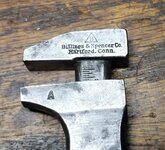
Huh? These questions tell me you're still not understanding. It's not offset and there's no memorization required. The dynamic jaw is marked in 32/nds like any standard rule would be and you read it just like you would any standard rule. You turn the adjusting knob until the edge of the dynamic jaw is lined up with the hatch mark for the size fastener you're going to be turning and that's precisely how wide the jaws will be open.Part 2 … agreeing that the first mark is not zero … how far offset is it? Are you supposed to remember that number?
This is not an uncommon wrench. There are several on this thread as well as the 'Bicycle Wrench' thread, including mine, linked here. I will drop a few others below.Tomorrow I will open it all the way, get a clear picture.
Attachments


Private Lugnutz
Well-known member
You could, and I wouldn't bet against it being used that way in some circumstances at the turn of the last century, but I will reiterate and reemphasize that was not the original intent.You could say it is a fastener *measuring* wrench.
From the patent...

Mintgrun
Well-known member
Can't argue with that! (not that I was looking to argue, just saying how it might be a useful feature)
I recently acquired a couple of big ones in a toolbox purchase, shown here with the smallest one I own.

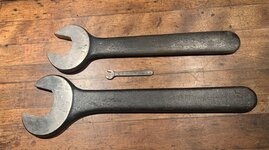
1-5/8", 1-1/4" and 5/16".
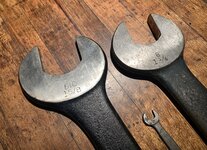
Just a few more and I'll have a complete set!
(I do have a few more, but I'll bet the Biggest & Smallest retain their titles for a long time).
Tom
I recently acquired a couple of big ones in a toolbox purchase, shown here with the smallest one I own.
1-5/8", 1-1/4" and 5/16".
Just a few more and I'll have a complete set!
(I do have a few more, but I'll bet the Biggest & Smallest retain their titles for a long time).
Tom
Private Lugnutz
Well-known member
Very caliperesque....just saying how it might be a useful feature...
I wouldn't bet against them! I'd have trouble challenging that pair with any brand-matching pair of SOE engineers wrenches in my collection, including Williams. And I see what you cleverly did there.I'll bet the B(iggest) & S(mallest) retain their titles for a long time

Snerk.Just a few more and I'll have a complete set!
Old tool guy
Well-known member
- Joined
- Apr 13, 2023
- Messages
- 3,449
Actually i do understand, but your explanation did clear up a couple of things. It also reinforced my point … in my mind anyway.Huh? These questions tell me you're still not understanding. It's not offset and there's no memorization required.
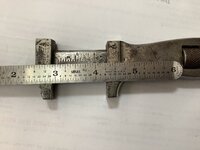
Unless you have the jaw open more than an inch, you might not notice the end of the scale. yes the half inch mark is taller than the others, but to me it’s basically just a bunch of hash marks. And if you are less than a half inch open, it’s difficult to figure out what the mark is. The first mark is 1/16” so if the fifth mark is showing, you have to add 2/32 plus 5/32 to get the actual size. I think it’s a solution looking for a problem.
Attachments
Private Lugnutz
Well-known member
Well, I don't disagree, for most modern use cases, as I already said, although I put it more tolerantly, and pointed out that B&S was certainly not the only adjustable wrench mfgr to do so, with Ridge following suit many years later, so your argument is with Mr. Billings on this point, and he and his 146-year-old patent are long gone, with only tens of thousands of his iconic pocket wrenches left behind to defend him!I think it’s a solution looking for a problem.
On the scale..., the hatch marks are identical to a standard steel rule. I don't know what more should need to be said than simply pointing that out. The heights of the 32nd, 16th, and 8th inch hatch marks on the dynamic jaw are all represented exactly as they appear on a standard steel rule. There's no addition necessary, but I've given up trying to understand why it's troubling you. We have clearly reached an impasse on that, I have no reason to continue trying to persuade you, and I certainly have no stake in defending the scale on an antique collectible wrench.
Maybe you should go back to that antique store and ask for your $20 back!
Old tool guy
Well-known member
- Joined
- Apr 13, 2023
- Messages
- 3,449
Maybe he would buy it back for $5.
It doesn’t trouble me, i was just trying to understand the finer points. Obviously it was deemed useful since he got a patent for it. And i appreciate your knowledge.
It doesn’t trouble me, i was just trying to understand the finer points. Obviously it was deemed useful since he got a patent for it. And i appreciate your knowledge.
Private Lugnutz
Well-known member
I was just kidding about returning it. And no worries. It was a fun discussion.
Do you use old school (no dial) calipers often? I can see how that could be the source of some frazzle, at first, the way the scale on those is offset. Until you play with a B&S a little.
Since I mentioned them a few times, I feel like I should qualify that the opening hatch marks on the shanks of Ridge adjustable pipe wrench dynamic jaws are not a scale or rule, per say, but standard pipe diameters, and, they are accompanied by fractional markings.

The only other vintage gripping tool I can think of off the top of ny head that included a marked scale, of sorts, for jaw openings, was the B.M.C. locking plier-wrenches. The square jaws and those opening pre-sets were features explicitly designed to overcome the lack of them, perceived as flaws, in available vise-grips at that time.


Do you use old school (no dial) calipers often? I can see how that could be the source of some frazzle, at first, the way the scale on those is offset. Until you play with a B&S a little.
Since I mentioned them a few times, I feel like I should qualify that the opening hatch marks on the shanks of Ridge adjustable pipe wrench dynamic jaws are not a scale or rule, per say, but standard pipe diameters, and, they are accompanied by fractional markings.
The only other vintage gripping tool I can think of off the top of ny head that included a marked scale, of sorts, for jaw openings, was the B.M.C. locking plier-wrenches. The square jaws and those opening pre-sets were features explicitly designed to overcome the lack of them, perceived as flaws, in available vise-grips at that time.
Oldtuleguy
Well-known member
- Joined
- Nov 4, 2017
- Messages
- 10,470


That’s pretty Kewl. I’ve never seen one beforeHere's an interesting pocket multi blade screwdriver