To avoid these ads, REGISTER NOW!

Lift Disconnect and Outlets

lyonkster

Well-known member
Joined
Nov 18, 2009
Messages
432
Location
Portland, OR
I'm planning to add a disconnect and some power outlets to my Advantage four post lift, and wanted to get some feedback on my plan. In the current setup, the lift power cord does not reach the ceiling outlet, so I'm using a short extension cord for now:
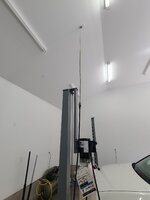
1751466932459.jpeg

My plan is to replace the ceiling receptacle with a 20A twist-lock, like this one:
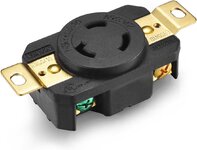
1751466983536.jpeg

Then I'll use some SOOW cable with a male twist lock on the end, to bring power down to the post.

At the post, I'd like to have a disconnect and two gang outlet box. Conceptually, something similar to what this Youtube video does:
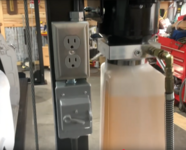
1751466838153.png

Except that my disconnect will be above the outlets, since the power is coming from above.

My questions are:

- Should I plug in the lift cord into one of the new outlets (which gives one more redundant opportunity to disconnect it in case of runaway motor), or is it better to cut off the male plug and hardwire the cord into the box for a cleaner look?

- For the disconnect, I can't use the Leviton industrial switch that the video has since it's only rated for 1 hp; my lift motor is 1.5 hp. So I'm considering using a higher rated switch like this:

1751467425543.jpeg

With an enclosure like this:

1751467489043.jpeg

Another option is using a switch like this:

1751467568583.jpeg


Any feedback would be appreciated, especially if any of this does not look right/safe!
 
To avoid these ads, REGISTER NOW!

MFortie

Well-known member
Joined
Aug 9, 2010
Messages
902
Location
San Diego County
Personally, I favor the paddle switch. Quick slap of the hand if and when needed.

I’m planning to do the same on my lift.
 

Sumboodie

Well-known member
Joined
Mar 20, 2021
Messages
10,692
Location
AK
Is a runaway motor a common thing now? Never heard of that and I've been in or around shops most of my life.
 

pbon

Well-known member
Joined
May 14, 2017
Messages
3,498
You have an easy disconnect now — yank the cord. I agree it is ugly and you could improve on the connection. The simple light switch style works fine. I have one of those for my compressor (with the correct rating for my compressor). If you need an outlet on your lift post, certainly add one while you are improving the wiring.
 
OP
L

lyonkster

Well-known member
Joined
Nov 18, 2009
Messages
432
Location
Portland, OR
Personally, I favor the paddle switch. Quick slap of the hand if and when needed.

I’m planning to do the same on my lift.

That's the one aspect I like about it, it's easier to "find" that type of switch in a moment of panic (if needed).
Is a runaway motor a common thing now? Never heard of that and I've been in or around shops most of my life.

I don't think it's "common", but not unheard of either - seems like cheap insurance.
OP will be installing a twist lock receptacle so he could not yank on the cord to disconnect the power.

Yup! My thinking is that I don't want to worry about the plug falling out of the ceiling receptacle due to cord weight and/or lift vibration.
Lift runs on 110V?

Yes, Advantage Lift is 110V.
 

TurnipTruck

Well-known member
Joined
Aug 28, 2005
Messages
1,562
Location
Southcentral Alaska
Is a runaway motor a common thing now? Never heard of that and I've been in or around shops most of my life.
The cheesy push button on my new Forward I10 welded itself ON the third time I ever used it and the first time it lifted 85% of capacity. I had the paddle safety switch installed and that thing got slapped in a panic.
A few years later and another industrial push button welded itself ON lifting a half ton engine. Another slap to the paddle switch.

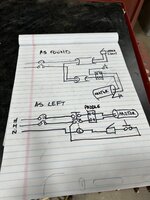
THEN I collected parts to add a contactor to isolate the motor load from the little push button and the up travel stop microswitch.

IMG_4570.jpegIMG_4572.jpegIMG_4571.jpeg
 

mikedodge

Well-known member
Joined
Jun 27, 2017
Messages
2,784
Rather then cutting the plug off the factory cord I'd be more inclined to put a second receptacle on the post just for that. If you're putting it all within reach anyway skip the disconnect switch since you can pull the plug in an emergency. Give it a red cover plate or some other color so it's obvious in a panic which plug to yank out.
 

pbon

Well-known member
Joined
May 14, 2017
Messages
3,498
Post #10 looks good to me. The OP is making this simple project complicated. I agree the lower junction box on the wall might be better. Mine is below — no disconnect box but I could add one if zi wanted to. The coil at the top is to give a little play in case I need to move the lift a foot or 2, though I have not moved it in 7 years.
 
OP
L

lyonkster

Well-known member
Joined
Nov 18, 2009
Messages
432
Location
Portland, OR
Rather then cutting the plug off the factory cord I'd be more inclined to put a second receptacle on the post just for that. If you're putting it all within reach anyway skip the disconnect switch since you can pull the plug in an emergency. Give it a red cover plate or some other color so it's obvious in a panic which plug to yank out.
Thanks for the suggestion, I like the idea of keeping the male plug on the existing cord so I can yank it in an emergency, so I'll do that. I may still add a paddle kill switch, just as belt and suspenders.
You could eliminate the plug and receptacle at the ceiling and run Liquidtite flexible conduit from the ceiling box down the lift post to your first junction box. Assuming you lift does not move.

Good point, but I do want the flexibility to move the lift to any of the three bays (I have a lift ceiling outlet at each bay for that purpose).
Post #10 looks good to me. The OP is making this simple project complicated. I agree the lower junction box on the wall might be better. Mine is below — no disconnect box but I could add one if zi wanted to. The coil at the top is to give a little play in case I need to move the lift a foot or 2, though I have not moved it in 7 years.

I agree that the kill switch is a bit more complicated than just a plug that I can pull, but I don't mind doing a couple of hours worth of extra work to set it up the way I want it to be. I suppose that I can skip the kill switch for now and plan to add one later, but knowing me, if I did that, I'd never get back to adding it at a later point as I'll get too distracted with other projects.
Pic of motor nameplate?

This is what I see:

1751550310119.jpeg
The cheesy push button on my new Forward I10 welded itself ON the third time I ever used it and the first time it lifted 85% of capacity. I had the paddle safety switch installed and that thing got slapped in a panic.
A few years later and another industrial push button welded itself ON lifting a half ton engine. Another slap to the paddle switch.

THEN I collected parts to add a contactor to isolate the motor load from the little push button and the up travel stop microswitch.

IMG_4570.jpegIMG_4572.jpegIMG_4571.jpeg

This is very helpful, thank you. So to be clear, you replaced the original push button switch with the paddle switch, right? I considered that idea also, although I want to be careful not to do anything that might void the warranty. I'm guessing it won't? I have to admit that I don't fully understand your schematic, could you help me understand the piece parts involved (or if is in your thread, I'm happy to go look there)? I see you also have a pair of outlets on the post, I'm thinking the same approach for me.
 

TurnipTruck

Well-known member
Joined
Aug 28, 2005
Messages
1,562
Location
Southcentral Alaska
This is very helpful, thank you. So to be clear, you replaced the original push button switch with the paddle switch, right? I considered that idea also, although I want to be careful not to do anything that might void the warranty. I'm guessing it won't? I have to admit that I don't fully understand your schematic, could you help me understand the piece parts involved (or if is in your thread, I'm happy to go look there)? I see you also have a pair of outlets on the post, I'm thinking the same approach for me.
I rewired the whole lift so the 240v to the motor only went through the contactor (big relay) AND the dpst (double pole single throw) paddle switch. The 120v branch circuit powers the contactor coil (C) only when the push button is pressed AND the uptravel stop switch isn’t. (Did I fuse that branch and not draw it? I’ll have to check…)
The diagram I posted uses common electrical symbology; I can break it down further if you need.

A contactor is resting on the top right of the breaker panel:
IMG_4555.jpeg

Paddle switch next to the push button, with the contactor above.
IMG_4569.jpeg
 
Last edited:
To avoid these ads, REGISTER NOW!
OP
L

lyonkster

Well-known member
Joined
Nov 18, 2009
Messages
432
Location
Portland, OR
I rewired the whole lift so the 240v to the motor only went through the contactor (big relay) AND the dpst (double pole single throw) paddle switch. The 120v branch circuit powers the contactor coil (C) only when the push button is pressed AND the uptravel stop switch isn’t. (Did I fuse that branch and not draw it? I’ll have to check…)
The diagram I posted uses common electrical symbology; I can break it down further if you need.

A contactor is resting on the top right of the breaker panel:
IMG_4555.jpeg

Paddle switch next to the push button, with the contactor above.
IMG_4569.jpeg
I see, you rewired the original push button and upper limit switch to interrupt the relay (contactor) circuit, which then opens/closes the 220V wiring to the motor. So this way you get the push button and limit switch out of the high current loop (?). Very clever. I'll have to see if I can modify this approach for my 110V wiring.
 

mikedodge

Well-known member
Joined
Jun 27, 2017
Messages
2,784
I don't think it's a very common thing to have those buttons fail at least it's never come up much. But that's the reason I also want to put one of those quick to hit disconnect switches on my not yet installed 2 post.
 
OP
L

lyonkster

Well-known member
Joined
Nov 18, 2009
Messages
432
Location
Portland, OR
I really like big red panic buttons on stuff I want to be shut off in a panic.
Me too. I agree with the other posts that a corded plug can be pulled in an emergency, and thus can serve as a disconnect. But I also think that in an "oh sh*t" situation, a red paddle is easier/faster/more intuitive to hit than trying to unplug a power cord.
 

mikedodge

Well-known member
Joined
Jun 27, 2017
Messages
2,784
Me too. I agree with the other posts that a corded plug can be pulled in an emergency, and thus can serve as a disconnect. But I also think that in an "oh sh*t" situation, a red paddle is easier/faster/more intuitive to hit than trying to unplug a power cord.

That's why I mentioned using a red or different colored cover for that outlet that it gets your attention.
Either way it's a small price compared to damage of hitting the ceiling if you can't stop it.
 
OP
L

lyonkster

Well-known member
Joined
Nov 18, 2009
Messages
432
Location
Portland, OR
That's why I mentioned using a red or different colored cover for that outlet that it gets your attention.
Either way it's a small price compared to damage of hitting the ceiling if you can't stop it.

Sorry, maybe I wasn't clear - my plan is to use both a corded plug and a paddle switch, not one instead of the other. I like to have redundancy, especially given the potential catastrophic results of a runaway situation, as you mentioned.
 

kabinenroller

Well-known member
Joined
Sep 14, 2013
Messages
898
Location
S.E. Wisconsin USA
When I first had my BendPak installed (professionally)
I had the push button fail and the lift would not stop until I unplugged it. ( I have a drop cord from a ceiling mounted box to a twist lock just above the lift motor/pump) Not long after replacing the switch a contactor failed and I had to reach for the twist lock again. Now I have a lever disconnect box mounted on the lift inches from the switch, I am able to kill the power instantly if there is a malfunction and now have made it a habit to disconnect the power using the box whenever I am not raising or lowering the lift.
 

mikedodge

Well-known member
Joined
Jun 27, 2017
Messages
2,784
Sorry, maybe I wasn't clear - my plan is to use both a corded plug and a paddle switch, not one instead of the other. I like to have redundancy, especially given the potential catastrophic results of a runaway situation, as you mentioned.

You were clear. I was only pointing it out because in an oh **** situation you'd notice a red outlet quicker then two with normal covers and that would jog memory pretty quick to yank that cord.
 

PT Doc

Well-known member
Joined
Nov 12, 2010
Messages
3,197
I have a few of the Leviton motor rated switches and have not had issues. Enclosure are great and all works as intended. They also have 3 phase switches.
 

pbon

Well-known member
Joined
May 14, 2017
Messages
3,498
I have a Leviton switch for my compressor and it works great. Maybe Leviton makes them in red since redundancy or “can’t miss it” seems to be a concern.
 
OP
L

lyonkster

Well-known member
Joined
Nov 18, 2009
Messages
432
Location
Portland, OR
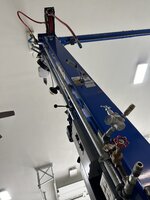
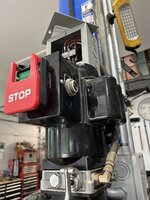
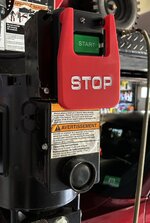
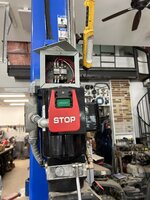
Thanks for all the suggestions. Here's how I ended up setting things up:

1752205211589.jpeg
1752205235607.jpeg

Power cord comes down from the ceiling and into the box 2 gang box, then to the box below with the paddle STOP switch, and then back up into the 2-gang box. The paddle switch kills power to all four outlets. The lift cord will plug into one of the outlets.

For now I decided not to use the twist lock at the ceiling, just the regular three prong plug. If I find the plug falls out from the ceiling receptacle, I'll switch to the twist lock.
 
Last edited:
To avoid these ads, REGISTER NOW!
Top Bottom