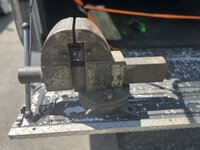
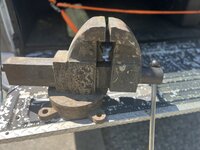
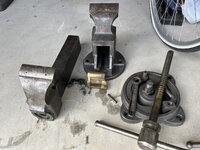
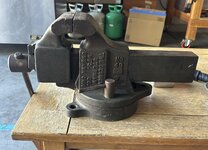
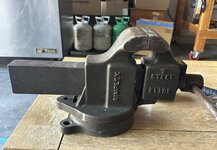
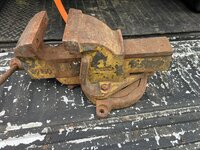
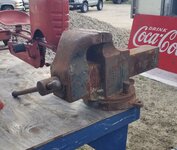
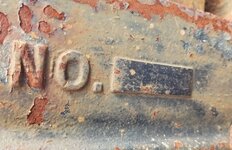
Found my first American Scale Co. this morning!
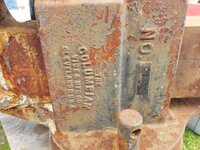
I didn’t realize I forgot the specs!! It’s a 23A 4.5” at about 87lbs.Specs and model No.?
I have a couple of AS vises, they are very well made!
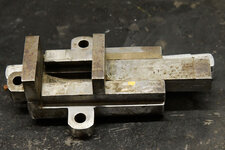
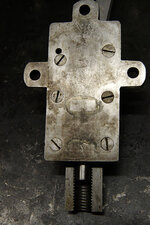
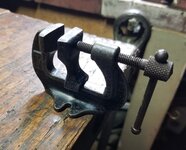
Yep. I lost my terminology for a bit there. With the brass (bronze?) gibb screws, it's tighter than a bull's *** in fly time. Not perfectly flat on the back, but I can fix that.Cool little shop made Timm!
Do I understand correctly that the slide is beveled onto the gibbs?


I love the look of bronze and steel! I can’t spake to how common a brass nut is in Parker vises, but I’ve owned several Prentiss’s with bronze nuts. I haven’t identified any rhyme or reason to the occurrences of bronze slides in vises, but I do always enjoy seeing them.If you were guessing, what material would you say that this main screw was cast from?
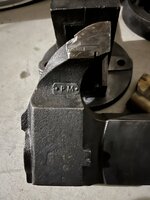
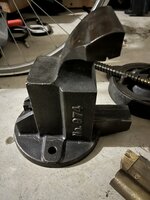
I’ve just dissembled a Charles Parker 974 and was more than a little surprised by this color I saw as I spun the fixed jaw around to remove the retainer pin and main screw.
This is only Parker #5 for me. Maybe you’ve seen this before?![]()
I’ve just dissembled a Charles Parker 974
When I see bronze or brass where a normal tool or part would normally be steel, or cast iron, I think recast or reproduction. If you can find an iron version, see if yours is smaller by the shrink rate difference.I’ve just dissembled a Charles Parker 974 and was more than a little surprised by this color I saw as I spun the fixed jaw around to remove the retainer pin and nut.
Steel would potentially be stronger than Brass/Bronze, but only if the right type of steel alloy were used.

Yeah, and the reversed-thread screw is kinda' driving me nuts. It's just wrong--like a right-hand drive vehicle on American roads.Cool little shop made Timm!
Do I understand correctly that the slide is beveled onto the gibbs?
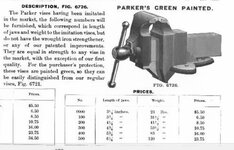
Awesome thanks for all the details! That's really cool. I was thinking about painting it but I'm gonna keep it as is.EDIT: I should have noted that this was from a 1964 RIDGE Tool Company catalog. That's probably the reason for the number changes
It's definitely in pretty good shape for it's age. I think I might clean this one up and keep it. Replacing the jaws might be a fun time once I learn how to go about it.OneMore: I just discovered that by 1967 the Ridge Tool Company changed the name of their vises from Simplex to Ridgid. That narrows the possible age of your vise to 59 - 61 years.
looks brass to me, brass nuts were used to impart less wear on the spindle, they are easily replaceable vs the main spindle, theoretically just as strong as steel as forces are in direct compression and not in shear, IMOIf you were guessing, what material would you say that this nut was cast from?
I’ve just dissembled a Charles Parker 974 and was more than a little surprised by this color I saw as I spun the fixed jaw around to remove the retainer pin and nut.
This is only Parker #5 for me. Maybe you’ve seen this before?
(edit: nut not screw)
![]()


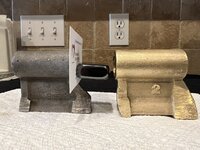
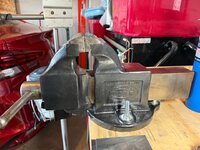
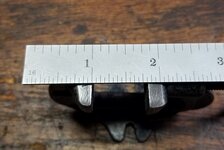
A few more shots for size context.