To avoid these ads, REGISTER NOW!

Track saw question

gizardlizard

Well-known member
Joined
Aug 29, 2019
Messages
727
Location
Madison, WI
Question for anybody that owns a quality track saw: For precision cuts 8’ and over, do you prefer a one piece track or have you gotten decent results by bolting shorter tracks together? I’m buying a Makita track saw and just wondering if I should buy two 55” tracks and bolt them together when needed or get a 55” and a 112” for longer cuts.
 
To avoid these ads, REGISTER NOW!

Nobody-named-Olli

Well-known member
Joined
Jan 9, 2025
Messages
1,615
Location
North Rhine-Westphalia; Germany
If you can store, transport and handle the long rail, get the long rail for long cuts. Additionally get a smaller one for small cuts.

I’ve had good results with joining my Festool rails - but if I could handle & store one long rail, which I can’t, I would always prefer that over joining rails.

Kind regards,
Olli
 
Last edited:

cgrutt

Well-known member
Joined
Mar 4, 2016
Messages
8,324
I don't own a track saw (yet) but would think you will want the shorter track most of the time. Personally, I'd buy one of the short tracks and the long one if you have room to store it.
 

yatg

Well-known member
Joined
Aug 16, 2019
Messages
2,827
Location
Southern Oregon
Got a Makita saw last year and all 3 tracks, 39, 55, 118, and the carry bags.
Thought about getting 2 55's and the kit to connect them, but the price was close to the same for the long track.
The 39 is used the most.
If they made a shorter track, I'd buy it. Guess I could get another track and cut it down.
The 55 is good for cutting 4x8 plywood.
You don't want to be slinging a real long track around unless you have to.
Spent well over $1000 on it, but its the first major NEW tool I've bought in a long time.
 

bdbecker

ALLIANCE MEMBER
Joined
Nov 18, 2015
Messages
5,572
Location
Iowa
It all depends on what your definition of precision is. Some may argue that you should only use a track saw for breaking down full sheets, but to run everything through a table saw for the final cut to size.

If you have the means to get both a 55" and a 118" (and the space to store/use them), I don't see any disadvantage to having both options available. Personally, I've never had an issue using two 55" tracks joined together, but my projects may not require the same level of accuracy as yours.
 

rlitman

Well-known member
Joined
Oct 18, 2010
Messages
24,624
Location
Long Island
It all depends on what your definition of precision is. Some may argue that you should only use a track saw for breaking down full sheets, but to run everything through a table saw for the final cut to size.

If you have the means to get both a 55" and a 118" (and the space to store/use them), I don't see any disadvantage to having both options available. Personally, I've never had an issue using two 55" tracks joined together, but my projects may not require the same level of accuracy as yours.
My tablesaw fence is significantly longer than what Biesemeyer made (after I extended it), but it's still nowhere near 55" long. I don't see how any tablesaw could compete for straightness against two tracks joined together.
 

bdbecker

ALLIANCE MEMBER
Joined
Nov 18, 2015
Messages
5,572
Location
Iowa
My tablesaw fence is significantly longer than what Biesemeyer made (after I extended it), but it's still nowhere near 55" long. I don't see how any tablesaw could compete for straightness against two tracks joined together.

I agree, I've never had issues running two 55" sections of track. That's why I said "Some may argue..." that table saws are more precise.

I could see how extending the fence on a small portable job site style saw might have its advantages, but on a cabinet saw where there is usually a fair amount of space along the fence on the infeed side, I don't see what the benefit would be. Once the material is past the blade, it's cut.
 

tarbellb

Well-known member
Joined
Apr 17, 2011
Messages
5,760
Location
Oregon
I'll tell you what pisses me off

My 55" track is to short to properly cut 48"

The Makita and I assume most track saws use a front and rear cam adjustment for how they align on the track
The first and last few inches one or the other isn't in the track cutting 48"! wtf
 

jar944

Well-known member
Joined
Jul 26, 2010
Messages
5,932
Location
Northern VA
I'll tell you what pisses me off

My 55" track is to short to properly cut 48"

The Makita and I assume most track saws use a front and rear cam adjustment for how they align on the track
The first and last few inches one or the other isn't in the track cutting 48"! wtf

You have to plunge to start the cut.
 

Firebrick43

Well-known member
Joined
May 12, 2015
Messages
14,098
Location
West central Indiana
I have three tracks for my dewalt and never put the shorter ones together, always use the long one for 96” cuts. I have done a 120” cut with the short and long, it *****
 

jar944

Well-known member
Joined
Jul 26, 2010
Messages
5,932
Location
Northern VA
And that's what I do........ but damn it couldn't they have just made it a few inches longer🤔

Is anybody else making a slightly longer Makita compatible track?

A 1500mm would have made sense rather than the 1400mm/55" and been exactly 1/2 of the 3000/118".
 

AEAdam

Well-known member
Joined
May 27, 2023
Messages
2,777
Location
SE PA
I have 2 55” and the short one and kits to connect all of them. Wouldn’t mind buying a 118” but I feel like I’d like to see it before I bought it. I feel like they could easily get damaged in shipping.

I have Bosch and Milwaukee saws and tracks.
 

signcrafter

Well-known member
Joined
May 9, 2012
Messages
12,366
I bought the makita track saw over a decade ago and it came with one 55 and I bought another 55 and the kit to join them because after dropping that much on the saw I didn't want to spend the money on the long track. It ***** to join them and I had to use a long level to get the tracks straight on every cut. I eventually got the long track and if you can afford it that is definitely the way to go. So nice to have the 55 and long to break down sheet goods. So now I have two 55s and the long one. I've thought about cutting the extra 55 down to make like a 36 and 19 or something like that but haven't yet. I have connected them all together to make a straight cut on a big bar I built.
 

Torque&Recoil

Well-known member
Joined
Dec 13, 2015
Messages
432
Location
NE Ohio
I have the Makita with one 55 and one long track. Obviously, I have no experience trying to join two 55s, but... from my experience... damn, the long track RULES. I honestly can't imagine messing with anything else.

And, congratulations on getting a track saw. After I got mine, I said out loud - why did I wait so long to get this thing? Without a doubt, it has changed my woodworking for the better. Much better, actually !
 
To avoid these ads, REGISTER NOW!

AEAdam

Well-known member
Joined
May 27, 2023
Messages
2,777
Location
SE PA
I bought the makita track saw over a decade ago and it came with one 55 and I bought another 55 and the kit to join them because after dropping that much on the saw I didn't want to spend the money on the long track. It ***** to join them and I had to use a long level to get the tracks straight on every cut. I eventually got the long track and if you can afford it that is definitely the way to go. So nice to have the 55 and long to break down sheet goods. So now I have two 55s and the long one. I've thought about cutting the extra 55 down to make like a 36 and 19 or something like that but haven't yet. I have connected them all together to make a straight cut on a big bar I built.
I’ve never once done this. I find it easy to join the tracks. Sounds like the ends of your tracks are off or something else is wrong.

Keep in mind, the groove in the saw that indexes to the track isn’t a zero clearance fit (tho it is adjustable). So the saw‘s base can accommodate a tiny step or tiny tiny kink at the joint. And because, by definition, the joint is in the middle of the cut, the blade kinda helps the saw stay straight. Even if there was a tiny kink, the saw wouldn’t be able to mirror that.

The track design is robust and the finished cuts will never reflect the joint between the tracks. Never. Separate tracks work fine. I think if you were a production cabinet shop and assembling and disassembling track between different cuts got old, you’d want the 8’ track. In that instance, you’d have dedicated storage.

My advice: For new track saw buyers, start with 2 55” tracks. You will be fine. All saw buyers need to think more about blades than tracks. I don’t like my choices of blades for the Milwaukee. I think I would have been happier with makita’s blades.

Other thing to think about is batteries. I had other milwaukee tools prior to buying a plunge cutting tracksaw. My track saw really needs a pretty big battery, which is really not useful for any other tool I own. So it’s not the case that I was smart to “stick with Milwaukee” because I already had batteries. Technically the batteries all interchange, but no way I’d want the 5amphr brick battery on my drill.
 

mike93lx

ALLIANCE MEMBER
Joined
Dec 9, 2013
Messages
37,642
Location
Richmond, VA
Got a Makita saw last year and all 3 tracks, 39, 55, 118, and the carry bags.
Thought about getting 2 55's and the kit to connect them, but the price was close to the same for the long track.
The 39 is used the most.
If they made a shorter track, I'd buy it. Guess I could get another track and cut it down.
The 55 is good for cutting 4x8 plywood.
You don't want to be slinging a real long track around unless you have to.
Spent well over $1000 on it, but its the first major NEW tool I've bought in a long time.
This guy track saws
 

gamp945

Well-known member
Joined
Jun 4, 2014
Messages
1,547
One of my first *major* tool purchases was a Dewalt corded track saw. I purchased the 59" and 102" tracks. I used the heck out of this system but eventually realized four problems:
  1. The long track was barely long enough for 8' rips. Even though the 102" track is 8.5' and is technically longer than 8' sheet goods, the track needs to be longer than the cut piece on *both* sides in order to have enough room to plunge before the cut and through the end of the cut.
  2. The long track was not long enough to cut pieces longer than 8'. When I needed to cut 10' sheet goods, I needed to join the 102" track to the 59" track for a total track length of almost 13.5'. The joining mechanism for almost all track systems is less than ideal, and the joint does not result in a perfectly straight cut, especially over long distances.
  3. The joint was not perfectly flush, causing difficulty smoothly operating the saw over the joint
  4. The 8.5' track was a huge PITA to store and transport.
I then discovered the Bosch FSN track system. Same as the Mafell system and manufactured to a high standard in Germany. IMO, this is the best designed track system. The Bosch joining system uses a unique mechanism that is much wider than others and uses cams to force the tracks into near-perfect 180-degree alignment


41HtZPqczxL._AC_SL1000_.jpg

This joining system makes it feasible to use smaller sections of track to create long sections that are in perfect alignment.
Bosch makes several track lengths that are very convenient for typical short cuts but that can be easily joined to make long cuts, including 32", 44", and 63".

My most used section is 32" in length and includes shelf pin holes that can be used with a jig for that purpose:
5126pOH-3CL._AC_SL1200_.jpg

I also purchased the 2 x 63" track kit. So in total, I have 3 tracks: one 32" and two 63". The combination possibilities cover short, medium, and long cuts. The two 63" sections joined together create a 10.5' track and allow me to easily rip both 8' and 10' sheet goods. The tracks are small enough to be convenient to store and transport.

There are other virtues of the Bosch system, but the OP's question was about lengths, so I'll stop there.
 

signcrafter

Well-known member
Joined
May 9, 2012
Messages
12,366
I’ve never once done this. I find it easy to join the tracks. Sounds like the ends of your tracks are off or something else is wrong.

Keep in mind, the groove in the saw that indexes to the track isn’t a zero clearance fit (tho it is adjustable). So the saw‘s base can accommodate a tiny step or tiny tiny kink at the joint. And because, by definition, the joint is in the middle of the cut, the blade kinda helps the saw stay straight. Even if there was a tiny kink, the saw wouldn’t be able to mirror that.

The track design is robust and the finished cuts will never reflect the joint between the tracks. Never. Separate tracks work fine. I think if you were a production cabinet shop and assembling and disassembling track between different cuts got old, you’d want the 8’ track. In that instance, you’d have dedicated storage.

My advice: For new track saw buyers, start with 2 55” tracks. You will be fine. All saw buyers need to think more about blades than tracks. I don’t like my choices of blades for the Milwaukee. I think I would have been happier with makita’s blades.

Other thing to think about is batteries. I had other milwaukee tools prior to buying a plunge cutting tracksaw. My track saw really needs a pretty big battery, which is really not useful for any other tool I own. So it’s not the case that I was smart to “stick with Milwaukee” because I already had batteries. Technically the batteries all interchange, but no way I’d want the 5amphr brick battery on my drill.
When I put my two 55s together and made a 8' cut there was a bow if you will in the cut. I started lining my tracks up on the cut marks and then would use a 72" long level on the side of the track to make them straight. There is play in mine and needed to do this for every cut. Maybe there is something wrong with the ends of my tracks or something but they were not straight just joining them with the kit and putting them on the cut marks. I solved this by getting the longer rail so I wouldn't need to join tracks anymore.
 

AEAdam

Well-known member
Joined
May 27, 2023
Messages
2,777
Location
SE PA
When I put my two 55s together and made a 8' cut there was a bow if you will in the cut. I started lining my tracks up on the cut marks and then would use a 72" long level on the side of the track to make them straight. There is play in mine and needed to do this for every cut. Maybe there is something wrong with the ends of my tracks or something but they were not straight just joining them with the kit and putting them on the cut marks. I solved this by getting the longer rail so I wouldn't need to join tracks anymore.
I appreciate your post. I feel like there are a few people out there who got defective tracks and now everyone thinks joining track is a bad idea.

The tracks should **** together. The saw actually doesn’t care about the edge of the aluminum track. That can be off a little.
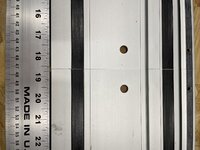
IMG_8561.jpeg
The saw actually runs on the raised part to the right of the 2 holes in the picture. Thats the feature that has to be straight.

These are extrusions so they should be dimensionally very good. The only real way to screw up a track is to have the ends cut out of square with that raised feature.

I’ve never done it but you could probably recut the ends with a chop saw.

Point is, I have old Bosch track and new Milwaukee track and both sets are better than they need to be. If you get bad track, send them back. If you have out of warranty track, try swapping them end for end. Maybe if one end is out the other is square. If both ends are out, theoretically you can fix it with a machinists square and a file.
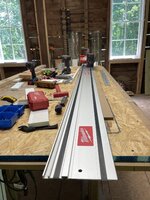
IMG_8563.jpeg
The connectors are not supposed to force the tracks straight. You **** them hard, then tighten the grub screws.

One more thing: The tracks aren’t all identical, but they are basically interchangeable between Festool, Milwaukee, Makita and maybe Maffel. If you were worried, either buy and check and plan to make a return, or buy Festool. I don’t think there’s an enormous price difference. (The difference in tracks is the non slip strips on the bottom and the anti tip feature that many of us will never use.

Edit: Props to anyone who can correctly identify the wooden plane in the pic above. Hint, there’s a piece of scrap on the bench showing what it does and explains why I’m using it.
 

signcrafter

Well-known member
Joined
May 9, 2012
Messages
12,366
I appreciate your post. I feel like there are a few people out there who got defective tracks and now everyone thinks joining track is a bad idea.

The tracks should **** together. The saw actually doesn’t care about the edge of the aluminum track. That can be off a little.

IMG_8561.jpeg
The saw actually runs on the raised part to the right of the 2 holes in the picture. Thats the feature that has to be straight.

These are extrusions so they should be dimensionally very good. The only real way to screw up a track is to have the ends cut out of square with that raised feature.

I’ve never done it but you could probably recut the ends with a chop saw.

Point is, I have old Bosch track and new Milwaukee track and both sets are better than they need to be. If you get bad track, send them back. If you have out of warranty track, try swapping them end for end. Maybe if one end is out the other is square. If both ends are out, theoretically you can fix it with a machinists square and a file.

IMG_8563.jpeg
The connectors are not supposed to force the tracks straight. You **** them hard, then tighten the grub screws.

One more thing: The tracks aren’t all identical, but they are basically interchangeable between Festool, Milwaukee, Makita and maybe Maffel. If you were worried, either buy and check and plan to make a return, or buy Festool. I don’t think there’s an enormous price difference. (The difference in tracks is the non slip strips on the bottom and the anti tip feature that many of us will never use.

Edit: Props to anyone who can correctly identify the wooden plane in the pic above. Hint, there’s a piece of scrap on the bench showing what it does and explains why I’m using it.
I could have spent more time figuring out what the deal was but I just got the long track so no more worries about joining tracks. It's really nice not having to worry about joining tracks anymore, even if they go together perfect it's a pain if you're making a bunch of cuts both ways in sheet goods. If you can afford it the long track is the way to go vs joining tracks. But guess it depends on budget and how often you are making long cuts.
 

AEAdam

Well-known member
Joined
May 27, 2023
Messages
2,777
Location
SE PA
I could have spent more time figuring out what the deal was but I just got the long track so no more worries about joining tracks. It's really nice not having to worry about joining tracks anymore, even if they go together perfect it's a pain if you're making a bunch of cuts both ways in sheet goods. If you can afford it the long track is the way to go vs joining tracks. But guess it depends on budget and how often you are making long cuts.
Right. And storage of the beast. I’ve seen some clever solutions, like behind the garage door. But if you have to travel at all, that’s a consideration.

Remember, the whole concept behind track saws was for European pros, either in small shops or doing cabinetry onsite. The idea is to set up a hasty work bench out of sawhorses and sheet goods and move the saw on precision tracks rather than moving the wood across a stationary precision saw and fence. And they can load their shops into a VW golf.

I’m not a European pro, but I absolutely work wherever is most convenient for me within my property, setting up temporary work stations wherever convenient, inside or out.

Now walking an 8’ track up a flight of stairs or carrying it to an out building is no issue. But I guess my point is, think about the utility of being able to pack up and move to another location (for me it will probably be kids’ homes).

So the alternative to the 8’ track could be 3 55s. So far this has not been a problem for me. I break my tracks down as and when and it’s no problem.
 

whateg01

Well-known member
Joined
Mar 13, 2006
Messages
11,370
Location
doo dah, kansas, usa
Other thing to think about is batteries. I had other milwaukee tools prior to buying a plunge cutting tracksaw. My track saw really needs a pretty big battery, which is really not useful for any other tool I own. So it’s not the case that I was smart to “stick with Milwaukee” because I already had batteries. Technically the batteries all interchange, but no way I’d want the 5amphr brick battery on my drill.
I think the Bosch uses a special battery. I saw somebody the other day try to put a 5 ah battery from one of the drills in it and then they went and got the big'un from the saw case. I haven't looked at them that closely to confirm that, but it makes sense. And yeah, the battery for the saw is bigger.
 

whateg01

Well-known member
Joined
Mar 13, 2006
Messages
11,370
Location
doo dah, kansas, usa
I could have spent more time figuring out what the deal was but I just got the long track so no more worries about joining tracks. It's really nice not having to worry about joining tracks anymore, even if they go together perfect it's a pain if you're making a bunch of cuts both ways in sheet goods. If you can afford it the long track is the way to go vs joining tracks. But guess it depends on budget and how often you are making long cuts.
It's no different than anything else here. Different strokes. I currently have 2 trailers and wouldn't want to be without them. Yet countless people here suggest that it's stupid to own a trailer; just rent one when needed. Otoh, a bunch of people here suggest owning a pickup is stupid because one can easily hook up a trailer to a car when a bigger piece of cargo needs to be moved.

I like a longer track for the convenience, but I could get by with shorter tracks, connecting them when needed. It does make me think more about order of operations so I don't have to connect/disconnect/reconnect/etc.
 

jar944

Well-known member
Joined
Jul 26, 2010
Messages
5,932
Location
Northern VA
The tracks should **** together. The saw actually doesn’t care about the edge of the aluminum track. That can be off a little.

No guarantee the tracks are cut square, or remain square after usage. Festool (at least previously) in their training tells users to keep them separated and not butted tight.
 

gamp945

Well-known member
Joined
Jun 4, 2014
Messages
1,547
I think the Bosch uses a special battery. I saw somebody the other day try to put a 5 ah battery from one of the drills in it and then they went and got the big'un from the saw case. I haven't looked at them that closely to confirm that, but it makes sense. And yeah, the battery for the saw is bigger.
The Bosch track saw can use any Bosch battery. But obviously higher Ah (larger) batteries generally provide greater performance in high amperage tools like a track saw. So, what battery you need to use may depend on what you are cutting.

I don't understand the attraction to cordless track saws. I always have my vacuum hose hooked up, so the track saw is always tethered anyway. A power cord goes to my dust extractor and both turn on automatically when I start the saw.

The corded Bosch track saw is a higher quality machine (very similar to the Mafell) compared to the cordless version.
 

tarbellb

Well-known member
Joined
Apr 17, 2011
Messages
5,760
Location
Oregon
No guarantee the tracks are cut square, or remain square after usage. Festool (at least previously) in their training tells users to keep them separated and not butted tight.
I appreciate your post. I feel like there are a few people out there who got defective tracks and now everyone thinks joining track is a bad idea.

The tracks should **** together. The saw actually doesn’t care about the edge of the aluminum track. That can be off a little.

The connectors are not supposed to force the tracks straight. You **** them hard, then tighten the grub screws.

.................

My OE Makita tracks only require me to **** the ends tight,
ive checked dozens of times over the years and theyve stayed straight. I consider myself lucky

Of course any new tracks or accidents and they get rechecked
 

AEAdam

Well-known member
Joined
May 27, 2023
Messages
2,777
Location
SE PA
No guarantee the tracks are cut square, or remain square after usage. Festool (at least previously) in their training tells users to keep them separated and not butted tight.
That's really interesting and kinda counterintutive. But maybe the Festool connectors are self centering? I thought they were all the same as everyone else's (said differently, everyone copied Festool's design).
My OE Makita tracks only require me to **** the ends tight,
ive checked dozens of times over the years and theyve stayed straight. I consider myself lucky

Of course any new tracks or accidents and they get rechecked
Right. That's my experience. And another worry. I handle my tracks with care. I do set them on end, which I probably shouldn't do.

I hope this line of discussion of joining tracks, the criticality of the ends, how the connectors work, the fragility of the tracks in general, is helpful.
 

AEAdam

Well-known member
Joined
May 27, 2023
Messages
2,777
Location
SE PA
The Bosch track saw can use any Bosch battery. But obviously higher Ah (larger) batteries generally provide greater performance in high amperage tools like a track saw. So, what battery you need to use may depend on what you are cutting.

I don't understand the attraction to cordless track saws. I always have my vacuum hose hooked up, so the track saw is always tethered anyway. A power cord goes to my dust extractor and both turn on automatically when I start the saw.

The corded Bosch track saw is a higher quality machine (very similar to the Mafell) compared to the cordless version.
I bought Milwaukee because I had Milwaukee batteries. I thought I could at least use the smaller battery in a pinch. The saw really doesn't run well with a small battery. So this meant to me, my existing batteries, if not large enough to accomondate the saw, were of no real value to me, meaning, I should have considered saws I didnt' curently have batteries for. You can't really share drill batteries with track saws. The only thing I saved was the cost and space of an extra charger (which is not nothing).

In terms of cutting capability and battery life, I'm more than satisfied with the battery saw.

I think the discussions we've had about this often come down to the specific uses for these tools. Some guys use these in dedicated woodshops because they excel at breaking down sheetgoods, but maintain their use of table saws. Others say these tools replace the functionality of a table saw, but its a shop based tool with near permanent dust collection (long tracks are no problem) etc. Those of us maybe closer to using these for their intended purpose maintain the battery is an essential part of the functionality of the system.

I was recently using mine to cut subflooring on a new mezzanine I built. Having no cord was a game changer for me (when you are moving 4x8x3/4" plywood around, I typically slide that stuff and any cords or hoses in the way just makes that more difficult and time consuming.) So it all boils down to specifically how and where you use your track saw.
 

neophyte

Well-known member
Joined
Apr 23, 2012
Messages
9,715
Location
Pennsylvannia
I appreciate your post. I feel like there are a few people out there who got defective tracks and now everyone thinks joining track is a bad idea.

The tracks should **** together. The saw actually doesn’t care about the edge of the aluminum track. That can be off a little.

IMG_8561.jpeg
The saw actually runs on the raised part to the right of the 2 holes in the picture. Thats the feature that has to be straight.

These are extrusions so they should be dimensionally very good. The only real way to screw up a track is to have the ends cut out of square with that raised feature.

I’ve never done it but you could probably recut the ends with a chop saw.

Point is, I have old Bosch track and new Milwaukee track and both sets are better than they need to be. If you get bad track, send them back. If you have out of warranty track, try swapping them end for end. Maybe if one end is out the other is square. If both ends are out, theoretically you can fix it with a machinists square and a file.

IMG_8563.jpeg
The connectors are not supposed to force the tracks straight. You **** them hard, then tighten the grub screws.

One more thing: The tracks aren’t all identical, but they are basically interchangeable between Festool, Milwaukee, Makita and maybe Maffel. If you were worried, either buy and check and plan to make a return, or buy Festool. I don’t think there’s an enormous price difference. (The difference in tracks is the non slip strips on the bottom and the anti tip feature that many of us will never use.

Edit: Props to anyone who can correctly identify the wooden plane in the pic above. Hint, there’s a piece of scrap on the bench showing what it does and explains why I’m using it.
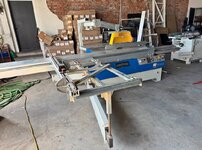
Mafell uses a completely different track design from Festool.
The two early makers of track saws that are still around are Festool and Mafell.
Festool became better known for track saws, so a lot of other track saws are now made “compatible” (actual more semi compatible), with the Festool track design.
In addition to Festool, this included Hilti, were the saws were track compatible, Makita, and now some others, possibly including regular Metabo.
Mafell also made at least one plunge saw that was semi compatible with the Festool tracks. (I think only for 90 degree cuts).
Mafell developed their own track system, that some consider superior, however, the raised guide bar is a completely different dimension to the Festoon tracks, and the thickness of the tracks is different, which would cause alignment issues if saws are tilted.
Bosch from my understanding, uses the Mafell tracks, and maybe even has dome of their saws made by Mafell, or did in the past.
Fein a couple decades or more ago also sold a track compatible circular saw that was compatible with the Mafell track system, and likely the Fein saw was made for Fein by Mafell. I’ve never seen the saw for sale in the USA, other than on a Fein price list.
I think Flex of Germany may have also used the Mafell track system for some saws that were not ever sold in North America.
Dewalt technically uses a different track design with a centered rib, but Dewalt also put an extra groove in their track saw base allowing the Dewalt saws to be compatible with the Festool tracks.
 

gamp945

Well-known member
Joined
Jun 4, 2014
Messages
1,547
Bosch from my understanding, uses the Mafell tracks, and maybe even has dome of their saws made by Mafell, or did in the past.
Fein a couple decades or more ago also sold a track compatible circular saw that was compatible with the Mafell track system, and likely the Fein saw was made for Fein by Mafell.
The corded Bosch plunge saw is almost the same as the Mafell unit and may indeed be designed and/or manufactured by Mafell. The cordless Bosch plunge saw seems to be designed and made by Bosch.

A bit off topic for this thread, but the different track saw systems also vary in the availability of accessories: attachments for circular saws, routers, jigsaws, shelf pin jigs, edge guides, miter jigs, and 90-degree squares are available for some brands.
 

jar944

Well-known member
Joined
Jul 26, 2010
Messages
5,932
Location
Northern VA
That's really interesting and kinda counterintutive. But maybe the Festool connectors are self centering? I thought they were all the same as everyone else's (said differently, everyone copied Festool's design).

They are not self centering. The user is expected to align the tracks with a straight edge. The ends are not to be relied on for square.
 

tak1313

Well-known member
Joined
Feb 4, 2018
Messages
658
I got the corded Makita a few years ago with 2 55" tracks. One track was slightly bowed, so I got another one that was straight and cut the bowed one down to 39" with no (or reasonable) bow.

I've never had a problem joining the two tracks using a straight edge (on the bump that is ACTUALLY the reference for the saw - versus the edge), but being a home user, I also rarely have need for the 118" track.

I don't know if I would get a 118" even if I needed it more often. I am confident with joining my two 55 tracks that it's straight all the way, but I might not be as confident with one single 118". They are, after all, extrusions and not machined, so the likelihood of a 118" track being bowed along its length increases significantly versus two known 55" tracks joined together.

The longest straight edge I have to check is a 6 foot Empire Blue level (I have machined straight edges, but the longest is 48"), so I could only be sure of any 6ft section being pretty straight,
 
To avoid these ads, REGISTER NOW!
Top Bottom