Private Lugnutz
Well-known member
It sure does! Lends credence to the concept not being a one-off and a place to start looking. Thanks for posting!Lugnutz: This is not the tiny vise you posted but it does have features in common with yours.


It sure does! Lends credence to the concept not being a one-off and a place to start looking. Thanks for posting!Lugnutz: This is not the tiny vise you posted but it does have features in common with yours.
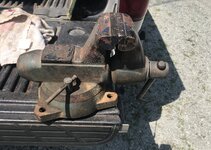
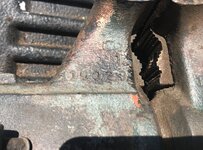
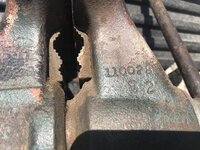
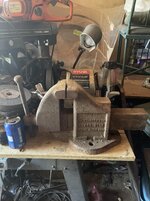
Beautiful find Man. Looks to be a 608.Saw - and left behind - this massive Columbian (I didn't measure and guy didn't know, but looked at least like 8" jaws) this morning. I couldn't read the model number. Posterity pics.

That looks like it could be a 608 Lugz. That's why I roll the swaps with a heavy duty cart so I never have to leave one of those big monsters behind...Saw - and left behind - this massive Columbian (I didn't measure and guy didn't know, but looked at least like 8" jaws) this morning. I couldn't read the model number. Posterity pics.
 Oops I see TheRealZeus beat me to it. Ed.
Yes, I can see it now! Thanks.Looks to be a 608.
It wasn't the size - he was on the closest table to the PL, but the price. I only have a dozen or so vises and all of them were "steals", where the seller was uninformed, badly underinformed, or informed enough but letting things go low.That's why I roll the swaps with a heavy duty cart so I never have to leave one of those big monsters behind...




Cool! Why does the sign say "Prentiss Patent Vise." If the company name didn't change until after the sign was built? Was the Prentiss name used for the vise itself before the company name was changed (since it was after all the designers name)?The reunion of two of the greatest items of American vise history ever found...
At the risk of being longwinded but for the sake of being thorough, I want to document the history of the items in these pictures with as much detail as possible. Nearly 4 years ago, my passion for American history intertwined with an unexplainable appreciation for vises. Ever since then, I've dedicated innumerable hours to the research, discovery, and publication of the history of vises in America - most prominently, the history of the Prentiss Vise Company. I don't say any of this as someone soliciting a request for applause but as an unremarkable, obsessive, 28 year-old family man from Texas who enjoys the thrill of discovery and fears the sad reality that material things like these are destined for the scrap heap if they're not preserved. Ok, moving on...
What you're looking at is a genuine, 53" long wooden advertising model of the renown Prentiss Patent Vise, topped with a 47" long, double sided, wooden sign advertising the same. The model and the sign were both located separately, having changed hands and sporadically surfaced several times over the course of digitalized history. After becoming aware of their existence, I spent nearly a year attempting to locate each one. After months of searching and several incredible strokes of luck (a story too long to document here), I located both. I was lucky enough to obtain the sign for my personal collection, and I was doubly lucky to discover that the model was owned by a friend of mine. Even though the sign and the model are part of two separate collections, we were determined to reunite them for, perhaps, the first time in over 100 years.
When were they made? - With 99% certainty, both the sign and the model were made between 1876 and 1878. Despite Mason Prentiss patenting his revolutionary swivel-jaw vise on March 17, 1868, the earliest known mention of the manufacture of Mason's vise didn't surface until May 11, 1876 (over 8 years later). It was on this day (and also a week later on May 18, 1876) that both the Corning Journal and the Watkins Express newspapers announced that James F Hall of Hoosick Falls, NY had recently moved to Havana, NY in order to "manufacture the adjustable jaw vise". The smattering of newspaper articles that came in the following several years confirmed that this "adjustable jaw vise" was indeed Mason Prentiss' patented swivel-jaw vise. Though the finer details of the early days are not yet clear, what is confirmed is that the manufacturing of Prentiss's vise began as a product of the partnership between James F Hall and Elbert P Cook, both residents of Havana, NY. The partnership between these two men was known locally as "Cook & Hall", and it was under this company name that the first visual depiction of a Prentiss vise ever saw the light of day on February 24, 1876 (which just so happens to be my birthday). See the very last picture for a snip of this advertisement. Cook & Hall operated in Havana, NY for only a little over a year until General John E Mulford (a resident of Havana, NY) and Mortimer G Lewis bought out Cook's interest in the business, incorporated it the Hall Manufacturing Company on September 10, 1878, relocated its offices to 23 Dey Street in NYC, and contracted with Bagley & Sewall of New York City to produce the company's vises (there are reams of other supporting details and concrete support to back this up, but they are too lengthy to include here).
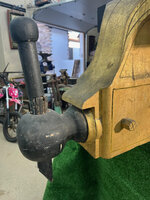
In both the 1876 advertisement and the vise model, you'll notice the funky little growth on the driver's side of the dynamic jaw. From numerous other photos, contextual clues from the time period, and a teaspoon of deductive reasoning, we know that this was an oil plug, an access point to allow the user to oil the vise screw (similar to the oil plug/hole in later Reed vises). For unknown reasons, the company decided to do away with this oil plug very early on. This is most clearly seen by comparing the April 1879 and May 1879 issues of the American Machinist where the Prentiss Patent Vise is advertised. Not a single feature of the advertisement is changed between the two issues except that the oil plug disappears, never to be seen thereafter. Given the presence of the oil plug on the vise model, we can conclude that it was very likely built during the Hall Manufacturing era (the company didn't change their name to the Prentiss Vise Company until April 18, 1881).
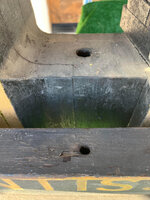
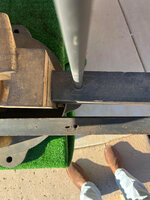
Additionally, you'll notice two distinct holes in both the vise model AND the vise sign (the black pipes that connect the two are not original). The distance between both sets of holes is exactly 22 1/4". Combined with similarities in material, color scheme, and age, this observation leads us to conclude without a doubt that the vise model and the sign were 1) both manufactured at the same time and 2) displayed together.
There is SO much more that could be said (all of which I look forward to posting incrementally with time), but I'll cut the post off here. Please always feel free to reach out with any questions about the history of the Prentiss Vise Company or about your specific Prentiss vise, and I'll very likely be able to help you, and do so happily.
I would check the underside of the wedge to see if there’s remnants of a dowel that went completely through, landing where the hole is.The reunion of two of the greatest items of American vise history ever found...
At the risk of being longwinded but for the sake of being thorough, I want to document the history of the items in these pictures with as much detail as possible. Nearly 4 years ago, my passion for American history intertwined with an unexplainable appreciation for vises. Ever since then, I've dedicated innumerable hours to the research, discovery, and publication of the history of vises in America - most prominently, the history of the Prentiss Vise Company. I don't say any of this as someone soliciting a request for applause but as an unremarkable, obsessive, 28 year-old family man from Texas who enjoys the thrill of discovery and fears the sad reality that material things like these are destined for the scrap heap if they're not preserved. Ok, moving on...
What you're looking at is a genuine, 53" long wooden advertising model of the renown Prentiss Patent Vise, topped with a 47" long, double sided, wooden sign advertising the same. The model and the sign were both located separately, having changed hands and sporadically surfaced several times over the course of digitalized history. After becoming aware of their existence, I spent nearly a year attempting to locate each one. After months of searching and several incredible strokes of luck (a story too long to document here), I located both. I was lucky enough to obtain the sign for my personal collection, and I was doubly lucky to discover that the model was owned by a friend of mine. Even though the sign and the model are part of two separate collections, we were determined to reunite them for, perhaps, the first time in over 100 years.
When were they made? - With 99% certainty, both the sign and the model were made between 1876 and 1878. Despite Mason Prentiss patenting his revolutionary swivel-jaw vise on March 17, 1868, the earliest known mention of the manufacture of Mason's vise didn't surface until May 11, 1876 (over 8 years later). It was on this day (and also a week later on May 18, 1876) that both the Corning Journal and the Watkins Express newspapers announced that James F Hall of Hoosick Falls, NY had recently moved to Havana, NY in order to "manufacture the adjustable jaw vise". The smattering of newspaper articles that came in the following several years confirmed that this "adjustable jaw vise" was indeed Mason Prentiss' patented swivel-jaw vise. Though the finer details of the early days are not yet clear, what is confirmed is that the manufacturing of Prentiss's vise began as a product of the partnership between James F Hall and Elbert P Cook, both residents of Havana, NY. The partnership between these two men was known locally as "Cook & Hall", and it was under this company name that the first visual depiction of a Prentiss vise ever saw the light of day on February 24, 1876 (which just so happens to be my birthday). See the very last picture for a snip of this advertisement. Cook & Hall operated in Havana, NY for only a little over a year until General John E Mulford (a resident of Havana, NY) and Mortimer G Lewis bought out Cook's interest in the business, incorporated it the Hall Manufacturing Company on September 10, 1878, relocated its offices to 23 Dey Street in NYC, and contracted with Bagley & Sewall of New York City to produce the company's vises (there are reams of other supporting details and concrete support to back this up, but they are too lengthy to include here).
In both the 1876 advertisement and the vise model, you'll notice the funky little growth on the driver's side of the dynamic jaw. From numerous other photos, contextual clues from the time period, and a teaspoon of deductive reasoning, we know that this was an oil plug, an access point to allow the user to oil the vise screw (similar to the oil plug/hole in later Reed vises). For unknown reasons, the company decided to do away with this oil plug very early on. This is most clearly seen by comparing the April 1879 and May 1879 issues of the American Machinist where the Prentiss Patent Vise is advertised. Not a single feature of the advertisement is changed between the two issues except that the oil plug disappears, never to be seen thereafter. Given the presence of the oil plug on the vise model, we can conclude that it was very likely built during the Hall Manufacturing era (the company didn't change their name to the Prentiss Vise Company until April 18, 1881).
Additionally, you'll notice two distinct holes in both the vise model AND the vise sign (the black pipes that connect the two are not original). The distance between both sets of holes is exactly 22 1/4". Combined with similarities in material, color scheme, and age, this observation leads us to conclude without a doubt that the vise model and the sign were 1) both manufactured at the same time and 2) displayed together.
There is SO much more that could be said (all of which I look forward to posting incrementally with time), but I'll cut the post off here. Please always feel free to reach out with any questions about the history of the Prentiss Vise Company or about your specific Prentiss vise, and I'll very likely be able to help you, and do so happily.


That’s exactly correct, Bryson. From the very beginning (see the 1876 advertisement, for example), the company referred to the vise as the “Prentiss’ Patent Self-Adjusting Bench Vise”, “Prentiss’ Patent Adjustable Jaw Vise”, and “Prentiss’ Patent Vise”.Why does the sign say "Prentiss Patent Vise." If the company name didn't change until after the sign was built? Was the Prentiss name used for the vise itself before the company name was changed (since it was after all the designers name)?
Hey, Real Zeus, thanks for the input! I actually did check at the time, and the hole goes straight through to the slide as you pointed out in your drawing. However, the jury is out on whether the rod was steel or wood (though, like you mentioned, I tend to think it was wood)I would check the underside of the wedge to see if there’s remnants of a dowel that went completely through


The 106lbs is definitely not accurate. It’s not a common brand, but I’ve heard these were made by Nippon Industries in Japan around WWII. They’re basically a Japanese copy of Morgan’s. It seems Nippon might’ve also made these vises for Milwaukee at one time (notice the “Made in Japan” in the ad).Does anyone recognize this No. 140 vise? I believe it may be an Iron City vise. The jaws measure 4" across and the overall length is about 15". The owner claims it weighs 106 lbs which seems a little over the top to me. Can anyone here verify if this is infact correct?
In one of the most interesting and unique threads on the internet... (IMHO)Whelp.. that is a contender for the coolest post of the day.
I think what the seller means by "106 lb" is "Damn this thing is heavy!"Does anyone recognize this No. 140 vise? I believe it may be an Iron City vise. The jaws measure 4" across and the overall length is about 15". The owner claims it weighs 106 lbs which seems a little over the top to me. Can anyone here verify if this is infact correct?
 ️ N
️ N
Thanks for sharing, CRS! That’s an amazing one. I wonder if it still exists. I have a friend who owns a postcard that depicts (what I believe to be) the same Athol vise model but earlier in their history (attached)Micahd: Here's another wooden model of a vise.
Do you have a picture of the vise?How much should a vise stand weigh if the vise I'm going to put on it is 400kg?
 one second.
never seen another.

I am seeing a couple declarations that the patent no. 142,546 but unable to dig at this time. Good luck!******* kit vise I think…


Spot on. I couldn't find any available pages for it, so I pulled them from the USPTO's databaseI am seeing a couple declarations that the patent no. 142,546 but unable to dig at this time. Good luck!
Beware, that is a design patent number, as @micahd1997 shows. If you lead with a D at google parents, or DATAMP, it will come up.I am seeing a couple declarations that the patent no. 142,546 but unable to dig at this time. Good luck!
Mine too, keep pushing the Baby title, maybe double king's ransom.Mine is the deluxe edition with the “pipe clamps” . Likely worth a kings ransom
 www.garagejournal.com
Thanks Patrick I knew the starrett was a really nice vise but was not sure about the Wilton. I am hoping he hangs on to the starrett since it is from his dad.@elmer tell him you want both!! The Starrett is very nice and quality. One of the best. The Wilton is “home owner” but still a nice quality vise.


Looks great! I definitely like the raw steel look over the original burnt orangeI finished this today to make using my drill press vises easier to lock down
I need to do something like that to make more real estate for my mag-base DP vise--and then I could have a single, round hole in the DP table!Not technically about vises, but I finished this today to make using my drill press vises easier to lock down.
Looks great! I definitely like the raw steel look over the original burnt orange