To avoid these ads, REGISTER NOW!

3.5” Drive Sockets?

kxxr

Well-known member
Joined
Apr 25, 2011
Messages
504
Location
Big Sky Country
Browsing eBay, I see Wright Tool 85834 - 2-1/2Inch Drive 6 Point Standard Impact Socket - 4-1/4Inch listed for thousands of dollars. What tool is used to drive such a these giant sockets? Wright Tool lists drive sizes up to 3.5” on their sockets but I don’t see anything that big in the drive tools.
 
To avoid these ads, REGISTER NOW!

neophyte

Well-known member
Joined
Apr 23, 2012
Messages
9,713
Location
Pennsylvannia
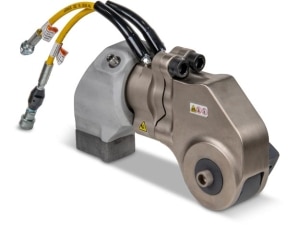
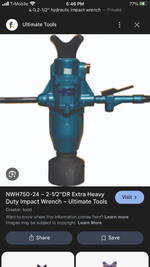
There are giant hydraulic and/or pneumatic wrenches that drive the large sockets.
These wrenches and sockets are used for karge industrial applications, and structures, and on things like shops, were a day of down time can easily be $100,000.
 

Attachments

  • IMG_0656.png
    IMG_0656.png
    1.9 MB · Views: 44
  • IMG_0655.png
    IMG_0655.png
    1.5 MB · Views: 43
  • IMG_0654.png
    IMG_0654.png
    690.3 KB · Views: 43
OP
K

kxxr

Well-known member
Joined
Apr 25, 2011
Messages
504
Location
Big Sky Country
Thanks. That helps to picture how they’re used. I saw photos of single sockets for $14,000. There was nothing in the picture to show scale but they must be huge. 3.5” drive, 10 1/2” socket looks like any other if there’s nothing to compare. I have not seen any like that. Thanks again.
 

seber

Well-known member
Joined
May 31, 2016
Messages
4,198
Location
Deep East Tx.
Check out power dams. You will see a lot of really big fasteners. The more modern approach is to use multiple drive fasteners to secure a single nut.
 

Shiftless

Well-known member
Joined
Mar 9, 2014
Messages
14,553
Location
East Bay SFO
Pretty sure I have seen some of those larger ones used on oil rigs etc.

I would hate the weight of at least 24" of adapters, to try to turn that socket with a 1/4" ratchet.:ROFLMAO:
Ha ha
Take pictures and show them to the SnapOn driver when you make that warranty claim on the ratchet. Video the transaction and post a link here please. 😎

Why would the ratchet break just because I used a 10 foot long steel pipe cheater?
 

Steve_P

Well-known member
Joined
Sep 15, 2010
Messages
5,185
Most stuff that large uses a stud and then you stretch the stud with a hydraulic tensioner and the nut is installed hand tight. I can't imagine they're selling too many 2.5" drive sockets these days.
 
To avoid these ads, REGISTER NOW!

Steve_P

Well-known member
Joined
Sep 15, 2010
Messages
5,185
How much torque do these generate?


What does this mean? That the nut is just threaded on but not tight, and other fasteners used to keep it there?


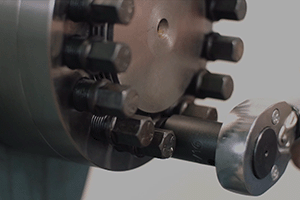
We also used these. Install by hand and then tighten a bazillion smaller fasteners that stretch the stud or shank. Simple idea, one of those, "why didn't I think of that" designs. So instead of tightening one fastener to 1000 lbf-ft, you tighten twenty to 50 lbf-ft to get similar elongation. We used these in confined spaces where there was no room for a 6'+ torque wrench, which we also had.
 

afazz

Well-known member
Joined
Nov 25, 2007
Messages
860
Location
Pittsburgh, PA
Most of those big sockets are used on a hydraulic torque wrenches. One of the most common brands, and the general slang term for these devices, is Hytorc. The 3-1/2" drive Hytorc Avanti model goes up to 138,510 foot pounds, which should be enough for most bridges and skyscrapers. As stated above, multi-jackbolts and stud tensioners are also quite common in these large bolted assemblies for infrastructure projects.


Mid-size stuff (1" drive) can be used with a torque multiplier or large pneumatic impact gun
 

Beerhippie

Well-known member
Joined
Oct 13, 2023
Messages
9,848
Location
Far NE Oregon
The Fremont Bridge in Portland, OR was built in the early '70s. The final part of the process was raising the pre-fab center span, which was done with HUGE nuts on HUGE threaded rods. I was barely a teen back then and tried to, but couldn't, lift one of the nuts! It took a week or so of constant work with huge pass-through hydraulically-driven sockets.

That was over fifty years ago, but my memory is like a steel trap (rusty), so I'm sticking to my story.
 

Snapped-off

Well-known member
Joined
Feb 22, 2012
Messages
4,804
Location
Indiana

We also used these. Install by hand and then tighten a bazillion smaller fasteners that stretch the stud or shank. Simple idea, one of those, "why didn't I think of that" designs. So instead of tightening one fastener to 1000 lbf-ft, you tighten twenty to 50 lbf-ft to get similar elongation. We used these in confined spaces where there was no room for a 6'+ torque wrench, which we also had.
I think the only place I've seen these in person is on the 3" countermeasure launchers on a sub.
 

Steve_P

Well-known member
Joined
Sep 15, 2010
Messages
5,185
I think the only place I've seen these in person is on the 3" countermeasure launchers on a sub.


We use these a lot. It's a slow process, but it works great. We use the hydraulic stud tensioning method with "long pole" tools typically where we cannot send a human into because of radiation exposure. So, we can lower a tensioner on a pole that's supported from small bridge crane, use cameras- also on poles, and... tighten stuff without sending a human into a cavity of death.

Edit- I don't remember anything over 2" diameter. But plenty of stuff from 1-2", and UN and UNF. :rolleyes: :rolleyes:
 

Snapped-off

Well-known member
Joined
Feb 22, 2012
Messages
4,804
Location
Indiana
We use these a lot. It's a slow process, but it works great. We use the hydraulic stud tensioning method with "long pole" tools typically where we cannot send a human into because of radiation exposure. So, we can lower a tensioner on a pole that's supported from small bridge crane, use cameras- also on poles, and... tighten stuff without sending a human into a cavity of death.

Edit- I don't remember anything over 2" diameter. But plenty of stuff from 1-2", and UN and UNF. :rolleyes: :rolleyes:
The launcher tubes are 3". Not sure what size the superbolts were.
 
To avoid these ads, REGISTER NOW!
Top Bottom