To avoid these ads, REGISTER NOW!

Grounding wire question - wifi box

tominboise

Well-known member
Joined
Jan 17, 2022
Messages
195
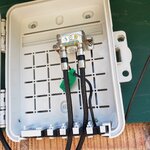
I get wifi provided by Sparklight, via an overhead coax line to a box mounted on the fascia of my house. I had to move this box in order to install a patio cover. It was grounded to the main panel mast via a short piece of 12ga solid wire. I moved the box about 30' from the main panel mast. Would solid 12ga be appropriate as a ground at this length? Should I use 10ga solid instead? Is there a better way to ground it in lieu of running it so far to the mast? Also, other then staples, is there any way to discretely secure this ground to the fascia?
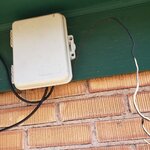
20250729_153013.jpg

Inside the box:

20250729_153021.jpg
 
To avoid these ads, REGISTER NOW!

mm08822

Well-known member
Joined
Jan 13, 2012
Messages
5,957
Location
NJ
Is the 35' to the main panel a problem?
Not ideal, but it needs to be done. And for sure on the #10 or even #8.
The only other way is to drive an additional ground rod closer and connect a shorter wire AND also connect that new rod to your other existing rods with #6 or #8 copper depending on service size.
 
OP
T

tominboise

Well-known member
Joined
Jan 17, 2022
Messages
195
I ordered a 50ft roll of 8ga solid copper from HD which will be delivered tomorrow. I need to get some clamps to secure it to the fascia.
 

mm08822

Well-known member
Joined
Jan 13, 2012
Messages
5,957
Location
NJ
I ordered a 50ft roll of 8ga solid copper from HD which will be delivered tomorrow. I need to get some clamps to secure it to the fascia.
Is it bare or insulated? Copper won't play well against aluminum. If your trim/siding is not metal then it won't matter.
 
To avoid these ads, REGISTER NOW!

mm08822

Well-known member
Joined
Jan 13, 2012
Messages
5,957
Location
NJ
Use a bonding bridge and connect all the extra stuff (cable, telco, etc) to it instead of going into the panel or a grounding rod.
I think that's in the NEC within the last 10 years.

It is required now and being pushed heavily. However, older services have a hodge-podge of connection practices made by other utilities.
 

walta

Well-known member
Joined
Jan 13, 2017
Messages
2,311
Location
Dutzow Missouri
Just to be 100% clear you don’t own that box and the providers rules for installation of the service likely require to be install within a few feet of the electric service. Sooner or later they will be on site and when the tech finds this nonconforming installation there will be a **** show.

Do you have anything connected to their equipment with a wire?

Walta
 

75gmck25

Well-known member
Joined
Jul 21, 2014
Messages
1,325
Location
Alexandria, VA
I think we are getting confused by mixing house current electrical code with a low voltage device installation.

Since you are grounding a low voltage, unpowered device (a coax cable splitter/junction), I don't think 120 volt code requirements for grounding even apply. You want a good ground so you have better protection from lightning strikes or other over-voltage situations, but I think you can ground it without worrying about the existing grounding for the house circuits.
 

mm08822

Well-known member
Joined
Jan 13, 2012
Messages
5,957
Location
NJ
I think we are getting confused by mixing house current electrical code with a low voltage device installation.

Since you are grounding a low voltage, unpowered device (a coax cable splitter/junction), I don't think 120 volt code requirements for grounding even apply. You want a good ground so you have better protection from lightning strikes or other over-voltage situations, but I think you can ground it without worrying about the existing grounding for the house circuits.
Not so, they must be bonded to be/become one system.
 

dscheidt

Well-known member
Joined
Apr 26, 2017
Messages
2,895
I think we are getting confused by mixing house current electrical code with a low voltage device installation.

Since you are grounding a low voltage, unpowered device (a coax cable splitter/junction), I don't think 120 volt code requirements for grounding even apply. You want a good ground so you have better protection from lightning strikes or other over-voltage situations, but I think you can ground it without worrying about the existing grounding for the house circuits.

No. There's a code requirement to bond everything in one place, and for good reason, it keeps the cable/phone/whatever from beng at different potential than the electrical system. Without a common bond, it's possible to have a shock hazard from coax, and it causes all sorts of problems when lightning hits it. The requirement is fairly new, and not universally followed by installers, and there are millions of old installations still out there, so plenty of stuff done wrong.
 

wyliesdiesels

Well-known member
Joined
Aug 14, 2012
Messages
20,022
Location
Modesto, CA
I think we are getting confused by mixing house current electrical code with a low voltage device installation.

Since you are grounding a low voltage, unpowered device (a coax cable splitter/junction), I don't think 120 volt code requirements for grounding even apply. You want a good ground so you have better protection from lightning strikes or other over-voltage situations, but I think you can ground it without worrying about the existing grounding for the house circuits.
wrong wrong wrong.

communications infrastructure including antennas are covered under the NEC.

also, a grounding electrode regardless of what its for, is covered under the NEC

it would be incredibly stupid to install an isolated grounding electrode. doing so causes equipment to be at different potentials, which can cause fried equipment especially if there are lightning strikes and surges as well as potential for shock hazard...

you want everything bonded and at the same potential. NEVER install an isolated grounding electrode
 
To avoid these ads, REGISTER NOW!
Top Bottom