To avoid these ads, REGISTER NOW!

The VISES of Garage Journal

To avoid these ads, REGISTER NOW!

PeterPeter

Well-known member
Joined
Apr 30, 2019
Messages
176
Location
Newburyport
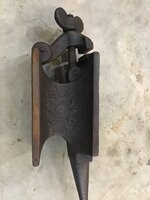
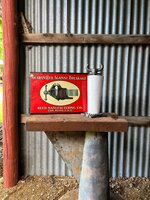
Now here’s a mystery wrapped in a riddle. Have you ever heard of/seen a C. Parker no. 89? I do not see an embossed 1/2 on this vise, and the ad calls it an 89. There’s the 88, and a 89 1/2, and this one seems to split the difference by removing the front slide support! Pretty crazy, no? Or is it an 89 1/2 that just got a hack job? There is no mention of size in the ad, but I’d venture a guess it is the much larger no. 89 1/2 body.
IMG_1685.jpegIMG_1686.jpegIMG_1687.jpeg
peter, who would love to pick a peck of rusty Parkers.
 
Last edited:

PeterPeter

Well-known member
Joined
Apr 30, 2019
Messages
176
Location
Newburyport
Close inspection will likely show the front jaw support busted off... I have a 4" Parker jawed Oswego with the support MIA

What do the jaws actually measure? i'd guess the "1/2" fell off them pattern.
It’s an old ad, two hours from me, and they’re asking a big price for what amounts to a parts machine. I haven’t asked, bcs I doubt I would travel that far for yet another parts collection. 🙂
 

NC Fabricator25

Well-known member
Joined
May 28, 2010
Messages
193
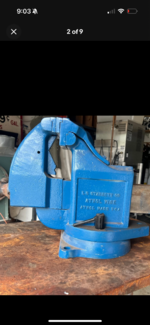
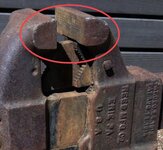
Noticed a very unique Starrett 926 on the large auction site. Vise has an odd raised rear jaw that seems to be fastened to the original lower jaw. But oddly the front jaw itself is higher and lines up with the increased height rear jaw. At first glance it looks like a smaller main casting was mated to a larger dynamic jaw, but the main casting is a 926, the largest Starrett made. Anybody have any thoughts about what this is? IMG_2923.png
 

Attachments

  • IMG_2924.png
    IMG_2924.png
    2.7 MB · Views: 33
  • IMG_2925.png
    IMG_2925.png
    2.6 MB · Views: 31
  • IMG_2926.png
    IMG_2926.png
    1.6 MB · Views: 38

Outlawmws

Well-known member
Joined
Aug 9, 2011
Messages
39,305
Location
The Badlands
At first glance it looks like a smaller main casting was mated to a larger dynamic jaw, but the main casting is a 926, the largest Starrett made.

I think you spelled it out, someone took a combination vise's, D jaw and machined it to fit the smaller vise. Then the fabricated the static jaw extension, and bolted it on I'd expect the jaw screws were used, and those two added bolts.
 

NC Fabricator25

Well-known member
Joined
May 28, 2010
Messages
193
I think you spelled it out, someone took a combination vise's, D jaw and machined it to fit the smaller vise. Then the fabricated the static jaw extension, and bolted it on I'd expect the jaw screws were used, and those two added bolts.
Agree, it's obviously some kind of one-off adaptation. But I have to wonder what the dynamic jaw and casting is from? The main body is a 926, a rather large vise, so the dynamic jaw would have been from a larger vise to be that much taller. Did Starrett make any vises larger, or taller? Of course it could have been from a different manufacturer too.

Interesting for sure, but a bit much for my budget!
 

Outlawmws

Well-known member
Joined
Aug 9, 2011
Messages
39,305
Location
The Badlands
Agree, it's obviously some kind of one-off adaptation. But I have to wonder what the dynamic jaw and casting is from? The main body is a 926, a rather large vise, so the dynamic jaw would have been from a larger vise to be that much taller. Did Starrett make any vises larger, or taller? Of course it could have been from a different manufacturer too.

Interesting for sure, but a bit much for my budget!
Combination vises are by their nature taller vises and a bit beefier since the jaw towers are so tall to accommodate the pipe jaw below. . but for their size, often the jaws are a bit narrower than you might expect. - that said they likely narrowed the D jaw, and adapted the jaw caps from the Starrett.
 

DCRUTT

Well-known member
Joined
Jul 28, 2012
Messages
48
Location
Rochester, NY
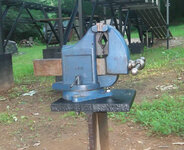
Recently picked up a Reed 31. Latest patent date is 1914. I believe I found the build date on both jaws. I’ve attached pics. I think it is 918. Open for opinions. Thanks.
 

Attachments

  • IMG_9455.jpeg
    IMG_9455.jpeg
    568.6 KB · Views: 18
  • IMG_9457.jpeg
    IMG_9457.jpeg
    570.6 KB · Views: 17
  • image.jpg
    image.jpg
    952.6 KB · Views: 37

KMScott

Well-known member
Joined
Feb 14, 2012
Messages
4,643
Location
Daufuskie Island, South Carolina
Noticed a very unique Starrett 926 on the large auction site. Vise has an odd raised rear jaw that seems to be fastened to the original lower jaw. But oddly the front jaw itself is higher and lines up with the increased height rear jaw. At first glance it looks like a smaller main casting was mated to a larger dynamic jaw, but the main casting is a 926, the largest Starrett made. Anybody have any thoughts about what this is?

Looks like a 326 married with a 926 then a custom jaw support manufactured. Starrett used the same broach on both vises for the Dynamic square hole. In my opinion.
 

Attachments

  • IMG_2984.jpeg
    IMG_2984.jpeg
    1.2 MB · Views: 29
  • IMG_2985.jpeg
    IMG_2985.jpeg
    881 KB · Views: 32
Last edited:

CRSINMICH

Well-known member
Joined
Aug 15, 2015
Messages
2,414
Location
Southeastern Michigan
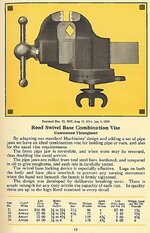
DCRUTT: Here is a page from a ca. 1931 Reed catalog. It gives the applicable patent dates for their combination vises. This style of through-the-bench mounting didn't survive much longer than 1931 so that's probably the youngest your vise could be. The numbers stamped into the jaws could be parts numbers. Speaking of jaws, look closely at the jaw faces in this catalog cut. They are unusual. Take a look at the faces on your vise. Post some pictures of them and a shot showing the entire vise.

1931 ca Reed Catalog page.jpg


colmal

Well-known member
Joined
Sep 8, 2021
Messages
454
Location
Australia
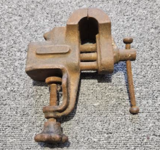
I was sent these pics a few days ago, it followed a friend home, have seen some similar maybe UK, even Japanese possibly, found a few pics somewhat similar,

It got dropped off tonight as a Thankyou, and it's more unique than I first thought, has 2 unusual features- both handle ends have roughly a 1/5" movement with peening holding them on the shaft.

And the handwheel looks like wrought cast iron - that ain't a cheap mass produced item.
Quite well built, has some weight to it, and yeah forgot to measure jaws or weight- just put it in my molasses bath as it's fully seized and the gentlest way I have to bring it back.

Can have a better look in a few days but my curiosity has bitten- that handwheel says late 1800's to me , but that is just a stab in the dark to be honest, can anyone satisfy my curiosity ? Possibly original black paint.


1754397280213.png1754397309484.png
 

micahd1997

Well-known member
Joined
Apr 27, 2022
Messages
257
This style of through-the-bench mounting didn't survive much longer than 1931
I was unaware that they didn’t last past 1931. Would you happen to have any supporting documentation? That’d be helpful.

I had a broken № 33 a couple years ago (marked 751, usually indicative of July, 1951) and decided to make the first Reed paper towel holder
 

Attachments

  • IMG_3897.jpeg
    IMG_3897.jpeg
    765.5 KB · Views: 38

Shiftless

Well-known member
Joined
Mar 9, 2014
Messages
14,557
Location
East Bay SFO
I happen to also have a Reed 31 in my collection. The jaws appear to be cast in place.
This pic is from about 8 years ago when I found it in a neighborhood dumpster.

813AD8D0-2ADF-4121-BBFD-9CB1ADBBBEBE.jpeg
 
To avoid these ads, REGISTER NOW!

designer485

Well-known member
Joined
Jan 12, 2010
Messages
550
Location
Orange County, CA
I starting cleaning all of the dirt and grease and layers of paint off of this American Scale Red Seal 62 and found a single "3" stamped on the dynamic jaw. Any ideas what this refers to? Date? Batch number?

20250803_Tools-D75_8469.jpg

20250803_Tools-D75_8468.jpg
 

CRSINMICH

Well-known member
Joined
Aug 15, 2015
Messages
2,414
Location
Southeastern Michigan
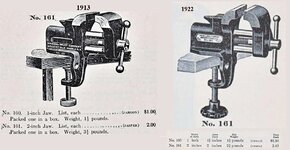
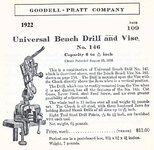
colmal: I believe your gift vise is a Goodell-Pratt 161 from Massachusetts, USA. The rectangular boss with rounded ends was a giveaway. In their 1913 catalog, the clamp knob was knurled but by 1922 it was the hand wheel type. Congrats.

1913 1922 G-P 161 vises.jpg
 
Last edited:
CRSINMICH

Well-known member
Joined
Aug 15, 2015
Messages
2,414
Location
Southeastern Michigan
micahd: Just to be clear, when I said that bench mounting style didn't last much longer, I meant that not many manufacturers continued making vises that way. Reed may have kept making them for a time. The only documentation I could cite would be that they don't show up in catalogs often after about that time.
 

micahd1997

Well-known member
Joined
Apr 27, 2022
Messages
257
micahd: Just to be clear, when I said that bench mounting style didn't last much longer, I meant that not many manufacturers continued making vises that way. Reed may have kept making them for a time. The only documentation I could cite would be that they don't show up in catalogs often after about that time.
Thanks for the clarification, CRS. That makes sense. I truthfully haven’t dug into Reed’s catalogs enough to have much of a say on the timeline, so more than anything I was interested to hear more of what you had found. The possibility certainly exists that my Reed was stamped incorrectly at the factory, so when markings might differ from the original manufacturer’s catalogs, I trust the catalogs pretty religiously.

As you said, the thru-bench style certainly seems to become less common after the 20s-30s for most manufacturers. With that in mind, I’m interested to check Reed’s catalogs from the 50s and see whether that line was still being advertised. My gut tells me not
 

Outlawmws

Well-known member
Joined
Aug 9, 2011
Messages
39,305
Location
The Badlands
Not sure everyon here watches the Vise info thread, so crossposting this one:

I believe a guy on the Coleman site I'm on has uncovered an unknown Parker vise; I have been unable to find this model in this thread, the main vise thread, catalogs I have (so far), or google searches...:

Based on the 1867 patent it has to be prior to 1885.

Model: 0.210 (hows that for an odd model No.? - Yes, a leading 0)
Marked: C.PARKER MERIDIAN CT. on the opposite side
Collar Mark: Pat. Nov 26, 1867 (Patent No 71498 for the collar)
jaw width: 3-1/4"
Weight: - TBD
Max opening: - TBD

Working on the TBD's...

It is amazingly complete and it great condition om what I see! The best is he plans to use it! (hes a wood worker, both professionally and in his own projects., so should see light use.

Pics:

Moses Parker-Vise 1.jpg


Moses Parker-Vise 2.jpg


Moses Parker-Vise 5 Collar patent.jpg


Moses Parker-Vise 6 Collar.jpg


Moses Parker-Vise 3.jpg


Moses Parker-Vise 4.jpg
 

micahd1997

Well-known member
Joined
Apr 27, 2022
Messages
257
Not sure everyon here watches the Vise info thread, so crossposting this one:

I believe a guy on the Coleman site I'm on has uncovered an unknown Parker vise; I have been unable to find this model in this thread, the main vise thread, catalogs I have (so far), or google searches...:

Based on the 1867 patent it has to be prior to 1885.

Model: 0.210 (hows that for an odd model No.? - Yes, a leading 0)
Marked: C.PARKER MERIDIAN CT. on the opposite side
Collar Mark: Pat. Nov 26, 1867 (Patent No 71498 for the collar)
jaw width: 3-1/4"
Weight: - TBD
Max opening: - TBD

Working on the TBD's...

It is amazingly complete and it great condition om what I see! The best is he plans to use it! (hes a wood worker, both professionally and in his own projects., so should see light use.

Pics:

Moses Parker-Vise 1.jpg


Moses Parker-Vise 2.jpg


Moses Parker-Vise 5 Collar patent.jpg


Moses Parker-Vise 6 Collar.jpg


Moses Parker-Vise 3.jpg


Moses Parker-Vise 4.jpg
I'm no Parker expert, but a couple thoughts:

Firstly, beautiful vise! It looks like the dynamic jaw support was broken off, but otherwise in great condition

Secondly, I found two Parker catalogs earlier this year, and the scans are available for public viewing
Aside from the bizarre model number of 0.210, your friend's vise is the spitting image of Parker's "Vulcan" thru-bench No. AA vise with 3 1/4" jaws (page 3 in the 1899 catalog and page 42 in the 1901 catalog). Even though the model number is different, I'd wager that it's the exact same vise, meaning that it could certainly be dated as late as the 1901 catalog (if not later...I'm not sure when Parker discontinued the thru-bench design)

Thirdly (all theory and speculation on this one...): Page 44 of the 1899 catalog and page 48 of the 1901 catalog depict another one of Parker's thru-bench vises. Model #2100 is shown with 1/8 jaws. Even though several features are slightly different that the No. AA (primarily a different style of mounting wrench and the jaws being 1/8" smaller than the No. AA), maybe someone at the foundry confused the two models and, on top of that, accidentally (somehow...?) put the tailing "0" in "2100" at the beginning of the model number. Just spit-balling, but those are my thoughts
 

Attachments

  • Parker 1899 Catalog Page - AA.pdf
    1,011.9 KB · Views: 5
  • Parker 1899 Catalog Page - 2100.pdf
    780.2 KB · Views: 4

colmal

Well-known member
Joined
Sep 8, 2021
Messages
454
Location
Australia
^^ You are welcome. Let me know if you find numbers or lettering when you clean it - especially if it is NOT a G-P.
it has some letters on the pad- couldn't make them out- I've found the best way to see them is patience-let the molasses do it's work, then a gentle wire brush with a Dremel.

LOL- going to ask him , what about the rest of it.

1754422797156.png1754422823964.png
 

Outlawmws

Well-known member
Joined
Aug 9, 2011
Messages
39,305
Location
The Badlands
I'm no Parker expert, but a couple thoughts:

Firstly, beautiful vise! It looks like the dynamic jaw support was broken off, but otherwise in great condition

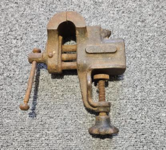
Secondly, I found two Parker catalogs earlier this year, and the scans are available for public viewing
Aside from the bizarre model number of 0.210, your friend's vise is the spitting image of Parker's "Vulcan" thru-bench No. AA vise with 3 1/4" jaws (page 3 in the 1899 catalog and page 42 in the 1901 catalog). Even though the model number is different, I'd wager that it's the exact same vise, meaning that it could certainly be dated as late as the 1901 catalog (if not later...I'm not sure when Parker discontinued the thru-bench design)

Thirdly (all theory and speculation on this one...): Page 44 of the 1899 catalog and page 48 of the 1901 catalog depict another one of Parker's thru-bench vises. Model #2100 is shown with 1/8 jaws. Even though several features are slightly different that the No. AA (primarily a different style of mounting wrench and the jaws being 1/8" smaller than the No. AA), maybe someone at the foundry confused the two models and, on top of that, accidentally (somehow...?) put the tailing "0" in "2100" at the beginning of the model number. Just spit-balling, but those are my thoughts

Thx Micah,

I missed the jaw support - good spot:

It does not make sense for Parker to have patent references for patents that are expired. it was flat illegal back then. Still is AFAIK

I do agree the Vulcan looks closest, mostly due to the "D-handle" for the bottom swivel nut. but that could also have been swapped out in the last 120+ years.w

I'm not a fan of the casting mistake theory on the number. There is a decimal point in there, and it has no other purpose...
 

PghJKB

Well-known member
Joined
Oct 13, 2012
Messages
490
Location
Industrial Heartland
Thx Micah,

I missed the jaw support - good spot:

It does not make sense for Parker to have patent references for patents that are expired. it was flat illegal back then. Still is AFAIK

I do agree the Vulcan looks closest, mostly due to the "D-handle" for the bottom swivel nut. but that could also have been swapped out in the last 120+ years.w

I'm not a fan of the casting mistake theory on the number. There is a decimal point in there, and it has no other purpose...

Couple of shots and beers you may understand the exact purpose of the decimal point

JKB
 

Shiftless

Well-known member
Joined
Mar 9, 2014
Messages
14,557
Location
East Bay SFO
Couple of shots and beers you may understand the exact purpose of the decimal point

JKB
The few of us active here today should get together and test the validity of that approach. 😎


Google says…

d9GcSgOwf_fzW20kF2V_934r8-9LiL4MDtQfJU4sRmkDHnsw&s.jpg

Stories are murky at best as to how the boilermaker first came into existence, but it's pretty clear that the drink was originally consumed by blue collar workers at the end of a long shift – which is why it's now become the shift drink of choice among bartenders.
 

micahd1997

Well-known member
Joined
Apr 27, 2022
Messages
257
It does not make sense for Parker to have patent references for patents that are expired. it was flat illegal back then. Still is AFAIK
Oh really? Very interesting, that’s the first time that I’ve ever heard that. I’ll have to dig in and educate myself. However, I’d suggest that, regardless of whether it were illegal at the time, Parker seems to have still been producing their vises with the 1867 patent markings by 1899 and 1901. Many of the depictions in the 1899 and 1901 catalogs even depict the fine detail of the patent date on the collars. Since patents were only protected for 17 years at the time, that would place Parker outside that protected timeframe by 15 years in 1899.

The introductory page of both catalogs announce the new “Vulcan” line of Parker vises. From everything I can see, your friend’s vise and the thru-bench Vulcan № AA appear to be identical (aside from the bizarre model number). That leads me to believe your friend’s vise couldn’t be much older than 1899. You’ll notice that the 1901 catalog still refers to the “Vulcan” line as a new line even though they were “new” two years earlier in the 1899 catalog. However, because Parker proudly placed them on pages 2-5 in the 1899 catalog and much further back in pages 41-43 in 1901, I’m convinced that Parker’s prioritized placement in 1899 supports that it was the first year Parker’s Vulcan line saw the light of day.
I do agree the Vulcan looks closest, mostly due to the "D-handle" for the bottom swivel nut. but that could also have been swapped out in the last 120+ years
I agree that it’s certainly possible that the D handle had been switched out in the last 120 years. However, I’d also say that it’s an equal possibility that the shaft collar was swapped out in that time frame (though I’d imagine that both possibilities are slim)

I'm not a fan of the casting mistake theory on the number. There is a decimal point in there, and it has no other purpose
I’m also personally not a fan of that theory, even though it’s my own 😅 I generally think that too much “slop” or “slack” is attributed to the foundries that manufactured these vises back then. Human error is certainly real, and there are vises that fell through the cracks and made it into the public’s hands that reflect this. However, I tend to think that the casting, manufacturing, and inspection processes were much tighter than most people think and that random decimal points (and other oddities) can rarely be explained away by slapping the bandaid of human error on it. If I ever pull the human error card, I try to do so with sufficient caveats that it’s just my own speculation and nothing more.
 

Attachments

  • C803F6E1-4BC0-4400-8105-70B1471F4C11.jpeg
    C803F6E1-4BC0-4400-8105-70B1471F4C11.jpeg
    352.2 KB · Views: 11
  • 041B5C5F-1782-4B47-A421-35A9E6224A2A.jpeg
    041B5C5F-1782-4B47-A421-35A9E6224A2A.jpeg
    337.7 KB · Views: 13
Last edited:

Beerhippie

Well-known member
Joined
Oct 13, 2023
Messages
9,941
Location
Far NE Oregon
The few of us active here today should get together and test the validity of that approach. 😎


Google says…

d9GcSgOwf_fzW20kF2V_934r8-9LiL4MDtQfJU4sRmkDHnsw&s.jpg

Stories are murky at best as to how the boilermaker first came into existence, but it's pretty clear that the drink was originally consumed by blue collar workers at the end of a long shift – which is why it's now become the shift drink of choice among bartenders.
The Boilermaker that was served in blue-collar bars out here back in the day had the shot glass carefully lowered into the beer so it sat upright at the bottom of the beer glass with little mixing (a lost skill?). The proper way to drink one was to shoot the whole thing and come up with the shot glass held between your teeth by the bottom rim--and then try not to chunder.

Many a hangover was installed with those....
 

Outlawmws

Well-known member
Joined
Aug 9, 2011
Messages
39,305
Location
The Badlands
That leads me to believe your friend’s vise couldn’t be much older than 1899.

What is needed is catalog pages from 1867 -1885 for the 1867 patents.

You’ll notice that the 1901 catalog still refers to the “Vulcan” line as a new line even though they were “new” two years earlier in the 1899 catalog. However, because Parker proudly placed them on pages 2-5 in the 1899 catalog and much further back in pages 41-43 in 1901, I’m convinced that Parker’s prioritized placement in 1899 supports that it was the first year Parker’s Vulcan line saw the light of day

The repeat of a "new" announcement 2 years later in 1901 doesn't really surprise me. Nor does the reuse of existing art depicting the 1867 date, as most every catalog back in the day routinely reused old art masters, and even printed "dialog" despite changes. This has been noted across the board for most any catalogs with printed images. Sears, SK, Plvmb, any number of tool companies went cheap and used existing as much as possible.

I have a Parker #3 with not one but three different patent dates from 1867. as well as one from 1854. the vise was made for many years and its last catalog entry is from 1894.

These patent dates should place my #3 between 1867 and 1871 - 1854 + 17.

The problem is not many catalogs are available from the 1800's - it gets better as they get close to 1900, but still thin compared to the later Parker years.
 

micahd1997

Well-known member
Joined
Apr 27, 2022
Messages
257
What is needed is catalog pages from 1867 -1885 for the 1867 patents.
I couldn’t agree more. I’m on the trail of several good sources, so hopefully those will bear fruit soon
The repeat of a "new" announcement 2 years later in 1901 doesn't really surprise me. Nor does the reuse of existing art depicting the 1867 date, as most every catalog back in the day routinely reused old art masters, and even printed "dialog" despite changes
Agreed here as well. I was primarily making the point about the 1867 patent depictions in the catalogs to to point out that - if it were indeed illegal at the time to sell products that bore a company’s expired patent, it would seem inconsistent that the company would be allowed to continue advertising their vises with depictions of the expired patent.
 
To avoid these ads, REGISTER NOW!
Top Bottom