
To avoid these ads, REGISTER NOW!

Well she definitely isn't a Wilton.

rslaback

Well-known member
Joined
Jul 24, 2010
Messages
4,078
Location
Westcentral Wisconsin
I picked up an 8 inch vise at the local consignment sale for cheap enough. I noticed it was a Klutch branded vise and I've had decent luck with Northern Tool in the past so here we are. When I picked it up it was lighter built than I'd expected and I noticed it was missing a jaw. Not a big deal, I'll make a set of aluminum soft jaws. It'll be nice to have a dedicated soft jaw vise...

When taking off the remaining factory jaw I could visibly see a taper to it which I thought was odd.

20250803_030435.jpg

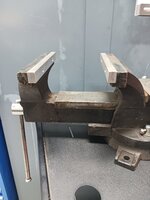
Never the guy to give up I lunged forward, took my measurements and machined those jaws into existence from a bar of 1/2 by 3/4 aluminum.
20250803_030646.jpg


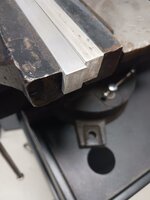
You never really know the quality of a vise until you see how the jaws mate to one another...
20250803_030727.jpg

20250803_030737.jpg


Aparently the taper on that original jaw was a feature, not a bug.
 
To avoid these ads, REGISTER NOW!

cgrutt

Well-known member
Joined
Mar 4, 2016
Messages
8,306
Are the actual jaws aligned as poorly or just the inserts? I suspect it may have more to due with the mounting position (threaded holes/keyways etc) than the actual casting. I'd probably try to make a new set of jaws that conform to the mounting details. Curious if you plan to cut "teeth" (not sure what they are actually called) in face of the soft jaws or leave them flat. If also recommend using some anti seize or perhaps a strip of zinc foil between the aluminum and steel to prevent galvanic corrosion.
 

Shiftless

Well-known member
Joined
Mar 9, 2014
Messages
14,552
Location
East Bay SFO
There’s a reason all those old American made vises are so sought after and valuable.

That’s what I was thinking too.
Looks to me like there is a problem with the jaw tower alignment and not just the inserts. Maybe a P.O. was abusing that vise and caused a structural bend. This is a pretty noticeable misalignment to be like that from the factory. Even a factory with lesser standards of quality control.
 

Attachments

  • 5EA66F33-BB1D-4264-A05B-CF0B93889A6C.jpeg
    5EA66F33-BB1D-4264-A05B-CF0B93889A6C.jpeg
    358 KB · Views: 13

kbuhagiar

Well-known member
Joined
Dec 27, 2005
Messages
1,750
Location
Escondido, CA
Not surprising at all.

Back in the early days, when offshore tools first started flooding our markets (circa 1976) that sort of quality was not uncommon. I bought a vise from one of those flea market/swap meet tool vendors back around that time, and it exhibited the same sort of characteristics. But it was cheap, and brand new, and I was young and dumb, lol.
 

Shiftless

Well-known member
Joined
Mar 9, 2014
Messages
14,552
Location
East Bay SFO

Well she definitely isn't a Wilton.​


You said that again. For comparison, here is a pic of a fellow with his twin 8 inch Wilton machinist vises. 800S models. Vise aficionados will recognize him as having (AFAIK) the biggest and best vise collections anywhere. Jesus Marquez.
A Wilton 800S (without a stand of course) weighs 238 pounds.


0273CEFD-A9D0-4C5A-BE02-CD58CFF1BB0D.jpeg
 

merkyworks

Well-known member
Joined
Nov 11, 2016
Messages
587
Location
Texas

Well she definitely isn't a Wilton.​


You said that again. For comparison, here is a pic of a fellow with his twin 8 inch Wilton machinist vises. 800S models. Vise aficionados will recognize him as having (AFAIK) the biggest and best vise collections anywhere. Jesus Marquez.
A Wilton 800S (without a stand of course) weighs 238 pounds.


0273CEFD-A9D0-4C5A-BE02-CD58CFF1BB0D.jpeg

his instagram is “mexashop1”, and his collection is incredible
 

dscheidt

Well-known member
Joined
Apr 26, 2017
Messages
2,897
There’s a reason all those old American made vises are so sought after and valuable.

yeah, nostalgia. Prices, at least around here, are now so high that a new, superior quality, Taiwanese vise can be had for less money than a clapped out American one, let alone one good enough shape to actually use. Vintage Amercian made vises are nice, but they're largely made with the height of 19th century technology, so they're bigger, heavier, and weaker than what can easily be made today.
 

Shiftless

Well-known member
Joined
Mar 9, 2014
Messages
14,552
Location
East Bay SFO
Vintage Amercian made vises are nice, but they're largely made with the height of 19th century technology, so they're bigger, heavier, and weaker than what can easily be made today.

Let‘s put an “easily made” new vise up against a Reed C series, not necessarily a 4C, and see who wins. I would nominate many other oldies like those from Parker, or Rock Island, etc.

Fireballs are pretty tough but I wouldn’t consider them easily made. If they were, the price would be lower wouldn’t it?
 

redwrench60

Well-known member
Joined
Sep 10, 2011
Messages
6,069
Location
East Tennessee
Sure, these days there are some decent players out there for budget friendly vises but most have the life expectancy of a condom wrapper on prom night. Bought with high hopes and worn out in one use.
 
To avoid these ads, REGISTER NOW!

redwrench60

Well-known member
Joined
Sep 10, 2011
Messages
6,069
Location
East Tennessee

Well she definitely isn't a Wilton.​


You said that again. For comparison, here is a pic of a fellow with his twin 8 inch Wilton machinist vises. 800S models. Vise aficionados will recognize him as having (AFAIK) the biggest and best vise collections anywhere. Jesus Marquez.
A Wilton 800S (without a stand of course) weighs 238 pounds.


0273CEFD-A9D0-4C5A-BE02-CD58CFF1BB0D.jpeg
I was in a plant the other day that had one of those in their boiler room. It was dusty but in great condition mounted on a huge steel work bench in a forgotten corner. I bet it misses the crusty old Navy Vet in Liberty overalls with a Pal Mal hanging out of his face as he clamps a piece of 2” schedule 80 in the jaws and wrenches off a rusty gate valve.
 

seber

Well-known member
Joined
May 31, 2016
Messages
4,198
Location
Deep East Tx.
Probably poor machining of the notch they fit in. The manufacturer probably has a fixture so they can machine them in place after the vise is assembled. Since I have OCD about machined parts, I'd probably clamp it up in my mill and fix the original flaw.
That would leave the threaded holes in the wrong location. I'd just shave the high insert and let it go.
 

Steve_P

Well-known member
Joined
Sep 15, 2010
Messages
5,185
Sure, these days there are some decent players out there for budget friendly vises but most have the life expectancy of a condom wrapper on prom night. Bought with high hopes and worn out in one use.

Oh please. Even a $75 HF POS vise takes a 3' long pipe on the handle to break it- as confirmed by multiple destruction videos on Youtube. And I had one for 25 years and beat the **** out of it and it survived just fine. Yeah, it was crudely machined, and the casting wasn't pretty, but it's more than enough for 99.99% of users. I replaced it with a Yost ADI, which are absolutely fantastic and have an excellent fit and finish with a gib slide. But yeah, the US had magic cast iron many decades ago that no one else can replicate to this day :rolleyes:
 
OP
R

rslaback

Well-known member
Joined
Jul 24, 2010
Messages
4,078
Location
Westcentral Wisconsin
That would leave the threaded holes in the wrong location. I'd just shave the high insert and let it go.
I think I'm just going to use it as is. The primary use of my vise is to hold onto something for squeezing, beating, bending or welding. The jaw alignment is relatively petty for those purposes.

Wow, that's bad.

Can you tell what's causing the misalignment?
I think it is just a bad casting (or two)
Are the actual jaws aligned as poorly or just the inserts? I suspect it may have more to due with the mounting position (threaded holes/keyways etc) than the actual casting. I'd probably try to make a new set of jaws that conform to the mounting details. Curious if you plan to cut "teeth" (not sure what they are actually called) in face of the soft jaws or leave them flat. If also recommend using some anti seize or perhaps a strip of zinc foil between the aluminum and steel to prevent galvanic corrosion.
The jaws are actually that far out of alignment. They also have some taper just to the rabbet in which the jaw sits. The castings are pretty low quality. The holes are perfectly matched to the machining and the same on each jaw. I'm not too worried about galvanic corrosion. While the jaws and castings are different metals it is my understanding that electrolyte/water is needed and this will spend its life under roof.
Fireballs are pretty tough but I wouldn’t consider them easily made. If they were, the price would be lower wouldn’t it?

The primary objective of a business is to charge the consumer as much as possible while maximizing profits. If the cost of an item decreases or is low originally, the company has very little interest in passing that on to you. It's about what you would pay for it. This isn't the thread for it but I work as a subsidiary of a mega corp and carry a company phone. We are big enough that we negotiate the **** out of everything. And that is why my company owned S25 cost the company I work for $93 but it costs $700 at Best Buy. Samsung still made a profit on it at $93.
 

whateg01

Well-known member
Joined
Mar 13, 2006
Messages
11,364
Location
doo dah, kansas, usa
... I'd probably try to make a new set of jaws that conform to the mounting details.

That would leave the threaded holes in the wrong location. I'd just shave the high insert and let it go.
That's no doubt why the original jaws had a taper. OP could fix the misalignment of the outer surfaces of the jaws just by reinstalling the originals.
 

1Bad55Chevy

Well-known member
Joined
Feb 20, 2025
Messages
623
Fireballs are pretty tough but I wouldn’t consider them easily made. If they were, the price would be lower wouldn’t it?

This is a 1912-1918 Reed ad, it list the 207 Reed for $85. If you use an inflation calculator from 1913 you will see that translates to $2,769.46. The Fireball vise cost $2,070 today! I don't see a way any company could build a reproduction vise to the 207 and sell it for under $3k (imported of course) in 2025.

These vintage industrial vises were extremely expensive when they were new and I think people forget this.
 

Attachments

  • Screenshot_20250803_210110_eBay.jpg
    Screenshot_20250803_210110_eBay.jpg
    1,004.6 KB · Views: 14

Shiftless

Well-known member
Joined
Mar 9, 2014
Messages
14,552
Location
East Bay SFO
This is a 1912-1918 Reed ad, it list the 207 Reed for $85. If you use an inflation calculator from 1913 you will see that translates to $2,769.46. The Fireball vise cost $2,070 today! I don't see a way any company could build a reproduction vise to the 207 and sell it for under $3k (imported of course) in 2025.

These vintage industrial vises were extremely expensive when they were new and I think people forget this.
Excellent point.
And that’s why high quality vintage vises are such a good deal. If you spend time looking around you can score a decent condition Reed (Not a 7 incher) but somewhere between 4 and 6) for a couple hundred bucks or if you’re really lucky a lot less.
But of course, you have to invest some time and effort chasing them down. To some of us, that is fun and we consider it a hobby. Kinda like panning for gold which some guys consider a hobby as well.
 

redwrench60

Well-known member
Joined
Sep 10, 2011
Messages
6,069
Location
East Tennessee
Oh please. Even a $75 HF POS vise takes a 3' long pipe on the handle to break it- as confirmed by multiple destruction videos on Youtube. And I had one for 25 years and beat the **** out of it and it survived just fine. Yeah, it was crudely machined, and the casting wasn't pretty, but it's more than enough for 99.99% of users. I replaced it with a Yost ADI, which are absolutely fantastic and have an excellent fit and finish with a gib slide. But yeah, the US had magic cast iron many decades ago that no one else can replicate to this day :rolleyes:
My first experience with cheap vises was when a shop I worked for expanded, and bought a bunch of new vises from HF and Home Depot for the new work benches and within a year all of them were either broken and scrapped or so whomped out they were useless while all the original Wilton’s from the mid 70’s while ugly, were still truckin and completely functional. I personally witnessed a tech break an Irwin vise nearly in half, by hand, just clamping a ball joint press in place to push out some U-joints on a drive shaft. I’ll keep my Wilton’s and Morgan’s.
 

seber

Well-known member
Joined
May 31, 2016
Messages
4,198
Location
Deep East Tx.
Oh please. Even a $75 HF POS vise takes a 3' long pipe on the handle to break it- as confirmed by multiple destruction videos on Youtube. And I had one for 25 years and beat the **** out of it and it survived just fine. Yeah, it was crudely machined, and the casting wasn't pretty, but it's more than enough for 99.99% of users. I replaced it with a Yost ADI, which are absolutely fantastic and have an excellent fit and finish with a gib slide. But yeah, the US had magic cast iron many decades ago that no one else can replicate to this day :rolleyes:
The old vises were in fact magic iron. They were made of malleable iron, not cast. In addition, the castings were much heavier than the **** that comes from China. Hit cast iron with a hammer and go buy another vise. Hit malleable iron and just keep on truckin. The other problem you will find with cheap vises is voids in the casting. I have two broken no name vises in the recycle bin at the moment. Both of them have voids across the broken area. I didn't break them but I'd bet there was no excess force used to do it as the handles are pristine.
I also have a Yost sitting on the floor. I bought it new and mounted it thinking I had solved the vise problem. Plenty of leverage in the screw and nice gib adjustments to keep it tight. Problem is, when I adjust the gibs to take out the play, the jaw won't move. It is just a sloppy as any other vise. In addition, the rotation does not lock for ****. Went back to a Wilton.
 

NHtoolguy

Well-known member
Joined
Mar 4, 2018
Messages
328
Location
Gilford, NH
I think we also lost a lot of casting expertise when US-based foundries closed. The work was hot and dangerous, and moved off shore to areas with fewer regulations and lower labor costs. I marvel at the beautiful, intricate iron castings on early American machines. Those pattern makers and foundry workers were true artisans in their craft.
 

reader2580

Well-known member
Joined
Dec 31, 2014
Messages
14,550
Location
Minneapolis, MN
but I work as a subsidiary of a mega corp and carry a company phone. We are big enough that we negotiate the **** out of everything. And that is why my company owned S25 cost the company I work for $93 but it costs $700 at Best Buy. Samsung still made a profit on it at $93.
The carrier is likely subsidizing the phone cost. A company called Counterpoint Research estimated it costs $469 to make an S23. Now, they are using quantity one prices for components versus the discounts Samsung gets buying a hundred thousand at a time.
 

Cruzan80

Well-known member
Joined
Jul 22, 2015
Messages
4,230
Location
Denver, CO
While I like old vises as much as the next guy, there is also a skew in comparison due to "survivor" syndrome. Any vise that has made it 100yrs was probably a better than average copy, as the ones that had issues were broken and thrown away many years earlier. So it isn't always a true 1:1 comparison.
 

dscheidt

Well-known member
Joined
Apr 26, 2017
Messages
2,897
The old vises were in fact magic iron. They were made of malleable iron, not cast. In addition, the castings were much heavier than the **** that comes from China.

there's nothing magic about malleable iron. It's the height of 19th century technology. It relies on careful (thus expensive) heat treatment to get the right properties., and judging by the number of magic iron vises I've seen that were broken and brazed back together[1], or just scrapped, not always done well. I suspect that many of the larger vises main body and fixed jaws exceeded the capacity of the foundries to properly anneal them to get the desired grain structure. Malleable iron is also dependent on having the proper stuff go in the melt, and the details of that weren't well understood until the middle of the 20th century. (There was plenty of empirical knowledge, as malleable iron castings have been made for more than a millennium, but actually understanding what was going on is important to consistent quality.)

Ductile iron, forged steel, and austempered ductile iron are superior materials to make a bench vise from. You can have lighter stronger pieces, that have better failure modes.


[1] I spent a couple years looking for a 6"ish magic american vise. The vast majority I saw for sale were either broken, or had been repaired. the few that weren't didn't have any evidence of use, and the sellers clearly thought they were made of solid gold
 
To avoid these ads, REGISTER NOW!
Top Bottom