@zmotorsports
A question I have been pondering. There are some people I have encountered who think it is possible to get by with the bare minimum in terms of tooling. They have a minimalist approach to tools- and life.
Have you ever encountered someone whom you felt was a total professional and able to competently tackle a variety of jobs who followed this philosophy?
On the flip side of the coin, I remember visiting a Goodyear franchise truck shop in a rural area of the U.S. about 20+ years ago. I saw a mechanic (technician) working there who had a giant, double decker MAC toolbox and was very proud of his $50K US in tools, but couldn’t solve a simple issue with retracting a brake piston. A C-clamp would have easily worked.
In your professional experience, what gives?
Are there highly competent and professional minimalists who get buy with ingenuity and the bare minimum?
How often are those with giant tool collections all show and little go?
If the person only worked on one car with no computer, worked on basic appliances that had no computers, and didn't branch out of their own little world of items to work on, then yea I know it's possible to have basic hand tools to work on everything in that person world.
The problem is when you start adding computer and variety of items to work on, then the number of tools goes up. Also, how far in depth does that person go with working on their vehicles? If it's just simple oil change, air filter, brakes, and simple items then there's no need for all of the tools most of us have in the garage. But then you will be taking the vehicle to a shop to have them repair it when it gets beyond that scope of work.
More and more tools are getting to be diagnostic tools, specialty one off tool for a particular brand, and tools that speeds up the job compared to doing it the way of simple hand tools.
If you can limit what you work on, then you can do what's called the 5S principle, unfortunately most of us works on more than one thing only and requires the large number of tools we have.
I don't know that I could say it any better than Cody
@madison069.
I started out with the absolute bare minimum of tools. In fact, my assortment was a basic set of wrenches, a few pliers, screwdrivers and a 3/8" socket set. I did a LOT of work using those basic tools, but that work consisted of mainly brakes, routine maintenance and then I slowly started getting in to tune-ups. This was in the 80's so prior to ECM's, EFI and O/D transmissions, so about as basic as it gets.
As I started learning more and improving my skillset, I was also being asked to do more in-depth repairs I used part of my side job money to buy additional tools to do more work. By late 80's/early 90's and just recently married, money was tight so I was trying to do as much as possible with as few tools as I absolutely needed. Unfortunately, I found myself having to turn work away simply because I wasn't equipped to do the jobs, either in tools or specific knowledge because I didn't have the required tools.
Back to your actual question, I don't think it is quite as cut and dry. Do I think there are mechanics that can do high quality work with minimal tools? Yes, as long as the jobs they are performing don't require specialty tools or advanced equipment. For example, can a guy charge an A/C system using a refrigerant charge with a low side gauge? Yes. Should a person use this procedure and charge money for it? In my opinion, no. That is a DIY approach and there are inherent risks and/or gambles. Can a lot of diagnosis be accomplished with a good VOM without an oscilloscope? Absolutely, remember an oscilloscope is basically a device that measures voltage over time. Therefore a VOM may not be able to capture some glitches or faults, but a lot can be diagnosed with a VOM meter.
Next part of your question, do I think there are some that are all show and no go? Ab-so-frea-kin-lutely. I liken it to the phrase of "all hat and no cattle".
Do I think good mechanics need the highest level or grade/brand of tools? No. Most who follow my thread or have read my comments can deduce that I have a strong personal choice when it comes to tools, but I also feel not every tool needs to be Snap-on. Do I have a lot of Snap-on, MAC, and Matco tools? Yes, I have a propensity to purchase quality tools but that is just as much of a personal choice as it is needing the tool to do specific tasks.
On the flip side I have worked with mechanics and seen mechanics at other shops that had the biggest and baddest toolbox, all the latest and greatest Snap-on this or MAC that but when push comes to shove, they couldn't fix their way out of a paper sack. We had a mechanic fairly recently that would go on the tool trucks and purchase tools weekly that he neither had the skillset at the time to use, nor the need for, but he had them in his toolbox. He really struggled with even the most basic mechanical principles and don't even get me started on electrical systems. He asked my opinion about a meter one day and I gave him a couple of fairly inexpensive recommendations to get him going and told him to keep it simple and then he could upgrade as time went on, but a basic one will allow him to do the vast majority of what he needed. He came into my office a week or so later with his brand new Snap-on meter that was loaded with options, even bluetoothed to his phone.

He completely missed the boat on my trying to help him. I walked through the shop on multiple occasions and like to meandor up to the mechanics while they are performing various tasks and just observe and many times a conversation will erupt pertaining to how I would do something or they would explain a particular scenario. Any one of my mechanics know when they are working on an electrical problem and they ask for my help that they had damned well better have their meter in their hands when I walk up. On multiple occasions I would walk into the shop and this particular mechanic (I use that term loosely with this person) and he would have wires disconnected and pulled apart and pulling his hair out. He'd ask me for assistance and the first question I'd ask is where is your meter? Crickets. You'd think a person would get that through their head after the first time, or the second time for sure, but this happened at least a dozen times over the course of a few months and he never caught on. I would explain that his meter IS his window into the system and without that he cannot properly diagnose and only guess, but he loved to throw parts at things and I would make mention on many occasions how I feel about parts swappers.
The other mechanics saw it as well and would joke with him about it. One day he asked one of his coworkers to help him with a problem and the mechanic walked to his toolbox and said "do you hear that? It's that fancy meter of yours saying it wants to go with me so it will come out of the drawer once in a while." It was funny, but he still didn't get it.
Needless to say he is no longer employed here as of a few months ago. There is only so much you can do to help someone, but like my dad always said; "you can't help someone who won't help themselves."
Long answer, but I've seen both sides. Yes, there are some good mechanics that can and some good work with minimal tools if they specialize or stay in their lane. However, if they want to branch out and work on a variety of things, then there will need to be some expenditure of cash to obtain the necessary tools. In my experience those at the top of their game will have quite a few tools that make the jobs go faster, easier and ultimately earn them more money. That speed and proficiency can be passed along to their customers in less billed hours, if they are also an honest mechanic. The other side of that is quality of work. Speed of repair isn't always a good thing, as quality in my opinion matters more so than speed. If a mechanic is just trying to go through the motions to get to the fastest repair, it doesn't necessarily mean he's the best. Speed and high quality seldom go hand in hand.

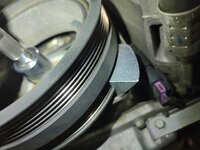


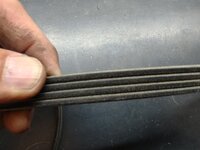

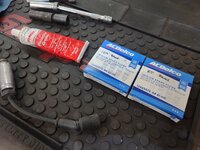
 I did all of the fluids a while ago and didn't think the belts and plugs were as high of a priority as the fluids, but now I just want to do them because I have had them sitting on the shelf for a few months and I am trying to clear off my "to do" list so I can move on to some other things.



















 Watching my father work was something to be seen. He could do most any repair with the above mentioned tools and not give a seconds thought about it. He viewed his tools as simply that; tools to get a job done and nothing more. His tools were abused well beyond what any tool should be, but they simply served as a means to an end.