To avoid these ads, REGISTER NOW!

Running electrical ~200ft from Transformer to Barn

CBoaz

New member
Joined
Sep 2, 2025
Messages
2
Hi All,

After discussing with some electrician friends + local utility company, I've decided to run electrical from a transformer we had installed between my home / in-laws home when we first built our homes (ran primary from the vault located at street / see image attached). I was considering pulling from our home panel, but we're also building a garage + office behind the house next year so I didn't want to place too much of a pull off our home panel. Currently building the barn (see image below), but need to finish the exterior, lean to, time, all that jazz.

I plan to do this all DIY - leaning heavily on friends + neighbors, some of who are actually electricians - but I'm really interested in learning from any of y'all who have done this before. Complete newbie over here, so best practices, caveats, do this + use this vs. don't do or use that's, etc. etc. Panels, conduit type, electrical outlets, the works. ~200ft running from the transformer to panel. Planning for a 120v panel as I don't think I'll have heavy machinery inside. Mostly run of the mill tools, lights, etc.

Any thoughts very much appreciated!

CB
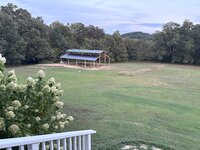
Barn In Process.jpeg
 

Attachments

  • CBoaz BARN & ELECTRICAL OUTLINE.pdf
    431.6 KB · Views: 5
Last edited:
To avoid these ads, REGISTER NOW!

mm08822

Well-known member
Joined
Jan 13, 2012
Messages
6,053
Location
NJ
Start identifying your likely uses of the space for floor plan, heating/ac/insulation needs, electrical, lighting, etc. These will all be inputs needed to complete the next phases.

Your electrical service will be 120/240 volt, whether you have any 240 volt loads or not. Contact your power company for their service requirements, metering, rates, etc. for the building purpose.
 

Stuart in MN

Well-known member
Joined
Sep 8, 2005
Messages
23,179
Location
Minneapolis
You indicated you've talked to the utility company, but I'd recommend you make sure with them that they're willing to run a separate service to the new building - more often than not electric utilities will only provide a single service to a residential property.

Also, the utility may have a worksheet on their website that you can fill in with the anticipated loads (lights, outlets, HVAC, power tools, etc.) that will help you determine just what size service you need. Again, not every utility offers them but it's fairly common.
 
OP
C

CBoaz

New member
Joined
Sep 2, 2025
Messages
2
You indicated you've talked to the utility company, but I'd recommend you make sure with them that they're willing to run a separate service to the new building - more often than not electric utilities will only provide a single service to a residential property.

Also, the utility may have a worksheet on their website that you can fill in with the anticipated loads (lights, outlets, HVAC, power tools, etc.) that will help you determine just what size service you need. Again, not every utility offers them but it's fairly common.
They did tell me it'll need to be categorized as commercial, so we've crossed that bridge already. Thanks for the foresight!
 

Gutman

Well-known member
Joined
Jan 10, 2019
Messages
296
Location
ENC
Smart move IMO. Only downside (in my case) is separate associated 'fees' of having a separate meter/service.
 

83VillageRepair

Well-known member
Joined
Aug 17, 2007
Messages
768
Location
Merkel, Texas
The only drawback to two services is two meter charges. The economic model that utilities run on is going away from consumption charges to raising meter charges. The norm in the future will be something like $100 per meter + usage + time of use charges, more if commercial. So if you run off your existing service you will lock yourself into only one meter charge. Just food for thought.
 
Last edited:

PCustoms

Well-known member
Joined
Jul 23, 2011
Messages
23,514
Location
VT
They did tell me it'll need to be categorized as commercial, so we've crossed that bridge already. Thanks for the foresight!

Make sure you understand the math on this. 2nd meter (monthly base charges) plus the higher $/kwh commercial rate can add up fast...

You could run a larger service to this area and then feed off that to the house and anything else.

Whatever you do, run a 240v panel, as it gives you options moving forward.
 

Codyboy

Well-known member
Joined
Jan 31, 2019
Messages
1,722
Location
S.E. TEXAS
Make sure you understand the math on this. 2nd meter (monthly base charges) plus the higher $/kwh commercial rate can add up fast...

You could run a larger service to this area and then feed off that to the house and anything else.

Whatever you do, run a 240v panel, as it gives you options moving forward.
Don't forget the kva charges also. Commercial accounts will read the kva usage and charge accordingly.

OP, is your house the one closest to the barn?
PCustoms gas a good idea.

Upgrade your house to a 320 amp and run from there to a subpanel in the barn.
Or depending on load and you have a 200 amp service already at the house that may work too.
Depends on your load.

I have two meters on my property and they're both billed at the residential rate.
But each meter is $30 a month just to have it.
So 60 bucks every month then add usage.

If I could have done one 320 amp I would have.
But almost 1000 feet between the two wouldn't be so great.
 

wyliesdiesels

Well-known member
Joined
Aug 14, 2012
Messages
20,074
Location
Modesto, CA
Panels, conduit type, electrical outlets, the works. ~200ft running from the transformer to panel. Planning for a 120v panel as I don't think I'll have heavy machinery inside. Mostly run of the mill tools, lights, etc.
your service will have to be 120/240v regardless that you will only have 120v loads.

your PoCo may require a load calc to size the service

keep in mind many PoCos charge higher rates for secondary services on the same property. may end up being cheaper in the long run to connect it to your house service
 
To avoid these ads, REGISTER NOW!

wyliesdiesels

Well-known member
Joined
Aug 14, 2012
Messages
20,074
Location
Modesto, CA
Don't forget the kva charges also. Commercial accounts will read the kva usage and charge accordingly.
Kva charges? electricity is billed in kWh[rs].... are you referring to demand charges? those are also based on highest sustained kW used over X period of time.... electric meters dont meter in kva
 

PCustoms

Well-known member
Joined
Jul 23, 2011
Messages
23,514
Location
VT
Kva charges? electricity is billed in kWh[rs].... are you referring to demand charges? those are also based on highest sustained kW used over X period of time.... electric meters dont meter in kva
All I could think was maybe the transformer/service size somehow sets the baseline rates?
 

Codyboy

Well-known member
Joined
Jan 31, 2019
Messages
1,722
Location
S.E. TEXAS
Actually yes, commercial meters do read KVA.
And you are billed for it along with kwh. Yes, a "demand meter" the demand is KVA.
Even the smart metet at my house will read KVA demand. Right now it is peaked at 15.4 kva.
Residential meters here all read KVA but are not billed for it. Also it never resets to 0.0 like a commercial account will do each billing cycle.
 

Attachments

  • Screenshot_20250902_182810_Chrome.jpg
    Screenshot_20250902_182810_Chrome.jpg
    1.1 MB · Views: 5

wyliesdiesels

Well-known member
Joined
Aug 14, 2012
Messages
20,074
Location
Modesto, CA
Actually yes, commercial meters do read KVA.
And you are billed for it along with kwh. Yes, a "demand meter" the demand is KVA.
Even the smart metet at my house will read KVA demand. Right now it is peaked at 15.4 kva.
Residential meters here all read KVA but are not billed for it. Also it never resets to 0.0 like a commercial account will do each billing cycle.
must be specific to your PoCo. The 3 i deal with here dont use kva for demand charges, they use kW
 
Last edited:

dscheidt

Well-known member
Joined
Apr 26, 2017
Messages
2,909
must be specific to your PoCo. The 2 i deal with here dont use kva for demand charges, they use kW
What’s the peak load.? kVA is more accurate way of sizing required delivery capacity, which is what it’s supposed to be recovering. For smaller loads, a kW measurement is easier, especially with a mechanical meter, and the difference isn’t that high for lots of commercial accounts. With industrial loads with horrible power factors, it is worth getting peak instantaneous load, because there you are also recovering cost of generation capacity.
 

ericm

Well-known member
Joined
Apr 17, 2016
Messages
1,963
Location
Southern Oregon
Also, the utility may have a worksheet on their website that you can fill in with the anticipated loads (lights, outlets, HVAC, power tools, etc.) that will help you determine just what size service you need. Again, not every utility offers them but it's fairly common.
That would be great. My utilities in CA and OR wanted load calcs done by electricians. For both I gave the electrician a list of the power consuming devices I'd have and how they would be used.
 

wyliesdiesels

Well-known member
Joined
Aug 14, 2012
Messages
20,074
Location
Modesto, CA
What’s the peak load.? kVA is more accurate way of sizing required delivery capacity, which is what it’s supposed to be recovering. For smaller loads, a kW measurement is easier, especially with a mechanical meter, and the difference isn’t that high for lots of commercial accounts. With industrial loads with horrible power factors, it is worth getting peak instantaneous load, because there you are also recovering cost of generation capacity.
here is one example. less than 35kW demand goes on the rate tier linked below.

"This schedule applies to general power use with a demand of less than 35 kW for the following:"

further down it says:

"Whenever demand equals or exceeds 35 kW for three (3) consecutive months the customer will be placed on an appropriate industrial Rate Schedule. "


Codyboy

Well-known member
Joined
Jan 31, 2019
Messages
1,722
Location
S.E. TEXAS
here is one example. less than 35kW demand goes on the rate tier linked below.

"This schedule applies to general power use with a demand of less than 35 kW for the following:"

further down it says:

"Whenever demand equals or exceeds 35 kW for three (3) consecutive months the customer will be placed on an appropriate industrial Rate Schedule. "

It appears that some utilities use kw for demand and others ( like here) use kva for demand.
 

dave*99

Well-known member
Joined
May 5, 2009
Messages
4,286
Location
Coastal NJ
Last edited:

Stuart in MN

Well-known member
Joined
Sep 8, 2005
Messages
23,179
Location
Minneapolis
That would be great. My utilities in CA and OR wanted load calcs done by electricians. For both I gave the electrician a list of the power consuming devices I'd have and how they would be used.
The trick is finding the worksheet...at least in my experience with multiple electric utilities in the upper midwest, they tend to hide the worksheet in an obscure corner of their website, so you may have to dig around for a while to find it.

I did have a project once that was in PG&E's territory in California and I seem to remember they had a worksheet you could use, but that was years ago and wouldn't know where to find it anymore.
 
To avoid these ads, REGISTER NOW!
Top Bottom