Happy Anniversary, Bob!
Lou
Thanks
Lou!
Bob, glad you're posting and the train anniversary is unique. I like the tshirt John
@Toolfool gave you, he recently gifted me a neat VW beetle shirt.
Take care, enjoy the anniversary and stay well.
Thank you
Joel! John is a very kind and generous member. I was happy to see him move to Florida but completely understand his decision to leave. A wet climate is one thing but weather that tries to kill you is a whole different issue.
Glad you won the battle with that train, Bob. GJ is a better place with you here.

John, I feel the same way about you [not the battle thing] making GJ a better place.
Thanks
Jon!
Bob
There is no train that is a match for you.
Happy anniversary!
@gman007, I lost the battle but won the war!
I concur.

Steve, those barges and yachts passing by your waterfront property are a similar hazard for you. The passenger cars that beat me up weighed 100,000 to 150,000 pounds (45,359 to 68,039 kilograms). I suspect those Garbo barges and Yachts are similar weight and have no brakes so keep your head on a swivel when cruising in your yacht tender. Every yacht that passed us on the Intracoastal back in the 1980s appeared to be a floating bar and the helmsman misunderstood the 'No Wake" signs (an excuse to be asleep at the helm).
Lately, I've had some issues, too. Not like Cheryl went through, for Travis. But on my own person. First of all, I hate needles of any sort. As I'm at a Drs office, for a regular checkup, once in a while the vampires have to take blood from me. (The nice doctors...) (Metallitubby knows my obsession with garlic pills...). Even that doesn't work with them. Ha. As the Drs need blood from me, I have to lay down on on one of thems fancy beds with the pull-out drawers for steps. Cheryl has to hold my hand and I hope for the best.....
One day, I had a lump in my throat. It got more painful. I was given antibiotics. Didn't help. Ended up in the emergency room. ( In Hudson, this time) I was about to go through an emergency guy and his syringe needle about the size to work on an elephant. I had a cyst, or, something infected, in my throat. He tried to numb my throat. Didn't work. He tried to poke at that syst with his equipment, and I really freaked out. Oh, hell no.... So, I was sent to Regions and emergency and saw a NoseThroat expert. They numbed me a bit better, calmed me down, to the point that they could stab at that lump and could start draining pus out of the lump. At that point, my voice wasn't as squeaky any more. Things were working. I never want to go through that again... Did I mention my hate of needles???
Rick, I grew up when the doctor gave me a lollipop after every shot so I almost looked forward to the needle. When I woke up in the hospital 12 hours after arriving, I felt no pain. When that changed, the nurse in the ICU would give me a shot in the **** that hurt like hell. Moments after the shot (turned out to be Morphine) I was asleep like never before for about four hours. Rinse and repeat for two days. When they stopped the Morphine injections, the worst pain came from my ankle. When I arrived at the hospital I had lost so much blood my veins were collapsing and the only way to get an IV needle into a vein was to make a cut across my ankle bone and insert the needle into and exposed vein end. One of the ICU nurses was a young man and he seemed to enjoy checking the frozen blood bag and giving it a squeeze to make sure it was flowing. The surge of ice going from ankle to groin inside the leg was a very unpleasant surprise. Had I been strong enough to lift my right arm I am pretty sure I would have punched the guy.
I consider needles to be a necessary evil in healthcare. I've had them stuck in just about every part of me but the ones involving my eyes have been the creepiest. First needle is tiny, to administer a local anesthetic, followed by a big needle shoved deeper into the eye to **** out the original cloudy (cataract) lens and finally an even larger needle to insert the rolled-up artificial lens in the sac.
Bob, I know your history with friendly trains and stuff... Congrats on your anniversary with trains, and adversary trains, too. Trains are bigger than all of us. Not that you did anything wrong with your train experience, it was an accident, but it reminds me of something my two doggies did... My smaller dog tried to pick a fight with Echo, a German Shepherd. I scolded the smaller dog and told her that "that's one fight you're not going to win". My smaller dog took it to heart and she knew I meant what I said. To this day, both dogs "understand" each other. They both get along nowadays. I'm not trying to downplay on your experience with your accident at all. I think it was horrible, what happened to you.
Cheryl and I have a chance to go on a boat ride on the St. Croix River, on a paddle boat. It might be the Padelford. I've spelled it correctly, so the "a" is a long vowel. It's about a two hour cruise along the river, a bus would pick us up in Baldwin, then let us browse Stillwater for a bit of time (after the cruise) before the bus ride home. Middle of the day, not a "booze cruise". I'm looking forward to this.
Rick, friends and acquaintances asked me if I was afraid of trains because of my incident. My answer was no and I was back on that same train less than three months later (artificial arm fittings at the Institute for the Crippled and Disabled in Manhattan). Like most people involved in serious auto accidents, you don't fear the thing that hurt you but you might fear doing the thing that caused the accident.
In 1990 we had the chance to ride the steam locomotive powered train on the Zig-Zag Line in Australia and I jumped at the chance. OK, I didn't jump, I just climbed aboard and inhaled the unique coal and steam smoke entering the open windows of the passenger car.
https://zigzagrailway.com.au/
Hey Bob, just catching up on your thread and hope everything now OK with you and yours. Wow, what an anniversary indeed on 9/9.
Hey
Greg, thanks for stopping by. So far, two of our three family members are responding well to treatment and the third acts like his blind eye is perfectly normal and carries on as a delightful 2-year old.
Googling the Padelford a bit, I found out that the name suggests a business of running these big, two level paddle wheel boats on the mighty Mississippi River. The St. Croix River isn't much smaller than the mighty Missisip. There are three rivers that come together at La Crosse, WI. If I have my facts and history straight, that would be the Mississippi, the St. Croix, and the Wisconsin River, (That river, coming from the Wisconsin Dells area.). The St. Croix River is no slouch, either. Home of Andersen Windows, in Bayport, MN. They (Andersen) got started in Hudson, WI as a sawmill business, but ended up concentrating their efforts on windows. They moved shop across to Minnesota, but did the move, wintertime, across the ice on the St. Croix, a much shorter distance as the crow flies... I was there, a few years ago, at their current location, for a tour, and saw some of their "special machines" that our Company made for them. Neat story, neat history.
Edit: I had that a little bit wrong. The Mississippi and St. Croix Rivers come together at Prescott, WI. A bit North of La Crosse.
Rick, I've been on one paddle wheel boat but I was very young so it isn't a vivid memory. I have much more vivid memories of the paddle wheel boats in Alaska (
https://en.wikipedia.org/wiki/Steamboats_of_the_Yukon_River). The ones we saw were lined up in a field.

We also came across gold mining dredges in Alaska and the Yukon. If you've ever watched the TV show
Gold Rush, you've seen the Beets' gold mining dredges, many of them used over a hundred years ago. We came across this one sitting in a field of gravel, the tailings from the dredge. I guess the gold ran out and they abandoned the dredge where it was.
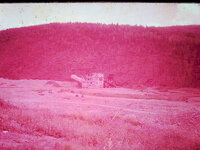
Talking about La Crosse, we spent a few times down there, through Cheryl's work, for her conventions. I married a Lunch Lady. Ha. But her work suggested that she should go to these conventions, and take a test. I helped her study for her test, and it paid off! She passed the test! There were three Cities involved with the conventions, on a three year rotation. La Crosse, Green Bay, and Wisconsin Dells. In La Crosse, we stayed at the Radisson.
But always had a room with the windows facing the River. Boy, was that interesting! The amount of boat traffic on the Mississippi was fun to watch. There were barges and big boats going, almost constantly. The barges, especially got my attention. Some of those barges, tied together, 2 wide and 3 long. Those barges are huge! I once saw a worker on a barge, and counted his steps, walking, thinking I could calculate a 2 foot step ( each pace) into the length of a barge. I had some idea, by using that, on how long a barge is. I forget numbers by now. But the bigger thing was that all of these barges were tied together and a tug boat pushed them uphill ( ok, upstream) from the back end. The tug boat had to be tethered from each corner from the back end with a chain or a rope in order to steer the big assembly. Every one of those barges were the same. My question is, why push from behind? Wouldn't it be easier to hook a chain to the front of the barges, and pull forward? I never did get an answer for that.
Rick, our home in the Hudson Valley had a view of the river and we could watch ships passing. We lived in that home from 1966 to 1970 and most of the barges we saw were towed behind the tugboat with huge ropes and/or cables. The propulsion systems on those tugs were the standard propeller and rudder. Times have changed and most tugboats have Z-drives that can rotate the propeller 360 degrees, eliminating the need for a propeller. The Z-drive makes pushing and steering a barge much easier. Here's the AI basic answer:
"Tugboats began adopting Z-drives and other advanced propulsion systems in the mid-to-late 20th century, a process that started in Europe and gained widespread traction in North America during the 1980s
. The transition from standard propellers to these advanced systems was a gradual evolution, not a single event.
Timeline of tugboat propulsion changes:
- 19th and early 20th century: After paddlewheel designs gave way to propellers around 1850, the standard propeller driven by a steam engine dominated tugboat technology. The early 1900s saw the beginning of the shift from steam to more efficient diesel and diesel-electric engines, but these still drove standard propellers.
- 1950s: The key innovation that made the change possible was the invention of the Z-drive transmission in 1950 by Josef Becker in Germany. The Z-drive, also called an azimuth thruster, uses a propeller that can rotate 360 degrees, allowing for far greater maneuverability. A competing system, the Voith-Schneider cycloidal drive, was developed even earlier in 1925 but saw more niche adoption.
- 1960s: The first azimuthing thrusters were built in Germany.
- 1980s: Z-drive propulsion was first used in North America, specifically for ship-assist tugs that guide large vessels in and out of port. In the U.S. inland waterways, a conventional towboat was retrofitted with z-drives in 1982.
- 2000s to today: Z-drives have become the dominant form of propulsion for newly built tugs, particularly those used for harbor and ship-assist work. For example, z-drives appeared on U.S. inland waterway vessels starting around 2008. Some traditional propeller/rudder configurations are still used for port-to-port towing, where maximum maneuverability is less critical."
Video of the Z-drive:
Video of the Voith-Schneider cycloidal drive:
The propeller system is like our oscillating fans in our homes and shops. The cycloidal drive is like the tower fans (Vornado).
I think it was sometime in the late 1950's or early 1960's that they stopped pulling and started pushing the barges on the Hudson River. I never found out why but I think it gives them more precise control, e.g. when navigating between pilings under bridges and such.
Lou
Lou, I don't recall many pusher tugs when we were boating on the Hudson (1971-75). We had to be careful because the tow lines were often under water. I do remember slowing way down when encountering a tugboat (alone or towing) because they left a huge but invisible wake. None of that foamy water to indicate a huge breaking wave, just a slow but long rise to the smooth crest and then a slide into an equally large trough. Crossing that wave while going fast meant going airborne (ask me how I know). Even reducing speed was risky as it was easy to reach the crest and take a nosedive on the back side of the wave that would scoop up a ton of water and come over the windshield.
As far as I'm concerned, Bob is THE toughest man alive. What he survived is waay beyond the current popular word, AMAZING.
The ONLY man that might give him a contest is the guy that had to amputate his own arm after it was crushed between two rocks, trapping him with no other way out.
Hope you and your wife are well, Bob. My best to you, Dan
Dan, thanks for the compliment. I might be more stubborn than tough. That guy who amputated his own arm must have heard about "Coyote Ugly." After a night of drinking you wake up in a strange bed and try to roll over. Rather than wake the really ugly woman it's under, you chew your arm off. That was my explanation for a couple of decades.
Well now, you've forgotten about Chuck Norris methinks.
Lets just agree to disagree and rate Bob and Chuck equal first ??

Greg, I wouldn't want to fight Chuck Norris. I wouldn't want to make Chuck Norris angry. But I might hang out with him if he ties his left arm behind his back.
Ok, you've seen this too. I bet you are correct on the more precise steering. It still boggles my mind that they do it that way. It makes me think of trying to push a rope, uphill on a windy day, or trying to back up a long trailer with your pickup the entire distance. It just seems wrong to me. Ha.
Rick, imagine pushing a long trailer with the hitch on the front of your truck and being able to turn all four wheels in any direction you wanted.
Ahhh, but here is where your thinking is not transferring from hard ground to water , if you don't mind me saying.
A boat is steered from the aft (rear) unlike a car which steers from the front. So just think of a barge as being the front of the boat and the tug being the rear half of the boat, so to speak , like bolted onto the back of it making one longer boat....and it will make more sense !
We attended the 2024 NASSAM (North American Solstice & Sky Annual Meet) in La Crosse and stayed at the Radisson.
What a cool town La Crosse and the whole area is.
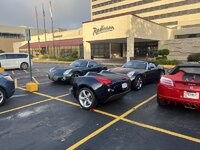 Raddison parking lot
 by
jon72vega, on Flickr
 Mississippi River in La Crosse
 by
jon72vega, on Flickr
 Riverboat near the Raddison
 by
jon72vega, on Flickr
 Barges upstream bound
 by
jon72vega, on Flickr
A view of the Solstice & Sky car show from the roof of the Radisson.
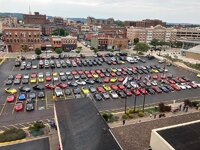 Another drone picture of the car show
 by
jon72vega, on Flickr
It was time to head home way too soon.
 Loaded up, going home
 by
jon72vega, on Flickr
SORRY BOB FOR THE THREAD DETOUR.
Now back to your scheduled programing.
Jon, don't be sorry! I love your detour. Reminds me of our time as members of the South Florida Corvette Association and NCCC (National Council of Corvette Clubs, Inc.).
@Coolabah, thank you for your response. It seems so simple, after reading your thoughts, to the point that I ask myself...what was I thinking?? But again, thank you for setting me straight.
Rick, technology changes and what was once the accepted best practice gets replaced with something (sometimes) better. While cruising the Internet and reading about tugboat technology, I came across a reminder of the SS United States record crossing of the Atlantic:
"The S.S. United States broke the eastbound transatlantic speed record on its maiden voyage in July 1952, crossing from New York to England in 3 days, 10 hours, and 40 minutes. This journey achieved an average speed of over 35 knots, earning the ship the prestigious
Blue Riband for speed, a record that remains unbroken by any ocean liner to this day."
@jon72vega, those are some great pics. I remember seeing some things in your pics, of the back yard of the hotel. Travis an I spent a lot of time, walking to various places. If you go North on that sidewalk, there's a museum up there. We did catch a ride on that paddle boat. We walked to do a tour of the Hixon House. (Kind of a rich man's house, turned into a museum). Plenty of things to do in La Crosse. I enjoyed every minute I was there. If I remember right, Pearl Street was very close to the Hotel. I bought a Cheese wedge from one of those gift shops, to support the football team, called the Packers. I'm not a ball game fan of any sort, just wanted to buy a foam cheese wedge hat.
Rick, it's always great to leave home and travel to a new destination, near or far. I'm not into hats much but I did buy one in St. Thomas that I wore to dinner on our cruise ship.
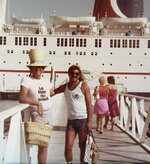
I entered the dining room saying "I'm late, I'm late, for a very important date!" The hat is carefully stored in one of those places that escapes me at the moment.