Private Lugnutz
Well-known member
Yes, it is. I love the approach. No photographs. Every trap, rifle, knife, and axe in a figure that he refers to in the text, all in the hands of public or private collections, is hand drawn....the Carl Russell book is a fascinating read,
Chapter IV, Knives of the Frontiersmen, was helpful. While I didn't find anything definitive, bits and pieces provided me enough to carry on.
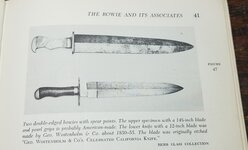
At the coarsest level, Russell devotes much attention to what he simply refers to as "big knives", and a few examples (see below) would literally and figuratively befit the sheath. In the subparagraph focused exclusively on The Bowie Knife, in which he describes the early patterns as "heavy enough to cleave a human skull, and rugged enough to disarticulate the joints of a bull elk—or dig the grave of a fallen comrade," he notes what he calls "the preponderance" of clip-points, agreeing with Peterson's description of them (in American Knives) as the "classical form", but describes a "goodly number of double-edged, spear-pointed, dagger-like bowies." And one of the figures below (pg 193) identifies the same single-edged spear-point blade as a bowie exemplified by the Civil War era D-guard bowies as I showed above.
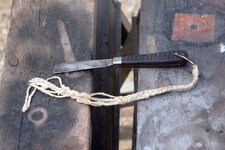
While I would not deign to identify my sheath as military, I am also liking the look of the Ames Rifleman's Knife of 1849 (p.197) with its foot-long blade, and the description of its sheath as a "leather scabbard having a brass tip and a brass throat." I can see an enterprising contemporary making a rawhide one around a frame of the same "iron wire" he later describes being used as bindings to secure wooden sheaths in the same time period. Per Russell, "iron wire appears quite frequently on fur trader's lists" (p.373).
The only points I gleaned from the subparagraph on sheaths was some confirmation of some kind of provision, usually a hole, at the tip, for a leg-tie. I keep thinking the nub, knob, or button on mine, while binding the rawhide at the tip there, would also be perfect for passing a loop over and around the leg and cinching. As for wearing, he talked about traders and scouts and soldiers wearing them at the small of the back, but also "in a sheath attached to the strap that supported his rifleman's pouch" (p.210).
I talked to a friend of a friend who is going to try to put me in touch with a history prof that I am hoping to send some photos to. More to follow in good time.
Attachments


Last edited:

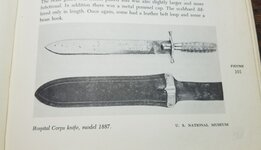
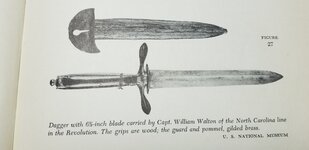
 ). I did enjoy seeing the length (14-1/2"!) of the double-edged spearpoint bowie in Pic 1 and the shape of the Hospital Corps knife and sheath in Pic 2, and I could be convinced that the sheath for the 18th century knife in Pic 3 is rawhide with an upturned collar. It easily has the most coarse, roughest appearance of all sheaths in the book. But learned nothing new or definitive.