To avoid these ads, REGISTER NOW!

Amprobe multimeter bit the dust what to replace it with?

Bennylava

Well-known member
Joined
Apr 17, 2012
Messages
870
Location
Cleburne, TX
Hi all, about 8 years ago I bought an Amprobe AM-510 on the recommendation of this board. IIRC it was because it was a good value being a fluke subsidiary, and containing a lot of fluke parts. But now when you turn the dial, it makes a high pitched electrical squealing, and some electrical creaking noises. And typically the screen just stops displaying anything as you're trying to use it. So I'm guessing it's done for. I made sure the rechargeable 9v battery has a full charge.

So what's a good mulitmeter to replace it, that won't break the bank? Seems like everybody and their dog makes one. Is there anything wrong with the Klein MM400? It's only $80 and people who review it seem to like it well enough. Maybe it's not up to amprobe or fluke standards, but maybe it will do the job on automotive, just fine.
Thanks!
 
To avoid these ads, REGISTER NOW!

rlitman

Well-known member
Joined
Oct 18, 2010
Messages
24,582
Location
Long Island
Open it up and look for a blown out capacitor. It may be a cheap and easy fix. Have you tried a non-rechargeable standard 9V battery?
 
OP
B

Bennylava

Well-known member
Joined
Apr 17, 2012
Messages
870
Location
Cleburne, TX
Open it up and look for a blown out capacitor. It may be a cheap and easy fix. Have you tried a non-rechargeable standard 9V battery?

That's what it used to have, and it did work fine before that died. Then again it also worked fine for a few years on the rechargeable. But I guess it's possible the rechargeable has degraded some in 3 years time and can't power it well enough anymore. I'll give it a shot!
 

iron block

Well-known member
Joined
Jun 22, 2015
Messages
262
Location
Bay Area, CA
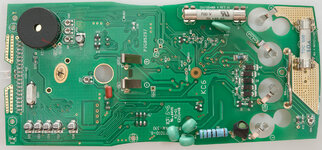
Following up on what rlitman said, it looks like there are 6 electrolytics on the top of the board, and two on the bottom. One is marked 4.7uF/35V, the others are all 10 uF/16V.

These SMD electrolytic capacitors can fail with a tell-tale "fishy" smell from the leaked electrolyte. Might be worth a sniff.

Some great teardown photos are available at Henrik Jensen's review site.

Top photo:
1759969723294.jpeg

Bottom photo:
1759969787617.jpeg
 
OP
B

Bennylava

Well-known member
Joined
Apr 17, 2012
Messages
870
Location
Cleburne, TX
Following up on what rlitman said, it looks like there are 6 electrolytics on the top of the board, and two on the bottom. One is marked 4.7uF/35V, the others are all 10 uF/16V.

These SMD electrolytic capacitors can fail with a tell-tale "fishy" smell from the leaked electrolyte. Might be worth a sniff.

Some great teardown photos are available at Henrik Jensen's review site.

Doesn't smell fishy, and there doesn't seem to be any obvious burnt spots. There's a little weirdness around the flashlight button on the board, in the form of some very small, hazy white staining. But I never use the flashlight button, and it doesn't seem like that would cause these kinds of problems.

Maybe there's someone out there who does repairs on them. Then again maybe it's not worth the expense, and I'm better off just buying a new one.

I'm not familiar with that type of fuse, but I did note that mine don't seem to have any writing on them. They're just white. At first you might think that means they're blown, but the meter does still try to work for a minute before the screen just stops displaying anything.

So that would lead you to believe the fuses must not be blown, otherwise it wouldn't work at all.
 
Last edited:

willf650

Well-known member
Joined
Mar 10, 2010
Messages
789
Doesn't smell fishy, and there doesn't seem to be any obvious burnt spots. There's a little weirdness around the flashlight button on the board, in the form of some very small, hazy white staining. But I never use the flashlight button, and it doesn't seem like that would cause these kinds of problems.

Maybe there's someone out there who does repairs on them. Then again maybe it's not worth the expense, and I'm better off just buying a new one.

I'm not familiar with that type of fuse, but I did note that mine don't seem to have any writing on them. They're just white. At first you might think that means they're blown, but the meter does still try to work for a minute before the screen just stops displaying anything.

So that would lead you to believe the fuses must not be blown, otherwise it wouldn't work at all.
The fuses in meters are for protection when reading current. Even if blown they would not stop the meter from powering up or entering any of the functions.

If they were blown all that would happen is the meter wouldn't read current when attempting use that function.

I wouldn't think a meter of that price would be worth servicing.
 

visionguru

Well-known member
Joined
Jan 2, 2017
Messages
1,233
Location
Chicago
Is there anything wrong with the Klein MM400? It's only $80 and people who review it seem to like it well enough.
From the specs, Klein MM400 is a basic 4000 count, 1% accuracy multi-meter. $80 is highway robbery, and it doesn't even come with a case. $20 seems more appropriate.

Search on Amazon, $80 can buy way better meters.
 

Rinspeed

Well-known member
Joined
Apr 26, 2020
Messages
1,817
Location
NY
You didn't say what you need a meter for but the Fluke T5 are an awesome basic meter for home and auto use.
 

bwringer

Well-known member
Joined
Jan 1, 2013
Messages
10,253
Location
Indianapolis
I've been very happy with my Klein MM450. It's the one with a much larger digital display, which makes a huge difference to me. $80 at Home Despot.
 

redwrench60

Well-known member
Joined
Sep 10, 2011
Messages
6,062
Location
East Tennessee
I’m really curious what happens if you try a fresh new alkaline 9V battery. DMM’s that take a 9V are very sensitive to battery voltage. Sometimes acting funny even before the low battery indicator comes on.
 

willf650

Well-known member
Joined
Mar 10, 2010
Messages
789
Since this is automotive based board I’ll assume you will be using the meter for automotive and basic home use. I’ll share my thoughts on meters based on the ones I have but I’m no means an expert on meters but have about 10 and use them regularly but not for automotive use.

One of which is a Fluke T5 and I hate it. The T5 is not really a meter but a fancy tester. It is really lacking in the functions and it is really bad on reading resistance beyond a basic continuity check.

I have a Klein clamp style multi meter. I bought it in an emergency as I lost a meter. It functions well enough but the one downfall is the display. It is a reverse contrast which is fine inside and is readable in low light but for me I have real trouble seeing it outside in the sun. This is the downfall to this meter for me and may be shared buy other Klein meters.

I have a bunch of Flukes and thinking back I broke 2 of them physically. The rest still live and some are 30 years old. I would recommend them as a brand the most but some are expensive compared to what you are mentioning here. Most of the ones I have range from about $350-$650. Taking this into account I looked on Amazon and saw a model called the 15B was about $110 and looked nice for the money. Seems to be have most of the features I would need. One thing you may want make sure of is the display has a backlight function as not all Flukes do.

On a budget I have a Field Piece multi meter that was given to me by an employer. It is 23 years old and still functions but it has been a backup meter most of its life. It is a very highly featured meter and is based around the HVAC field. It even has a 3 phase rotation check. When I got it the only reason it didn’t become a primary meter is it was slower to give readings than the Flukes I was used too. I see a ton of guys using Field Piece meters and can recommend them as a budget brand.

This is the current equivalent of the Field Piece meter I have:
LT17A

These are the thoughts of an idiot but 4 things to look out for in a multi meter are the following:

Resistance reading capability as some cheap multi use meters are only capable of basic continuity readings of 1-3k.

A backlight display is really nice and not all meters have it.

Capacitance reading capability. Not all meters have this but you may not need this function.

Current readings, not all meters have this function but you also may not need it.

Long winded answer.
 
Last edited:

richfinn

Well-known member
Joined
Jan 29, 2011
Messages
4,810
Location
Leeds, Yorkshire, England
I've long been a Fluke guy, but recently bought a couple of Brymen meters (maybe available as Greenlee in USA), you can't knock the spec and build quality for what they cost and they have a wide range suitable for all skill levels.

 
To avoid these ads, REGISTER NOW!

jayemm

Well-known member
Joined
Dec 18, 2018
Messages
1,512
Location
up high down low
Following up on what rlitman said, it looks like there are 6 electrolytics on the top of the board, and two on the bottom. One is marked 4.7uF/35V, the others are all 10 uF/16V.

These SMD electrolytic capacitors can fail with a tell-tale "fishy" smell from the leaked electrolyte. Might be worth a sniff.

Some great teardown photos are available at Henrik Jensen's review site.

Top photo:
1759969723294.jpeg

Bottom photo:
1759969787617.jpeg
Those 6 "electrolytic" capacitors look like aluminum/polymer capacitors and lack the cross slits the electrolytics have for venting purposes.
 
OP
B

Bennylava

Well-known member
Joined
Apr 17, 2012
Messages
870
Location
Cleburne, TX
You didn't say what you need a meter for but the Fluke T5 are an awesome basic meter for home and auto use.

I just use it for house and automotive use. So I went with a basic Fluke:


Everyone says they don't really die and I need a meter now, and that one has all the functions I need.
I’m really curious what happens if you try a fresh new alkaline 9V battery. DMM’s that take a 9V are very sensitive to battery voltage. Sometimes acting funny even before the low battery indicator comes on.

Put a new energizer 9v in there, same result. Guess the problem wasn't the battery. I had forgotten what I paid for the meter, but as one member mentioned it's not worth saving, it was $50 and it lasted about 7 years. It's in the garbage.
 

ItsNemo

Well-known member
Joined
Mar 5, 2016
Messages
4,805
Location
Canada
You didn't say what you need a meter for but the Fluke T5 are an awesome basic meter for home and auto use.

Having a T5-600, I'd say it's only really useful for quick 120/208/240v testing on panels and branch circuits, it's not overly useful elsewhere.

OP - just bite the bullet and get a Fluke, they're worth it for a reason, even a 117 would do the job without going to the more expensive 87v that everyone wants.
 

redwrench60

Well-known member
Joined
Sep 10, 2011
Messages
6,062
Location
East Tennessee
I just use it for house and automotive use. So I went with a basic Fluke:


Everyone says they don't really die and I need a meter now, and that one has all the functions I need.


Put a new energizer 9v in there, same result. Guess the problem wasn't the battery. I had forgotten what I paid for the meter, but as one member mentioned it's not worth saving, it was $50 and it lasted about 7 years. It's in the garbage.
Well, ****. I was hoping that would square you away. Oh well it was worth a shot.

As for meters, I always gravitate to Flukes. Even the budget Flukes are better than the premium cheapies.
 
OP
B

Bennylava

Well-known member
Joined
Apr 17, 2012
Messages
870
Location
Cleburne, TX
Having a T5-600, I'd say it's only really useful for quick 120/208/240v testing on panels and branch circuits, it's not overly useful elsewhere.

OP - just bite the bullet and get a Fluke, they're worth it for a reason, even a 117 would do the job without going to the more expensive 87v that everyone wants.

I may upgrade to the 117 at some point, or even a bit higher as I learn more. But for now I just went with the Fluke 15b+, a good entry level model. Should be great for general automotive and house use.
 

willf650

Well-known member
Joined
Mar 10, 2010
Messages
789
I may upgrade to the 117 at some point, or even a bit higher as I learn more. But for now I just went with the Fluke 15b+, a good entry level model. Should be great for general automotive and house use.
Unless you’re doing actual electronics work the 15b will suffice.

Your next needed purchase will be a clamp meter or accessory amp clamp to use with the 15b.
 

nadogail

Well-known member
Joined
Jan 23, 2009
Messages
31,928
Location
Coronado, CA
Mine died during an install job in Taiwan, I replaced it with a locally sourced Hiroki.

That was the same week that the tanks rolled into Tienaman Square to put down the student pro democratic demonstrations.
 

bornbadbob

Well-known member
Joined
Jan 3, 2025
Messages
214
I just use it for house and automotive use. So I went with a basic Fluke:


Everyone says they don't really die and I need a meter now, and that one has all the functions I need.


Put a new energizer 9v in there, same result. Guess the problem wasn't the battery. I had forgotten what I paid for the meter, but as one member mentioned it's not worth saving, it was $50 and it lasted about 7 years. It's in the garbage.
Tough to go wrong with a Fluke.
 
OP
B

Bennylava

Well-known member
Joined
Apr 17, 2012
Messages
870
Location
Cleburne, TX
Unless you’re doing actual electronics work the 15b will suffice.

Your next needed purchase will be a clamp meter or accessory amp clamp to use with the 15b.

Main purpose of the clamps? Just clamp on and it reads the voltage somehow, or is it for the sake of convenience? Meaning it just hangs there, making it easier to find a place to put the meter in a cramped work environment.
 

terrific

Well-known member
Joined
Nov 22, 2021
Messages
329
Main purpose of the clamps? Just clamp on and it reads the voltage somehow, or is it for the sake of convenience? Meaning it just hangs there, making it easier to find a place to put the meter in a cramped work environment.
They read the amperage passing through the wire, so that you don't have to find a place to break the circuit and insert the multimeter in series. They're very useful, but very expensive. They have limitations, which you should look up.
 
OP
B

Bennylava

Well-known member
Joined
Apr 17, 2012
Messages
870
Location
Cleburne, TX
They read the amperage passing through the wire, so that you don't have to find a place to break the circuit and insert the multimeter in series. They're very useful, but very expensive. They have limitations, which you should look up.

Thanks! Yeah I always imagined the limitation would be related to the wire's insulation.
 
To avoid these ads, REGISTER NOW!
Top Bottom