Fordguy1964
Well-known member
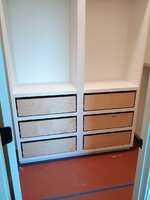
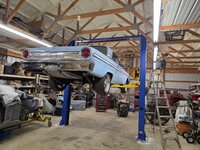
So this weekend I did a thing. I'm really getting close to having an honest to goodness shop here. I'm getting pretty excited to use it.



I remodeled for 30+ years. Did a hundred (literally) bathtub jobs like you are doing except the surrounds were almost always tiled.Sorry for no pics, but the USB port in my cell data any more. Have been doing bathroom remodel back to studs and had plumber in to rough-in tub/shower. Got badly misinformed from hardware supplier and tub/surround vendor and rough-in was a bit too deep in the wall. I happen to hate PEX for so many reasons, it is all in soldered copper (as is rest of 45YO house). So, just needed to pull the lot back an inch or so, but that would leave shower valve off square. Needed to be able to bend two lenghts of pipe out a few degrees down low and a foot higher beck to vertical. I have bending capacity and use a lot from 1/4" up 2", but no way to get at an assembled run inside a stud wall. So, I made a lever bender with two hooks to pull on outboard end and a "push shoe" in the middle to do the outward bends and a set of shoes traded to outboard end with tensile loop in the middle to bend inward. A little practice with bare steel shoes gave wall failures in compression, so made another set with 1/8" nitrile liners and it allowed a very small bend with only minor distortion and no compression collapse. VERY limited in how much it can bend but staging multiple points got me into alignment and square to wall.
If only the rest of the world used rigid copper there might have been a market for this, but as it would still be a very special case tool at best. It will just take up more space in a drawer of the cabinet where my pipe tools go
We went into this somewhat blind (haven't built a house in last 45 years) so made the HUGE mistake of trusting what I assumed to be a trustworthy name brand tub and enclosure (Kohler). Also did big no-no and ordered fixed glass screen with swinging door well in advance as everyone was quoting us several weeks to deliver putting us in line but with time to correct values once surround in place. Had to make a 4' x5' square to get the opening dead on (as glass doesn't have much range of adjustment and found much to my horror that vertical dimensions of the surround included being bowed nearly 1/4".I remodeled for 30+ years. Did a hundred (literally) bathtub jobs like you are doing except the surrounds were almost always tiled.
I was SO glad when they came out with Pex.
It's much faster and cheaper - both for materials and especially labor, lasts longer than copper, you can easily bend it around as needed and you didn't have to worry about burning the customer's house down when you sweat the joints in tight locations.
Pex for me lasted 20 years, Chlorine in the water broke it down and hot water accelerated the degradation. Cost me $10K to re-pipe the whole house after it burst and flooded the downstairs. 90% of the houses in my area built about the same time are having the same problems. Class action suite only replaced pex from 15' from Water heater. And it has expired about 5 years ago. I know it was a bad batch but I'm not 100% sold on it. My mom and dads house, they have been in it for 55 years no issues with copper water lines ever.We went into this somewhat blind (haven't built a house in last 45 years) so made the HUGE mistake of trusting what I assumed to be a trustworthy name brand tub and enclosure (Kohler). Also did big no-no and ordered fixed glass screen with swinging door well in advance as everyone was quoting us several weeks to deliver putting us in line but with time to correct values once surround in place. Had to make a 4' x5' square to get the opening dead on (as glass doesn't have much range of adjustment and found much to my horror that vertical dimensions of the surround included being bowed nearly 1/4".
You bring up a most interesting question: where do you get info on pex outlasting Cu? I have seen a lot of copper pushing up a century but pex hasn't been around for 1/2 that time. Polyethylene isn't a particularly long life material (better when hidden in walls away from UV) and IMHO Pex C is just plain **** to start with, B mediocre and A just another plastic with mediocre oxidative stability, progressive crosslinking with age and of course being a plastic is going to express toxic chemistry (from process and to add UV stability) into drinking water.


PEX will outlast copper the first time the plumbing freezes in a power outage.....
You bring up a most interesting question: where do you get info on pex outlasting Cu? I have seen a lot of copper pushing up a century but pex hasn't been around for 1/2 that time. Polyethylene isn't a particularly long life material (better when hidden in walls away from UV) and IMHO Pex C is just plain **** to start with, B mediocre and A just another plastic with mediocre oxidative stability, progressive crosslinking with age and of course being a plastic is going to express toxic chemistry (from process and to add UV stability) into drinking water.
Interesting, have not heard about that. Mostly test reports show PEX lasting 50 years or more.Pex for me lasted 20 years, Chlorine in the water broke it down and hot water accelerated the degradation.
Well I hope you're right, cause my house is 21 years old.Interesting, have not heard about that. Mostly test reports show PEX lasting 50 years or more.

Interesting, have not heard about that. Mostly test reports show PEX lasting 50 years or more.
Since they started using Type M copper in the 1970's, it seems copper only lasts around 20 years. People blame the water system, but it seems more likely to be the thin copper.


That sounds like a case of galvanic corrosion. If your house goes back to the bad ol' days when the plumbing was used as an electrical ground, it definitely is.I dealt with multiple pinholes in copper pipe in my previous residence, beginning around 1993 and continuing episodically until I had ripped out and replaced the last of it around 15 years later. That house was built in 1957, and I'm reasonably confident the failing copper was original to the house. Oddly, except where the pinholes were and places where the flux residue hadn't been sufficiently removed, that old pipe showed no evidence of corrosion internally or externally. I could only guess as to the true cause of failure.
I see you are in central Maryland.I dealt with multiple pinholes in copper pipe in my previous residence, beginning around 1993 and continuing episodically until I had ripped out and replaced the last of it around 15 years later. That house was built in 1957, and I'm reasonably confident the failing copper was original to the house. Oddly, except where the pinholes were and places where the flux residue hadn't been sufficiently removed, that old pipe showed no evidence of corrosion internally or externally. I could only guess as to the true cause of failure.
Fair comments. We happen to have a super reliable grid, so even though we get -40 pretty regularly decent insulation and minimal routing near outside walls means frozen plumbing pretty rare. Agree about Cu corrosion being better or worse depending on how much attention paid to galvanic series in straps, nails and screws, water quality and no doubt copper quality. I have a natural aversion to plastics of many kinds, and PE is far, far away from something I would trust.PEX will outlast copper the first time the plumbing freezes in a power outage.
PEX also completely skips any concerns about galvanic corrosion in plumbing systems. Hopefully, most buildings have abandoned the use of galvanized pipes from the street to the house, but water heaters and other things in the system are still galvanically reactive with copper--and, contrary to old plumber's tales, there is no way to electrically isolate the two if there are any wires attached to anything--dishwasher, water heater, etc--as they're electrically bonded through the ground wires.


That sounds like a case of galvanic corrosion. If your house goes back to the bad ol' days when the plumbing was used as an electrical ground, it definitely is.
I see you are in central Maryland.
Are you a WSSC customer? There were law suits and zillions of complaints of poor water quality causing pin hole leaks throughout their distribution territory.


While it sounds like a lot of your problem is water quality (glad I'm on a well at home), the same reason applies to both: Corrosion will act first and fastest on tiny surface irregularities and impurities.I don't dismiss this as an explanation. But, I do wonder why only scattered pinholes appeared over the course of roughly 15 years, with the remainder of the pipe appearing to have retained its original thickness and integrity. I am far from an expert on the topic, but I would not expect galvanic corrosion to have been localized to such a few, pin-point locations. Most of the instances of galvanic corrosion I've encountered have not been so discriminating. Puzzling, at least to me.
Copper I used in the 90's here is stating to get pin holes, I'm thinking pex may be easier to run between floors.Interesting, have not heard about that. Mostly test reports show PEX lasting 50 years or more.
Since they started using Type M copper in the 1970's, it seems copper only lasts around 20 years. People blame the water system, but it seems more likely to be the thin copper.
Not only is PEX easier to run, but the time and money you save will knock yer socks off.Copper I used in the 90's here is stating to get pin holes, I'm thinking pex may be easier to run between floors.


So 6-8' of copper from the water heater to a supply manifold then Pex?Here is my defective 22 year old Pex
Every time I see a flood/restoration truck and a dumpster in my neighborhood I know what happened. I personally know 15 family's that their pex leaked just inches or feet from the water heater.
Poster mentioned that this was a defective batch.So 6-8' of copper from the water heater to a supply manifold then Pex?
Not only is PEX easier to run, but the time and money you save will knock yer socks off.
I pretty much stopped hanging copper around the brewery about ten years ago. PEX is hard to get as tidy in exposed runs, but it takes me minutes to run a line that would take hours in copper and the cost is a fraction of that of type L copper. There are also no worries about trapped runs, expansion/contraction problems, etc.
I avoid using PEX where it will be exposed to direct sunlight, but sun coming through a modern window--or what was a modern window twenty years ago--doesn't seem to have any problems. If I have to do an outside run, I'll run it in conduit--also a nice way to keep exposed runs tidy, but then it starts getting into the price/install time range of copper.
Another nice thing about PEX is the lower rate of heat conduction compared to copper. Even without insulation, hot water is noticeably hotter at the end of the run and condensation on cold lines less of a problem. The PEX seems to have less of a tendency to clog with lime scale in our hard water, but the jury's still out on that.
I agree. I'll add that the battery expanders are fast, and wicked cool to operate. I love the manifold arrangement of PEX. I love the reduction in connections. One end on the manifold, and one end at the outlet. That eliminates lots of joins at elbows, and splicing two lengths of pipe. That is a huge reduction in joins that I see as potential failure points. I get concerns about plastics. But then copper is what is added to boat bottom paint to kill barnacles, and algae. I guess I just live life on the edge!Being able to color-code the lines sure don't hurt, either.
I'm now using PEX for water--up to 187 degrees F at 60 psi--and CO2 and air at 125 psi. No problems so far.
I guess I've become somewhat of a fanboy, but these are my observations after decades of hanging copper and about one decade of PEX.
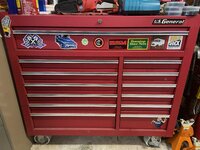
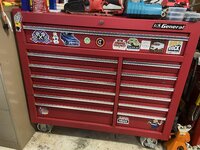
Looks good, any paint residue come off on the microfiber towel?Spent some time cleaning the outside of my tool boxes, general dust/grime and who knows what on them. I used Sprayway glass cleaner and a microfiber towel. I also added a few more stickers that I had laying around.
before:
After:
Before:
After:


While it sounds like a lot of your problem is water quality (glad I'm on a well at home), the same reason applies to both: Corrosion will act first and fastest on tiny surface irregularities and impurities.
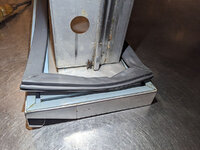
One of those things that a person puts off for so long and when you finally fix it you wonder why you left it for so long nagging at you!!
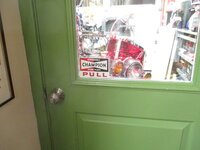
Big doings at the Flying 'M' Cycles Garage today!....I added a vintage style Champion Spark Plug PUSH/PULL double sided sticker to my Office/Shop door window. WOW! I'm exhausted...