To avoid these ads, REGISTER NOW!

Using a die to cut M4 threads on round stock

vdotmatrix

Well-known member
Joined
Sep 13, 2011
Messages
485
Location
Northern Virginia
I am using an M4 .75 die to cut threads on M4 round stock aluminum.
i need the threads to be 10mm in length on this rod.
is there a machinist trick as to how many turns equal the amount of travel? Uh, besides using calipers or a ruler?
 
Last edited:
To avoid these ads, REGISTER NOW!

RoninB4

Well-known member
Joined
Jul 22, 2020
Messages
3,565
Location
Under My House
i need the threads to be 10mm….
-Is that 10mm of fully formed/cut threads? Most dies (and even taps) will have partial formed/cut threads for the first few threads. Your application calls for 10mm of length? How accurate does that dimension need to be? Does it thread into something until it stops like a stud or something go onto the threads like a nut? Application requirements are everything.
is there a machinist trick as to how many turns equal the amount if tracel?
-You can estimate the number of rotations required but it still doesn't take into account:

1) How many rotations did it take to get the threads started?
2) How many partial threads are allowed for it to function correctly?
3) Is the die adjustable or is it a fixed, non-adjustable type?
4) What are you using to get the die started?
Uh, besides using calipers?
-Uh, what do you have against using calipers? There are plenty of "machinist tricks" but simple measuring is so basic to verify I don't know why this would be objectionable. If you don't like using calipers I doubt you'll like using math to calculate the number of rotations required. Removing the die (or tap) to clear chips is often recommended anyway for several reasons. Ask if you want to know why.

-You can use a sharpie to mark off where 10mm is and thread up to that line but that still may not account for partial threads or achieve how accurate that dimension needs to be. You can flip the die around and cut the partial threads to make fully cut threads but this will place a greater stress on what's being cut. Cutting full depth on 4mm of aluminum doesn't take a lot of stress to bend/deform the aluminum so the die better be sharp and have some cutting fluid used or the aluminum will micro-weld itself to the die teeth and/or tear the material and produce ragged looking threads. I often use kerosene on aluminum, WD-40 may/may not work well for this. The die needs to be started correctly, failure to align the die axis to the shaft axis can/will produce a banana-shaped object with threads. A dull die can also produce the banana shaped object. A dull die can even just twist off the threaded portion anywhere along the length when cutting force exceeds the shear limit of that material, aluminum types are very different from each other. Aluminum may be soft but that doesn't mean it's easy to thread with a die or even a tap.

-I had no intentions of lecturing here and I don't want to be disrespectful either. I'm just trying advise what kind of results to expect if/when things go wrong. Creating threads in metal is not as simple as most people think it is.
 
OP
V

vdotmatrix

Well-known member
Joined
Sep 13, 2011
Messages
485
Location
Northern Virginia
-Is that 10mm of fully formed/cut threads? Most dies (and even taps) will have partial formed/cut threads for the first few threads. Your application calls for 10mm of length? How accurate does that dimension need to be? Does it thread into something until it stops like a stud or something go onto the threads like a nut? Application requirements are everything.

-You can estimate the number of rotations required but it still doesn't take into account:

1) How many rotations did it take to get the threads started?
2) How many partial threads are allowed for it to function correctly?
3) Is the die adjustable or is it a fixed, non-adjustable type?
4) What are you using to get the die started?

-Uh, what do you have against using calipers? There are plenty of "machinist tricks" but simple measuring is so basic to verify I don't know why this would be objectionable. If you don't like using calipers I doubt you'll like using math to calculate the number of rotations required. Removing the die (or tap) to clear chips is often recommended anyway for several reasons. Ask if you want to know why.

-You can use a sharpie to mark off where 10mm is and thread up to that line but that still may not account for partial threads or achieve how accurate that dimension needs to be. You can flip the die around and cut the partial threads to make fully cut threads but this will place a greater stress on what's being cut. Cutting full depth on 4mm of aluminum doesn't take a lot of stress to bend/deform the aluminum so the die better be sharp and have some cutting fluid used or the aluminum will micro-weld itself to the die teeth and/or tear the material and produce ragged looking threads. I often use kerosene on aluminum, WD-40 may/may not work well for this. The die needs to be started correctly, failure to align the die axis to the shaft axis can/will produce a banana-shaped object with threads. A dull die can also produce the banana shaped object. A dull die can even just twist off the threaded portion anywhere along the length when cutting force exceeds the shear limit of that material, aluminum types are very different from each other. Aluminum may be soft but that doesn't mean it's easy to thread with a die or even a tap.

-I had no intentions of lecturing here and I don't want to be disrespectful either. I'm just trying advise what kind of results to expect if/when things go wrong. Creating threads in metal is not as simple as most people think it is.
I‘ve certainly come to the right place, thanks for responding! I could easily just use a ruler, caliper or crayon, but was looking for a more technical method.
1.using the tapered side, perhaps half a turn, not much, die bites into Al.
2. Locknuts go in the ends
3.it is fixed.
4.? Die holder? Has handles.

i have nothing against my Mitutoyo 500 196-30 the best set I have for accuracy.

Simplest solution hides in plain sight for me. A sharpie! I come to forums for answers to questions I have. Thank you. The next responder‘s post is very helpful to me too! .7mm/turn, about 14 turns. I did not know how to use the pitch length.
 

Attachments

  • IMG_1574.jpeg
    IMG_1574.jpeg
    565.3 KB · Views: 54
  • IMG_1576.jpeg
    IMG_1576.jpeg
    200.7 KB · Views: 53

RoninB4

Well-known member
Joined
Jul 22, 2020
Messages
3,565
Location
Under My House
I‘ve certainly come to the right place, thanks for responding! I could easily just use a ruler, caliper or crayon, but was looking for a more technical method.
-You want "more technical"? How about chucking it up in the lathe and using a sharp pointed cutting bit to scribe a very thin/shallow line on the shaft that's been blackened with a sharpie? That's what I do with either the lathe or just a height gauge off the surface plate.
1.using the tapered side, perhaps half a turn, not much, die bites into Al.
-Looks like your drawing shows the thread ending at a shoulder and that 10mm length also includes the thickness of the shoulder.
2. Locknuts go in the ends
-And the locknuts capture or hold something on the 4mm threaded shaft? If some component is being held by the nut then the entire length of the shaft needn't be threaded does it?
3.it is fixed.
-The that makes a full depth of cut so your die better be sharp and fairly unused.
4.? Die holder? Has handles.
-Most of them do unless you've got a kung-fu grip. I was inquiring how you intend to align the axis of the die with the axis of the 4mm shaft. Due to the pitch of a threading die or tap, the cut begins at one spot and that can cause the die to get leaned over one way or the other. Getting started off-angle will lead to bad things and the handles on a holder don't always offer enough control over the starting process. Once the die is started, whether aligned or off-angle, it's very difficult to correct it.
i have nothing against my Mitutoyo 500 196-30 the best set I have for accuracy.
-I'm so relieved to hear that and my faith in you has been restored (y)
Simplest solution hides in plain sight for me. A sharpie! I come to forums for answers to questions I have. Thank you.
-You're welcome, glad to offer something that might help someone.
The next responder‘s post is very helpful to me too! .7mm/turn, about 14 turns. I did not know how to use the pitch length.
-Just a little reading would have revealed how to calculate that, just a suggestion for future reference :)
 
OP
V

vdotmatrix

Well-known member
Joined
Sep 13, 2011
Messages
485
Location
Northern Virginia
-You want "more technical"? How about chucking it up in the lathe and using a sharp pointed cutting bit to scribe a very thin/shallow line on the shaft that's been blackened with a sharpie? That's what I do with either the lathe or just a height gauge off the surface plate.

-Looks like your drawing shows the thread ending at a shoulder and that 10mm length also includes the thickness of the shoulder.

-And the locknuts capture or hold something on the 4mm threaded shaft? If some component is being held by the nut then the entire length of the shaft needn't be threaded does it?

-The that makes a full depth of cut so your die better be sharp and fairly unused.

-Most of them do unless you've got a kung-fu grip. I was inquiring how you intend to align the axis of the die with the axis of the 4mm shaft. Due to the pitch of a threading die or tap, the cut begins at one spot and that can cause the die to get leaned over one way or the other. Getting started off-angle will lead to bad things and the handles on a holder don't always offer enough control over the starting process. Once the die is started, whether aligned or off-angle, it's very difficult to correct it.

-I'm so relieved to hear that and my faith in you has been restored (y)

-You're welcome, glad to offer something that might help someone.

-Just a little reading would have revealed how to calculate that, just a suggestion for future reference :)
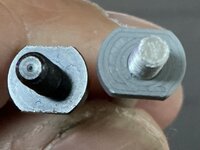
i have read and watched a lot of material but the basics are second nature to you folk here. This is an axle shaft for an RC plane. The smooth section is where wheel spins freely. the oblong washer fits in a recess on the strut and holds the axle in place.

This is NOT easy for many reasons you have mentioned.
  • This flavor of aluminum is very soft. Securing it in a vice deforms it.
  • I found a different die holder to use instead of this POS one that came with this set. HOW the heck do I start a level cut? It will feel level, but when I stoop down to look it is a joke.....not until the die starts to really bite will it settle down.
  • I tried using an M4 spacer to hold this during fabrication and it mushed the threads towards the end.
  • i need to maybe find a harder aluminum round stock, This is 6063 and I just ordered some 6061.
 
Last edited:

RoninB4

Well-known member
Joined
Jul 22, 2020
Messages
3,565
Location
Under My House
i have read and watched a lot of material but the basics are second nature to you folk here.
-Yes it is kinda second nature to me, I was a toolmaker for 25+ years so it better be.
This is an axle shaft for an RC plane.
-Ahhh finally I learn the application, a worthwhile project.
The smooth section is where wheel spins freely. the oblong washer fits in a recess on the strut and holds the axle in place.
-Can't imagine the entire assembly particulars but your description is good.
This is NOT easy for many reasons you have mentioned.
  • This flavor of aluminum is very soft. Securing it in a vice deforms it.
-The more pure an aluminum alloy is the softer it is. Not surprising that it deforms easily and fragile materials like that require special handling considerations. It doesn't require exotic holding equipment, you just have to be familiar with the material itself and have things on hand like wood or leather vise jaw inserts to avoid marring/deforming it. This is especially true for something like a wheel spindle, any deformation and the wheel doesn't spin properly.
  • I found a different die holder to use instead of this POS one that came with this set.
-Most die holder and tap holders available to the public and especially ones that come in sets really are poorly made, they're made from a type of zinc die-cast or what's often called "pot metal" (made from metal scraps) or Zamac. The stuff is ok for carburetors or things that don't get stressed but not for tooling handles like die/tap holders. They break easily and often at the wrong moment. They're one of the few tooling accessories that I feel aren't worth the purchase when made from this inferior material.
  • HOW the heck do I start a level cut?
-Using machinery like a lathe often help but if you don't have one it's all by hand/eye and not easily done. A tap can be guided but a threading die is more difficult since you only have the face as a reference surface. Do you have a lathe or drill press? I can suggest how to do this.
  • It will feel level, but when I stoop down to look it is a joke.....not until the die starts to really bite will it settle down.
-That's what I was trying to describe about the die getting off angle. By the time the die "bites" into the material it's almost too late to do anything about correcting it because the die wants to follow the path of the pitch. I rarely try to thread without something to ensure alignment. Some do thread without proper alignment and get predictable results, usually not good results.
  • I tried using an M4 spacer to hold this during fabrication and it mushed the threads towards the end.
-Thread deformation happens a lot, you shouldn't feel bad about it considering what you have to work with and the methods you used.
  • i need to maybe find a harder aluminum round stock.
-There's several types of aluminum alloys, the most commonly available is 6061. The 7075 alloy approaches mild steel for strength and impact resistance but doesn't fare well for outdoor applications. Alloy 6061 would probably work just fine for what you need. The "T" designations following the alloy numbers are for heat treating and/or strain hardening and mean little for this application. You can either do this yourself with some suggestions or just send it to me and I'll do it for cost of postage both ways since it's a very small/quick job. I also have several types of aluminum here if a new part is needed. I'll leave this decision up to you.
 
OP
V

vdotmatrix

Well-known member
Joined
Sep 13, 2011
Messages
485
Location
Northern Virginia
-Yes it is kinda second nature to me, I was a toolmaker for 25+ years so it better be.

-Ahhh finally I learn the application, a worthwhile project.

-Can't imagine the entire assembly particulars but your description is good.

-The more pure an aluminum alloy is the softer it is. Not surprising that it deforms easily and fragile materials like that require special handling considerations. It doesn't require exotic holding equipment, you just have to be familiar with the material itself and have things on hand like wood or leather vise jaw inserts to avoid marring/deforming it. This is especially true for something like a wheel spindle, any deformation and the wheel doesn't spin properly.

-Most die holder and tap holders available to the public and especially ones that come in sets really are poorly made, they're made from a type of zinc die-cast or what's often called "pot metal" (made from metal scraps) or Zamac. The stuff is ok for carburetors or things that don't get stressed but not for tooling handles like die/tap holders. They break easily and often at the wrong moment. They're one of the few tooling accessories that I feel aren't worth the purchase when made from this inferior material.

-Using machinery like a lathe often help but if you don't have one it's all by hand/eye and not easily done. A tap can be guided but a threading die is more difficult since you only have the face as a reference surface. Do you have a lathe or drill press? I can suggest how to do this.

-That's what I was trying to describe about the die getting off angle. By the time the die "bites" into the material it's almost too late to do anything about correcting it because the die wants to follow the path of the pitch. I rarely try to thread without something to ensure alignment. Some do thread without proper alignment and get predictable results, usually not good results.

-Thread deformation happens a lot, you shouldn't feel bad about it considering what you have to work with and the methods you used.

-There's several types of aluminum alloys, the most commonly available is 6061. The 7075 alloy approaches mild steel for strength and impact resistance but doesn't fare well for outdoor applications. Alloy 6061 would probably work just fine for what you need. The "T" designations following the alloy numbers are for heat treating and/or strain hardening and mean little for this application. You can either do this yourself with some suggestions or just send it to me and I'll do it for cost of postage both ways since it's a very small/quick job. I also have several types of aluminum here if a new part is needed. I'll leave this decision up to you.
thank you....good to know. I am all about fabrication!!!! I have a drill press no Lathe.
 
OP
V

vdotmatrix

Well-known member
Joined
Sep 13, 2011
Messages
485
Location
Northern Virginia
-Yes it is kinda second nature to me, I was a toolmaker for 25+ years so it better be.

-Ahhh finally I learn the application, a worthwhile project.

-Can't imagine the entire assembly particulars but your description is good.

-The more pure an aluminum alloy is the softer it is. Not surprising that it deforms easily and fragile materials like that require special handling considerations. It doesn't require exotic holding equipment, you just have to be familiar with the material itself and have things on hand like wood or leather vise jaw inserts to avoid marring/deforming it. This is especially true for something like a wheel spindle, any deformation and the wheel doesn't spin properly.

-Most die holder and tap holders available to the public and especially ones that come in sets really are poorly made, they're made from a type of zinc die-cast or what's often called "pot metal" (made from metal scraps) or Zamac. The stuff is ok for carburetors or things that don't get stressed but not for tooling handles like die/tap holders. They break easily and often at the wrong moment. They're one of the few tooling accessories that I feel aren't worth the purchase when made from this inferior material.

-Using machinery like a lathe often help but if you don't have one it's all by hand/eye and not easily done. A tap can be guided but a threading die is more difficult since you only have the face as a reference surface. Do you have a lathe or drill press? I can suggest how to do this.

-That's what I was trying to describe about the die getting off angle. By the time the die "bites" into the material it's almost too late to do anything about correcting it because the die wants to follow the path of the pitch. I rarely try to thread without something to ensure alignment. Some do thread without proper alignment and get predictable results, usually not good results.

-Thread deformation happens a lot, you shouldn't feel bad about it considering what you have to work with and the methods you used.

-There's several types of aluminum alloys, the most commonly available is 6061. The 7075 alloy approaches mild steel for strength and impact resistance but doesn't fare well for outdoor applications. Alloy 6061 would probably work just fine for what you need. The "T" designations following the alloy numbers are for heat treating and/or strain hardening and mean little for this application. You can either do this yourself with some suggestions or just send it to me and I'll do it for cost of postage both ways since it's a very small/quick job. I also have several types of aluminum here if a new part is needed. I'll leave this decision up to you.
I was doing this vertically. I should try this horizontally.
 

no704

Well-known member
Joined
Apr 27, 2016
Messages
5,223
I e die cut threads in 5N Aluminum. Used a tail stock die holder manually in a lathe w lots of WD. Worked ok. Would not recommend free handing it.
With only a dp id get the table as square as possible and Chuck up a tube that is a good fit to the part. Leaving the part long so you can cut off the part that gets marked up. Maybe crank down a tap wrench on the part
 
To avoid these ads, REGISTER NOW!

RoninB4

Well-known member
Joined
Jul 22, 2020
Messages
3,565
Location
Under My House
-The video posted by the OP shows some good points to know. Use of lube, which side of the die should be used to start the threading (important), periodic reversing to break chips, how to secure the die in the holder, etc. The one thing he fails to discuss/demonstrate is, perhaps, the most important aspect to threading with a die. Aligning the die axis to the shaft axis is critical and he doesn't even mention it. His method of just clamping in a vise and having a go at it with the die is carelessly incomplete as an instructional lesson.

-If anybody wants to duplicate what was done in the video you might just find out why axial alignment is important.
 

whateg01

Well-known member
Joined
Mar 13, 2006
Messages
11,364
Location
doo dah, kansas, usa
You should taper(chamfer) the end before starting the die. That makes it easier to get the die centered and makes it easier to start.

Maybe the petg accomplished this, but if not, stop the threads short of where the wheels ride on the axle so that it is not on the threaded portion. I don't remember seeing whether the wheels have ball bearings or are just running right on the aluminum axle or what the wheels are made of. I guess the whole thing is probably pretty lightweight, but something harder than aluminum spinning on soft aluminum is likely to gall it and then stop spinning.

Are you working from plans? Or are you "winging" it? (Guessing from the napkin sketch, no plans.)
 
OP
V

vdotmatrix

Well-known member
Joined
Sep 13, 2011
Messages
485
Location
Northern Virginia
You should taper(chamfer) the end before starting the die. That makes it easier to get the die centered and makes it easier to start.

Maybe the petg accomplished this, but if not, stop the threads short of where the wheels ride on the axle so that it is not on the threaded portion. I don't remember seeing whether the wheels have ball bearings or are just running right on the aluminum axle or what the wheels are made of. I guess the whole thing is probably pretty lightweight, but something harder than aluminum spinning on soft aluminum is likely to gall it and then stop spinning.

Are you working from plans? Or are you "winging" it? (Guessing from the napkin sketch, no plans.)
I need much more chamfer for sure, but the one I made last night was a significant improvement with nice threads running the entire length of design. The 3d portion of this axle is the PETG, and that screws on until it hits the end and held in place. I switched over to PLA. THE WHEEL spins in the smooth portion of the axle-yes very lightweight, relatively.
I created a portion of this in Fusion (360) with the help of calipers, which is as important as the threaded portion. Those are my plans but fabricated as close as possible from the OEM part.
 

RoninB4

Well-known member
Joined
Jul 22, 2020
Messages
3,565
Location
Under My House
I can put the die holder in the press vice and chuck up the work piece, perhaps turn the drill by hand....
-You can use a variation of this method but it's not as simple as you've written/typed, there's a coupe of more details to ensure it works well.
complicated.
-If you consider that to be complicated then I wouldn't suggest a career of machining would be a good fit for you. Most people have a distorted understanding of how things are machined/manufactured, especially with CNC/DNC being so commonplace. It's not just put it in the machine and push a button or clamping something in a vise walking a cutter into the material. Often, setting up the machine and tooling takes far longer to do than the actual cutting of metal does.

-If you consider using using a drill press and vise to imitate a lathe a complicated method then I don't know if I can offer a method that's simple/uncomplicated for you. Perhaps send it to someone would be the easiest/simplest method.
 
OP
V

vdotmatrix

Well-known member
Joined
Sep 13, 2011
Messages
485
Location
Northern Virginia
-You can use a variation of this method but it's not as simple as you've written/typed, there's a coupe of more details to ensure it works well.

-If you consider that to be complicated then I wouldn't suggest a career of machining would be a good fit for you. Most people have a distorted understanding of how things are machined/manufactured, especially with CNC/DNC being so commonplace. It's not just put it in the machine and push a button or clamping something in a vise walking a cutter into the material. Often, setting up the machine and tooling takes far longer to do than the actual cutting of metal does.

-If you consider using using a drill press and vise to imitate a lathe a complicated method then I don't know if I can offer a method that's simple/uncomplicated for you. Perhaps send it to someone would be the easiest/simplest method.
Geeez, this isnt resume hour. This is a fascinating technical discipline that requires shitloads of training and equipment. You see the simple task I have at hand, if you can help share it with everyone, if you want. I don’t care what you think people know or don’t know about fabrication. In my case, The die holder will not fit in the press vice. I would have to build something to hold this irregular piece. This complicates the task. Also I would have to devise a way to manually turn the chucked piece and exert downward pressure. Complicated. If you are a machinist you wouldn't bother with this primitive method. You come here to say you can’t help OR share an idea. Thanks for stopping by.
 

RoninB4

Well-known member
Joined
Jul 22, 2020
Messages
3,565
Location
Under My House
Geeez, this isnt resume hour.
-Resume hour? Boy did you read that wrong. I can see that my attempts to educate were wasted time and effort on you.
This is a fascinating technical discipline that requires shitloads of training and equipment.
-No, it doesn't always require all that for simple tasks if you can learn and adapt. You are apparently unwilling to do either.
You see the simple task I have at hand, if you can help share it with everyone, if you want.
-You originally came here asking an absurdly simple question. You just wanted an easy answer with the least amount of effort required on your part. Simple reading or math was too much to bother with to help yourself. Even reading my words seems to have been too complicated to understand.
I don’t care what you think people know or don’t know about fabrication.
-Now you're frustrated that I haven't given you an easy solution to your silly problem
In my case, The die holder will not fit in the press vice. I would have to build something to hold this irregular piece.
-No, you don't have to build some complicated fixture. You have limited imagination.
This complicates the task.
-Hardly complicated but that seems to be the favorite word among those needing instant gratification or are too lazy to try learning something.
Also I would have to devise a way to manually turn the chucked piece and exert downward pressure.
-Gosh that's just about at the limit of human capability using both hands at once isn't it?
Complicated.
-I have no idea how you've survived this long.
If you are a machinist you wouldn't bother with this primitive method.
-You have no idea what I would "bother" with or not, you hadn't the patience to try listening first. I guess things in your world are either "complicated" or "primitive". How unfortunate for you.
You come here to say you can’t help OR share an idea.
-I did offer to help with advice and even offered to do it for you for free in one of my replies. Because of the arrogance in your post I will offer no further advice or offer to do it for you. I will offer one last suggestion, don't take the advice of someone that thinks they're knowledgeable but is confused by a 90° HVAC feeder duct.
Thanks for stopping by.
-Oh finally I get a thanks. Too little, too late, and insincere to boot. What I offered for free previously I wouldn't do now if you paid me to. Ingrate.
 
Last edited:
OP
V

vdotmatrix

Well-known member
Joined
Sep 13, 2011
Messages
485
Location
Northern Virginia
-Resume hour? Boy did you read that wrong. I can see that my attempts to educate were wasted time and effort on you.

-No, it doesn't always require all that for simple tasks if you can learn and adapt. You are apparently unwilling to do either.

-You originally came here asking an absurdly simple question. You just wanted an easy answer with the least amount of effort required on your part. Simple reading or math was too much to bother with to help yourself. Even reading my words seems to have been too complicated to understand.

-Now you're frustrated that I haven't given you an easy solution to your silly problem

-No, you don't have to build some complicated fixture. You have limited imagination.

-Hardly complicated but that seems to be the favorite word among those needing instant gratification or are too lazy to try learning something.

-Gosh that's just about at the limit of human capability using both hands at once isn't it?

-I have no idea how you've survived this long.

-You have no idea what I would "bother" with or not, you hadn't the patience to try listening first. I guess things in your world are either "complicated" or "primitive". How unfortunate for you.

-I did offer to help with advice and even offered to do it for you for free in one of my replies. Because of the arrogance in your post I will offer no further advice or offer to do it for you. I will offer one last suggestion, don't take the advice of someone that thinks they're knowledgeable but is confused by a 90° HVAC feeder duct.

-Oh finally I get a thanks. Too little, too late, and insincere to boot. What I offered for free previously I wouldn't do now if you paid me to. Ingrate.
You have done nothing but denigrate and belittle from the start. Other contributors do not do this. You have had every intention of lecturing and trying to show everyone that you are an insufferable know-it-all, Hermione. Thanks for stopping by.
 
Last edited:

slowtwitch73

Well-known member
Joined
Apr 18, 2019
Messages
5,876
Location
Hellgate
There probably technically is a way to roughly figure that out.. the tricky part is knowing when the die bites and starts actually cutting the thread. And as mentioned, if you need 10mm of functional thread, you will need to go father down than 10mm.

It would be a bit of a party trick imo... easy enough to figure out with any number of ways...
 
OP
V

vdotmatrix

Well-known member
Joined
Sep 13, 2011
Messages
485
Location
Northern Virginia
There probably technically is a way to roughly figure that out.. the tricky part is knowing when the die bites and starts actually cutting the thread. And as mentioned, if you need 10mm of functional thread, you will need to go father down than 10mm.

It would be a bit of a party trick imo... easy enough to figure out with any number of ways...
I am getting better and better. The last one I did was very good. Thanx.
 

BillK

Well-known member
Joined
Aug 24, 2006
Messages
9,328
Location
Beautiful Southern Maryland
I didnt read all of the replies but when I got to "axle shaft for RC plane" I stopped. Are you sure you shouldnt be using steel ? Aluminum is going to wear pretty badly. Also must be a really light Park Flyer to be using a 4mm axle ?

Cant say for sure without a picture of the landing gear but I would use a partially threaded 4mm screw and not have to worry about cutting threads.
 
OP
V

vdotmatrix

Well-known member
Joined
Sep 13, 2011
Messages
485
Location
Northern Virginia
I didnt read all of the replies but when I got to "axle shaft for RC plane" I stopped. Are you sure you shouldnt be using steel ? Aluminum is going to wear pretty badly. Also must be a really light Park Flyer to be using a 4mm axle ?

Cant say for sure without a picture of the landing gear but I would use a partially threaded 4mm screw and not have to worry about cutting threads.
The OEM is aluminum. The oblong washer spacer is also aluminum but I thought I could simplify this and print a thread spacer/washer part. I could have fabricated this part from aluminum and made some tiny TIG tacks, but the forces involved here are minimal so i used PLA now instead. It is all fun.
 

Attachments

  • IMG_0706.jpeg
    IMG_0706.jpeg
    157.1 KB · Views: 26
Last edited:

Atlascycle

Well-known member
Joined
Aug 9, 2008
Messages
246
Location
Fremont, Ne
Dude, you were getting very good advice from a Master Toolmaker, you were making the advice complicated,
your drawing is showing what i assume is a 3D printed "Washer", Print a guide to keep the Threading die square and print a set of vee jaws for the Vice to hold the Aluminum Rod to keep it from Turning
 
OP
V

vdotmatrix

Well-known member
Joined
Sep 13, 2011
Messages
485
Location
Northern Virginia
Dude, you were getting very good advice from a Master Toolmaker, you were making the advice complicated,
your drawing is showing what i assume is a 3D printed "Washer", Print a guide to keep the Threading die square and print a set of vee jaws for the Vice to hold the Aluminum Rod to keep it from Turning
Good idea, if i ever need to make more of these. Thanks
 
To avoid these ads, REGISTER NOW!
Top Bottom