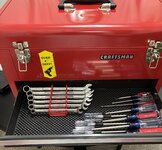
they're not showing up?No pics
they're not showing up?
From some research, it seems the "Pratt-Read Craftsman" ones do this but I'm still not sure what kind of corrosion that is.Now they are!
That's some weird corrosion going on - I have some of the same screwdrivers somewhere (used, beat up) and the metal doesn't look like that at all
These came from IllinoisDo you live near salt water.... Like an ocean... ?? This is why adding your general location in your profile is helpful.
Pratt-Read used Zinc plating on their own production, so that's probably zinc corrosion. WF used chrome and then a "cobalt coating" starting in '98.From some research, it seems the "Pratt-Read Craftsman" ones do this but I'm still not sure what kind of corrosion that is.
I think it is zinc. You can tell some of screwdrivers have that greenish zinc hue.Pratt-Read used Zinc plating on their own production, so that's probably zinc corrosion. WF used chrome and then a "cobalt coating" starting in '98.
So the handles are also more brittle you think? Also, no way to clean up the shanks anymore ehh? Besides something extreme like another acid or something.Cellulose Acetate Butyrate that the handles are made of break down and when they do they outgas a mild butyric acid. Which is why they smell so bad
Because they were in the plastic case the acid fumes attacked the zinc coating on the shanks.
I clean and polish up lots of rusted, stained, and pitted tools with a wire wheel on a bench grinder and it usually comes out great. I would try that or a 3M radial bristle wheel on a bench grinder if you have it. You can get small versions of both for a drill too.So the handles are also more brittle you think? Also, no way to clean up the shanks anymore ehh? Besides something extreme like another acid or something.
The finish has gone away in areas. It's no longer a cleaning project. You can polish off the rest of it to make it look consistent but then you have an unprotected bare metal screwdriver.I clean and polish up lots of rusted, stained, and pitted tools with a wire wheel on a bench grinder and it usually comes out great. I would try that or a 3M radial bristle wheel on a bench grinder if you have it. You can get small versions of both for a drill too.
The handle may be fine for a while or crumble, tomarrow. Acetate is funny in that regardSo the handles are also more brittle you think? Also, no way to clean up the shanks anymore ehh? Besides something extreme like another acid or something.
Gotcha. I'll probably just leave alone at this point. Shanks are all smooth now. Even if they were sitting loose for all this time, that acetate still breaks down in same way? Or a lot worse when trapped in package?The handle may be fine for a while or crumble, tomarrow. Acetate is funny in that regard
You can clean up the shanks more but it’s going to be mechanical such as sand paper and you will be removing the zinc and expose bare steel
Yes.Even if they were sitting loose for all this time, that acetate still breaks down in same way?
Boxes, cases, etc trap the gas.Or a lot worse when trapped in package?
boy now you got me paranoid about putting these in my box lol !Yes.
Boxes, cases, etc trap the gas.
Those don't look they're going to start breaking apart before your eyes with handling, but make no mistake, the off-gassing that @Firebrick43 mentioned is just symptomatic, and they are deteriorating. Some go faster than others, and environment matters.
"Stinkdrivers", as we regulars dub them down here on the Vintage Board, are the eternal bane of vintage collectors. When found inside much older toolboxes or midget socket sets (in the form of the spinner handles), for example, they are often visually crumbling or fuzzing up and cracking or otherwise badly deformed, and you can literally see the corrosive rot they caused on everything in their vicinity, while everything else in the box is relatively untouched. CAB is not the only culprit. Tenite and early Pyralin, too. Yours dubiously exemplify the chart from a study I conducted.
Two common and popular methods for slowing, containing, or retarding the desiccation are (1) regular applications of your preferred penetrating oil and (2) one application of rattle can clear acrylic.
Good info, thanks. My drawers have liners but obviously the gas can travel.Oh, if they're users, and you're going to keep them in a box with a lid, I would definitely clear-coat the handles. I have clear-coated my collectibles and I still don't keep them in their boxes. Picture shelves of socket sets each with the spinner sitting outside on top. They are killers!
NOS in a NOS boxOh, if they're users, and you're going to keep them in a box with a lid, I would definitely clear-coat the handles. I have clear-coated my collectibles and I still don't keep them in their boxes. Picture shelves of socket sets each with the spinner sitting outside on top. They are killers!