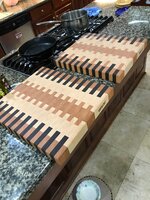
School me on cutting board construction

jollygreengiant

Well-known member
Joined
Nov 10, 2013
Messages
2,354
Location
Ontario, Canada
I'm looking to make a few wood cutting boards for myself and some family in the near future and I'd like some input on a few things:

1. What wood species do you find the best for making boards out of?

2. End grain vs side grain, is there any real difference?

3. I'm thinking of making some smaller sized boards for more everyday use so I'm not hauling out a great big board for a small job. How thin have you made boards before without encountering problems?

Yes there's lots of information about this floating around on the interwebs, but a lot of it is contradictory. And a lot of it is youtube videos where the focus is to get views and not the product. I was hoping to get some feedback from you guys since you'll have actually built them and used them.

TIA!
 
To avoid these ads, REGISTER NOW!

whateg01

Well-known member
Joined
Mar 13, 2006
Messages
11,183
Location
doo dah, kansas, usa
...
Yes there's lots of information about this floating around on the interwebs, but a lot of it is contradictory. And a lot of it is youtube videos where the focus is to get views and not the product. I was hoping to get some feedback from you guys since you'll have actually built them and used them.

TIA!
If you think you won't get contradictory info here, I have a bridge I'll sell you!

I like maple and walnut. End grain is better.
 

cgrutt

Well-known member
Joined
Mar 4, 2016
Messages
8,146
Cherry is nice too. Avoid softwoods or open grain hardwoods such as red oak. Some woods can be toxic teak, etc. I prefer long grain purely for esthetics but end grain is better on your knifes.

ETA corrected typo
 

K13

Well-known member
Joined
Oct 24, 2007
Messages
2,221
Location
St. Albert, AB Canada
Cherry is nice too. Avoid softwoods or open grain hardwoods such as red oak. Some woods can be toxic teak, etc. I prefer long grain purely for esthetics but edge grain is better on your knifes.
I assume you meant end grain not edge grain is better for your knives.
 

cgrutt

Well-known member
Joined
Mar 4, 2016
Messages
8,146
Also only use a food safe finish. Mineral oil and bees wax is safe and effective. There are other oils but some can be toxic and others can turn rancid. Don't finish with any plastics polyurethane etc.
 
OP
J

jollygreengiant

Well-known member
Joined
Nov 10, 2013
Messages
2,354
Location
Ontario, Canada
If you think you won't get contradictory info here, I have a bridge I'll sell you!

I like maple and walnut. End grain is better.

Good point!

Cherry is nice too. Avoid softwoods or open grain hardwoods such as red oak. Some woods can be toxic teak, etc. I prefer long grain purely for esthetics but end grain is better on your knifes.

ETA corrected typo

Is the end grain better because it doesn't dull the knives as fast?

Also only use a food safe finish. Mineral oil and bees wax is safe and effective. There are other oils but some can be toxic and others can turn rancid. Don't finish with any plastics polyurethane etc.

Yep, I have a board now that I got as a gift, and it only gets beeswax.
 

cgrutt

Well-known member
Joined
Mar 4, 2016
Messages
8,146
Good point!


Is the end grain better because it doesn't dull the knives as fast?


Yep, I have a board now that I got as a gift, and it only gets beeswax.
Believe there are multiple advantages, not as hard on cutlery, cuts on board don't show as badly, cuts on endgrain are self healing to a degree, and the board may be more stable less likely to warp among others. Personally I don't like the way it looks though so would never make a cutting board that way. To each his own and all that.
 

tjansson

Well-known member
Joined
Apr 25, 2018
Messages
196
Location
Northern Vermont
On the thickness question: I made a 7/8" thick 10x14" hard maple edge grain board about 15 years ago and it's still going strong. It's made of 7/8" square x 14" long strips. It sometimes has very small bow in it. It'd call it a success. It's a nice size and weight.
 

RonnieC

Well-known member
Joined
Aug 7, 2013
Messages
789
Location
Orlando, FL
Here’s a couple I made about 8 years ago. The larger one is maple, about 14 x 17 x 2” thick. It is two pieces of maple glued side by side with the top being face grain.
The smaller (7 x 13 x 5/8”) is maple laminated with walnut. Again, face grain.
IMG_5588.jpeg
I understand all the debate regarding grain orientation but it’s a cutting board. We had face grain cutting boards growing up and they lasted for my parents’ adult lives. Granted, the face grain cutting boards show the most damage over time.
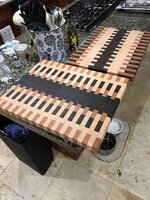
@SMOKEYBEAR recently posted a nice thick end grain cutting board table in the “show off your woodworking” thread that is worth a look.
 

MoonRise

Well-known member
Joined
Nov 5, 2010
Messages
4,025
Location
NJ
'Best' is end grain. Stable, shows least cut marks, gentlest on the knife edge, sort of Self-healing on the cut marks, is generally more hygienic, but takes more work and glue ups to make.

Next is edge grain construction, last is face grain construction.

I prefer hard maple, but cherry and walnut are good too. No to exotic woods or open grain woods.

I made a big (but thin at 3/4") face grain cutting board decades ago. I wasn't all that sophisticated in my woodworking at the time. Two big pieces of hard maple glued edge to edge. Nothing fancy, lives on the counter always and sees almost daily use. Mostly cutting bread or as a work surface making sandwiches or kneading dough for more bread. Cutting or slicing almost anything but I try not to cut/mince/chop/smash garlic or shallots or onions on it anymore, because I don't want EVERYTHING to smell or taste like garlic or shallots or onions. Oh, hot peppers too for same reason.

Years ago, I also made an edge grain cutting board, still only 3/4" thick. Hard maple again. That one is smaller, maybe 10x12 or so. Handy for small tasks. But I wish I had made it bigger. Maybe not as big as the BIG one, but bigger.

And thicker. Just because.

Finish should be mineral oil or a mineral oil and beeswax mixture.

To me, the wood and adhesives and finish all need to be food safe.

Chef take on cutting boards?


Notgrownup

Well-known member
Joined
May 5, 2014
Messages
5,843
Location
Snow Hill NC
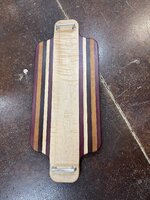
I have only used Maple, walnut, Cherry and Purple Heart.
I’ve only done edge grain and not tackled end grain yet. I’m limited to 12” because of my planer. I like to use biscuit joinery to reinforce my glue joints, it may be overkill but I like to do it. I made more charcuterie boards lately though but I mix it up. It’s very therapeutic for me.
 

Attachments

  • IMG_3163.jpeg
    IMG_3163.jpeg
    937 KB · Views: 31
  • IMG_3255.jpeg
    IMG_3255.jpeg
    441.5 KB · Views: 29
  • IMG_3384.jpeg
    IMG_3384.jpeg
    1 MB · Views: 29
  • IMG_4348.jpeg
    IMG_4348.jpeg
    823.1 KB · Views: 28
  • IMG_5645.jpeg
    IMG_5645.jpeg
    669.4 KB · Views: 27
  • IMG_6551.jpeg
    IMG_6551.jpeg
    1.5 MB · Views: 30

SMOKEYBEAR

Well-known member
Joined
Jan 3, 2016
Messages
447
I typically only make them using left overs from other projects, unless I have particular idea I'm trying to bring to reality or a request.

I've found edge grain and face grain to be interchangeable when making them, the planer and joiner don't seem to care between those two orientations of the wood. Mix and match hasn't caused me any hassles either. Using face grain, a wider one can come together much faster. I actually prefer edge grain, they seem to glue tighter and plane flatter, but those results may be me and my equipment.

End grain is a different monster. The tables I've built are end grain, end up being many more glue ups, cutting, fitting, planning. My planer and joiner are both straight knife cutters, they will not like end grain pieces going through them, it could bring a lot of damage to the work and or the machine. I've watched some videos where people have been successful with the heli cutter head machines. A heli cutter for my two old machines are expensive enough, I'd just look at new machines vs a retro fit. My joiner is a 6" craftsman from the 60s or 70s. The planer is an old Makita 2040. They both do well enough for me with sharp knives.

I built a pretty significant router sled for end grain. I use Freud flattening bits. Works good enough for me. I enjoy running it.

Wood - I like hard maple, walnut, Hickory and white oak. I'll say, white oak or at least some Ive used seems to move alot even after final finishing. Maybe it wasn't dry enough. I've used Purple Heart, IPE's, Zebrawood, Wenge as accent strips or pieces.

I make plenty of mistakes, juice grooves still elude my skill set.
 
OP
J

jollygreengiant

Well-known member
Joined
Nov 10, 2013
Messages
2,354
Location
Ontario, Canada
Here’s a couple I made about 8 years ago. The larger one is maple, about 14 x 17 x 2” thick. It is two pieces of maple glued side by side with the top being face grain.
The smaller (7 x 13 x 5/8”) is maple laminated with walnut. Again, face grain.

I understand all the debate regarding grain orientation but it’s a cutting board. We had face grain cutting boards growing up and they lasted for my parents’ adult lives. Granted, the face grain cutting boards show the most damage over time.
@SMOKEYBEAR recently posted a nice thick end grain cutting board table in the “show off your woodworking” thread that is worth a look.

Your smaller laminated board, I take it that it's stayed pretty well flat? I've thought about making one from a single wide piece of wood but wondered if it would cup a bit.

'Best' is end grain. Stable, shows least cut marks, gentlest on the knife edge, sort of Self-healing on the cut marks, is generally more hygienic, but takes more work and glue ups to make.

Next is edge grain construction, last is face grain construction.

I prefer hard maple, but cherry and walnut are good too. No to exotic woods or open grain woods.

I made a big (but thin at 3/4") face grain cutting board decades ago. I wasn't all that sophisticated in my woodworking at the time. Two big pieces of hard maple glued edge to edge. Nothing fancy, lives on the counter always and sees almost daily use. Mostly cutting bread or as a work surface making sandwiches or kneading dough for more bread. Cutting or slicing almost anything but I try not to cut/mince/chop/smash garlic or shallots or onions on it anymore, because I don't want EVERYTHING to smell or taste like garlic or shallots or onions. Oh, hot peppers too for same reason.

Years ago, I also made an edge grain cutting board, still only 3/4" thick. Hard maple again. That one is smaller, maybe 10x12 or so. Handy for small tasks. But I wish I had made it bigger. Maybe not as big as the BIG one, but bigger.

And thicker. Just because.

Finish should be mineral oil or a mineral oil and beeswax mixture.

To me, the wood and adhesives and finish all need to be food safe.

Chef take on cutting boards?


For your 3/4" edge grain board, did you cut all your pieces to that dimension and then glue, or glue and then mill down to 3/4?

I have only used Maple, walnut, Cherry and Purple Heart.
I’ve only done edge grain and not tackled end grain yet. I’m limited to 12” because of my planer. I like to use biscuit joinery to reinforce my glue joints, it may be overkill but I like to do it. I made more charcuterie boards lately though but I mix it up. It’s very therapeutic for me.

Those boards are beautiful! I've only ever seen pics of purple heart but I'd really like to get my hands on some. Where do you find that?

I typically only make them using left overs from other projects, unless I have particular idea I'm trying to bring to reality or a request.

I've found edge grain and face grain to be interchangeable when making them, the planer and joiner don't seem to care between those two orientations of the wood. Mix and match hasn't caused me any hassles either. Using face grain, a wider one can come together much faster. I actually prefer edge grain, they seem to glue tighter and plane flatter, but those results may be me and my equipment.

End grain is a different monster. The tables I've built are end grain, end up being many more glue ups, cutting, fitting, planning. My planer and joiner are both straight knife cutters, they will not like end grain pieces going through them, it could bring a lot of damage to the work and or the machine. I've watched some videos where people have been successful with the heli cutter head machines. A heli cutter for my two old machines are expensive enough, I'd just look at new machines vs a retro fit. My joiner is a 6" craftsman from the 60s or 70s. The planer is an old Makita 2040. They both do well enough for me with sharp knives.

I built a pretty significant router sled for end grain. I use Freud flattening bits. Works good enough for me. I enjoy running it.

Wood - I like hard maple, walnut, Hickory and white oak. I'll say, white oak or at least some Ive used seems to move alot even after final finishing. Maybe it wasn't dry enough. I've used Purple Heart, IPE's, Zebrawood, Wenge as accent strips or pieces.

I make plenty of mistakes, juice grooves still elude my skill set.

That's a very good point about end grain. I only have a 12" lunchbox planer with straight knives, and I don't have a big enough router to use for flattening. So I'd have to mill down to final width and then do the glue up.
 

Notgrownup

Well-known member
Joined
May 5, 2014
Messages
5,843
Location
Snow Hill NC
@jollygreengiant I get it at specialty hardwood suppliers. You should have somewhere in your area that has it. Heck even when I was in Bathurst NB visiting there was a specialty place and Bathurst is small. North Carolina has tons of places . I’m in a fairly rural area but when I go to Raleigh area it becomes more available. Not sure where you are in Ontario but just google it. It’s very nice wood , the color is beautiful. Whenever I visit my family in NB I always bring back Canadian maple. There is a place in Bathurst NB called Thermalwood. They have thermically modified woods and I love to go there and buy some pieces. You should look it up.
 

alinc100

Well-known member
Joined
May 26, 2013
Messages
3,010
Location
Dearborn,MI
I have only used Maple, walnut, Cherry and Purple Heart.
I’ve only done edge grain and not tackled end grain yet. I’m limited to 12” because of my planer. I like to use biscuit joinery to reinforce my glue joints, it may be overkill but I like to do it. I made more charcuterie boards lately though but I mix it up. It’s very therapeutic for me.
Great looking boards. Do not let the width of the planer stop /limit your widths. Make 2 12" boards, glue 'em together and flatten the last joint with a handplane. You now have a 24" cutting board.
 

Notgrownup

Well-known member
Joined
May 5, 2014
Messages
5,843
Location
Snow Hill NC
Great looking boards. Do not let the width of the planer stop /limit your widths. Make 2 12" boards, glue 'em together and flatten the last joint with a handplane. You now have a 24" cutting board.
Yeah I’ve thought about that before. For now I’m limiting myself to 12”. I’ve inherited 5 huge butcher block counter tops for free and I’m gonna make some BBQ chopping blocks for my son in law and his friend .. my SIL got these part of a deal and doesn’t work with wood. I will post pictures later..
 
To avoid these ads, REGISTER NOW!

RTM

Well-known member
Joined
May 13, 2019
Messages
13,053
Location
SF Bay Area
I’ve only made one, with maple. I’ve been told to avoid the exotics due to allergy concerns, a fellow WW had a bad reaction to a fairly common one. Beware tho, other exotics are hard on edges, lots of silica in some of them.

Was also told to reverse the grain orientation for each board to help fight cupping.
 

Notgrownup

Well-known member
Joined
May 5, 2014
Messages
5,843
Location
Snow Hill NC
I’ve only made one, with maple. I’ve been told to avoid the exotics due to allergy concerns, a fellow WW had a bad reaction to a fairly common one. Beware tho, other exotics are hard on edges, lots of silica in some of them.

Was also told to reverse the grain orientation for each board to help fight cupping.
I stick to the the 4 I mentioned above because I know they are safe.
 

engineer2

Well-known member
Joined
Dec 13, 2009
Messages
11,790
Location
Chicago burbs
A few mistakes I made:
We were on vacation in one of those tourist shops that have nice cutting boards. Told the wife "I can made those!" Mistake #1.
Bought $100 worth of wood on Amazon, enough to make 3 cutting boards.
Spent a few weeks of evenings in my spare time making them. Would have been nice to have a 12" planer, but I don't own one.
A month after getting them done the purpleheart in one shrank and catastrophically split. Sounded like a gunshot.
Had to cut it out and re-do it. Lesson learned: dry the wood in an oven before you begin.
Next time I'll just let her spend the $50 on a damn cutting board!
They turned out pretty good and the wife loves them.
(no idea what happened to the third one, maybe one of the kids has it.)
boards.jpg
 

Notgrownup

Well-known member
Joined
May 5, 2014
Messages
5,843
Location
Snow Hill NC
A few mistakes I made:
We were on vacation in one of those tourist shops that have nice cutting boards. Told the wife "I can made those!" Mistake #1.
Bought $100 worth of wood on Amazon, enough to make 3 cutting boards.
Spent a few weeks of evenings in my spare time making them. Would have been nice to have a 12" planer, but I don't own one.
A month after getting them done the purpleheart in one shrank and catastrophically split. Sounded like a gunshot.
Had to cut it out and re-do it. Lesson learned: dry the wood in an oven before you begin.
Next time I'll just let her spend the $50 on a damn cutting board!
They turned out pretty good and the wife loves them.
(no idea what happened to the third one, maybe one of the kids has it.)
boards.jpg
Yep. My shop is climate controlled so my good lumber stays dry @nd within the perfect humidity content.
 
OP
J

jollygreengiant

Well-known member
Joined
Nov 10, 2013
Messages
2,354
Location
Ontario, Canada
Yeah I’ve thought about that before. For now I’m limiting myself to 12”. I’ve inherited 5 huge butcher block counter tops for free and I’m gonna make some BBQ chopping blocks for my son in law and his friend .. my SIL got these part of a deal and doesn’t work with wood. I will post pictures later..

I never thought about that. I also have a piece of leftover butcher block counter top leftover from a previous project. I'll have to look into that, I think it's birch so should be ok for a cutting board.

A few mistakes I made:
We were on vacation in one of those tourist shops that have nice cutting boards. Told the wife "I can made those!" Mistake #1.
Bought $100 worth of wood on Amazon, enough to make 3 cutting boards.
Spent a few weeks of evenings in my spare time making them. Would have been nice to have a 12" planer, but I don't own one.
A month after getting them done the purpleheart in one shrank and catastrophically split. Sounded like a gunshot.
Had to cut it out and re-do it. Lesson learned: dry the wood in an oven before you begin.
Next time I'll just let her spend the $50 on a damn cutting board!
They turned out pretty good and the wife loves them.
(no idea what happened to the third one, maybe one of the kids has it.)

Lol at mistake #1. But really your entire experience sounds a lot like some of mine. I just keep reminding myself it's not always about the money.

Yep. My shop is climate controlled so my good lumber stays dry @nd within the perfect humidity content.

I don't have that luxury yet. Haven't run into any issues so far as long as I start projects with dry wood.
 

RonnieC

Well-known member
Joined
Aug 7, 2013
Messages
789
Location
Orlando, FL
Your smaller laminated board, I take it that it's stayed pretty well flat? I've thought about making one from a single wide piece of wood but wondered if it would cup a bit.
Yes it has stayed flat. It’s small so we just use it mostly for slicing cheese for cheese and crackers. I scrub it quickly under running hot water with a plastic brush. Dry immediately, all set. Maybe once a year I will apply some cutting board oil/wax.
 

Lumpy102

Well-known member
Joined
Aug 26, 2012
Messages
205
Location
Ontario Canada
Those boards are beautiful! I've only ever seen pics of purple heart but I'd really like to get my hands on some. Where do you find that?
Jollygreen, if you're anywhere close to London there was a place on Sarnia Rd right where it meets Hyde Park, Phillmore Ent. they had quite a selection of cool woods.
 

mbatarga

Well-known member
Joined
Sep 14, 2005
Messages
883
Location
GA
I like the combination of maple, cherry and walnut. Finish is mineral oil.
PM me if you want to get in touch and I'll talk you through the design/construction.
 

Attachments

  • IMG_2878.jpg
    IMG_2878.jpg
    761.5 KB · Views: 34
  • IMG_3119.jpg
    IMG_3119.jpg
    742.3 KB · Views: 34

MoonRise

Well-known member
Joined
Nov 5, 2010
Messages
4,025
Location
NJ
For your 3/4" edge grain board, did you cut all your pieces to that dimension and then glue, or glue and then mill down to 3/4?

OK, so I took a closer look at the 'small' edge grain cutting board. It's 10.75 x 13.5".

It's actually one inch thick, made IIRC and from looking at it from ripping some 3/4" thick hard maple into one inch wide strips and them turning the strips 90 degrees so that the face grain was glued together and the edge grain became the top and bottom of the cutting board. Clamped and glued up, IIRC just some sanding and scraping after glue up but no planing or planer involved.

It has held up fine. Just too small to be a main board for me.

The 'big' face grain cutting board is 18x24". That is a good workhorse size for me as a main board. It's a cutting board, not a chopping block. When the surface shows too many cut marks, I scrape (cabinet or card scraper, NOT a paint scraper! 😆 ) and sand it a little and then reapply the mineral oil and wax finish.

The ends of the glue joint have opened a hair or two, not enough to warrant doing anything about it but I notice it.

Decent size for working on, but a little big to easily wash in the kitchen sink. Double wide single bowl sink, so I have to put the board in short way and wash half with half hanging out and then rotate 180 degrees and wash the other half.

Purple heart looks pretty for sure, but IMNSHO the exotic tropical hardwoods shouldn't be used in food use cases. Woods (or 'grass' like bamboo) with high silica content are NOT good for cutting boards because the silica dulls the knife edges quickly. Heck, the silica dulls your woodworking tools too!
 

ggoss

Well-known member
Joined
Feb 10, 2014
Messages
143
Location
Cary, NC
I believe the writer does such academic research professionally. It seems that sentence was poorly written - the writer's next few sentences clarify that dangerous cross-contamination can occur in either direction - from veggies to meat or vice versa.

Cross-contamination is a myth—Both vegetables and meat have bacteria on them, particularly E. coli, so let’s kill the cross-contamination myth right away. Cutting vegetables on a separate board, for example, accomplishes nothing, as harmful bacteria from veggies is just as likely to transfer to meat—or fruit, for that matter.

That said, if the meat is to be cooked and the veggies aren’t, it’s probably better to cut veggies first when you are cutting both on one surface in the same session.
 

gba2331

Well-known member
Joined
Sep 22, 2021
Messages
759
IMO don’t treat cutting boards like furniture, tell the recipients to use them and if they get rough then you can replace/resand. Don‘t overthink it, at least for the first few.
 
OP
J

jollygreengiant

Well-known member
Joined
Nov 10, 2013
Messages
2,354
Location
Ontario, Canada
I strongly recommend giving this a read: https://www.finewoodworking.com/2024/10/10/the-best-food-safe-finish-may-be-none-at-all

No glue, no finish, and a wood with low extractive content is the way to go.

Can't read it, it's behind a paywall.

Though I'd be interested to hear the authors reasoning behind saying no glue, since there sure are a lot of cutting boards made with glue.

Jollygreen, if you're anywhere close to London there was a place on Sarnia Rd right where it meets Hyde Park, Phillmore Ent. they had quite a selection of cool woods.

Thanks! I'll have to check them out. I know there's a place down by Tillsonburg but I don't think they carry any exotic stuff.

I like the combination of maple, cherry and walnut. Finish is mineral oil.
PM me if you want to get in touch and I'll talk you through the design/construction.

Those boards are beautiful! I think I need to try building a few basic ones first before I tackle a design like that lol. But I appreciate the offer and I'll keep that in mind.

I believe the writer does such academic research professionally. It seems that sentence was poorly written - the writer's next few sentences clarify that dangerous cross-contamination can occur in either direction - from veggies to meat or vice versa.

That's a rather odd statement from that article. The author states that cross contamination is a myth, but then in the very next sentence says that cross contamination can happen??

I'd have to read the rest of the article, but cross contamination is no myth. But it does go both ways.
 

RonnieC

Well-known member
Joined
Aug 7, 2013
Messages
789
Location
Orlando, FL
I met the author of the article at a woodturning symposium in February of this year. She spoke about spalting in wood and that it is not dangerous. Spalting seems to be an area of expertise for her.
 
To avoid these ads, REGISTER NOW!
Top Bottom