To avoid these ads, REGISTER NOW!

Why does one bad battery wired in parallel cause others to overcharge?

Hakeem

Well-known member
Joined
Jan 22, 2024
Messages
1,273
Location
Chicago
Recently worked on a semi where the driver reported 1-2 of the batteries emitting steam. Immediately my first thought was an overcharging issue. For those who are unfamiliar, most semi trucks use 4 12volt batteries wired in parallel to provide 12volts and a whole lot of amperage.

I put a meter on the batteries once disconnected and found 3 were at 13.9 volts, and one was 9.6 volts. Foolishly I didn’t check the alternator with the old batteries in place but once I changed the batteries, the charging voltage was at 14.2v—right in line with manufacturer specifications. So it seems like a cell in the 9.6v battery went bad and once it was no longer able to accept 12.6volts, the extra juice ended up going to the good batteries, causing them to overcharge.

Can someone help me understand exactly what is going on at an electrical level here? If the alternator provides the voltage & current to charge all 4 batteries to ~12.6volts under normal conditions, why does one battery failing cause the other batteries to charge to a higher voltage than normal? Does the voltage regulator in the alternator “sense” the low voltage in the bad battery and drive the alternator to deliver more voltage than normal?
 
To avoid these ads, REGISTER NOW!

mm08822

Well-known member
Joined
Jan 13, 2012
Messages
6,033
Location
NJ
The 9.6v battery was acting as a load to the other batteries. Other bats were expending power to it. Current flows when a voltage difference exists.

The resulting voltage provided by the other 3 bats was drawn down, causing the voltage regulator to sense this and charge the attached circuit. Until the sensed voltage reaches the proper level, charging occurs to all the batts. The good batts are then over charged which can shorten their lives.

Disclaimer: explanation based on knowledge/memory from earlier decades of vehicle charging schemes.

Multi battery schemes, with batts in series, or series/parallel, use battery management systems (BMS) to monitor/charge segments of the battery bank. Very common in cordless tool batts. Concept could easily apply to many applications.
 

wyliesdiesels

Well-known member
Joined
Aug 14, 2012
Messages
20,067
Location
Modesto, CA
as said above, the bad battery was acting as a load which caused the alternator to keep charging.
had there been a smart charger connected to the batteries, it would have sensed the issue and stopped charging.
 

dave*99

Well-known member
Joined
May 5, 2009
Messages
4,275
Location
Coastal NJ
The 9.6v battery was acting as a load to the other batteries. Other bats were expending power to it. Current flows when a voltage difference exists.

The resulting voltage provided by the other 3 bats was drawn down, causing the voltage regulator to sense this and charge the attached circuit. Until the sensed voltage reaches the proper level, charging occurs to all the batts. The good batts are then over charged which can shorten their lives.

Disclaimer: explanation based on knowledge/memory from earlier decades of vehicle charging schemes.

Multi battery schemes, with batts in series, or series/parallel, use battery management systems (BMS) to monitor/charge segments of the battery bank. Very common in cordless tool batts. Concept could easily apply to many applications.
The 4 batteries are in parallel according to the OP. A voltage regulator sets the output voltage of the alternator between 13.5 to 14.2 approximately. There is a bad battery as part of the pack, perhaps it draws excessive current, perhaps the alternator can't provide enough current and the voltage can't be maintained.

But how do the other paralled batteries get overcharged if the voltage regulator limits the charge voltage?
 

dcg9381

Well-known member
Joined
Jun 20, 2018
Messages
11,883
Location
Austin, TX
But how do the other paralled batteries get overcharged if the voltage regulator limits the charge voltage?
Because the alternator sees them as one "battery". If you put a volt meter on all 4, if one was at 9v, and the others at 13v, the measurement would be below 13v. The regulator doesn't know that 3 are charged and one isn't so it keeps putting out more power than necessary..

I constant 14.2v (likely higher) will boil off the batteries eventually.

Happens with big RVs all the time as they commonly have multiple batteries in parallel and no BMS or management. When one battery goes, the others get in trouble..
 

dave*99

Well-known member
Joined
May 5, 2009
Messages
4,275
Location
Coastal NJ
Because the alternator sees them as one "battery". If you put a volt meter on all 4, if one was at 9v, and the others at 13v, the measurement would be below 13v. The regulator doesn't know that 3 are charged and one isn't so it keeps putting out more power than necessary..

I constant 14.2v (likely higher) will boil off the batteries eventually.

Happens with big RVs all the time as they commonly have multiple batteries in parallel and no BMS or management. When one battery goes, the others get in trouble..
I don't doubt a bad battery impacts the group - but still struggling with the details.
If the paralleled group of 4 sits below 13V, how do the other 3 overcharge? They are not at 14.2V.
 

cgrutt

Well-known member
Joined
Mar 4, 2016
Messages
8,356
I don't doubt a bad battery impacts the group - but still struggling with the details.
If the paralleled group of 4 sits below 13V, how do the other 3 overcharge? They are not at 14.2V.
Path of least resistance? If two batteries are in parallel to each other and one is damaged and presents higher load (ie resistance) wouldn't the good battery have higher current passing through it all things equal? Ohms law.
 

dave*99

Well-known member
Joined
May 5, 2009
Messages
4,275
Location
Coastal NJ
Path of least resistance? If two batteries are in parallel to each other and one is damaged and presents higher load (ie resistance) wouldn't the good battery have higher current passing through it all things equal? Ohms law.
Current does not follow the path of least resistance. Current follows all paths inversely proportional to resistance (impedance.)
In a parallel circuit ALL batteries are at the same voltage. Yes a discharged battery will draw more charging current than a fully charged battery. So the current into each battery can be different.

In the absence of a charging voltage, the low battery will draw current from the charged batteries. That can kill the group when the alternator is off.

But the question at hand is why are the good batteries boiling when connected to the same regulated voltage they normally see?
 

dcg9381

Well-known member
Joined
Jun 20, 2018
Messages
11,883
Location
Austin, TX
But the question at hand is why are the good batteries boiling when connected to the same regulated voltage they normally see?
Let me try again: Because the voltage the regulator references is lower due to the "one" bad battery. So the regular assumes "charge needed". The reality is that 3 batteries don't need additional charge, they're at high voltage and keeping them there will (over time) cook them off.

I get what you're asking. If we had 4 good batteries, all "balanced" then the regulator would recognize fully charged and the regulator would "float" them - or not charge as hard. It just takes one bad one to ruin the regulator "logic". Alternators on regulators are not just on/off, they can do variable voltages.
 

cgrutt

Well-known member
Joined
Mar 4, 2016
Messages
8,356
Current does not follow the path of least resistance. Current follows all paths inversely proportional to resistance (impedance.)
In a parallel circuit ALL batteries are at the same voltage. Yes a discharged battery will draw more charging current than a fully charged battery. So the current into each battery can be different.

In the absence of a charging voltage, the low battery will draw current from the charged batteries. That can kill the group when the alternator is off.

But the question at hand is why are the good batteries boiling when connected to the same regulated voltage they normally see?

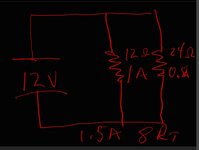
Its been a while since I studied this so please forgive me but if I had 12v across two resistors in parallel, a 12 Ohm and 24 Ohm. Would that not be equivalent of 8 ohms, so 1.5A current in total. 1 amp through the 12 ohm resistor and 1/2 amp through the 24 ohm resistor. If this is true as ohms law dictates than isn't it also true that twice the current is flowing through the portion of circuit with half the resistance?


Screenshot_20251107_152555_Samsung Notes.jpg
 

dave*99

Well-known member
Joined
May 5, 2009
Messages
4,275
Location
Coastal NJ
Its been a while since I studied this so please forgive me but if I had 12v across two resistors in parallel, a 12 Ohm and 24 Ohm. Would that not be equivalent of 8 ohms, so 1.5A current in total. 1 amp through the 12 ohm resistor and 1/2 amp through the 24 ohm resistor. If this is true as ohms law dictates than isn't it also true that twice the current is flowing through the portion of circuit with half the resistance?


Screenshot_20251107_152555_Samsung Notes.jpg
True - and current does not just follow the path of least resistance, it follows both paths as shown. The 12 ohm path is lower resistance than the 24 ohm path but current follows both paths.

But I do know some people that follow the path of least resistance.
 

cgrutt

Well-known member
Joined
Mar 4, 2016
Messages
8,356
True - and current does not just follow the path of least resistance, it follows both paths as shown. The 12 ohm path is lower resistance than the 24 ohm path but current follows both paths.
I never said it only follows the path with least resistance only that the current would be higher in the battery with less load all things equal. So if good battery is seeing more current pass through it than bad battery couldn't that explain how good battery gets overcharged? Yes both are same voltage but one is higher load relative to other.
 

dave*99

Well-known member
Joined
May 5, 2009
Messages
4,275
Location
Coastal NJ
Let me try again: Because the voltage the regulator references is lower due to the "one" bad battery. So the regular assumes "charge needed". The reality is that 3 batteries don't need additional charge, they're at high voltage and keeping them there will (over time) cook them off.

I get what you're asking. If we had 4 good batteries, all "balanced" then the regulator would recognize fully charged and the regulator would "float" them - or not charge as hard. It just takes one bad one to ruin the regulator "logic". Alternators on regulators are not just on/off, they can do variable voltages.
OK, so the sense wire connects the battery terminal to the sense terminal on the regulator. And the charge wire connects the alternator output to the battery. A small voltage drop is across the charging wire due to charging current. The sense terminal adjusts the alternator output based on voltage at the battery itself. It's proportional to state of charge. The bad battery is loading the charge wire, so lower voltage is sensed and it's forcing the alternator output voltage to increase. The good batteries boil due to the higher voltage.
Or something close to that.
Makes sense.
 
Last edited:

dave*99

Well-known member
Joined
May 5, 2009
Messages
4,275
Location
Coastal NJ
I never said it only follows the path with least resistance only that the current would be higher in the battery with less load all things equal. So if good battery is seeing more current pass through it than bad battery couldn't that explain how good battery gets overcharged? Yes both are same voltage but one is higher load relative to other.
The good battery will see less current flowing into it from the charger. Watch the ammeter on your battery charger when you connect a dead battery. Current starts high and decreases as the battery recovers.
 

cgrutt

Well-known member
Joined
Mar 4, 2016
Messages
8,356
The good battery will see less current flowing into it from the charger. Watch the ammeter on your battery charger when you connect a dead battery. Current starts high and decreases as the battery recovers.
Im not talking about a good battery that needs to be charged Im talking about a battery with a bad cell that causes it to present higher load (resistance) relative to other good batteries that are connected together in parallel. All will see same voltage. The battery with higher load relative to others should see lower current, at least according to ohms law. Anyway Im done with this. Later.
 

Wrench97

Well-known member
Joined
Jun 23, 2018
Messages
12,146
Location
Southeastern Pa
A shorted(bad cell) will boil the acid in that cell and cause a smell and maybe smoke making it seem as the batteries are overcharging.
If left in use I've seen them produce enough explosive gasses to actually explode. Ya it's a mess to clean up...
 

mm08822

Well-known member
Joined
Jan 13, 2012
Messages
6,033
Location
NJ
Each battery cell can be modeled as a voltage source and a resistor in series. Each battery has 6 sets, each in series. Each battery is wired in parallel to the others. Each connection (post) has a resistance. Each cable has a resistance between points.

All of this connects to the output of a regulator. If the regulator is just sampling the single resulting voltage of the 4 batts in parallel at its terminals, it has no clue whether it is 1 or 100 batts in the circuit.

This overall equivalent circuit gets a voltage inputted to in from the regulator. Let's say 14.2 vdc. The 14.2 vdc is higher than the overall battery circuit voltage which causes current to flow into each battery. The amount varies in each batt based on its internal voltage sources (6) opposing the applied 14.2vdc. Additionally, each cell resistance limits the overall current. Each cell can have a different resistance value based on its age, etc. Each of the resistances and cell voltages collectively oppose the current trying to flow b/c of the applied 14.2 vdc. I don't recall the details of this as it has to do with lead plate scaling from the acid, and 100 other details.

Anyway, once the charger applies its voltage to the battery circuit, 3 of the 4 batteries can see excessive charging time and impact the chemistry, boiling off the hydrogen, etc........The dying/dead batt just loads the down the other 3 batts and the regulator is oblivious.

I have no working values of these internal resistances when perfect, starting to fail, failed, etc., so I can't do any calcs to show the impact. Ultimately, the applied voltage is altering the chemical reactions and for too long starts to damage plates, etc.
 

Bert_

Well-known member
Joined
Dec 24, 2016
Messages
9,771
Location
NW Iowa
The good batteries weren't overcharging.

Bad battery has a shorted cell. Normally 12v divided by 6 cells=2v per cell. With a shorted cell the other five cells in the bad battery were getting overcharged. 12/5=2.4v per cell. That will make it boil.
 

dave*99

Well-known member
Joined
May 5, 2009
Messages
4,275
Location
Coastal NJ
The good batteries weren't overcharging.

Bad battery has a shorted cell. Normally 12v divided by 6 cells=2v per cell. With a shorted cell the other five cells in the bad battery were getting overcharged. 12/5=2.4v per cell. That will make it boil.
That was my suspicion. But there seemed to be support for premise in the OP that the good batteries boiled.
Hence the questions as to how that happens.
 
To avoid these ads, REGISTER NOW!
OP
H

Hakeem

Well-known member
Joined
Jan 22, 2024
Messages
1,273
Location
Chicago
Great discussion in here. Really helped my understanding of what was happening and how these parallel battery systems work in general. I really wish I had put a meter on the original batteries when charging to see what the alternator was doing, and then with the truck off, to see what the 3 good batteries + 1 bad battery was reading at. Oh well, lesson learned for next time.

Special thanks to @mm08822 , @dcg9381 @dave*99 @cgrutt
 

cmandp

Well-known member
Joined
Dec 22, 2011
Messages
1,285
Location
New Jersey
Im still confused. There were a few that said the bad battery was being over charged and a few that said the the 3 good ones were.

Im not clear on which is correct.
 

whateg01

Well-known member
Joined
Mar 13, 2006
Messages
11,430
Location
doo dah, kansas, usa
In a running vehicle, the battery acts as a load on the alternator. Maybe be cars are smarter but in general, the alternator puts out ~14 VDC. It's a constant voltage device. That's why it has a voltage regulator instead of a current regulator. It doesn't push current into the battery. The battery draws current from the alternator. The alternator doesn't "see" a dead battery and push more energy into the others. It's still putting out the same 14 VDC and the good batteries are still drawing the same current they would otherwise
 

mm08822

Well-known member
Joined
Jan 13, 2012
Messages
6,033
Location
NJ
Im still confused. There were a few that said the bad battery was being over charged and a few that said the the 3 good ones were.

Im not clear on which is correct.
The 3 good ones were being overcharged. The one with a bad/failing cell can actually limit or cause zero charge current to pass into it.

A bad/open cell can be considered high resistance or even an open circuit.

Google "what happens to a lead acid battery when it is left on a charger" which is the equivalent of what is happening when the regulator is still seeing a voltage lower than its charge cut off value.
 

dave*99

Well-known member
Joined
May 5, 2009
Messages
4,275
Location
Coastal NJ
A bad/open cell can be considered high resistance or even an open circuit.
Wouldn’t that make the 4 battery bank appear as a 3 battery bank?

I expect a shorted cell in a battery to have a greater impact on a bank. An open cell should render that battery as “disconnected “. No?
 

Bert_

Well-known member
Joined
Dec 24, 2016
Messages
9,771
Location
NW Iowa
Im still confused. There were a few that said the bad battery was being over charged and a few that said the the 3 good ones were.

Im not clear on which is correct.

A guy pulls the cover on the battery box and sees smoke. It happens quick and it could be easy to mistake what you see.

I don't see how the good batteries would be overcharged unless the voltage regulator is bad. On the other hand it's really easy to explain why a battery with a shorted cell would be boiling.
 

mm08822

Well-known member
Joined
Jan 13, 2012
Messages
6,033
Location
NJ
Wouldn’t that make the 4 battery bank appear as a 3 battery bank?

I expect a shorted cell in a battery to have a greater impact on a bank. An open cell should render that battery as “disconnected “. No?
Yes, the cell could fail as full open, fully shorted or something in-between.

Full open would just effectively take that bat out of the charging circuit. The regulator is only using sensed voltage and charge time, it's not aware of how many batts are attached. In this case, I would say this is the best failure mode protecting the other 3.

Fully shorted would cause the now 5 remaining cells in that faulted battery to overcharge. This failure type could also be dragging down the sensed voltage seen by the reg so the other batts charge more than should.

The in-between state can also impact each batt with that 1 batt that has the lower voltage in the 1 cell.

Severity of this damage is based on duration. It just doesn't happen in 5 mins and all is lost. How long is vehicle running like this? Is that 1 batt loading the other 3 when engine off?
 

whateg01

Well-known member
Joined
Mar 13, 2006
Messages
11,430
Location
doo dah, kansas, usa
Fully shorted would cause the now 5 remaining cells in that faulted battery to overcharge. This failure type could also be dragging down the sensed voltage seen by the reg so the other batts charge more than should.
Y'all keep saying this but does the voyage regulator not just output a constant 14-ish volts? It's not going to see a low voltage and bump the voltage up to 30 V to make up for it!
 

dscheidt

Well-known member
Joined
Apr 26, 2017
Messages
2,908
Y'all keep saying this but does the voyage regulator not just output a constant 14-ish volts? It's not going to see a low voltage and bump the voltage up to 30 V to make up for it!
The voltage regulator is measuring the voltage of the batteries as a system of them in parallel. If one has a lower voltage, then the parallel voltage is lower than the 13.6 or so it should be. So the voltage regulator increases the output voltage of the alternator, trying to keep the batteries charged. The applied voltage at the batteries will be higher than it should be.
 

whateg01

Well-known member
Joined
Mar 13, 2006
Messages
11,430
Location
doo dah, kansas, usa
The voltage regulator is measuring the voltage of the batteries as a system of them in parallel. If one has a lower voltage, then the parallel voltage is lower than the 13.6 or so it should be. So the voltage regulator increases the output voltage of the alternator, trying to keep the batteries charged. The applied voltage at the batteries will be higher than it should be.
Ok, and then the voltage at the batteries is still 13.6 V. That's not over charging any batteries.
 

mm08822

Well-known member
Joined
Jan 13, 2012
Messages
6,033
Location
NJ
Y'all keep saying this but does the voyage regulator not just output a constant 14-ish volts? It's not going to see a low voltage and bump the voltage up to 30 V to make up for it!
Let's say the reg cut-in voltage is when the sensed circuit is below 12.7vdc. Once the batt voltage is below the 12.7vdc, the reg closes the circuit between the alternator and batts applying 14.2 vdc. Some amount of charge time and voltage sampling is used to determine if the batt voltage did in fact raise above 12.7vdc from the charging interval. If it did, then the reg doesn't charge further. If still below, then charges further. (Voltages mentioned are for explanation purposes only.)

I don't think any reg output would be dropping 30 vdc across a 12v batt. Not sure where you got 30vdc from.
 

whateg01

Well-known member
Joined
Mar 13, 2006
Messages
11,430
Location
doo dah, kansas, usa
Let's say the reg cut-in voltage is when the sensed circuit is below 12.7vdc. Once the batt voltage is below the 12.7vdc, the reg closes the circuit between the alternator and batts applying 14.2 vdc. Some amount of charge time and voltage sampling is used to determine if the batt voltage did in fact raise above 12.7vdc from the charging interval. If it did, then the reg doesn't charge further. If still below, then charges further. (Voltages mentioned are for explanation purposes only.)

I don't think any reg output would be dropping 30 vdc across a 12v batt. Not sure where you got 30vdc from.
What vehicle battery is getting over charged from having 14 v applied? For that matter, what vehicle stops charging the battery "when it's full"? Every vehicle I've ever worked on has 14 v when it's running, whether I just start it or it's been running all day.
 

Bert_

Well-known member
Joined
Dec 24, 2016
Messages
9,771
Location
NW Iowa
The voltage regulator is measuring the voltage of the batteries as a system of them in parallel. If one has a lower voltage, then the parallel voltage is lower than the 13.6 or so it should be. So the voltage regulator increases the output voltage of the alternator, trying to keep the batteries charged. The applied voltage at the batteries will be higher than it should be.
Yup, parallel circuit. The voltage at every battery is the same.

A shorted cell loading down the system is no different than turning on the headlights, to the voltage regulator at least. The voltage regulator just wants to maintain a safe, constant 14V.
 

mm08822

Well-known member
Joined
Jan 13, 2012
Messages
6,033
Location
NJ
What vehicle battery is getting over charged from having 14 v applied? For that matter, what vehicle stops charging the battery "when it's full"? Every vehicle I've ever worked on has 14 v when it's running, whether I just start it or it's been running all day.
I repeat "(Voltages mentioned are for explanation purposes only.) " Pick whatever numbers you want. You are missing the concept of charging below a threshold voltage vs. not charging above. But sure aren't @ 30vdc.
 

whateg01

Well-known member
Joined
Mar 13, 2006
Messages
11,430
Location
doo dah, kansas, usa
I repeat "(Voltages mentioned are for explanation purposes only.) " Pick whatever numbers you want.
Huh?

You are missing the concept of charging below a threshold voltage vs. not charging above. But sure aren't @ 30vdc.
No. I understand charging below a threshold and not charging above a threshold. I've not seen an automotive system that works like that. The alternator/regulator output 14-ish volts and anything before that gets charged. Show my a car that doesn't
 

AntonLargiader

Well-known member
Joined
Nov 20, 2016
Messages
1,372
Location
Charlottesville, VA
I'd be checking the overall voltage regulation over time to look for an answer. Yes, if the other three batteries never see more than the usual voltage then they shouldn't overcharge, but if the VR sees the overall voltage drop (acting like an undercharged battery) and boosts the output again in response - which could be happening in very quick cycles - then I can see the overcharging. 13.9 is VERY high for an open circuit voltage; I'm not sure you can ever get there with flooded batteries and true 14.2V charging. I suspect the additional load was driving it higher in some way.
 

RiverRider

Well-known member
Joined
Mar 3, 2015
Messages
587
Location
DFW area
A voltage regulator in the strictest sense is a circuit that attempts to maintain a certain voltage at its own output and will vary its output current in whatever manner is necessary to maintain that constant voltage. If the load increases and the voltage begins to drop, the regulator will increase its current output to maintain the desired voltage. If the voltage begins to rise, then the regulator will throttle back the current in prder to maintain the desired voltage.

Alternators in cars of yesteryear were no more complicated than that. The alternator output an AC voltage which was rectified to DC, and then a regulator---often as simple as a 13.8 v zener diode held that voltage down to a constant 13.8 vdc. It is my understanding that automotive charging systems are more sohisticated than that these days and I know little about them, but I do know aircraft electrical power systems and while they do not accomplish voltage regulation (they'll be either 28.0 or 28.5 vdc) by the same means, it is still a circuit that throttles current in order to maintain a constant voltage under a varying load.

In the case of batteries connected in parallel, such as four 12 v batteries in a truck, the regulator is simply going to maintain that 13.8 vdc (or whatever the proper value may be) value by throttling current. If one of those four batteries develops a shorted cell, then it will cause the voltage on the bus to begin to drop and the regulator will respond almost instantaneously by throttling more current at its output. The regulator knows n-o-t-h-i-n-g about "who is out there" demanding more or less current---it does not care. It just wants to maintain a voltage level.
 
To avoid these ads, REGISTER NOW!
Top Bottom