
You are using an out of date browser. It may not display this or other websites correctly.
You should upgrade or use an alternative browser.
You should upgrade or use an alternative browser.
Best drill bits for drilling hardened chrome rod
- Thread starter cundifc
- Start date
kaymccampbell
Well-known member
Cobalt drills and Tap Magic.
strength_and_power
Well-known member
- Joined
- Apr 26, 2015
- Messages
- 1,426
What size hole? Drilling the end or through the diameter? How many holes? How accurate do your holes need to be?
mattthemuppet
Well-known member
Carbide drill and clamp securely.
1/2” diameter and drilling through the diamaterWhat size hole? Drilling the end or through the diameter? How many holes? How accurate do your holes need to be?
Doesn’t need to be accurate at all
strength_and_power
Well-known member
- Joined
- Apr 26, 2015
- Messages
- 1,426
I’d make a flat spot with a grinder so the bit won’t walk then go 3/16” as a pilot and right to 1/2” for your finished size1/2” diameter and drilling through the diamater
Doesn’t need to be accurate at all
TurnipTruck
Well-known member
Definitely start with a grinder to get past the hardening.
Until you know the material your dealing with then we are all guessing at what you may have. If you don't know then do a file test to see if it can be cut. If you file it then you can drill it. If the file just skips across the surface then you have a whole 'nother level of difficulty.Need to drill some holes in hardened chrome rod, rod is 2.5” diameter. What kind of drill bit is best for this job using drill press?
lg
no neat sig line
RoninB4
Well-known member
-The chrome is for abrasion (maybe also corrosion) resistance. There's different hardness levels of chrome but I would expect it to present difficulty drilling with plain carbon drills or even HSS/cobalt. As suggested, you need to get below the chrome either with carbide or a grinder. Getting centered over the rod can be critical, even off by a bit can result in deflection and shattering a drill. If you don't have a mill it's going to be a bit sketchy, especially when you pop out the other side. For this reason I don't suggest using carbide, it's so brittle it can shatter and leave pieces in the hole that are very difficult to remove. If you do have a mill then a very solid/rigid set-up will allow for using a carbide endmill, followed by a regular twist drill. Be very careful when the drill comes out the other side as it will tend to "grab" the material and either jam or shatter. Controlling the down-feed pressure is critical at this point. A small chamfer larger than your final hole size can also lessen the tendency for the chrome to come off in flakes later. Good luck.
OccupantRJ
Well-known member
Carbide tipped drills are available for tougher or hardened materials. The HHS steel shank is more forgiving than a solid carbide tool against shattering.
theoldwizard1
Well-known member
Assuming it is something like a hydraulic cylinder rod, The chrome layer is not that deep. Mill a flat spot (even by hand), center punch and use a starter bit. Then a typical good quality twist drill is all you need. At least until you hit the other side !1/2” diameter and drilling through the diameter
Doesn’t need to be accurate at all
rlitman
Well-known member
I agree. Getting started is the hardest part if you do it right and manage to push hard and keep making chips. OTOH, if you start to burn up bits and let the material work harden, you'll never get through.Assuming it is something like a hydraulic cylinder rod, The chrome layer is not that deep. Mill a flat spot (even by hand), center punch and use a starter bit. Then a typical good quality twist drill is all you need. At least until you hit the other side !
And to get it started, grind through the hardest part of the surface, punch and use a spotting drill or even a centering drill (not technically made for the job, but they perform it well) to make a dimple. You don't want to drill up in sizes incrementally, but a SMALL starting hold (smaller in diameter than the final size drill bit's web thickness) can help. For a 1/2" hole, that's around 1/8".
dr_clyde
Well-known member
Just out of curiosity, why?
theoldwizard1
Well-known member
I use those terms interchangeably. What is the difference ?... use a spotting drill or even a centering drill ...
badmatt
Well-known member
I use those terms interchangeably. What is the difference ?
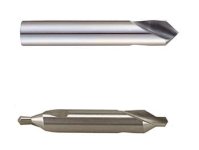
Spot drill on top. Its basically a 120° twist drill.
its so the chisel edge / center point of the drill cuts first rather than the outer corner of the flute. straighter holes.
As for drilling through chrome, best bet like others have said it to remove it from the area of the hole.. Chrome is in the 60's on the C scale. Drilling the softer nougat center at 40-50 HRC isnt that big of an issue if you have the rigidity and the feeds and speeds correct.
Carbide twist drill in a mill would be the best option to do this in my opinion.
rlitman
Well-known member
Starting with the image from the post above, true spotting drills have a more obtuse angle at the tip than drill bits (typically 140 degrees vs 135). The effect is that the dimple they produce brings your drill bit towards the center BY the center, rather than by the edges. Refer to this image:I use those terms interchangeably. What is the difference ?

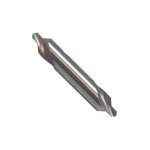
Center drills are designed to drill a hole, and then countersink it so that a lathe center rides on the countersink, with the point of the center free in the hole (partly so contamination in the hole doesn't get trapped and drive your turning off center, but also so that your turning rides on a large surface area). That counterbored hole makes for a terrible start to drilling (as spelled out from this image from reddit):
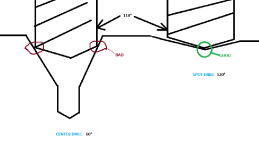
The thing is that the very tip of a center drill works just fine as a spotting drill. Just don't drill past the first shoulder. All you need is a conical dimple.
OccupantRJ
Well-known member

OccupantRJ
Well-known member
Firebrick43
Well-known member
Chrome is just below a diamond for hardness. Then the hardness of the rod. Lots of opinions here but no one has actually done it?
Have machines quite a few rods for industrial machines when machines were down. We kept common sizes up 3”.
I really don’t know what some are worried about as if you remove the chrome with a grinder and use decent tools to get below the 0.050” case depth the 1045 they are usually made out of machines and threads like butter.
We would use carbide inserts, turn up the speed and have a depth of cut deeper than the induction case depth. After that use HSS if you wanted to, again only the skin is hardened, the core machines very nice.
We didn’t have many (or any I can recall) large cylinders attached to the load with cross pins like cheap ag cylinders are but we didn’t have many have some small diameter lock cylinders or swing cylinders on the old sunstand stuff. I think those engineers fetishized hydraulics instead of air cylinders.
They would have 1/2” or 3/4” rods with roll pins. We would grind the chrome off and put the rod in a square 5c collet block, place horizontal in the Kurt vise and find center of the rod with an indicator and set zero in the DRO.
We would use a 4 flute center cutting carbide endmill the size finish size of the roll pin to mill a small flat in Y to get below the case at the apex and then center the endmill and plunge till the perimeter was below the case. Flip the block over and repeat. Then drill all the way thru with a drill bit to final size if using a spring roll pin or just undersize and ream to size if using a dowel pin for the cross pin.
Firebrick43
Well-known member
We had a Lucas a size or two bigger than that one and they were nice jig mills. I personally like the two DeVliegs better because they spindle feed but some of the guys were rabid about the Lucas and the table/saddle feed!
OccupantRJ
Well-known member
The parts done at work were small parts. They had 3 of the old Van Norman 22L mills. I built tooling and established production setups on them. They were sweet to run and were convertible from horizontal to vertical use.We had a Lucas a size or two bigger than that one and they were nice jig mills. I personally like the two DeVliegs better because they spindle feed but some of the guys were rabid about the Lucas and the table/saddle feed!
RoninB4
Well-known member
-What you posted is true but excessive heat should be kept in mind. The carbide tip is brazed/silver soldered onto the steel, much like with masonry drills. When heated enough, the brazed/soldered joint becomes soft enough to let the carbide go. An appropriate speed and/or using an interrupted/peck cycle is advised. When drilling hardened tool steel I've had one or two carbide tips let go in the past. Digging shattered carbide fragments out of a hole is no bueno. This not only applies to the start of the hole but also as you're exiting the other chromed side of the rod. Just an FYI for others here.Carbide tipped drills are available for tougher or hardened materials. The HHS steel shank is more forgiving than a solid carbide tool against shattering.
dnschmidt
Well-known member
This is a job for a mill. Use a solid carbide end mill to make a flat through the chrome and a good HHS or Cobalt drill to finish the deal. Make sure the piece is tightly chucked.