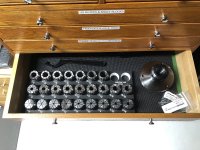
There's been some good general advice here but I also disagree with a lot of what's been written. Not so much that I think what people are telling you will give a bad result but rather that their suggested approach is not the only way to succeed. So I will give my alternative take.
1.
New Import vs. Old Iron: While old machines can be great, for a complete newbie they present a lot of opportunities to make bad choices. Sure, if your elderly neighbor down the road offers to sell you his clean 10EE or HLV-H that just happens to be sitting perfectly preserved in his barn for a couple grand, jump on that with both feet, *if* you are prepared to deal with a ton or more of machine that might require 3-phase power.
Meanwhile good examples of vintage home shop machines like the Atlas or sainted South Bend 9 often command very healthy prices due to their popularity, but in functional terms are equivalent and sometimes inferior to an import machine of similar size. And if they are worn, they will either be just as much of a project to tune up as a Harbor Freight special, or suitable mainly as a source for scrap iron. So take a look near you, if there is a deal out there it might be worthwhile, but if you don't find anything, don't be ashamed of going to HF or Grizzly and spending your time making chips instead of bargain hunting.
2.
"Make sure you get all the tooling with it!": I disagree with this for two reasons. First, depending on what you are going to do with the lathe, a beginner might happily make parts for *years* with nothing more than a 3-jaw chuck, drill chuck, and a couple HSS tool blanks. My advice here would be to think of five parts you'd like to make, repair, or modify, and find out what tooling is actually needed to do those. I almost never use a 4-jaw chuck and have never used my faceplate or traveling steady, for instance, and I've made a lot of parts.
The second reason I disagree with this advice is that *most* tooling is not that hard to find or expensive, unless you are looking for something very specific for an older/rare machine. Yes, the deal will probably be better if you buy a clean old machine with a cabinet full of goodies than a naked SB Heavy 10 and then immediately go looking for a 6-jaw chuck, set of 1/64th collets, and a taper attachment, but if you found a nice clean heavy 10 with nothing but a chuck for a good price, I wouldn't tell you to pass on that. Everyday tooling for newer import machines (and most older ones) is generally pretty easy to come by at a variety of price and quality points to suit your needs.
However, I do agree with this advice in one respect, which is that if a lathe uses change gears for threading, then I would be cautious about buying a machine that didn't come with its full set. In that case, I would first verify whether replacements are available at reasonable cost.
3.
"Always buy the biggest lathe you can": My first lathe was one of the ubiquitous Harbor Freight 7x10 specials, and the only thing I ever wanted to do on that machine and failed at was busting through the case hardening on some rolled ball screws. I made 1.5" toolholders from 4140 bar, 3" parts in 6061 that had great surface finishes, and so on. Buying and tuning up one of those will teach you a lot about what makes a lathe good, better, and best, and when you outgrow it you will have no trouble selling it for a reasonable value to the next contestant.
Also, they're small and weak enough to be extremely unlikely to kill or maim you. Step up to a 12" lathe and that is abolsutley not true, and even my little 10" demands a lot of respect. I am not saying that you should use a 7x lathe after drinking a six pack without any safety glasses, or that using a 10" lathe is extremely hazardous, but rather that the smaller the lathe, the bigger the margin for error. In many cases on the 7X even a full on crash would often only stall the spindle, whereas on the 10X the odds of breaking the tool and scrapping the workpiece was much higher.
Now, if you know that your parts definitely need 8" of swing or 30" of length, or you know you're going to be doing hard turning, etc., then no, don't buy a tiny little lathe and expect to do anything more than learn the basics with it and trade up. But if your work would fit in a 3" chuck and is mostly a few inches long, then no, you don't actually need a 10" lathe.
4.
Minimum Basic Tooling: As I alluded to above, if you are just making basic turned parts, you probably don't need very much besides the following:
- 3-jaw chuck: An independent 4-jaw can give you more accuracy and allow a much wider range of operations, but telling a beginner to start by mastering the 4-jaw is just hazing. Get a 3-jaw, make some parts, have fun, and then get a 4-jaw when you need it.
- HSS tool blanks: More on this below but a half dozen blanks and a bench grinder will enable you to do almost everything except boring and internal threading. Look for M2 HSS rather than cobalt, which generates more hazardous dust when ground.
- 4-way tool post: I would want at least a 4-way post so I can have a turning/facing, threading, and maybe a cutoff tool set up at the same time, versus a lantern-type single tool holder. The imported quick-change AXA/BXA/CXA holders are a relatively inexpensive and useful upgrade that can be added at any time.
- Tailstock: for drilling and supporting long parts
- Drill chuck with arbor to fit the tailstock
- Live or dead center to fit your tailstock, to support longer parts (either type is likely fine)
Again, your work will be your guide here. If you are going to be doing a lot of repair or modification of existing parts, then something like a 4-jaw or faceplate may be necessary. Likewise, if you're going to do more work on long shafts, then one or more types of steady rest may be very important. But
In addition, you will find that you want or need some basic supporting shop equipment like some type of metal saw to prepare stock, a bench grinder for tool shaping and sharpening, and measuring equipment like calipers or micrometers. In a pinch you can get rudimentary but usable versions of all of these at Harbor Freight for $100 or so if you just use a hacksaw (but you'll get sick of that quickly!)
5.
Carbide vs. HSS: As you dig into this, you will probably see a lot of chatter about carbide versus HSS cutting tools. This is one area where I will split the difference with the old-school curmudgeons. When you are starting from nothing, I think that learning to grind your own HSS tools is good both because it's cheap and works well, and also because it teaches you about tool geometry, which is important to understand. However, particularly if you get a 9" or smaller lathe, you will also see a lot of people saying things like, "that machine isn't rigid enough to use carbide" which I consider to be complete horse hockey. What is true is that HSS works perfectly well, is cheap, and relatively easy to wrap your head around. Leave insert tooling for later, not because you can't use it to good effect on a little light machine, but because you probably don't need it just yet.