To avoid these ads, REGISTER NOW!

Oh crud I have to cut my floor

1956chevy210

Member
Joined
Dec 2, 2015
Messages
18
So my shop floor isn't thick enough for concrete anchors so I'm going to go the hard route: Cut out sections of the floor where the lift posts go and pour them deeper. Yay! More on this some other day in a new post lol.

My biggest problem is that I have in-floor heat. My system uses 9 separate loops (circuits?) of PEX line that come of the brass hot water distro block and into the floor and run their course through the shop before returning to the boiler. I will have to cut through some of these to pour new lift pads. It's not avoidable. I'm not sure how many loops I will lose because I haven't mapped every loop, but I think it's about 3. So, I'll lose 30% of my heating of my heating capability. Again, that is only a guess at this point.

**My question is once I've cut through the lines and removed the old concrete, is there some way to repair the hot water loops so I actually don't lose any heating capability? Can PEX to PEX lines be connected like PVC pipe is connected with fittings and PVC cement? The PEX will be cut off flush with the vertical side of the concrete hole but maybe I can stick a fitting into it and glue it in place? The PEX lines are connected to the brass distro block with special hose clamps.

As a side note if the lines can be repaired I can either A) short circuit the loop by using one piece of PEX to connect the feed line to the return line, or B) use 2 pieces of PEX line to replace both of the removed sections of line so the loops continue their entire original courses. I'll just have to make sure to place the new lines off to the edge of the new concrete pads and away from where the anchors will go.

Thanks for reading!

1956chevy210
 
To avoid these ads, REGISTER NOW!

PoorUB

Well-known member
Joined
Mar 29, 2021
Messages
11,614
Location
Fargo, ND
You need a few inches of PEX sticking out of the slab to splice it.

I would score the concrete and inch or so deep and hopefully avoid cutting the PEX. Then next carefully jack hammer out the concrete trying to avoid hitting the PEX at all costs! With any luck you will not gave to splice any of the lines. Any way you do it you will have to carefully clear concrete away from the PEX to have room to splice it.

If you want to get down and dirty, score the concrete like mentioned above then move 6-8 inches inside of those cuts and cut all the way through the concrete and PEX and then jack hammer back to the score lines. At least you will find the PEX before you start jack hammering! After you get it all out, then you can splice the PEX back together.
 

Stuart in MN

Well-known member
Joined
Sep 8, 2005
Messages
22,974
Location
Minneapolis
I assume you're talking about a two post lift? Four post lifts generally don't need to be bolted down. Do you have a map of the tubing in the floor, or can you locate them using one of those temperature guns? I'd think it would be possible to remove the concrete around the tubes and then pour footings that have the tubes routed through them, but it would require some very careful demolition.
 

ipgenie

Well-known member
Joined
Jan 29, 2020
Messages
560
Location
Idaho
I can see right where the pex runs in my floor with a thermal camera. If you can mark the loops, you might be able make a few cuts between the loops to make demo around them easier. Last I heard they don't recommend slices in the slab but do some research on that and find out what the best option is.
I'd probably go with a 4 post if it were me but everyone has their preference and reasons for one VS the other.
 

finn

Well-known member
Joined
Mar 27, 2005
Messages
16,175
Location
The UP, God's country
Are you sure your Concrete isn‘t thick enough for a lift? I would look long and hard for a lift that is suitable for your existing floor before tearing up the floor. Recommendations were all over the place, depending on the brand when I put mine in.

I used a thermal camera to locate my pet tubes and adjusted the final pad location accordingly.

You can cut the tubes and insert crimped unions, but there’s some flow loss as the union reduces flow cross sectional area. A couple of unions are ok, but you’re going to cut a lot of tubes to meet the manufacturer’s pad requirements.

The last thing I would do is cut tubes. Better to change lift brands or go to a four post lift.

In floor heat sometimes isn’t all it’s hyped to be.
 

wssix99

Well-known member
Joined
Mar 2, 2011
Messages
5,153
Location
Chicago, IL
How thick is your floor? The lift specs have a fudge factor in them, so if you are just off by 1/2 an inch, then there are ways around that.

I would also go with a 4 post lift before tearing up this floor. It will be very messy... (I would actually go with a 4 post lift over a 2 post lift anyway. A 4 post lift is much better for hobby use and kinder on an aging body!)

If you have to do this, you will need to go with a pinned method of securing the repair slab to the old slab. (The key-under method will not work due to the other chipping you'd need to do for the PEX repairs.) I would also cut a wider section of the floor topping 1/2 inch down and cover it with a thin, specialized topping after its all over to get a clean rectangle. Otherwise, you'll have little concrete pollups in the floor everywhere you need to chip out the old floor for a PEX repair. The PEX manufacturers have instructions on how to do this, the specialized fittings needed for the repair joints and instructions on how to sleeve the PEX where it crosses the joint between the two slabs.
 

eviltwin

Well-known member
Joined
Jul 1, 2019
Messages
91
Location
Norcal
A lot of 9k 2-post lifts only require 4” of concrete. Is it normal to have less than that with pex in the slab? That wouldn’t leave a lot of concrete on the top/bottom of the tubing.
 

Prospecter

Well-known member
Joined
May 16, 2015
Messages
2,386
Location
Maine
Can you thicken the slab by adding to the concrete base on top of the floor rather than underneath?
 

BobnCO

Well-known member
Joined
Apr 2, 2023
Messages
197
Yes you could repair pex with the right tool and fittings (pex A and pex B have different fittings and tools). As pointed out would need break the concrete back so you have a few inches of pex to work with. As pointed out you could cut an inch or so then break it out (need to break it up ne way). (You can’t add concrete on top, not structurally tied in)
 

geneg

Well-known member
Joined
Oct 19, 2020
Messages
465
Location
Midwest
So my shop floor isn't thick enough for concrete anchors so I'm going to go the hard route: Cut out sections of the floor where the lift posts go and pour them deeper. Yay! More on this some other day in a new post lol.

My biggest problem is that I have in-floor heat. My system uses 9 separate loops (circuits?) of PEX line that come of the brass hot water distro block and into the floor and run their course through the shop before returning to the boiler. I will have to cut through some of these to pour new lift pads. It's not avoidable. I'm not sure how many loops I will lose because I haven't mapped every loop, but I think it's about 3. So, I'll lose 30% of my heating of my heating capability. Again, that is only a guess at this point.

**My question is once I've cut through the lines and removed the old concrete, is there some way to repair the hot water loops so I actually don't lose any heating capability? Can PEX to PEX lines be connected like PVC pipe is connected with fittings and PVC cement? The PEX will be cut off flush with the vertical side of the concrete hole but maybe I can stick a fitting into it and glue it in place? The PEX lines are connected to the brass distro block with special hose clamps.

As a side note if the lines can be repaired I can either A) short circuit the loop by using one piece of PEX to connect the feed line to the return line, or B) use 2 pieces of PEX line to replace both of the removed sections of line so the loops continue their entire original courses. I'll just have to make sure to place the new lines off to the edge of the new concrete pads and away from where the anchors will go.

Thanks for reading!

1956chevy210
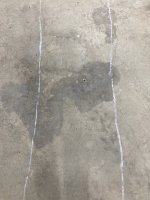
Have a steel fabricator make some larger baseplates. They can punch more holes for anchors where you need them. More smaller anchors further out from the posts can support the same as a few close to them. Weld thru the holes in the orig plates to the new plate as well as around the perimeter. Have the engineer at the fab shop review your plan if you are unsure. You could even take the posts & plates into them for welding.
Also, use PoorUB's suggestion for the cut out demo if you go that route. You shouldn't cut any lines if you're careful. But, I'd still want my baseplates larger than the cut out/repour.
 
OP
1

1956chevy210

Member
Joined
Dec 2, 2015
Messages
18
Thanks for all of the replies guys! Here I'll try to add some more fidelity on what I'm working with.

First, the thickness of the floor: I drilled 4 test holes in my floor. Two 1/4" test holes far away from where I want my lift just out of curiosity which were each 4.25" deep. This is the bare minimum for my lift which doesn't give me a warm fuzzy feeling. The two holes next to and at my preferred location were 3.5 inches deep (1/4" hole) and 3 inches deep (5/8" hole). Was there spalling? Yeah, probably, but spalling or not 3-3.5 inches doesn't cut it.

Next, the heating lines in the floor: See the first attached thermal pic below. It shows the heating lines running parallel to the body of a car that would be on my lift. I placed a box in between a couple of the lines to show where the bottom of the drivers side post would sit. (2-post lift). The lines average about 22-24 inches apart. So, if I was to cut a 4'x4' section to pour a thicker pad, I would cut through at least 2 lines meaning probably 2 loops. Probably what I would cut would be a feed line for one loop and a return line for a different loop. On the passenger side I would probably cut through one or two.

Here's a possibility though: Would it prudent and safe to dig and pour a cement pad 20" wide and ~6 feet long parallel with the heating lines so that at least on the driver side I wouldn't have to cut any lines there at all because I'm cutting the concrete parallel to them? Of course I'd have to be really careful not to cut lines anyhow. With this pad and with the post centered on it, I would be 1" away from the lines on each side and the outer edges of my anchor holes would be 6.5 inches from the seam between the old concrete and the new concrete, which is in spec (6" minimum from any edge). On the passenger side I would still cut 1 or 2 loops whether I did a long rectangular pad or a 4'x4' pad.

I'm leaning towards the "careful demolition" of the concrete so that I can repair the cut lines and route the replacement line sections towards the edges of the new pad.

But I'm inclined to just sat f-it, cut the lines, and either lose 3-4 heating loops (out of 9) or just put in a couple of ceiling mounted forced-air propane heaters.

Thanks for reading all this!

1956chev210
 

Attachments

  • AUTY8634.JPG
    AUTY8634.JPG
    1.6 MB · Views: 57
  • IMG_8733.JPG
    IMG_8733.JPG
    728.9 KB · Views: 57

sjvicker

Well-known member
Joined
Aug 9, 2014
Messages
600
Location
SW Washington
What brand/model of lift are you getting and what is the max weight you plan to lift?

I’ve seen some lifts have additional brackets for the base plates for sub par concrete on baseplate style lifts.

If it were mine, I’d probably weld on a bigger baseplate and add 6 more fasteners to it and call it a day.
 
To avoid these ads, REGISTER NOW!

Codyboy

Well-known member
Joined
Jan 31, 2019
Messages
1,614
Location
S.E. TEXAS
I would score it with a saw down an inch but not just the rectangle or square thats coming out.

I would score it an inch deep in a criss cross, tic tac toe pattern.
Then bust it out being careful to not hit the pex.

Measure to see where the lift will land and if the pex needs to be moved then do that. Heck I'd just move the pex to the edges so no chance to hit it with a bit drilling into the concrete.

Drill in existing concrete to epoxy rebar in to except the new concrete.
 

Codyboy

Well-known member
Joined
Jan 31, 2019
Messages
1,614
Location
S.E. TEXAS
Thanks for all of the replies guys! Here I'll try to add some more fidelity on what I'm working with.

First, the thickness of the floor: I drilled 4 test holes in my floor. Two 1/4" test holes far away from where I want my lift just out of curiosity which were each 4.25" deep. This is the bare minimum for my lift which doesn't give me a warm fuzzy feeling. The two holes next to and at my preferred location were 3.5 inches deep (1/4" hole) and 3 inches deep (5/8" hole). Was there spalling? Yeah, probably, but spalling or not 3-3.5 inches doesn't cut it.

Next, the heating lines in the floor: See the first attached thermal pic below. It shows the heating lines running parallel to the body of a car that would be on my lift. I placed a box in between a couple of the lines to show where the bottom of the drivers side post would sit. (2-post lift). The lines average about 22-24 inches apart. So, if I was to cut a 4'x4' section to pour a thicker pad, I would cut through at least 2 lines meaning probably 2 loops. Probably what I would cut would be a feed line for one loop and a return line for a different loop. On the passenger side I would probably cut through one or two.

Here's a possibility though: Would it prudent and safe to dig and pour a cement pad 20" wide and ~6 feet long parallel with the heating lines so that at least on the driver side I wouldn't have to cut any lines there at all because I'm cutting the concrete parallel to them? Of course I'd have to be really careful not to cut lines anyhow. With this pad and with the post centered on it, I would be 1" away from the lines on each side and the outer edges of my anchor holes would be 6.5 inches from the seam between the old concrete and the new concrete, which is in spec (6" minimum from any edge). On the passenger side I would still cut 1 or 2 loops whether I did a long rectangular pad or a 4'x4' pad.

I'm leaning towards the "careful demolition" of the concrete so that I can repair the cut lines and route the replacement line sections towards the edges of the new pad.

But I'm inclined to just sat f-it, cut the lines, and either lose 3-4 heating loops (out of 9) or just put in a couple of ceiling mounted forced-air propane heaters.

Thanks for reading all this!

1956chev210
Careful demo means no cut lines.
Just take your time and no slIicing ot repair should be necessary.

Just saw your thermal image after I posted a minute ago.

I noticed the very cold dark spot on the left side of the pic. Is that where the bodies are kept on ice?
Lol
 

Dig Doug

Well-known member
Joined
Apr 16, 2018
Messages
1,078
If you must thicken the slab and want to keep the loops follow this procedure

This will take some time to try to keep the loops in tact
following this process you can establish where exactly the loops are and how deep they are within the slab

DONT cut it!
The cut isn’t going to aid in removing the concrete it’s only there to have a clean finished edge at the end
lay out your lift pads where you want the lift to be positioned, make sure everything is square and straight

just start breaking out the concrete In the center area of where the lift will sit & slightly away from the loop. The idea is work out from the middle of the Lift pad and spread out to the 4 edges - Do Not to start at the edge and work across to the other edges

I like to drill 5 - 1inch holes in a ⭕️ big enough for your hand to scoop out the broken concrete, then chip out the concrete all the way to the sub grade
then slowly work out from there

you need a hole or void for the breaking concrete to chip out and expand into the drilled holes helps this process

chip out to enlarge the circle ⭕️ hopefully you can chip out enough to make a little trough parallel to the loop then work you way towards the loop line

after you have established where and how deep the loops are then cut out as needed for a finished edge after repouring the concrete

Note - concrete cracks and then blows out you have a potential to damage the loops just by breaking the concrete, having it crack then blow apart and potentially taking the loop w/ it. The loop may tear, crack, collapse & rip no matter how careful you take out the concrete

this will be time consuming but if done correctly you should maintain the hot water loop


good luck
@1956chevy210
 

Jetfixr320

Well-known member
Joined
Nov 21, 2013
Messages
171
Atlas lifts, 2 post lift installation manual gives instructions how to properly reinforce a concrete floor.
 
OP
1

1956chevy210

Member
Joined
Dec 2, 2015
Messages
18
Hi folks,

The lift I already bought is a Tuxedo TP11KC-DX 11,000 lb, clear floor, 2-post lift. I bought it already because this is the same lift I had at my last place and I got a good deal on a barely used lift. My heaviest vehicle right now is a 2005 GMC Sierra 2500HD ext cab short bed 4x4. I think when I weighed it 10 years ago it was 6400 lbs. But there could always be a Suburban in my future. Probably a 3/4 ton Suburban.

4-post lift? Nah. Taking wheels off and having a totally clear undercarriage are desirable attributes.

This damn in-floor heat is great for heating but is really a pain in the **** for a lift! I think I'm liking the longer baseplates running parallel (front to rear) of a lifted car, either welded or bolted on. I've often wondered why more lifts don't have this. I'd sure feel better about being underneath a car with big baseplates, and I've been under hundreds of cars. Heck, if they're super long enough, you wouldn't even need to bolt the lift to the floor! Shake it as much as you want, it's not tipping over to the front or rear! Well in reality you would still bolt it down, but you get my point.

I'm envisioning a baseplate on each side about 2 foot wide and extending about 3-4 feet beyond each lift bottom. Much like taking a 4'x8' sheet of metal and cutting straight down the middle lengthways so you have 2 plates, each 2'x8'. The existing baseplates on my posts are .56" (9/16) thick so this is a good starting point. I bet I'll have to hire a smart guy to do more calculations though to ensure it is bueno and to see where anchor holes need drilled. I'm not excited about seeing how much this will cost, but it would avoid all the concrete cutting and pouring and all the problems associated with the heating lines. Plus I'd actually feel safer with those long baseplates.

Thanks for all of the replies guys! If there are anymore tips, I'll be happy to have them. Going to take this slow before I decide on a way ahead.

1956chev210
 

ericm

Well-known member
Joined
Apr 17, 2016
Messages
1,963
Location
Southern Oregon
There's a lot of force on the arms trying to tip the columns over towards the centerline of a car raised on the lift. I'm finding conflicting information about whether the beam across the tops of the columns is structural. Some sources say it's just there to hold the cables, hoses and shutoff bar. Others say it's structural. If it's not structural (or not structural enough), your fore-aft reinforcement would not be doing much to resist the columns tilting inwards.

The added base plate is going to get in the way, or at least be a tripping hazard.

By winging it you're stepping off into uncharted territory. It seems unlikely that you will find an engineer willing to give you any sort of approval in writing, if you can even get one to look at it.

Since slabs mostly lose heat to the perimeter, losing some loops in the middle might not be so bad.
 

toplessHO

Well-known member
Joined
Oct 20, 2014
Messages
14,004
Location
central florida
Just a thought since you know locations of tubes.
Drill in between and carefully put some acid in the hole.
or go the mad scientist and put some liquid nitrogen in the drilled hole.
 

575cat

Well-known member
Joined
Dec 18, 2013
Messages
243
I wouldnt worry about it now your splitting hairs 3.5 big deal , if we were in a perfect world
 

Mainiac Mat

Well-known member
Joined
Sep 2, 2020
Messages
401
Location
Maine
Don't cut the slab!!!

The whole idea is to resist cantilever forces (called the "moment" in engineering parlance) that would tip the lift. You do this with a counter "moment" that resist those forces. This moment (or torque if you will) is a simple calculation.... M= F x D

M is the moment (usually in Ft-lbs)
F is the pull out resistance force off the anchors (usually expressed in lbs)
D is the length of the moment arm. (This would be measured from the bolt hole to the center of the column in inches, then converted to feet)

Fasteners driven deep into the concrete will generate higher F , and when coupled with the (not so long) length of the moment arm the existing feet pads provide, you get a high moment (in Ft-lbs). This is the "standard" method (i.e. the one that is cheapest to execute for the lift manufacturer), as it lets them get away with smaller feet.

The base plate extensions pictured by dave99 are increasing D (the moment arm length), and when coupled with the lower F of your anchors in 3.5" of concrete, you can get the same (or larger) M.
 
Last edited:

MovingAlong

Well-known member
Joined
Aug 17, 2013
Messages
1,190
4-post lift? Nah. Taking wheels off and having a totally clear undercarriage are desirable attributes.

Suspect you're already aware of options, but just in case, there are solutions to getting the wheels off.. RJ45W 4-Post Rolling Bridge Jack.

1772568282279.png

There are other manufacturers that make cheaper ones too of course...

But if the floor gets to be to much, maybe it's an option.

Saw you already purchased a two post, but they are resalable too.
 

JohnX14

Well-known member
Joined
Jun 2, 2014
Messages
548
Location
Boston 'burbs
I'd use the extended base support and be done. That 3.5" of concrete, in a continuous pour, will hold up fine, if it's on a proper base.
 
To avoid these ads, REGISTER NOW!
Top Bottom