To avoid these ads, REGISTER NOW!

Questions about converting a propane firepit to natural gas

ScaldedDog

Well-known member
Joined
Jan 15, 2008
Messages
1,065
Location
Sedalia, CO/NSB, FL
My wife had a plumber install a firepit last year, and install a propane-->natural gas conversion kit. The valve has gotten corroded and needs to be replaced, but I'm now wondering if the guy converted it correctly. I have two questions:

1) Is the screen air opening in the burner supposed to be shuttered closed when converting from LPG to LNG? As you can see in the photo, this one is not, but I've read where it is necessary.

2) I think the only equipment difference required to convert to LNG is the orifice. I haven't taken it loose, but am I correct in thinking the orifice is between the hose and burner?

The issue we had when the thing was working was low flame - maybe an inch and a half, or two inches - and would hiss of the valve was opened all the way. I'm wondering if that's an orifice size problem, or an open vent when it should be closed problem, or is it just how the thing works?

Here's the photo I referenced.
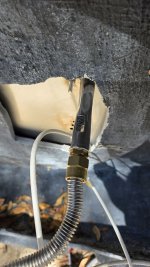
20260302_122855.jpg

Mark
 
To avoid these ads, REGISTER NOW!

The Cobbler

Super Moderator
Staff member
Joined
Oct 24, 2013
Messages
25,959
Location
Niagara Region, Ontario, Canada
the screen is adjustable so it would be adjusted to a neutral flame ideally. ( edit) yours looks to be fixed ) closed right off & you would get a carburizing flame ( soot)
it all depends on how the flame is burning if it needs adjusting or not.
the orifice is at the burner, and if the unit is rated to be converted to natural gas it would need to be changed. there may also be a regulator that needs changing or adjusting . first you need to determine if it is convertible
the hiss you hear is probably just the regulator doing it's job.
it is possible the orifice can be drilled to convert to nat gas, but if the unit is not approved to be converted you're skating on potential code issues . there are charts on line to help with sizing the orifice.
 
OP
S

ScaldedDog

Well-known member
Joined
Jan 15, 2008
Messages
1,065
Location
Sedalia, CO/NSB, FL
The unit I have is approved for conversion, at least in the sense that Akoya (the manufacturer) sells a conversion kit for it. That kit is what I have, but there isn't much to it: Just a hose, the exact same valve the unit came with, and a new orifice. I was surprised, but there is no regulator in sight, either before or after conversion.

For what it's worth - which may be nothing - this is what AI had to say about the process:

Converting a gas appliance (like a fireplace or stove) from propane (LP) to natural gas (NG) typically requires closing or covering the air shutter to reduce the air-to-gas ratio, as NG requires less primary air than propane. Proper conversion involves replacing the orifice with a larger NG-sized one, adjusting the air shutter, and converting the gas valve regulator.

Key Shuttering and Conversion Steps:

  • Air Shutter Adjustment: When switching from propane to natural gas, you must often adjust the air shutter to cover more of the burner pipe holes, as natural gas requires less air for combustion.
  • Orifice Replacement: Propane orifices are smaller. They must be replaced with the larger orifices provided in the natural gas conversion kit.
  • Regulator Conversion: The gas valve regulator must be switched from the "LP" setting to the "NAT" setting, typically by flipping a plunger or swapping a regulator cap.
  • Vent Baffle Replacement: In direct-vent appliances, the flue vent baffle may need to be replaced with a different size specifically for natural gas, such as changing a 6-5/8” wide baffle to a 17-5/16” wide one.
  • Safety Check: After conversion, check for leaks using a soap and water solution and ensure the flame has a blue base with yellow tips.
  • Note: Always consult the manufacturer's installation manual, as specific air shutter openings (e.g., 1/8" or 3/16") vary by model.
Mark
 
OP
S

ScaldedDog

Well-known member
Joined
Jan 15, 2008
Messages
1,065
Location
Sedalia, CO/NSB, FL
I found the propane connection stuff today, and there *was* a regulator in the hose, but there is not one on the natural gas hose. Also, I found the propane orifice, so I'll be able to compare it the NG one.

With respect to the valves, my knowledge of how these work is embarrassingly low. I could use schoolin'. The photo below shows the NG valve at the top, and the original (unused) propane valve on the bottom. The valve bodies are identical, and the spring loaded components to the left are nearly so. The markings on them are slightly different, and the spring on the propane one is a little stronger. What are these things? What I think is a flame sensor (not shown) screws into the silver fittings on the left. When the valve shaft on the right is pushed in to start the flame, the spring is compressed. Once the fire is started and the shaft is turned past 90* and released, the spring expands. What does this do? And if it is a flame sensor that screws into it, how does that work? There's no control board or even power to the unit, so what would a flame sensor's changing resistance even do? Like I said, I could use schoolin'.

20260302_162829.jpg

Mark
 

LopezBart

Well-known member
Joined
Oct 13, 2023
Messages
2,564
Location
Lopez Island, WA
Typically, the flame sensor is a themocouple which generates just enough power to hold the gas valve open. The flame forms part of the circuit; the coil is perhaps that gizmo w/ the spring.
 

BurtEggley

Well-known member
Joined
Oct 8, 2024
Messages
887
are you running green gas right out of an oil field where there is a lot of moisture in the lines?
 
OP
S

ScaldedDog

Well-known member
Joined
Jan 15, 2008
Messages
1,065
Location
Sedalia, CO/NSB, FL
probably a thermo couple or mechanical device that closes if the flame blows out . the valve closes so it doesn't continuously purge gas vapour

Typically, the flame sensor is a themocouple which generates just enough power to hold the gas valve open. The flame forms part of the circuit; the coil is perhaps that gizmo w/ the spring.
Thanks guys!
are you running green gas right out of an oil field where there is a lot of moisture in the lines?
No, just plain ol' natural gas from the city utility company.

The new ignitor should arrive today, so I'm wanting to get this thing going this week. I am still wondering if I shouldn't close off some of the inlet screen.

Mark
 

CraigStu

Well-known member
Joined
May 22, 2014
Messages
4,044
Location
Blacksburg, Va
Go back to post to and see what cobbler said about the screen. I agree, you adjust based on the flame coloration. I don't know how close the screen is to the hot area. If far enough away a wrap of tape could close it down some. If close, I'd use a hose clamp to close it down.
 
OP
S

ScaldedDog

Well-known member
Joined
Jan 15, 2008
Messages
1,065
Location
Sedalia, CO/NSB, FL
Thanks for your help guys. I got back to this today and in the process discovered the instructions for the converter kit the plumber left. He left a few other things (out), too:

The original propane orifice was still installed. I replaced it with the natural gas one from the kit.
The cover for the vent screen was not installed. The instructions for the kit said to completely cover the vent screen, so I did. See the first photo, below. BTW, good call on the hose clamp @CraigStu. That's exactly what was provided.
Based on the two omissions above, I made the assumption that he left the original valve in the unit, so I swapped it without modification for the one I found with the orifice and vent screen cover.

Here's a photo of the vent screen cover:
20260305_123320.jpg

Here's the finished product. It's hard to tell because of the breeze, but the flame is probably 3x the height it was before, so I'm pleased. One question, though: This was taken about 30 seconds after it lit, and the flame is really blue. What does that tell you? I'd like it more orange, and know that often gas fireplaces start out burning blue and "orange up" after a few minutes. I'm not sure this will do that, since it's out in the open. Thoughts?

20260305_200459.jpg

Mark
 

LopezBart

Well-known member
Joined
Oct 13, 2023
Messages
2,564
Location
Lopez Island, WA
Yellow flames are typically caused by incandescent carbon particles in the flames; you get these if the flames hit a cold target and are quenched or have insufficient air. It is of course healthier to avoid those yellow flames; there are all sorts of other compounds that are formed and often don't have time to burn completely. You may get yellow flames as the unit warms up and the admitted air becomes less dense; I'm not sure.
 

Hooked

Well-known member
Joined
Sep 24, 2010
Messages
443
Location
League City, Texas
I had the reverse problem when we built our house. I ordered a propane furnace from my local HVAC company but after installation I thought the flames were huge and we were using much more LPG than I thought we should. I had the company come out to check things and the tech discovered the NG orifice. They ordered the wrong model furnace.
 

HoosierBuddy

Well-known member
Joined
May 9, 2006
Messages
2,931
Location
Southern Indiana
Orange flames are when combustion is incomplete.

Natural gas, when mixed with the right amount of air, burns blue.

You'll get used to it. I think it looks great.

Agree with the above about comments about the plumber. He couldn't have f'ed the job up more if he'd have tried.
 
To avoid these ads, REGISTER NOW!
OP
S

ScaldedDog

Well-known member
Joined
Jan 15, 2008
Messages
1,065
Location
Sedalia, CO/NSB, FL
One last update. I had it on last night for awhile and, sure enough, the flame got much more orange after a few minutes:

20260306_184037.jpg

I don't understand the physics of that, since it's open to unlimited outside air, but I'm pleased with it. I'll just have to remember not to inhale.

Mark
 
OP
S

ScaldedDog

Well-known member
Joined
Jan 15, 2008
Messages
1,065
Location
Sedalia, CO/NSB, FL
I'm baaack...

I've been away from the house for a couple of months. When I went to turn on the firepit last night, the new valve was corroded just like the last one and was locked up. I sprayed some WD40 on it and came back to it this morning. It now moves through its range of travel, though not quite as freely as when new.

My question: What can I use to lubricate this thing that will keep it from corroding during hot wet FL summers? Penetrating oil? Silicone lubricant? Plain ol' WD40?

Mark
 

PoorUB

Well-known member
Joined
Mar 29, 2021
Messages
11,692
Location
Fargo, ND
I don't understand the physics of that, since it's open to unlimited outside air, but I'm pleased with it. I'll just have to remember not to inhale.
I do not believe you have that fire pit assembled correctly.
My understanding of a fire pit like that is the burner ring should be set 2-3 inches under the glass marbles so the glass marbles lay over the top of the burner. The gas works its way and the marbles act as a burner. If gives a much more random appearance and probably will "dirty" up the flame and it will burn more yellow.
 

fitter30

Well-known member
Joined
Jun 23, 2019
Messages
2,992
Location
Peace Valley,mo
Lp runs at 11" of pressure.
Nat gas at 3.5"
Lp orfice is smaller than nat gas
Post 4 pic of valve that silver part is pilot safety. Valve needs a regulator from 7" to 3.5"
 
OP
S

ScaldedDog

Well-known member
Joined
Jan 15, 2008
Messages
1,065
Location
Sedalia, CO/NSB, FL
I do not believe you have that fire pit assembled correctly.
My understanding of a fire pit like that is the burner ring should be set 2-3 inches under the glass marbles so the glass marbles lay over the top of the burner. The gas works its way and the marbles act as a burner. If gives a much more random appearance and probably will "dirty" up the flame and it will burn more yellow.
Yeah, it didn't ship with nearly enough of the glass marbles. I've since added a bunch to cover the ring, though there's nowhere near 2-3 inches of glass above it.

Mark
 

dave*99

Well-known member
Joined
May 5, 2009
Messages
4,275
Location
Coastal NJ
I do not believe you have that fire pit assembled correctly.
My understanding of a fire pit like that is the burner ring should be set 2-3 inches under the glass marbles so the glass marbles lay over the top of the burner. The gas works its way and the marbles act as a burner. If gives a much more random appearance and probably will "dirty" up the flame and it will burn more yellow.
I would normally agree but I did a quick search and found this. FWIW the gas burner on my fire table is covered with marbles as you described. So I guess it can vary.


1778477737296.png
 

Firebrick43

Well-known member
Joined
May 12, 2015
Messages
14,164
Location
West central Indiana
I found the propane connection stuff today, and there *was* a regulator in the hose, but there is not one on the natural gas hose. Also, I found the propane orifice, so I'll be able to compare it the NG one.

With respect to the valves, my knowledge of how these work is embarrassingly low. I could use schoolin'. The photo below shows the NG valve at the top, and the original (unused) propane valve on the bottom. The valve bodies are identical, and the spring loaded components to the left are nearly so. The markings on them are slightly different, and the spring on the propane one is a little stronger. What are these things? What I think is a flame sensor (not shown) screws into the silver fittings on the left. When the valve shaft on the right is pushed in to start the flame, the spring is compressed. Once the fire is started and the shaft is turned past 90* and released, the spring expands. What does this do? And if it is a flame sensor that screws into it, how does that work? There's no control board or even power to the unit, so what would a flame sensor's changing resistance even do? Like I said, I could use schoolin'.

20260302_162829.jpg

Mark
The "flame sensor" is a thermocouple that when placed in the flame produces a small amount of electricity, about 20-30 mv. When you turn on the valve it pushes the spring loaded plunger back allowing gas to flow. You start the flame and the thermocouples electricity holds the valve open. If the electricity stops, the little spring shuts the valve automatically to prevent raw gas from flowing if the fire dies.
 
OP
S

ScaldedDog

Well-known member
Joined
Jan 15, 2008
Messages
1,065
Location
Sedalia, CO/NSB, FL
For those new to the thread, the original issue I was having is resolved, and the firepit works fine. The current issue is that the valves corrode so fast in FL that they become unusable in weeks if not constantly exercised. I can do that when I'm here, but months can pass when I'm not. I ended up applying this stuff, and will report back when I know if it worked.


Mark
 

LopezBart

Well-known member
Joined
Oct 13, 2023
Messages
2,564
Location
Lopez Island, WA
For those new to the thread, the original issue I was having is resolved, and the firepit works fine. The current issue is that the valves corrode so fast in FL that they become unusable in weeks if not constantly exercised. I can do that when I'm here, but months can pass when I'm not. I ended up applying this stuff, and will report back when I know if it worked.


Mark

Looking at the SDS sheet, the active protective agent in that product seems to be oleic acid - a fatty acid commonly found in various natural fats, including olive oil.

If this proves insufficient in your environment, you might try Fluid Film, or even coating the valve stem area w/ grease.
 

cpakalolo

Well-known member
Joined
Mar 30, 2026
Messages
71
My wife had a plumber install a firepit last year, and install a propane-->natural gas conversion kit. The valve has gotten corroded and needs to be replaced, but I'm now wondering if the guy converted it correctly. I have two questions:

1) Is the screen air opening in the burner supposed to be shuttered closed when converting from LPG to LNG? As you can see in the photo, this one is not, but I've read where it is necessary.

2) I think the only equipment difference required to convert to LNG is the orifice. I haven't taken it loose, but am I correct in thinking the orifice is between the hose and burner?

The issue we had when the thing was working was low flame - maybe an inch and a half, or two inches - and would hiss of the valve was opened all the way. I'm wondering if that's an orifice size problem, or an open vent when it should be closed problem, or is it just how the thing works?

Here's the photo I referenced.

20260302_122855.jpg

Mark
That screen needs to be clean. The "pilot" flame serves as an oxygen depletion sensor that can tell if you are using it inside. Less oxygen makes the flame lazy and it doesn't hit the thermocouple that holds the gas valve open. That screen is the Primary air opening. If it is clogged, the flame will go out. As for the gas, Propane uses 11" of water column and natural gas uses 3.5. The propane is forced through a smaller orifice at a higher pressure to draw in more air for combustion. Some things are converted with an orifice and a spacer that sits on top of the spring that controls the pressure at the regulator. If the valves are the same, they will probably take the same parts. You have to try to get the regulator to stop regulating and rely on the one on the tank which is set at 11 to 13" water column. You can measure this with a peice of tubing and water if you are tricky.
 
To avoid these ads, REGISTER NOW!
Top Bottom