To avoid these ads, REGISTER NOW!

Review - R134A valve core changer (Schrader Valve tool)

HoosierBuddy

Well-known member
Joined
May 9, 2006
Messages
2,935
Location
Southern Indiana
Hey guys. I'm sure some of you already have one of these, but I didn't and now I do.


It's $25 and comes with 3 tools. A standard schrader valve wrench and 2 valve changing tools. The valve changing tools allow you to replace Schrader valve cores on R134A AC systems that are under pressure. In other words, you don't have to pull down the system. You don't need a recovery machine.

So....review good bad and ugly.

The Good! I was able to successfully change both high and low pressure schrader valves on 2 different R134A vehicles using the included tools.

The Bad! No instructions are included, but I found this video to walk me through the process.


The Ugly! The kit includes replacement valve cores included as a bonus....but after trying them I'd have to recommend you consider throwing them away and going to the parts store to buy better ones. These are very cheaply made and 2 of the 4 I used leaked when installed. The smallest size included in the kit is the worst, and I eventually just went to ORiley's and bought better cores and used those. $2 each.

Both cars were low on refrigerant, so after replacing the valves I hooked up my manifold set and charged the them back to spec. Heads up the R134A can from O'Riley's that is $29 is $12 at Walmart.

End of the day, my son was happy that the replacement AC system on his Fox mustang was working perfectly. My daughter-in-law (whose old CRV's ac is working better than it has in years) now thinks I'm some kind of genius. In the immortal words of Carl Spackler,

1781874816690.png
 
Last edited:
To avoid these ads, REGISTER NOW!

cgrutt

Well-known member
Joined
Mar 4, 2016
Messages
8,362
What is the overall quality of valves? Seem decent? Were the valve cores from OReilly rated for AC? I understand refrigerant can deteriorate seals used on the standard cores for tires. (I realize they are often different sizes).

ETA can you service the system with valves removed (will a manifold gauge set thread on to the device with core remover stem removed)?
 
Last edited:
OP
H

HoosierBuddy

Well-known member
Joined
May 9, 2006
Messages
2,935
Location
Southern Indiana
How did you determine the valve cores were leaking?
I used standard leak detection fluid as I would use to check gas piping. It didn’t really foam up like it would on a natural gas leak. I had to wait until the foam cleared out of the fluid sitting in the vertical test ports. Then I could see bubbles appearing around the Schrader valve stems and slowly coming to the surface of the fluid. A friend is a certified mechanic and he said that in the years he’s spent chasing small Freon leaks in cars, “90% of the time it is one or both Schrader valves”.

Also… he suggested listening closely when you remove the dust caps. A “puff” indicates a leaking Schrader valve. The caps aren’t pressure rated but a lot of times they will hold enough pressure from a leaking valve core that you can hear it when you unscrew the cap.
 
OP
H

HoosierBuddy

Well-known member
Joined
May 9, 2006
Messages
2,935
Location
Southern Indiana
What is the overall quality of valves? Seem decent? Were the valve cores from OReilly rated for AC? I understand refrigerant can deteriorate seals used on the standard cores for tires. (I realize they are often different sizes).

The valve cores included in the kit are not very good. The ones I got from my local parts store were designed for ac and worked great.


ETA can you service the system with valves removed (will a manifold gauge set thread on to the device with core remover stem removed)

The manifold set doesn’t thread on, it clamps on with quick connectors. Why would you want to service it with the valve cores removed? You’ve lost me….just like you would lose all the R134A if you charged it without valve cores and then removed the hoses.
 

cgrutt

Well-known member
Joined
Mar 4, 2016
Messages
8,362
The valve cores included in the kit are not very good. The ones I got from my local parts store were designed for ac and worked great.


The manifold set doesn’t thread on, it clamps on with quick connectors. Why would you want to service it with the valve cores removed? You’ve lost me….just like you would lose all the R134A if you charged it without valve cores and then removed the hoses.
Believe you can get better (faster?) Evacuation and refill with cores removed. I've seen videos where they use similar set up, install the valve and turn it off, remove core and install manifold, open valve and evacuate system and/or fill. Close valve, remove manifold and insert core, open valve and install core, remove valve. No refrigerant vented to atmosphere entire process.
 

cgrutt

Well-known member
Joined
Mar 4, 2016
Messages
8,362
The valve cores included in the kit are not very good. The ones I got from my local parts store were designed for ac and worked great.


The manifold set doesn’t thread on, it clamps on with quick connectors. Why would you want to service it with the valve cores removed? You’ve lost me….just like you would lose all the R134A if you charged it without valve cores and then removed the hoses.
See attached


zkdiesel

Well-known member
Joined
Oct 6, 2013
Messages
8,389
Location
chicagoland cornfields
Believe you can get better (faster?) Evacuation and refill with cores removed. I've seen videos where they use similar set up, install the valve and turn it off, remove core and install manifold, open valve and evacuate system and/or fill. Close valve, remove manifold and insert core, open valve and install core, remove valve. No refrigerant vented to atmosphere entire process.
Nobody and I mean nobody is removing cores to evacuate or charge r134a
 

cgrutt

Well-known member
Joined
Mar 4, 2016
Messages
8,362
Nobody and I mean nobody is removing cores to evacuate or charge r134a
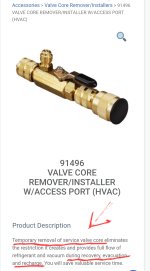
OK, well they apparently make a tool with access port if somebody wanted to they could.

Screenshot_20260619_234007_Chrome.jpg

Haven't done it personally but I've been researching recovery equipment and have seen it being done on videos. I realize this may not be what's done in the field. Just learning.
 

cgrutt

Well-known member
Joined
Mar 4, 2016
Messages
8,362
That’s for changing cores without removing Freon…,,
Then why have an access port for a manifold?

All I'm saying is I've seen this tool used to pull core before evacuating and charging system. Core was replaced afterwards.


ETA

From manufacturers website product description states explicitly that this particular tool is intended to temporarily remove core during recovey, evacuation and recharge. See below.

Screenshot_20260620_022151_Chrome.jpg

They make another almost identical product that doesn't have the service port.
 
Last edited:
To avoid these ads, REGISTER NOW!

Snapped-off

Well-known member
Joined
Feb 22, 2012
Messages
4,814
Location
Indiana
Nobody and I mean nobody is removing cores to evacuate or charge r134a
I definitely do on my 1,500lb systems. 😂

Then why have an access port for a manifold?

All I'm saying is I've seen this tool used to pull core before evacuating and charging system. Core was replaced afterwards.


ETA

From manufacturers website product description states explicitly that this particular tool is intended to temporarily remove core during recovey, evacuation and recharge. See below.

Screenshot_20260620_022151_Chrome.jpg
What he's saying is on automotive AC that holds ounces of refrigerant, nobody is going to bother pulling the cores. Residential and industrial systems? Absolutely.
 

Snapped-off

Well-known member
Joined
Feb 22, 2012
Messages
4,814
Location
Indiana
I used standard leak detection fluid as I would use to check gas piping. It didn’t really foam up like it would on a natural gas leak. I had to wait until the foam cleared out of the fluid sitting in the vertical test ports. Then I could see bubbles appearing around the Schrader valve stems and slowly coming to the surface of the fluid. A friend is a certified mechanic and he said that in the years he’s spent chasing small Freon leaks in cars, “90% of the time it is one or both Schrader valves”.

Also… he suggested listening closely when you remove the dust caps. A “puff” indicates a leaking Schrader valve. The caps aren’t pressure rated but a lot of times they will hold enough pressure from a leaking valve core that you can hear it when you unscrew the cap.
Some of the valve caps on my systems need to be unscrewed with pliers when a Schrader is leaking. The brass caps can hold in a good amount of pressure.
 

cgrutt

Well-known member
Joined
Mar 4, 2016
Messages
8,362
I definitely do on my 1,500lb systems. 😂


What he's saying is on automotive AC that holds ounces of refrigerant, nobody is going to bother pulling the cores. Residential and industrial systems? Absolutely.

Got it thanks. This all goes back to my original question if the remover posted by OP accepts a manifold gauge.
 

Snapped-off

Well-known member
Joined
Feb 22, 2012
Messages
4,814
Location
Indiana
Got it thanks. This all goes back to my original question if the remover posted by OP accepts a manifold gauge.
If those are standard threads in the small circle, you could hook up there while the core is removed and everything is valved off. Once you unscrew the core you need to remove the core tool (big circle).

The non automotive hvac tools have an additional port so you can just unscrew the core, and hook up a hose, without removing the core tool. Like the tool you posted.

Edit: Wouldn't be practical though in a tiny system.
1000040862.png
 

Snapped-off

Well-known member
Joined
Feb 22, 2012
Messages
4,814
Location
Indiana
Hence why I said r134!
Mine are also 134. 134 cools the rooms passively using the natural thermosiphon properties. No compressors needed.

410 then cools the 134 through a small heat exchanger when it's above 67F. Below that temp, the condenser fans suffice for heat rejection.
 

firebirdparts

Well-known member
Joined
Jun 8, 2016
Messages
10,669
Location
Kingsport, TN
I've only ever seen one leak in my life. When that happened I asked in the dedicated HVAC forum what the format is, and none of the HVAC pros in this forum had a clue. So evidently they don't get changed much.

For the person who asked how you know they're leaking, spit is excellent for the geometry in question.
 

racecougar

Well-known member
Joined
Jan 26, 2021
Messages
5,183
Location
Missouri
I can't say I've ever thought to use spit to check a Schrader valve for leakage. Lol.

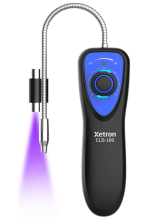
This is my "go to" when searching for leaks. Detectors are cheap.

1782133605996.png
 

llaht

Active member
Joined
Aug 13, 2014
Messages
36
How did you determine the valve cores were leaking?

I used standard leak detection fluid as I would use to check gas piping. It didn’t really foam up like it would on a natural gas leak. I had to wait until the foam cleared out of the fluid sitting in the vertical test ports. Then I could see bubbles appearing around the Schrader valve stems and slowly coming to the surface of the fluid. A friend is a certified mechanic and he said that in the years he’s spent chasing small Freon leaks in cars, “90% of the time it is one or both Schrader valves”.

Also… he suggested listening closely when you remove the dust caps. A “puff” indicates a leaking Schrader valve. The caps aren’t pressure rated but a lot of times they will hold enough pressure from a leaking valve core that you can hear it when you unscrew the cap.
2001 dodge Ram 3500, a/c reduced cooling and short cycling... had been like 2017 since last fill..... and it sits a lot.

decided instead of just topping it off back in April, took it to shop that did last work.
when he removed the cap for suction side he said... " probably a bad valve"...
the inside of the protective cap had some oil and residue inside it.
He indicated this was a sign of leakage.

System evac and remaining 134a recovered.
changed core, vacuum and hold test ( passed) and recharge.
so far so good...
did not feel like the 75bux was excessive.
 
To avoid these ads, REGISTER NOW!
Top Bottom