To avoid these ads, REGISTER NOW!

The uses and usefulness of different wrench types

YesIHaveAHammer

Well-known member
Joined
Jun 1, 2025
Messages
875
I'd be interested in which types of wrenches people have, find useful (or not), and what you use them for.

There are so many types. I have about 10 of the below, and could use many of the others, but I'm not familiar with scenarios where someone would need or prefer them. All of them were invented at some point, and I expect people keep buying them for some reasons so they keep making them.

Every design has its trade offs, being better than others in some respect, at the expense of being worse in another respect. When the trade offs suit the user's needs generally or a specific task, then that type of wrench is preferred or even required. Aspects include leverage, accessibility and confined spaces, versatility, portability, and cost.

There are also historical and regional aspects to it. Some types came about a very long time ago, and better alternatives (e.g. sockets, power tools) are now available and affordable. Some other types were invented in certain areas of the world (e.g. France, Scandinavia) and people got used to them and the habit was passed down the generations locally. Perhaps such types would not be conceived today because there's no problem that needs solving.

To keep things simpler, I'm going to leave ratcheting wrenches out of it because they can simply be considered variants of the basic types. Likewise I'll omit many of the exotic types made by the KTC company of Japan.
  1. Combination
    1. with angled box end
    2. with offset box end
    3. with flat box end
    4. long or extra-long
    5. stubby/short
    6. slim
  2. Double box end
    1. with deep offset ends
    2. with shallow offset ends
    3. flat long or extra-long
    4. flat short
  3. Double open end flat
  4. Midget double open end
    1. standard
    2. with rotationally offset ends at 15/75 degrees
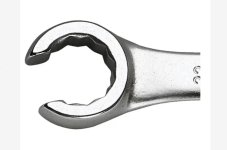
  5. Flare nut
    1. standard
    2. with flange
  6. Obstruction double box end
  7. Slogging (for hammering)
    1. open end
    2. ring end
  8. Single end (usually heavy duty)
    1. open end
    2. box end with separate handle
  9. Socket based (sometimes referred to as Saltus)
    1. combination with flex socket
    2. double ended flex socket
    3. right angle fixed socket (Cles a pipe)
    4. box wrench for use with through tommy bar
  10. Any of the relevant above with 6 point box ends
 
Last edited:
To avoid these ads, REGISTER NOW!
OP
Y

YesIHaveAHammer

Well-known member
Joined
Jun 1, 2025
Messages
875
* Combination with angled box end
Good for my portable box.

* Combination long or extra-long
Useful for leverage, and the box ends get into everywhere a combination wrench's box end does.

* Double box end with deep offset ends
Rarely use these. Length is good but the offset it too deep which makes them cumbersome - either to get the working end in somewhere, or the other end (offset the opposite way) is fouling on nearby things.

* Double box end flat
Came as part of a kit. Almost never use them as they're either fouling on nearby things, and have little hand clearance.

* Double open end flat
Useful in some size pairings, to keep with a machine for adjustment bolts or hydraulic line fittings.
I read on here the idea of having a set of these and a set of double box ends, instead of combination wrenches, so you have two wrenches in each size for use together.

* Midget double open end with rotationally offset ends at 15/75 degrees
Sometimes useful to allow doing confined space task, removing the need for wider disassembly of other parts in the area - saving time.

* Flare nut standard
In small sizes only, for brake lines.

* combination with flex socket
I got these in the original Saltus brand just for interest. Works at any angle, and the nut can't fall out the back. Perhaps mostly superseded by sockets.

* double ended flex socket
Just got one. Same remarks as previous. Probably even more compact and flexible headed than any square drive socket setup

* right angle fixed socket (Cles a pipe)
Captures the nut and is pass through for longer threaded rod or clamp brackets. Bit short, very sturdy, heavy. Round and comfortable. Got them out of interest only.

* Any of the relevant above with 6 point box ends
Glad I had them on a few occasions. Bit cumbersome for repositioning in general use.
 
Last edited:

Gmonkee

Well-known member
Joined
May 9, 2010
Messages
2,889
I kept a very good set of DOE and the French L wrenches.
Between the two near everything is accessible. It was my main use stuff the last years.

The combination wrenches, box end and variations of were an easy resell after I quit full time wrenching. Very universal fit to most regular tasks. My son got a lot too.

These last guys owe me big money. I paid a premium and the few times I used them the awesomeness was radiant. Tight spaces and old hands were not stopping me.
Diesel injector tubes can be zero fun.IMG_20260623_161102.jpg
 
Last edited:

sparky 1971

Well-known member
Joined
Oct 9, 2018
Messages
7,996
Location
Central Iowa
I know there are plenty of people that will disagree with me; that's fine, I don't care. I have found that the least useful wrench is the long flex head ratcheting wrench. I don't care for any flex head ratchet wrench I've ever used but the long ones are the worst. Every other type of wrench I've used or own has had it's place even though it might not come out of the box very often but the long flex ratchet wrenches might as well be in the dumpster.
 

AEAdam

Well-known member
Joined
May 27, 2023
Messages
2,787
Location
SE PA
I have one long and one short combination wrench in each size. But if I were starting over, I would just have long double box ends and short double open ends and be done with it.
Agree. I love long double box ends. Only...sometimes I like the angled ones and sometimes 0 degree. So I have both.

Almost never do I wish I had a shorter wrench. I like long wrenches.

I had to learn to trust my open end wrenches because those I started with were absolute ****. With the FD+ style wrenches, that open end is legit. And it's 0 degree......so, if I could only have one set it would be extra long FD+ combos.

That said, I have some tiny ratchet wrenches - nonreversible. And only a few sizes and I never thought I'd use them. I use them often -8, 10, 13 mostly. Pretty sure I also have a 12. They are very very handy. But I'm glad I don't have a large set of them.
 

Wrench97

Well-known member
Joined
Jun 23, 2018
Messages
12,147
Location
Southeastern Pa
I grab the long flex head ratcheting wrenches the most, they work well on belt tensioners, caliper bolts, suspension bolts generally any bolt you can't easily get a socket on.
 

Hakeem

Well-known member
Joined
Jan 22, 2024
Messages
1,276
Location
Chicago
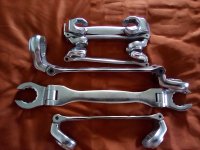
I have most wrench styles and they all have their use. Least used are probably the short double box end but they too have saved the day a few times. My favorite of these is probably the long double box ratchets in the lower left corner.
IMG_1783.jpeg

I know there are plenty of people that will disagree with me; that's fine, I don't care. I have found that the least useful wrench is the long flex head ratcheting wrench. I don't care for any flex head ratchet wrench I've ever used but the long ones are the worst. Every other type of wrench I've used or own has had it's place even though it might not come out of the box very often but the long flex ratchet wrenches might as well be in the dumpster.
I don’t like them either. For confined spaces I can’t get the head on the fastener without it bumping away. And if you have enough room to use your hand to get it on the fastener you might as well use a ratchet. Everyone raves about them but I don’t see the appeal.
 

whateg01

Well-known member
Joined
Mar 13, 2006
Messages
11,438
Location
doo dah, kansas, usa
I didn't see "end wrench" in the list

I hate the wrench that was in my hand 3 seconds ago and now I can't find it. It seems like every type of wrench in my toolbox has been used at some point. I guess there are a few I could do without. I am so glad I had a reversible ratcheting wrench a couple weeks ago replacing the timing belt on my son's ranger. One of the ps/ac bracket bolts is a real pita
 
OP
Y

YesIHaveAHammer

Well-known member
Joined
Jun 1, 2025
Messages
875
I kept a very good set of DOE and the French L wrenches.
Between the two near everything is accessible. It was my main use stuff the last years.

The combination wrenches, box end and variations of were an easy resell after I quit full time wrenching. Very universal fit to most regular tasks. My son got a lot too.
Quite an unusual choice to retain?

I have most wrench styles and they all have their use.
Interested in any remarks about the deep vs. shallow offset double box ends.

Least used are probably the short double box end but they too have saved the day a few times. My favorite of these is probably the long double box ratchets in the lower left corner.
Is it the flatness that make these useful?
 

fitter30

Well-known member
Joined
Jun 23, 2019
Messages
2,992
Location
Peace Valley,mo
Manufacturers/ their engineers design what ever to come up with specially tools so the average mechanic has to either make something that kind of works or not.
 

FigN⋅m

Well-known member
Joined
Feb 28, 2024
Messages
526
I have found that the least useful wrench is the long flex head ratcheting wrench.
As someone's only set? Absolutely. I kinda wish they could disconnect at the middle to act like regular length when needed.
I made it the first 50 years without 'em - pretty sure I could make the next, but they are fun to have around.
I had to learn to trust my open end wrenches because those I started with were absolute ****. With the FD+ style wrenches, that open end is legit. And it's 0 degree......so, if I could only have one set it would be extra long FD+ combos.
I recently added Icon's long pattern grippy open-end/reverse-ratcheting to the mix and it was kinda wild leaning into the
open end to crack a few bolts. These ain't my Pappy's - or even my, old CM wrenches...!
 

roofdweller49

Well-known member
Joined
Jan 22, 2023
Messages
186
Guys who like long double box end/double box end ratcheting - do you guys not run into clearance issues with such long issues?

Maybe because I'm usually working on jackstands but I rarely have enough room to swing long handles
 

bigredcornhead

Well-known member
Joined
Aug 9, 2011
Messages
439
TBH regular old standard length wrench sets have done very with once you learn you can lock the opposite ends together for leverage. The longer DBE(double box ends) are nice to have for the leverage in tight spots, but to me the only absolute necessary wrench sets are deep offsets wrench set. Only those can reach some nuts and bolts depending on application, with out them better hope you have a short stubby socket.
 

lolaetype

Well-known member
Joined
Dec 11, 2019
Messages
2,105
Location
North Western Arkansas
In order of frequency of use:

Standard length combination wrenches.
Stubby double box end offset.
Ratcheting, booth ends.
Extra long double box end offset.
Obstruction.
Crowfoot (is this a wrench or a socket?).
Flare nut.
 

KnurledNut

Well-known member
Joined
Jan 28, 2011
Messages
8,190
Location
n/a
I’ve come across some situations where having a combination wrench with the speed open end has saved time and aggravation. The Facom design works well.
The speed open/flarenut combination that Snap-on makes is another time saver.
Flare wrenches can have flat or angled ends. Sometimes, one or the other provides a better access advantage.
 

mikey03

Well-known member
Joined
May 17, 2024
Messages
2,155
I know there are plenty of people that will disagree with me; that's fine, I don't care. I have found that the least useful wrench is the long flex head ratcheting wrench. I don't care for any flex head ratchet wrench I've ever used but the long ones are the worst. Every other type of wrench I've used or own has had it's place even though it might not come out of the box very often but the long flex ratchet wrenches might as well be in the dumpster.
How come?
 

Wrench97

Well-known member
Joined
Jun 23, 2018
Messages
12,147
Location
Southeastern Pa
Guys who like long double box end/double box end ratcheting - do you guys not run into clearance issues with such long issues?

Maybe because I'm usually working on jackstands but I rarely have enough room to swing long handles
Sure but after awhile you pretty much know where they are not going to fit.
All wrench styles have their uses some being more limited then others.
 
To avoid these ads, REGISTER NOW!

Gmonkee

Well-known member
Joined
May 9, 2010
Messages
2,889
The more complicated any tool gets, the more moving parts makes it more likely to fail.

I had flex head ratcheting wrenches. I have owned near every style of wrench made since 1910.
It was a goal to use them all in real jobs and see what each shines at.

That said flex head wrenches tend to lose parts and get loose. Ratchet wrenches will fail, levers will shear off at times in use.

As time went on I would not replace what broke. If someone offered to buy the incomplete set I might accept.
Eventually others seen what I had and if they liked it and paid up... I had my fun testing them.

Off went the DBE, big sizes DOE sets, ratcheting stuff, long offset box, most everything back into stocks of working mechanics I knew. The combo wrenches went later as duplicate sets and later my last working set stayed at the shop I left. In the care of a younger man.
Why not, he would use them.

I kept my really nice DOE and the French wrenches because they did near everything well. The flex line wrenches too, I would have taken a huge loss in any sales.
My best of the lot, in a compact package.

I was also stuck with a five gallon bucket of tools , mostly ancient stuff, that wasn't useful to modern arts of the mechanic. The fun stuff actually.
I gave all that to my son.
And some modern types starter sets like combo wrenches and a socket set, but new ones.

He can learn what he uses as his skills grow.
 

Dave455

Well-known member
Joined
Mar 19, 2013
Messages
5,829
Location
Sussex, England
My most used are probably the double box end / ring spanner. Generally “shallow offset” but I have a variety.

Once you own a few double box end, some double open end are the perfect complement. Sometimes the open and are needed for a particular fitting, sometimes they just work for speed.

I suppose the other option is to go for combination. There are a few considerations here, one of which is the sizes of fastener you work with. If it’s Imperial, the box ends (without skipped sizes) work perfectly. If metric, combinations make it easier if you want to skip some sizes.

I tend to use combination in my (metric heavy) “road box” and they work just fine.

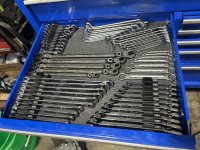
Here is my “go to” wrench drawer. I organise a bit differently from some. Instead of having one “wrench” drawer, or maybe two for Imperial and metric, I have a “mid size” wrench drawer, within which I keep both box end and open end wrenches, but in SAE, Metric and Whitworth.

Bigger wrenches I store elsewhere (individual boxes for SAE, Metric and Whitworth) ditto smaller wrenches, which are better off in a small drawer.
IMG_1262.jpeg

With regard to other styles of wrenches, I probably have most of them. Some I use a lot, some less so.

The regularly used ones I keep to hand in my shop. These include flare nut wrenches in the popular sizes (not many for automotive / workshop use), ratcheting wrenches (again in popular sizes) and metric extra long / aerospace box end wrenches, which I find invaluable in some circumstances.

All else sees less use, and in honesty I don’t even store these in my shop. If I’m going to need a short box end, or an aerospace box end in BSF, I usually know in advance and bring the appropriate tool. I store these in ”sets” in plastic boxes so it’s easy to grab the appropriate box. I also have a drawer with things like French style socket wrenches, which I find useful to “grab and go” sometimes.

I do find it’s worth having some 6 point box end. Sometimes you find that uniquely horrendous combination of a butter soft fastener that you can only get a flat wrench on. Ditto things like box spanners. There are some jobs where only these will fit (some lathe leadscrews).
 
Last edited:

theoldwizard1

Well-known member
Joined
Feb 22, 2011
Messages
43,243
Location
SE MI
I am NOT a tool polisher ! I only buy tools if I feel I really have a need (or feel I will have a need) for them.

Last thing I bought was a set of "long pattern", double box end, metric wrenches. I paid way to much for them because I want "old school", forged in USA, Craftsman.

At my age, I am basically buying for my son and grandson !
 

jumbojak

Well-known member
Joined
Jun 21, 2016
Messages
1,374
Location
Surry, VA
Angle wrenches are some of my favorites. They are short, and angled so usefully... Not something you grab every day but they can save so much time. I'd like to add a set of service wrenches to the mix. Then I'd have double and single open end wrenches. No fitting would be safe.
 
OP
Y

YesIHaveAHammer

Well-known member
Joined
Jun 1, 2025
Messages
875
Angle wrenches are some of my favorites.
I believe you mean single sized double open ends, with each head rotationally offset by a different amount. Not knowing an universally understood name, I'd called them that to avoid being ambiguous because many other wrenches are laterally angled at the box end, or have a step offset.

service wrenches
What are those?

double and single open end wrenches
Why the single ones?
 

AEAdam

Well-known member
Joined
May 27, 2023
Messages
2,787
Location
SE PA
How come?
(re: long ratcheting DBE wrenches)
Sometimes long is for leverage. Sometimes long is for access. I can fish a long wrench down between the front of a transverse engine and a frame rail. This is why I have long fixed head ratchets. A wrench is actually easier for me to seat. Again, imagine i can't touch the bolt head easily.

In this scenario, the long flex ratchet heads move too much. Maddeningly. You bump the fastener and the flex joint moves. And the heads are too big and I bump stuff with them, making this all worse.

Where there is access, the ratchet wrenches are fast. And long ones, and strong ones can break something free. And because non-offset wrenches are "in line" with the fastener head, these will always feel pretty great if they are great. I guess my personal opinion is, if you have access, need strength and leverage, need a flex head, I just use a socket.
 

jumbojak

Well-known member
Joined
Jun 21, 2016
Messages
1,374
Location
Surry, VA
I believe you mean single sized double open ends, with each head rotationally offset by a different amount. Not knowing an universally understood name, I'd called them that to avoid being ambiguous because many other wrenches are laterally angled at the box end, or have a step offset.


What are those?


Why the single ones?

You could describe them that way and be very precise doing so, but if you asked a dealer for some he'd look at you funny and then say, "Oh! You want a set of angle wrenches."

Service wrenches are short, single open ended but feature a different offset than your angle wrenches. If your angles have a 15° and 60° you would want your service wrenches to have a 30° angle to give you another set of options to get things moving when lines and whatnot are in the way. If you have 30° and 60° on your angles you would want a 15° service wrench, or a short combination wrench to make up the difference.

Brands typically offer service wrenches designed to fill the gap of their angles. Tekton, for example, has a 30°/60° on the angles and their service wrenches are offered in 15°. This is something to consider when buying these tools.
 

Gmonkee

Well-known member
Joined
May 9, 2010
Messages
2,889
When I was in selling off excess mode the market here had very clear demands.

The late model car guys wanted modern, common types and metric sizes. Brand came after that.
The heavy equipment guys wanted big sizes of DOE, cheap US made SAE, sockets in impact in the big drive sizes and specialty tools for yellow machines.

The prime stuff went fast. The historic US brands and unusual styles like loom wrenches, S wrenches, saltus or machine specific stuff was nothing but a curiosity.
I couldn't move angle wrenches either. Nobody could figure their purpose.
Ratchet wrenches, those went first stop. Even cheap ones. Vise grips too. Beat to **** or whatever.
 
Last edited:

Dave455

Well-known member
Joined
Mar 19, 2013
Messages
5,829
Location
Sussex, England
What are those?

A service wrench is a single open end wrench with a proportionally big jaw opening, relative to it’s overall size.

They are primarily used for large bore / low pressure pipe fittings, so they are common in many fields - heavy equipment, industrial, aerospace.

The wrench is long enough for the torque intended, but short enough to be used in confined spaces.
IMG_3457.jpegIMG_3456.jpeg
 
Last edited:

Hakeem

Well-known member
Joined
Jan 22, 2024
Messages
1,276
Location
Chicago
Quite an unusual choice to retain?


Interested in any remarks about the deep vs. shallow offset double box ends.


Is it the flatness that make these useful?
I use the deep DBE wrenches more often, they clear a larger obstruction in limited access areas when i can’t fit a ratchet+socket. The shallow offset wrenches come in handy every now and then but it’s less common to find a fastener where nothing else will fit. The first example that comes to mind was a few of the bell housing bolts on an Eaton transmission. The shallow offset was slim enough to fit in the narrow spaces but still cleared neighboring fasteners.

If I had to pick between them, it would be the deeps all day long. The shallow box ends are similar—but not identical— to a combination wrench box end so they are a bit redundant most of the time.

The short DBE wrenches are useful to me because of their short length + slim box ends. Sometimes there just isn’t enough space to swing anything longer.
 
OP
Y

YesIHaveAHammer

Well-known member
Joined
Jun 1, 2025
Messages
875
An enumeration of all attributes (I can think of) that may be used to describe any particular type.
  1. Number of sizes on one wrench
    1. Single, with different end variants
    2. Twin, with same end variant
  2. Length
    1. Standard
    2. Stubby
    3. Midget
    4. Long
    5. Extra long
  3. End type
    1. Open
    2. Box
    3. Flare nut - standard, flanged
    4. Socket
  4. Lateral head angle
    1. Flat / straight
    2. Angled
    3. Step offset - shallow, deep
    4. Right angle (only for socket ends)
    5. Flex / hinged
  5. Box points
    1. 12 point
    2. 6 point
    3. 6 point with grip feature
  6. Open end rotational angle
    1. Standard
    2. Offset (different at each end)
  7. Open end special feature
    1. Grip
    2. Speed ratcheting
  8. Thickness
    1. Standard
    2. Thin
    3. Thick heavy duty
  9. Ratcheting
    1. None
    2. Single direction
    3. Switchable
  10. Handle type
    1. Straight
    2. Obstruction
    3. Slogging / striking
 

Dave455

Well-known member
Joined
Mar 19, 2013
Messages
5,829
Location
Sussex, England
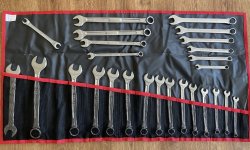
The wrenches from my road box.

In metric I historically had some fairly well used Facom No.40’s, with a few gaps. A year or so back I filled the gaps with some of the new 440’s. But I liked them so much, and the prices were so reasonable, that I ended up getting a complete set, and a roll to store them. (Tool rolls are great for mobile boxes by the way.

By buying combination wrenches I can easily just get the sizes I need. Which turned out to be a fullish set in the 440’s, but just the popular sizes in the 440XL’s.

Flare nut wrench carried just in 10mm. And some SAE size Britool.
IMG_3458.jpeg
 

Dave455

Well-known member
Joined
Mar 19, 2013
Messages
5,829
Location
Sussex, England
The O.P. asked about different wrench types, and what was useful, so here are a few patterns I do find useful. These are mostly from my shop, so used fairly often.

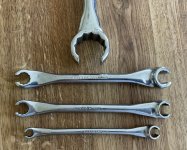
First off, flare nut wrenches. Borderline essential. But… before you go out and buy a “set”, probably with many sizes, think carefully. Money might be better spent buying a couple of different patterns, in sizes you do use. Snap On, Facom, and Hazet all offer more than one pattern of these. 80% of my automotive use is 10mm. 9 and 11 shown cover probably 95%.
IMG_3459.jpeg

I do have a lot more of these, but they tend to be for more specialised uses, working on machine tools (air chucks, tooling, coolant lines) or classic vehicles so are not needed in the shop regularly.
IMG_3463.jpeg

I mentioned short double box end. I developed a liking for these working with my Dad, who used them often. I have these in Metric, SAE and BS.
IMG_3461.jpeg

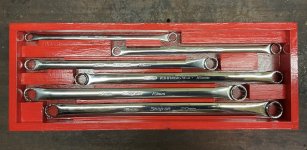
Finally, my all time favourites, the aerospace style / high performance wrench. I absolutely love these, and they handle pretty much anything my double box ends cannot. These Snap On are stupidly expensive now, but I got these on a deal, don’t abuse them, wipe them down, and store them carefully.

Although more specialised, both Facom and KTC offer versions of these.
IMG_3462.jpeg

I’m fortunate to own a set of these in BS sizes as well. Hard to find in BS these are Blue Point (pre Snap On) also and are quite superb.
IMG_3465.jpeg
 
Last edited:

mikey03

Well-known member
Joined
May 17, 2024
Messages
2,155
(re: long ratcheting DBE wrenches)
Sometimes long is for leverage. Sometimes long is for access. I can fish a long wrench down between the front of a transverse engine and a frame rail. This is why I have long fixed head ratchets. A wrench is actually easier for me to seat. Again, imagine i can't touch the bolt head easily.
havent used them much but yea I noticed the same problem. Why don’t they make the joints on the flex tighter? So you have to use two hands to bend them and then they stay in position?
 
OP
Y

YesIHaveAHammer

Well-known member
Joined
Jun 1, 2025
Messages
875
First off, flare nut wrenches. Borderline essential. But… before you go out and buy a “set”, probably with many sizes, think carefully. Money might be better spent buying a couple of different patterns, in sizes you do use. Snap On, Facom, and Hazet all offer more than one pattern of these. 80% of my automotive use is 10mm. 9 and 11 shown cover probably 95%.
Interesting to see the Snap-ons up close. The open-box end appears to be asymmetric, presumable for clearance. The open end I suspect is thicker than a normal open end to spread the pressure.

Interestingly Facom only does 9mm in the flanged model 43, and not in the 42.

I see many brands offer multiple size pairings on each wrench (e.g. 8x10, 10x11, 10x12), so you can minimise the number required.

Although more specialised, both Facom and KTC offer versions of these.
(Extra long flat double box). The Facom 59L appears to be discontinued.
 

Dave455

Well-known member
Joined
Mar 19, 2013
Messages
5,829
Location
Sussex, England
Interesting to see the Snap-ons up close. The open-box end appears to be asymmetric, presumable for clearance. The open end I suspect is thicker than a normal open end to spread the pressure.
You are exactly right.

You essentially have two options in the same tool, one being a deep open ender, which is really for round fittings with flats milled on. and the flare nut end.

The merits of Snap On, and the relative value, can be debated at length, but these particular tools are superb. The flare end is very close fitting, there is no slop, and I could probably be convinced that these wrenches are either made from different steel to the regular, or heat treated differently, as there is no flex in the jaws at all.
Interestingly Facom only does 9mm in the flanged model 43, and not in the 42.
Yes, and being someone who has a need for 9mm’s (BMW) I noticed that too. The No.42 wrench is the one that they offer in large sizes though (up to 41mm for sure) but the smallest is 8 x 10.

In fairness, 9mm is generally going to be used on brakes, and the No.43 is the better tool for that. I have some of those also.

More options are always better than less though,
.

For the benefit of others.

Facom No. 42
IMG_3467.jpeg

And No. 43
IMG_3466.jpeg
 

Hakeem

Well-known member
Joined
Jan 22, 2024
Messages
1,276
Location
Chicago
havent used them much but yea I noticed the same problem. Why don’t they make the joints on the flex tighter? So you have to use two hands to bend them and then they stay in position?
They can make them as tight as they want but with use, the yoke will spread and result in a floppy head. same issue that eventually befalls any flex head tool.
 

Banjorear

Well-known member
Joined
Jul 22, 2013
Messages
1,884
Location
Essex Co., NJ
I don't know, it really depends on the situation. Since I do all the maintenance/service on our daily drivers, sometimes that one wrench you rarely reach for is the one that saves the day.

It's been a while, but when we buy a car, the wife looks at style, driving, etc. I look at how easily can it be maintained.

That said, I was able to pick up a full set of Snap On SAE & metric flank drive box wrenches when my buddy retired from his Snap On route. These have been the best wrenches I've ever used and get used a lot.

Since I try to keep our cars to at least 200K or more, that is really important to me.
 
To avoid these ads, REGISTER NOW!
Top Bottom