To avoid these ads, REGISTER NOW!

Finishing existing shed for a workshop

mschoo92

Well-known member
Joined
Oct 2, 2023
Messages
74
Location
Sussex County, NJ
All,

I have an existing 10x12 shed that I’d like to spruce up and use for a small workshop and storage for my automotive tools. The eventual plan is to build some form of carport/workshop on my property but that’s not in the cards at the moment.

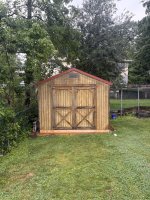
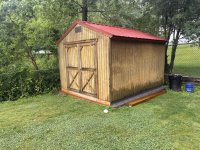
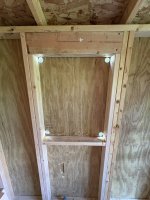
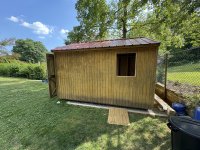
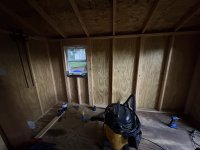
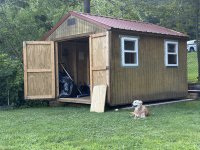
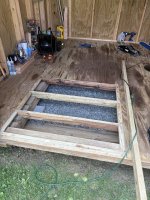
The shed is a 10x12 Amish shed, metal roof with 24” oc stud walls, 6’3” side walls and presumably 2x4 floor joists on 2 4x6 PT skids. The shed has no house wrap or vapor barrier and the siding has some rot on one side. I moved this shed onto a gravel foundation last year which seems to have helped with moisture as it was previously just sitting on blocks and getting significant moisture on siding with any rain or snow.

With this said, I’m looking for some advice on how to best set this up to minimize moisture and provide a good place for my tools to live for the next couple of years so I’m not constantly carrying things up and down from the basement.

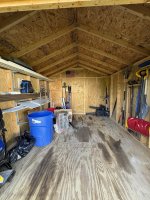
Photos of the shed for reference - I believe the wet spots on the floor are stains, although the one towards the center sometimes feels slightly damp and makes me wonder whether moisture below is having an affect on the floor.

I know the gravel pad is not large enough for the shed which is not helping with the wet on the right hand siding, I’ll also be turning this shed and extending the gravel another 4ft or so to move it far enough off the property line to work all around it. May add gutters too, but want to establish a path forward first.

Lastly, for those who use a shed workshop - what height are your walls? I’m tempted to raise the wall height to 8ft, that would increase project time and complexity but if the additional head height is worth it it’s something I’d consider.
IMG_9012.jpeg

IMG_9023.jpeg
IMG_9024.jpeg

Thanks in advance!
 
To avoid these ads, REGISTER NOW!

kaehlin

Well-known member
Joined
Mar 31, 2013
Messages
158
Location
East Lansing, MI
If it's level, seems like the dampness on that right side is likely due to rain / snowmelt runoff. Otherwise wouldn't it be on the gable end as well? So I would vote for gutters sooner rather than later.
I have no experience with a shed for a workshop, but raising the roof makes it much more complicated. If it's temporary, I would live with it for now.
Interesting project, I'll be interested to see what others say and how you approach it.
 

carlaisle

Well-known member
Joined
May 14, 2022
Messages
378
If you're going to raise the roof it would probably be faster to rebuild completely from scratch. Not necessarily cheaper, but faster, and you could make any other changes you want at the same time. Gutters will help with the bottom rot, but won't eliminate it. Water proofing/painting after repairing the rot would buy you a lot of time. Larger eaves would also help, as would raising the shed rather off the ground. Gravel splashes more than grass, so making the gravel pad larger won't address your bottom rot issue. Looking at your picture, it appears the water falling from your roof is landing directly on a solid piece of timber, which is exacerbating the splash onto the lower portion of your siding. Tools stored in a shed will rust in your climate just from the condensation that naturally occurs with temperate changes. Keeping everything oiled will help, but not eliminate this. Discolored spots on the floor look like oil stains but there's no way to make a positive diagnosis from here. Place a large piece of plastic sheet where the damp spots are and you'll find out if you have a leak from above after the next precipitation. Isolated damp spots in the middle of your floor are unlikely to come from below without the involvement of some kind of vermin/critters.
 

Fav Onefour

Well-known member
Joined
Jul 14, 2022
Messages
709
Location
MN cold and hot
Interesting idea. I bet a little more height would be nice. The floor staining sure looks like it's mostly oil. The sidewall splash is annoying but you have time if it's managed going forward.

Not sure if you'd like to keep the shed long term even if you can do the carport/workshop? Using the shed during the interim period shouldn't be a big deal. How long would affect my approach.

Cheapest option is a well drained base and somehow get those sides further off the ground. Gutters will help with splashing. It's not a sure bet though.

The other option of raising walls is doable but you'd most likely be replacing all the wall panels and redoing the door. Floor framing would definitely need to be assesed somehow. In the big picture, you would still be jacking the shed and peeking underneath. I'm not sure if that's worth the effort for a temporary use shed. Honestly, that's your call.

If you plan on keeping it around until the wood rots away, maybe a long term idea of using a concrete pad and a couple layers of block would be feasible. The approach would allow you to raise your height and give you a nice floor against rot and rodents. If you go that route, I'd use a vapor barrier under the pour and add a proper pressure treated sill with isolation barrier on top of the block. The project could be a DIY gig using bag mix. Maybe rent or borrow a mixer for the main pour. After that cures, drag the shed over and jack it up, remove the floor, and build block courses right under the walls. That approach would get your sides away from splash area and raise the wall height. Door height would still need to be addressed.
 

CraigStu

Well-known member
Joined
May 22, 2014
Messages
4,037
Location
Blacksburg, Va
Wow, is there NO sealer or stain of any kind on the outside? I think height is going to be your main tool to fix that. Whether it's sand or gravel, or just about anything, you will get splash onto the lower Xinches of the siding. Fav Onefour's idea of concrete/block to raise the wood off the ground is what I'd look into. I don't see a problem w/ the inside height. It's good enough to walk very near to the wall unless you are over 6ft so I don't think the added complexity is worth it.
 

Renegade1LI

Well-known member
Joined
Mar 11, 2018
Messages
4,962
Location
long island ny
If you're ok with the size & want a little more headroom I would consider raising it up to about an 8' side wall. If it was me I'd cut the shed free from the floor, jack it up & add some prebuilt wall sections to add below the existing walls. That's an easy shed to jack up & it's mostly empty, on the outside you could leave the t111 & just add some metal panels to the bottom with a moulding to give some detail. using metal would also eliminate yor splashing problem. Pre build the extensions, jack up to install, fasten to floor, add metal panels & than go get lunch.
 
To avoid these ads, REGISTER NOW!
OP
M

mschoo92

Well-known member
Joined
Oct 2, 2023
Messages
74
Location
Sussex County, NJ
I have no experience with a shed for a workshop, but raising the roof makes it much more complicated. If it's temporary, I would live with it for now.
Interesting project, I'll be interested to see what others say and how you approach it.

This is a good point and shared by many of the responses; I’m leaning towards living with existing height to simplify things.

If you're going to raise the roof it would probably be faster to rebuild completely from scratch. Not necessarily cheaper, but faster, and you could make any other changes you want at the same time.

Agreed - if raising the roof my plan would be to disassemble roof and walls. Being that far I’d likely want to look into the base and framing to see how they look and go from there. A lot of work but would make a better shed.

Tools stored in a shed will rust in your climate just from the condensation that naturally occurs with temperate changes. Keeping everything oiled will help, but not eliminate this.

If the shed were insulated would this alleviate rust, or is that just an inevitable outcome? That and keeping my detailing supplies from being compromised would be big deciding factors in which route I go.

Interesting idea. I bet a little more height would be nice. The floor staining sure looks like it's mostly oil. The sidewall splash is annoying but you have time if it's managed going forward.

Would love the extra height, based on the feedback probably won’t do this unless I end up taking the shed apart.

Not sure if you'd like to keep the shed long term even if you can do the carport/workshop?

Good point - I should probably clarify “temporary” just for all responses and future, but I wouldn’t get rid of this shed once the carport/workshop is done. I’d use it just for storage.

If you plan on keeping it around until the wood rots away, maybe a long term idea of using a concrete pad and a couple layers of block would be feasible…
This sounds like a great idea, although I think to add a concrete pad underneath would involve a change in how it’s considered by zoning and require additional set back distance, so for now I’d rather keep it on a temporary base.
 
OP
M

mschoo92

Well-known member
Joined
Oct 2, 2023
Messages
74
Location
Sussex County, NJ
Wow, is there NO sealer or stain of any kind on the outside? I think height is going to be your main tool to fix that. Whether it's sand or gravel, or just about anything, you will get splash onto the lower Xinches of the siding. Fav Onefour's idea of concrete/block to raise the wood off the ground is what I'd look into. I don't see a problem w/ the inside height. It's good enough to walk very near to the wall unless you are over 6ft so I don't think the added complexity is worth it.
To be honest I’m not sure, when I bought the house this was already here. It’s an “Old Hickory Buildings” shed, based on their site looks like sealer and paint are options but the receipt stapled to the inside of it doesn’t show anything regarding sealer or not. I’ll see what can be done to raise the shed, and heard regarding the effort to increase shed height.
If you're ok with the size & want a little more headroom I would consider raising it up to about an 8' side wall. If it was me I'd cut the shed free from the floor, jack it up & add some prebuilt wall sections to add below the existing walls. That's an easy shed to jack up & it's mostly empty, on the outside you could leave the t111 & just add some metal panels to the bottom with a moulding to give some detail. using metal would also eliminate yor splashing problem. Pre build the extensions, jack up to install, fasten to floor, add metal panels & than go get lunch.

Just when I think I’m convinced to leave as is, this sounds like a pretty straightforward solution. Love the idea of the metal panels for lower section.

If you want 8' walls, take the whole thing apart and build a new shed. That isn't worth trying to cobble 2' onto, IMO.

Also if you raise it up to 8' you would have some room for a small loft.

Both good points. Whether I rebuild or not I was hoping would be guided more from a point of whether there is any recommended vapor barrier, insulation or other that would leave this better suited as a workshop. Since I do want to build a carport down the road I don’t want to drop a huge amount of money into this, but I understand to make it nice to use is not free either.

Thanks all for your feedback so far!
 

carlaisle

Well-known member
Joined
May 14, 2022
Messages
378
If the shed were insulated would this alleviate rust, or is that just an inevitable outcome? That and keeping my detailing supplies from being compromised would be big deciding factors in which route I go.
Insulation alone won't do much. You need to fully control the climate. The temperature of the air can change much more rapidly than your much denser metal tools. When this happens, condensation forms on the surface which eventually turns into rust. You would need heat and AC in the shed to moderate the temperature swings. Of course, heat and AC aren't very efficient without insulation.
 

Fav Onefour

Well-known member
Joined
Jul 14, 2022
Messages
709
Location
MN cold and hot
Heavy tools and items like the shrink wrapped engine block stay cool longer while air temps rise. I compare the temp variation to what we see with morning dew. The idea is to prevent condensation on your good stuff. You can alleviate quite a bit of temp variation by simply using a small fan the keep tools and air at near the same temp. One of those little basement window fans exhausting out the back vent would produce a lot of cross flow. Humidity will rise and fall but you will see less condensation. It's not a perfect answer but it will help considerably. It also helps to use a light coat of oil on the goodies with bare metal.

AC and Heat is going down a rabbit hole. Those options work best with a managed and conditioned space. I don't think you want to start doing a full building envelope for a temporary shed. That approach has been used incorrectly quite a bit. The best way to do a healthy conditioned space is keep it conditioned. Cycling those systems off and on doesn't work well. Each cycle is like starting over and the bare metal goodies suffer while they go through condensation point and subsequent dry down.
 
OP
M

mschoo92

Well-known member
Joined
Oct 2, 2023
Messages
74
Location
Sussex County, NJ
Insulation alone won't do much. You need to fully control the climate. The temperature of the air can change much more rapidly than your much denser metal tools. When this happens, condensation forms on the surface which eventually turns into rust. You would need heat and AC in the shed to moderate the temperature swings. Of course, heat and AC aren't very efficient without insulation.

Understood - for now no plans to heat/air condition space, although I should consider it if and when I run power.

Do you have power to the shed? The only real way to control the climate is with ac & heat. I would opt for a window type unit like this one from amazon. There's nothing like working in a climate controlled environment, plus your tools will love it.

No power currently, the shed is approx 50ft from the house so not sure if I want to run power or try to do a solar/battery setup.

Heavy tools and items like the shrink wrapped engine block stay cool longer while air temps rise. I compare the temp variation to what we see with morning dew. The idea is to prevent condensation on your good stuff. You can alleviate quite a bit of temp variation by simply using a small fan the keep tools and air at near the same temp. One of those little basement window fans exhausting out the back vent would produce a lot of cross flow. Humidity will rise and fall but you will see less condensation. It's not a perfect answer but it will help considerably. It also helps to use a light coat of oil on the goodies with bare metal.

AC and Heat is going down a rabbit hole. Those options work best with a managed and conditioned space. I don't think you want to start doing a full building envelope for a temporary shed. That approach has been used incorrectly quite a bit. The best way to do a healthy conditioned space is keep it conditioned. Cycling those systems off and on doesn't work well. Each cycle is like starting over and the bare metal goodies suffer while they go through condensation point and subsequent dry down.

I like the idea of a fan, and would be open to adding a couple windows to help with airflow. As for AC/heat I understand, I probably won’t do that for this shed since I do want to build a carport down the road and would rather do it there if I add an enclosed workshop to it. But who knows, if the shed ends up less temporary than planned I think that would make a nice space.

Given everyone’s responses I’m thinking I may try to make this shed work with less changes, just make fixes where needed and possibly run power. From there I can get a feel for what (if anything) I want to add to it without dumping a ton of time and/or money into it from the start.
 
To avoid these ads, REGISTER NOW!
Top Bottom