To avoid these ads, REGISTER NOW!

Looking for a quality benchtop mill

drokihazan

Well-known member
Joined
Apr 8, 2018
Messages
273
I hear a lot of downsides to a benchtop mill, but floor space is at an extreme premium in my garage and will be for at least another 5 years. I've got a benchtop Wen drill press that has done right by me, doing things past it's limits like putting 5/8" holes in 3/8" mild steel. I would really like to be able to use an endmill though, I'd like to do stuff like easily cut slots without the tedium of drilling holes and connecting them with a file. I've been thinking that maybe replacing that drill press with a benchtop mill or a benchtop mill-drill is the answer I've been needing. I've looked at the LittleMachineShop mini mills for a couple of years now, and larger mill-drills with dovetail columns from Grizzly, Jet, Baileigh, etc. I live in the Bay Area and Bridgeports come up on marketplace a fair bit because this is a major industrial manufacturing hub, but almost no benchtop milling machines, so I think I'm gonna have to buy something new.

It's really hard to find like any information out there with opinions on mill-drills except from people who insist they're garbage and you need a full size mill, but I'm just absolutely not going to fit a Bridgeport in my garage, so I'm looking for something in between my tiny drill press and a Bridgeport.
 
To avoid these ads, REGISTER NOW!

American Locomotive

Well-known member
Joined
Jan 8, 2017
Messages
10,976
Location
Rhode Island
There was once a really solid bench top mill made decades ago (like 40-50 years ago), but they're very rare ...and also I can't remember who made it.

The current crop of bench top mills *can* do work, but they're just very limited. You typically can't do things quickly on a Bridgeport due to rigidity and power limitations, and a bench top mill amplifies that by a factor of 10.

You'll be using small cutters, with light cuts, taking lots of passes. As long as you're okay with that, they can work. IIRC there are some common upgrades that need to be done on them. I seem to recall the headstock gears being a problem.
 
Joined
Nov 5, 2025
Messages
14
A quality benchtop mill is like finding a quality 4x6 band saw, pretty rare. There's a reason that Bridgeports are so popular; they were considered bare minimum. Look at a Rung Fu, they were pretty popular a few years ago.
 

OccupantRJ

Well-known member
Joined
May 15, 2009
Messages
11,131
Location
Eastern North Carolina
Including room for an operator it takes about a 7to8x8 foot area for minimum use of a series 1 Bridgeport. There are models with 36”long tables that require less width. Here is my mill with 42” table and Clausing 12” lathe in an area that is 9’-8” from back of mill to opposing wall and around 8 feet from the left wall to the cleaning sign. Note that cabinets or such can tuck in alongside the mill. One can also be placed in a corner to be used. That is usually not recommended as ideal placement but with smaller work it does fine.IMG_1715.jpegIMG_3781.jpeg
 

RoninB4

Well-known member
Joined
Jul 22, 2020
Messages
3,568
Location
Under My House
-I've had over 35 years of machine shop experience and have some opinions regarding machinery. Do bear in mind that if I state an opinion it's just that....an opinion. Your situation/circumstances/expectations/budget will dictate your choices. Having qualified all that:

-You've stated that you want to use an end mill for making slots, good application as a drill press is NOT what you want to use.

-A big question for you to decide is whether you will want a machine that has a quill (for drilling/tapping/etc.) or not. I find a quill to be extremely useful but there's not as many tabletop mills that have a quill. You'll end up bringing the table up/down to meet the spindle or changing the height of the head itself. Many consider this a PITA but it's just the nature of the machine design itself, there's a lot of cranking with a Bridgeport too. There are horizontal mills and vertical mills, you'll have to decide which is better suited for you.

-Another consideration is your tolerances. If it's mostly just clearance holes/slots (+/- .015 inch) for fasteners then most tabletop mills are capable of this. For closer tolerance work (component fitment) then you'll have to be more selective in machinery choice. More money spent generally gets you machinery more capable of holding closer tolerances and better surface finishes.

-Will you want to do work that needs locational tolerances like hole-to-hole location? Hand cranked distances from the dials are not to be trusted for better than about +/- .002 per inch of travel and the greater the distances the greater the error you'll encounter. This can sometimes be compensated for with good measuring instruments but relying on the dials can lead to disappointment, even a Bridgeport is inaccurate. A digital readout (DRO) can be fitted to make life easier but this adds to the cost. I have them, use them and I like using machinery equipped with them but don't consider them critical to have unless the type of work calls for it. It's all about the type of work you'll do. You're starting down a rabbit hole of capability and accuracy/precision, only you can decide how far down the hole you'll go but your budget will take the hit the farther you go so plan accordingly.

-The physical size of your work will be a huge factor in machine choice. If your work will be no larger than 2x3 then you can consider a smaller, less expensive mill. I would advise looking for the largest machine you can afford because what you plan now will expand in scope. People rarely complain that their mill is too large but quite often find their mill is too small, it happens to everybody at some point. You'll also have to consider your electrical power requirements. Anything beyond single phase 110/220 will require either a VFD or phase converter to add to the cost. Machinery like this usually costs more than machinery using 3 phase power.

-Hope you've planned your budget to include measuring instruments, a vise, and cutting tools. It adds up depending upon the work you intend to do. I generally prefer a dovetail column over a round column mill but that's JMO due to loss of location when changing the height of the head-to-table (it's a frequent occurrence). There's plenty more to say but I'll stop here. More info from @drokihazan will get better replies. If you post machine candidates you'll also get opinions if you want them.
 

imagineer

Well-known member
Joined
Dec 13, 2015
Messages
1,016
Location
Ohio
I too have limited floor space in my shop and needed a mill. I went cheap and bought a well used Jet JMD-18 (Rong Fu clone). Whereas it's done everything I've required, that it's a round column mill is annoying. Too often when switching from a milling to a drill/tap operation on the same part, I need to raise the head of the mill, effectively losing the part orientation.

In hindsight, I should have made the space for a Bridgeport (several were available at the time for reasonable $$), or coughed up more $$ for a new benchtop mill from Little Machine Shop or Precision Matthews.
 

AEAdam

Well-known member
Joined
May 27, 2023
Messages
2,773
Location
SE PA
My experience aligns with your thoughts coming in. I had a mini mill and it was terrible. The better mini mills cost more than a Bridgeport which is 100X better at absolutely everything.

Here are some thoughts: people want to believe what they want to believe about Asian made goods. It’s a world view belief system. When you scratch the surface and start collecting data on small mills, you find the castings aren’t straight. And there’s slop in places where there shouldn’t be. And really simple operations become these fiddly science projects.

What is your tolerance for completely rebuilding a brand new machine? What about paying for mod components that make it actually function? Could you see yourself doing a little bit of hand scraping? How are you fixed for precision metrology tools? Have you always wanted to plumb the depths of the Starrett and Mitutoyo catalogs? Are you thinking you’d like to have a drawer full of test indicators? Does that sound fun to you?

Last questions, when all is said and done, you will pour a lot of time effort and money into a tool that is a financial loss. Or, you could pour the same time and money into a Bridgeport and have an asset. Are you good with that? Are you good with doing the work then upgrading in 5 yrs or whatever?

If so, I recommend the SIEG SX3 or SX4 style machines. Do not buy a round column mill. You can buy these from a selection of importers all claiming they have added value to the base Chinese machine. I’m not convinced. Just know going in, these are partially assembled milling machine kits. They need to be nearly completely rebuilt. But I think these guys can replace your drill press.

Step one, buy a surface plate larger than the table and column if possible. You will need it. I had a SX2 and the column was out of flat .015”. Table was twisted. We’re not talking about tenths and I wasn’t looking for +/-.003” parts.
 

PopcornSutton

Well-known member
Joined
Jun 10, 2024
Messages
790
Location
Northern Tip of VA
The limited time I've used a benchtop, one thing is an issue at least for me. If you are working on a piece where the quill doesn't have enough stroke, or you need to change from an endmill to a chuck and find you need to raise the head, DON"T get a round column mill.
 

zmotorsports

ALLIANCE MEMBER
Joined
Oct 20, 2009
Messages
21,417
Location
Northern Utah
There was once a really solid bench top mill made decades ago (like 40-50 years ago), but they're very rare ...and also I can't remember who made it.

The current crop of bench top mills *can* do work, but they're just very limited. You typically can't do things quickly on a Bridgeport due to rigidity and power limitations, and a bench top mill amplifies that by a factor of 10.

You'll be using small cutters, with light cuts, taking lots of passes. As long as you're okay with that, they can work. IIRC there are some common upgrades that need to be done on them. I seem to recall the headstock gears being a problem.

You may be thinking about an older Clausing 85 series or Millrite. They both offered a nice quality but smaller benchtop style of milling machine that are still sought after even today.


For the original poster, I had a Smithy machine for 17 years due to limited budget as well as floorspace and while a benchtop machine can do most everything a knee mill can do, they do have their limitations.

That being said, I would steer clear of a round column benchtop mill, especially it you will be side loading it a lot such as in the process of making slots. They definitely have their limits. Mine was a round column mill and I had to get very creative for those times I had to move the head on purpose, OR when it moved unintentionally. If you must hold tight tolerance, especially on slotting, I would highly recommend going with a knee mill if for nothing other than the overall rigidity.

For a benchtop milling machine, I would definitely stick with a square column head and I would suggest looking at Precision Mathews machines if looking to go new. My son had a PM45 that was converted to CNC and was a nice machine. I have a couple of Matt's machines as well of the Taiwanese variety and cannot express my satisfaction enough. I have owned my mill and lathe now for 12+ years and do not regret purchasing from Precision Mathews one bit. Matt's customer service and support after the sale are second to none.

Also, if you don't need a long table, I would agree with @OccupantRJ on looking at ones with smaller tables as they don't require as much floorspace. I have a Taiwanese milling machine that is a slightly smaller body (2/3) with a 35" table and it fits my work envelope perfectly and takes up less floorspace than a full-size Bridgeport with something like a 49" table.
 

liliysdad

Well-known member
Joined
Jul 18, 2008
Messages
5,413
I had a Clausing 8530, it was a beautiful machine. After having it for a while, I discovered that it was truly the worst of both worlds. It took up nearly as much room as a Bridgeport, while being too small to do any real sort of work. It sold for more than I paid for it, and honestly more than it was worth..
 

theoldwizard1

Well-known member
Joined
Feb 22, 2011
Messages
43,200
Location
SE MI
When buying small mills or lathes, stay away from anything that uses plastic gears. They are guaranteed to break. DC motor with speed control.

Buy the one with the biggest motor you can afford.
 

tool_scrounge

Well-known member
Joined
Jul 20, 2010
Messages
4,197
Location
Southern California
i would look for a used Index 40-H vertical mill or a Millrite with the small table.

Index 40-H
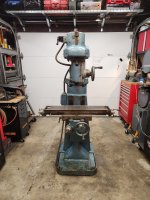
IMG_0149.jpeg
Millrite
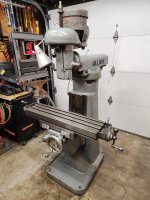
IMG_0150.jpeg
 

niget2002

Well-known member
Joined
Oct 2, 2012
Messages
11,142
Location
Josephine, TX
Blonidhacks on Youtube seems to have decent luck with whatever precision mathew's model it is she's running. You just need to know the limits of the machine and understand you're not going to hog out huge chunks of steel with it.

I'm still debating a benchtop lathe to go with my knee mill. My assumption is 'any' lathe is better than the fact I currently have 'no' lathe. As much as I'd love to pick up a good used big lathe, I 1) don't have the funds, and 2) do not live in an area where they fall from trees like they seem to in the NE.
 

txvwnut

Well-known member
Joined
Jan 1, 2015
Messages
7,630
Location
Bedford, Texas
I'll second Precision Matthews for a new unit, although dad had a round column RongFu bench top mill he bought in the 80's that made him quite a bit of money. The arguments for round column vs. square column have valid points but it really comes down to the operator of the machine to how well it will do what you need.

Here's a link for the OP to peruse, https://www.precisionmatthews.com/c....custom.milling_machine_type=Bench+Type+Mills
 
To avoid these ads, REGISTER NOW!

GeoBruin

Well-known member
Joined
May 5, 2018
Messages
3,741
You may be thinking about an older Clausing 85 series or Millrite. They both offered a nice quality but smaller benchtop style of milling machine that are still sought after even today.

The Clausing 85 series and Millrite MV series mills were knee mills, not benchtop mills. They were/are smaller, but still have fully functional knees.

For the record, I own or have owned a Grizzly G0759 (benchtop mill), a Rockwell 21-100 (small knee mill), and 3 different variants of the Millrite MV series knee mills with differing knee and table sizes.

The thing about a mill as others have noted is that you begin to accumulate a lot of tooling, vises, angle blocks, hold down fixtures, etc to the point where you have a whole cabinet full of the stuff in addition to the mill itself. If you have a benchtop mill, all that stuff can live below it so it doesn't take up any more floor space. With a knee mill, you need a separate cabinet that lives next to it, so you lose even more floor space.

I'm not debating that a knee mill is preferable in most every way to a benchtop mill/mill drill in terms of its actual use, but I find that many who respond to these threads simply don't appreciate the need for space efficiently. I have been in a very small shop for most of my "machining" life (single car garage) and there comes a point where there simply is no more space. You have to choose what you can own and operate, and sometimes it becomes a choice of compromising on the tool to have the tool at all.

If you have never operated a mill, or if you have limited experience, a benchtop mill will still feel transformative. It will open up a lot of possibilities you don't currently have. It will also make you very sensitive to feeds and speeds, tool choice, the rigidity/efficiency of your clamping setup, etc. because you will have to be to get good results. But you can get good results.

I guess I'm saying, if space is a minor concern sure, get a Bridgeport assuming you have the ability to move it and fit it into your space. But if space is an actual concern, as in, it's either a benchtop mill or nothing, definitely get the benchtop mill.

As a final thought, I have bought and sold lots of these small machines on the secondary market, and the little Grizzly fetched a much higher selling price than any of the larger knee mills. There was also much, much more interest in general. There is simply a larger market for people who can own one than a knee mill (even a small one) so if you do get one and decide to upgrade, you will be fine.
 

Attachments

  • 20231119_151504.jpg
    20231119_151504.jpg
    916.8 KB · Views: 22
  • IMG_20220113_181450.jpg
    IMG_20220113_181450.jpg
    666.5 KB · Views: 20
  • 20231112_135045.jpg
    20231112_135045.jpg
    797.6 KB · Views: 19
  • 20231216_201736.jpg
    20231216_201736.jpg
    826.2 KB · Views: 18
  • 20231211_161635.jpg
    20231211_161635.jpg
    934.1 KB · Views: 19
OP
D

drokihazan

Well-known member
Joined
Apr 8, 2018
Messages
273
So I hear a lot of feedback here, I'll respond to it with a couple details.

Like I said in my original post: I'm really just looking for dovetail columns, no round columns.
Also, a floor model machine simply isn't happening. I can't fit a Bridgeport right now, I can't fit a jig-borer, I'm really limited on floor and wall space. That's just how it is until we can buy a home at Bay Area prices and I can build a larger shop in the backyard.
What I *can* do is sell my benchtop drill press and take on a benchtop machine like a mill-drill. I've looked at a few options like the LMS Hi-Torques, as well as Precision Mathews, both of which are mostly Sieg machines. I've also looked at lots of mill-drills, and have a real interest in the geared head models from Jet.
Here's an example. The JMD-45GH has a 9x32 table with 5" of spindle travel and a 22" swing, goes down to 65rpm, an R8 spindle, variable speed geared head, a 1.5hp motor, and would fit on my bench where the press is, I'd just lose some workspace on the sides. Jet sells options with power downfeed, power x travel, and DROs - I'd probably buy one with power downfeed and retrofit x/y and DRO later if I felt I needed them. It's got some mass, about 700 pounds, and the bench I'd put it on is very rigid.
Also, tooling isn't an issue. I've got Mitutoyo and Starrett calipers, micrometers, parallels, dial gauges, etc. I'll buy R8 tooling as needed, and probably just pick up a Kurt vise off marketplace. The biggest thing for me is that I can barely find any reviews out there of these larger benchtop machines. I'm also okay with doing work to improve accuracy, if it's achievable. I'd love to be able to face mill small parts, and ideally this is a machine that could do that.
 

gamescastspencer

Well-known member
Joined
Apr 4, 2016
Messages
161
Location
Saint Peters, MO
That Jet mill appears to be a RF-45 derivative/clone. That basic machine is sold by many others in varying colors and probably quality to some extent. I believe Precision Matthews sells it as their 932. Shop around, you can likely get one with a DRO and other accessories for a fair bit less than the Jet.

Stefan Gotteswinter on YouTube used a RF45 machine for years and it seemed to work rather well for him.
 

zmotorsports

ALLIANCE MEMBER
Joined
Oct 20, 2009
Messages
21,417
Location
Northern Utah
The Clausing 85 series and Millrite MV series mills were knee mills, not benchtop mills. They were/are smaller, but still have fully functional knees.


If you have never operated a mill, or if you have limited experience, a benchtop mill will still feel transformative. It will open up a lot of possibilities you don't currently have. It will also make you very sensitive to feeds and speeds, tool choice, the rigidity/efficiency of your clamping setup, etc. because you will have to be to get good results. But you can get good results.


Good point, I guess due to their smaller size and many people have them on a floor support, I just assumed they were benchtop. Never used one myself, but have seen them in people's shops. Thanks for clarifying.


I concur with the second bolded statement above. When I had my small speed shop I did not have the space nor knowledge at the time to justify larger lathe and mill so a smaller lathe/mill was ideal for my application to be able to learn on and keep more of the custom work in-house rather than hiring out the machining work on the custom vehicles, bikes, quads and snowmobiles I was building in my shop. I became quite versed in that smaller machine and over the 17 years I had it, I had machined a lot of one-off parts and even some small production runs for my clients. I finally got to the point where I was pushing beyond my work envelope and desired a standalone 13" lathe and a smaller knee mill, but you can get good results with the smaller benchtop machines as long as you know and understand the limitations and really learn good clamping practices and learn feeds and speeds.
 

OccupantRJ

Well-known member
Joined
May 15, 2009
Messages
11,131
Location
Eastern North Carolina
Blonidhacks on Youtube seems to have decent luck with whatever precision mathew's model it is she's running. You just need to know the limits of the machine and understand you're not going to hog out huge chunks of steel with it.

I'm still debating a benchtop lathe to go with my knee mill. My assumption is 'any' lathe is better than the fact I currently have 'no' lathe. As much as I'd love to pick up a good used big lathe, I 1) don't have the funds, and 2) do not live in an area where they fall from trees like they seem to in the NE.
I suggest 12” Craftsman/Atlas with a quick change gearbox for an economical benchtop lathe. I bought one used 50 years ago and my son is still using it. In fact he installed a DRO after I gave it to him after restoring my Clausing. I bought it and paid for it modifying automatic transmission parts for a local race trans builder. I found local friend Beyond1 a unit that did not have quick change but had several accessories including a milling attachment for $400 a few years ago when I answered an ad to buy an electric motor.
 
Last edited:

LopezBart

Well-known member
Joined
Oct 13, 2023
Messages
2,547
Location
Lopez Island, WA
I used a Rong-Fu for many years (round column) with good success. If you can level it, a laser pointer mounted to the head that shines across the room on a vertical line makes it pretty easy to keep things lined up when raising the head. Failing that, raising it less than the quill travel makes it possible to restore the head rotation w/ a dial indicator against a angle plate bolted to the table.
 

Davefr

Well-known member
Joined
Jan 7, 2010
Messages
11,835
Location
OR
Don't get a Smitty. (Or is it Smithy) We have one here at work, and a major piece of ****.
I disagree. Mine has been a godsend for ocassional small projects and it was never intended to be anything more than a small benchtop 3 in 1 machine. If you choose the right tool for the job it'll hold it's own.
 

zmotorsports

ALLIANCE MEMBER
Joined
Oct 20, 2009
Messages
21,417
Location
Northern Utah
I disagree. Mine has been a godsend for ocassional small projects and it was never intended to be anything more than a small benchtop 3 in 1 machine. If you choose the right tool for the job it'll hold it's own.

Same. I had my Smithy 1239 for 17 years and it made me a lot of money over the course of those years in my speed shop. It wasn't the highest quality of machine by any stretch of the imagination, however, if you know the limitations and work within those confines with care to workholding and feeds & speeds, a person can produce some nice work on these machines.
 

American Locomotive

Well-known member
Joined
Jan 8, 2017
Messages
10,976
Location
Rhode Island
You may be thinking about an older Clausing 85 series or Millrite. They both offered a nice quality but smaller benchtop style of milling machine that are still sought after even today.


For the original poster, I had a Smithy machine for 17 years due to limited budget as well as floorspace and while a benchtop machine can do most everything a knee mill can do, they do have their limitations.

That being said, I would steer clear of a round column benchtop mill, especially it you will be side loading it a lot such as in the process of making slots. They definitely have their limits. Mine was a round column mill and I had to get very creative for those times I had to move the head on purpose, OR when it moved unintentionally. If you must hold tight tolerance, especially on slotting, I would highly recommend going with a knee mill if for nothing other than the overall rigidity.

For a benchtop milling machine, I would definitely stick with a square column head and I would suggest looking at Precision Mathews machines if looking to go new. My son had a PM45 that was converted to CNC and was a nice machine. I have a couple of Matt's machines as well of the Taiwanese variety and cannot express my satisfaction enough. I have owned my mill and lathe now for 12+ years and do not regret purchasing from Precision Mathews one bit. Matt's customer service and support after the sale are second to none.

Also, if you don't need a long table, I would agree with @OccupantRJ on looking at ones with smaller tables as they don't require as much floorspace. I have a Taiwanese milling machine that is a slightly smaller body (2/3) with a 35" table and it fits my work envelope perfectly and takes up less floorspace than a full-size Bridgeport with something like a 49" table.
I found it: It was actually a machine called the Benchmaster.
 

RoninB4

Well-known member
Joined
Jul 22, 2020
Messages
3,568
Location
Under My House
Also, a floor model machine simply isn't happening. I can't fit a Bridgeport right now, I can't fit a jig-borer, I'm really limited on floor and wall space. That's just how it is until we can buy a home at Bay Area prices and I can build a larger shop in the backyard.
-Big factor here if renting. You sure don't want to be in a situation (renting) that might require you to move a floor model mill more than once or twice. Even then, you'd be stuck with a 2,000 pound boat anchor to provide for in rental choices. A bench top is best for now.
What I *can* do is sell my benchtop drill press and take on a benchtop machine like a mill-drill.
-Wouldn't suggest giving up the drill press unless forced to do so, it's handy for secondary ops (chamfer, etc) or just popping holes.
-That's a lot of cash for what it costs new. Would suggest looking at some lightly used models that will cost a fraction of what the linked machine shows. I've just been on FB and CL for the SF area and found a couple of candidates for far less money.
Here's an example. The JMD-45GH has a 9x32 table with 5" of spindle travel and a 22" swing, goes down to 65rpm, an R8 spindle, variable speed geared head, a 1.5hp motor, and would fit on my bench where the press is
-Somebody else mentioned this in an earlier post but I'll repeat it: Strongly advise NOT to get a mill that uses plastic gears. I had one from Grizzly when I had no other options that used a plastic gear. The original exploded after a couple of months so I got 2 new ones. I was real careful not to take large cuts but it still exploded on a .010 DOC side milling aluminum. Perhaps the material has been improved but I'd have NO confidence in the plastic gears used by Chi-Wan. The motors they use are also of questionable longevity. Check for replacement parts before buying any machine.
The biggest thing for me is that I can barely find any reviews out there of these larger benchtop machines. I'm also okay with doing work to improve accuracy, if it's achievable. I'd love to be able to face mill small parts, and ideally this is a machine that could do that.
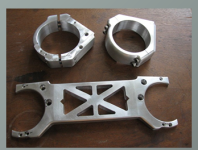
-One of the bigger critiques for machines in this class is the rigidity....or the lack of it. You'll end up taking smaller cuts or the machine will vibrate so much that the freshly milled surface will have chatter marks, it might even vibrate enough to shatter the cutter. Can decent work be done on one of these machines? Yes, it just takes longer. I made a 5 piece fork brace for my motorcycle (ZRX) on an even smaller mill than the one you posted the link to so it is possible.

1782933422208.png
 

zmotorsports

ALLIANCE MEMBER
Joined
Oct 20, 2009
Messages
21,417
Location
Northern Utah
-Wouldn't suggest giving up the drill press unless forced to do so, it's handy for secondary ops (chamfer, etc) or just popping holes.


I would agree with this. I also had people telling me to offload the drill press if space was that tight when I had my old shop. I opted to keep the drill press and glad I did because I still use it a lot to this day. Sometimes secondary operations, other times just because it is easier and faster.
 

BTL-A4

Well-known member
Joined
Feb 28, 2018
Messages
1,255
Location
Santa Clarita
@drokihazan I know you stated you didn't want a round-column mill, but I wanted to put in my 2¢. I have one and it works fine if you just make sure your Z height will fit all your tools and do whatever operations you need. The issue is there are not many choices for mills that fit on a bench and you limit your choices if you discount round-column machines. As you can see, people have strong opinions on them, both pro and con. I've seen a few Rong-Fu round column clones in Socal for anywhere from $500 to over $1,000. Not sure why there's such a price range; they all look similar. I've done good, precise work on mine.
However, if you can afford a newer, dovetail column machine, then that's the way to go for you. Precision Matthews is a great company, so buy from them or buy a used one if you decide to go that route. I had one of their lathes and they were able to help me get parts for it, even though it was no longer on production.
 
To avoid these ads, REGISTER NOW!
Top Bottom