I got a great deal on a 25 CFM unit. The issue is my compressor is a 10 HP Saylor Beal. I can't seem to find the rating at 100 PSI but it has 35 CFM at 175PSI. My main issue is painting. I think this would be great for the paint booth. I also bead blast a lot. Is it too small for the bead blaster? I blast with a pressure pot outside but I can bypass and go right off the compressor for that


You are using an out of date browser. It may not display this or other websites correctly.
You should upgrade or use an alternative browser.
You should upgrade or use an alternative browser.
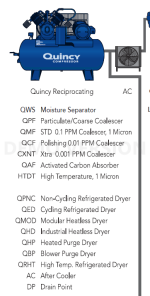
Quincy QRHT-25 non-cycling refrigerated air dryer Too small?
- Thread starter ng8264723
- Start date
stonesfan68
Well-known member
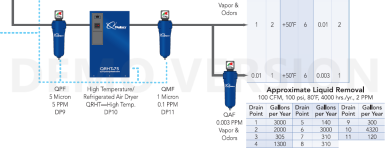
I don’t know much about that dryer, but the HT usually indicates that it is rated for a high inlet air temperature (~200F) and it should also have a built-in moisture separator, and perhaps an after filter as well. Check the manual or a brochure to confirm the included scope of supply.
Your compressor is rated for ~ 31 SCFM and the dryer is rated for 25 SCFM. Presumably the compressor doesn’t have a aftercooler and it discharges into an air receiver and then goes into the dryer. The dryer performance will be marginal during the summer months, but it will still remove moisture from the air. If you operate the compressor at a higher pressure then it will improve the dryer’s performance.
If the air compressor does have an aftercooler (usually a heat exchanger mounted on the back of the compresso belt guard) then everything will be fine.
I see you live in Massachusetts, so you don’t really have a summer like we do here in Houston. That will help the dryer’s performance, too.
Your compressor is rated for ~ 31 SCFM and the dryer is rated for 25 SCFM. Presumably the compressor doesn’t have a aftercooler and it discharges into an air receiver and then goes into the dryer. The dryer performance will be marginal during the summer months, but it will still remove moisture from the air. If you operate the compressor at a higher pressure then it will improve the dryer’s performance.
If the air compressor does have an aftercooler (usually a heat exchanger mounted on the back of the compresso belt guard) then everything will be fine.
I see you live in Massachusetts, so you don’t really have a summer like we do here in Houston. That will help the dryer’s performance, too.
Last edited:
engineer2
Well-known member
It should be fine unless you have situations where your compressor is running 100% of the time.
To take some load off the air dryer, you can always pipe in an aftercooler.
To take some load off the air dryer, you can always pipe in an aftercooler.
metlmunchr
Well-known member
- Joined
- Sep 10, 2011
- Messages
- 1,281
The QRHT is a high inlet temp model. Max inlet temp is 180*F. So, it can do the necessary cooling and water condensation to dry 25 cfm of air that's at 180*F and saturated. Every 20* increase roughly doubles the moisture carrying ability of air, so the HT type dryers have to have far greater cooling capacity than the standard inlet temp versions. It would be unusual for the air coming out of your tank to exceed 120*, and 120* air can't carry near as much moisture as 180* air can. Also, the HT dryer has to be able to cool the air/water mix from 180* down to about 40*. Since you'd be feeding it air at 120* or less, it has the capacity to cool more of the mix than it would if fed 180* air. The net result is that your HT dryer would easily handle the full output of your 10hp compressor.
If you look at the electrical specs on your dryer and compare with the standard inlet temp version of the same dryer, your dryer has a full load of 0.4 kW while the std inlet temp version of the same capacity has a full load of 0.2kW. A standard inlet temp version with a full load of 0.4kW will handle about 60 cfm. I'm not saying that yours would handle 60 cfm, but it will handle far more than 25cfm when fed air at the normal temps coming from the storage tank of a recip compressor. AFAIK, the primary application of high inlet temp dryers is for use with screw compressors which typically have very little storage capacity and therefore very little opportunity for air to cool or moisture to condense out in a relatively large storage tank as is typical of a recip compressor.
I noticed Quincy ships the dryers with a coalescing filter. Assuming you bought yours used, it is very important to add a coalescing filter if your unity didn't come with one. This filter's purpose is to remove oil from the air as any oil within the cooling circuits of a dryer will impede heat transfer and decrease the dryer's capacity. Of course you'd want a coalescing filter anyway for painting as any oil in the air is an instant disaster for painting. IMO, its not a bad idea to add another coalescing filter at your booth supply. At the cost of paint today, if it stops one drop of oil from getting to your spray gun, it has paid for itself.
If you look at the electrical specs on your dryer and compare with the standard inlet temp version of the same dryer, your dryer has a full load of 0.4 kW while the std inlet temp version of the same capacity has a full load of 0.2kW. A standard inlet temp version with a full load of 0.4kW will handle about 60 cfm. I'm not saying that yours would handle 60 cfm, but it will handle far more than 25cfm when fed air at the normal temps coming from the storage tank of a recip compressor. AFAIK, the primary application of high inlet temp dryers is for use with screw compressors which typically have very little storage capacity and therefore very little opportunity for air to cool or moisture to condense out in a relatively large storage tank as is typical of a recip compressor.
I noticed Quincy ships the dryers with a coalescing filter. Assuming you bought yours used, it is very important to add a coalescing filter if your unity didn't come with one. This filter's purpose is to remove oil from the air as any oil within the cooling circuits of a dryer will impede heat transfer and decrease the dryer's capacity. Of course you'd want a coalescing filter anyway for painting as any oil in the air is an instant disaster for painting. IMO, its not a bad idea to add another coalescing filter at your booth supply. At the cost of paint today, if it stops one drop of oil from getting to your spray gun, it has paid for itself.
I appreciate all the information especially from metimunchr!
This is my compressor. I do not have a cooler on the guard. I just have the finned cooling tubes on the head as in the pic

 www.compressedairadvisors.com
This is my compressor. I do not have a cooler on the guard. I just have the finned cooling tubes on the head as in the pic
Saylor-Beall 10 HP Two Stage Horizontal Air Compressor, 4500 Pump, 38 CFM @ 175 PSI, Magnetic Starter, Three Phase120 Gallon Horizontal / 230V/3Ph
Shop the Saylor-Beall 451012 and 451020 horizontal air compressors with the heavy-duty 4500 pump, 38 CFM @ 175 PSI, 120 or 200 gallon tanks, and three-phase power.
www.compressedairadvisors.com
BillK
Well-known member
What is the most air you will use at one shot ? I just looked at the specs on my Van Norman blast cabinet and it uses 16CFM. Unless you have a huge more industrial blaster I doubt that you will have a problem.
As far as painting goes I dont think that modern HVLP guns really use much air at all. A couple of specs I just found were in the 10 cfm range.
As far as painting goes I dont think that modern HVLP guns really use much air at all. A couple of specs I just found were in the 10 cfm range.
That is kind of vague! "A lot of air" means nothing, or everything, or somewhere in between! Do you know the actual CFM your sand blasters use? That is what matters.We do a ton of blasting. I have a zero blast cabinet and a pressure pot outside. The pressure pot uses a lot of air. But I could run it directly from the compressor