
You are using an out of date browser. It may not display this or other websites correctly.
You should upgrade or use an alternative browser.
You should upgrade or use an alternative browser.
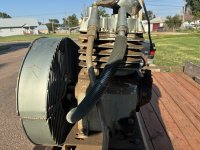
Does this air compressor look like it is worth trying to save?
- Thread starter gayler
- Start date


larry4406
Well-known member
The tank color says Saylor Beall to me.
If true, yes.
At worst you make a BBQ.
If true, yes.
At worst you make a BBQ.
larry4406
Well-known member
230V single phase motor as well.I’ll load it tomorrow morning and get pictures of the tag. I think it was in the buss garage. If so I bet it doesn’t have many hours on it. Probably nothing wrong with it.
I hope to be able to say you ****!
Chuckster in NJ
Well-known member
He *****!230V single phase motor as well.
I hope to be able to say you ****!

the motor alone is worth more than you paid for the unit... ( I know it was free)
micromind
Well-known member
230V single phase motor as well.
I hope to be able to say you ****!
Marathon is one of the better brands.
TRWham
Well-known member
Or maybe a Kellogg-American. Those intercooler tubes look more like Kellogg, as the SBs I have seen use a big, cast intercooler.The tank color says Saylor Beall to me.
If true, yes.
At worst you make a BBQ.
I haven’t had a chance to look at it yet. I loaded out on the trailer, but unfortunately it’s laying on the side where the tag for the tank is and the label for some reason I want to say the label on the side had some kind of a bird on it that I could be wrong. I’ll have it stood up and looked at this weekend hopefullyOr maybe a Kellogg-American. Those intercooler tubes look more like Kellogg, as the SBs I have seen use a big, cast intercooler.
TRWham
Well-known member
The tag on the tank will likely be the ASME label for whoever made the tank. It will have a date of manufacture and information about the tank material, test pressures, etc. There may also be a label or logo of the compressor OEM on the tank, but not always. Look on the pump itself to identify the compressor manufacturer.I haven’t had a chance to look at it yet. I loaded out on the trailer, but unfortunately it’s laying on the side where the tag for the tank is and the label for some reason I want to say the label on the side had some kind of a bird on it that I could be wrong. I’ll have it stood up and looked at this weekend hopefully
Make sure the tank isn't full of water.
Took some pictures.,it was all my 17 year old son and I could do to stand it back up!
Attachments
-
 IMG_0826.jpeg1.4 MB · Views: 105
 -
 IMG_0827.jpeg1.1 MB · Views: 94
 -
 IMG_0828.jpeg855 KB · Views: 78
 -
 IMG_0829.jpeg1.4 MB · Views: 78
 -
 IMG_0830.jpeg1.1 MB · Views: 75
 -
 IMG_0831.jpeg922.1 KB · Views: 79
 -
 IMG_0832.jpeg1.2 MB · Views: 73
 -
 IMG_0833.jpeg1.1 MB · Views: 67
 -
 IMG_0834.jpeg1.1 MB · Views: 61
 -
 IMG_0835.jpeg961.9 KB · Views: 60
 -
 IMG_0836.jpeg1 MB · Views: 58
 -
 IMG_0837.jpeg1.3 MB · Views: 58
 -
 IMG_0838.jpeg856 KB · Views: 95
micromind
Well-known member
The pump looks like the one on my Speedaire (Grainger) compressor, & can't remember who made them for Grainger.
A lot of Speedaire pumps are made by Champion and generally considered to be one of the best.
The Bean
Well-known member
Now i see the belt guard and understand the bbq comment. Lol.
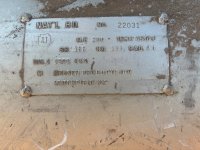
W.P = working pressure 200 psiI’ve got the compressor in my shop and hoping to hook it up tonight or tomorrow to see if it runs. Can anyone decipher the information on the tag on the tank for me thanks a lot guys! I appreciate it.
TP = temp 450 degrees
SH= shell thickness of body .166?
HD= head thickness on top/bottom of tank .133?
RD= radiographic testing 2:1
Tank date 1980
DIV 1= hazardous area classification

A quick update. It does run! I ran it up to 75psi twice just to see if the pump and motor worked. I was concerned about the tank so I didn’t go any further. I can take a plug out of the end of the tank and check for rust. What else should I do to check the health of the tank? I’ve heard of filling the tank with water and using a grease gun to pressurize it to check for leaks but don’t know if that’s a good idea?
Hohn
Well-known member
Yes, but that’s not a Champion pump.A lot of Speedaire pumps are made by Champion and generally considered to be one of the best.
Junkman
Well-known member
When you ran it up to 75 PSI, did you check the tank for any leaks? It might have a pinhole at the bottom of the tank. I had that happen to the compressor that I bought used in 1960. I got 10 years out of it before it started leaking air. I bought a new tank, and never had a problem with it, and sold it when I moved.
I was told that tanks are pressure-tested by filling them to 90% capacity with water and then pressurizing them with air. Supposedly, the water keeps them from coming apart like a hand grenade. I have no firsthand knowledge of whether this is true, but when in doubt, replace.
I was told that tanks are pressure-tested by filling them to 90% capacity with water and then pressurizing them with air. Supposedly, the water keeps them from coming apart like a hand grenade. I have no firsthand knowledge of whether this is true, but when in doubt, replace.
gimpyrobb
Well-known member
Yes, I'd test it. Put a gauge on there and pressurize it to at least twice the working pressure. You could also use a pressure washer if you know how to adapt it.A quick update. It does run! I ran it up to 75psi twice just to see if the pump and motor worked. I was concerned about the tank so I didn’t go any further. I can take a plug out of the end of the tank and check for rust. What else should I do to check the health of the tank? I’ve heard of filling the tank with water and using a grease gun to pressurize it to check for leaks but don’t know if that’s a good idea?
Thd tank can look pretty bad inside and still be good.
The biggest spot for rust through on a horizontal tank is at the bottom so have a look at that on the outside. You could also spray some soapy water on it when it's pressurized. But if it has any pinhole leaks you'd hear it with pressure in it.
The biggest spot for rust through on a horizontal tank is at the bottom so have a look at that on the outside. You could also spray some soapy water on it when it's pressurized. But if it has any pinhole leaks you'd hear it with pressure in it.
Last edited:
Not 2x MAWP!! At best 1.3x MWAP. Yes, it needs to be water filled. Not sure of the 90% amount but it is very high. Water is incompressible compared to gases. If there is a rupture, a water leak will show quicker and not contain the the explosive forces that a compressed gas can.Yes, I'd test it. Put a gauge on there and pressurize it to at least twice the working pressure. You could also use a pressure washer if you know how to adapt it.
The water will equally transmit the elevated head pressure imposed on it from the compressed gas to all portions of the vessel.
Even then, you have to protect yourself JIC!
You can also hold the pressure over time to vet out any pin holes that may otherwise be undetectable with "home instrumentation."
Skip the grease. Think about how much you would need to pump into it. What pressure could you create pumping grease? How do you clean it out? Compressed air is better but do you have any equipment that can develop ~260 psi, measure it accurately, and do so at elevated temps matching the compressor's output temp?A quick update. It does run! I ran it up to 75psi twice just to see if the pump and motor worked. I was concerned about the tank so I didn’t go any further. I can take a plug out of the end of the tank and check for rust. What else should I do to check the health of the tank? I’ve heard of filling the tank with water and using a grease gun to pressurize it to check for leaks but don’t know if that’s a good idea?
gimpyrobb
Well-known member
You think 300psi is too much? Why is that?
gimpyrobb
Well-known member
I see standard tests are 150%.Not 2x MAWP!! At best 1.3x MWAP. Yes, it needs to be water filled. Not sure of the 90% amount but it is very high. Water is incompressible compared to gases. If there is a rupture, a water leak will show quicker and not contain the the explosive forces that a compressed gas can.
The water will equally transmit the elevated head pressure imposed on it from the compressed gas to all portions of the vessel.
Even then, you have to protect yourself JIC!
You can also hold the pressure over time to vet out any pin holes that may otherwise be undetectable with "home instrumentation."
ASME standards for NEW pressure vessels use 1.3 MAWP. Since this is old and of uncertain upkeep, I would not exceed that value.I see standard tests are 150%.
Without having specs for which the tank was designed for and empirical data, SWAGing it isnt a good idea. (People making bombs have had unexpected results.)
gimpyrobb
Well-known member
But filled with water, it isn't a bomb.ASME standards for NEW pressure vessels use 1.3 MAWP. Since this is old and of uncertain upkeep, I would not exceed that value.
Without having specs for which the tank was designed for and empirical data, SWAGing it isnt a good idea. (People making bombs have had unexpected results.)
Cruzan80
Well-known member
While I am not saying the "fill with water and then pressurize" method doesnt have upsides, there is a downside of this compared with actual testing (which is cost prohibitive to the homeowner) from everything I have seen/read/discussed. You need to decide what level of testing you are comfortable with.
It is possible for the tank to be "stretched" beyond its elastic limit, without developing a leak. The idea is that while the tank will expand slightly due to the pressure, it should contract once the pressure is gone. But at a given high enough pressure, the steel will not "relax" back to its original shape once the pressure is released. You have then already stressed the metal and weakened it (and a formal test would fail the tank). This would mean the "shell" is weaker overall, rather than just a pinhole leak. However, there is no way to know this from the "fill with water and pressurize on your driveway" method.
The way it is done formally (from what I understand) is to submerge the entire tank in water, pressurize it, measure the amount of water displaced (possibly failing at this point if it expands too much?), and then de-pressurizing it and making sure the water level returns to the original mark.
It is possible for the tank to be "stretched" beyond its elastic limit, without developing a leak. The idea is that while the tank will expand slightly due to the pressure, it should contract once the pressure is gone. But at a given high enough pressure, the steel will not "relax" back to its original shape once the pressure is released. You have then already stressed the metal and weakened it (and a formal test would fail the tank). This would mean the "shell" is weaker overall, rather than just a pinhole leak. However, there is no way to know this from the "fill with water and pressurize on your driveway" method.
The way it is done formally (from what I understand) is to submerge the entire tank in water, pressurize it, measure the amount of water displaced (possibly failing at this point if it expands too much?), and then de-pressurizing it and making sure the water level returns to the original mark.
JuncleJohn
Well-known member
Why not just turn it on and let it fill with air? Then spray the tank with soapy water. Just like checking a tire for leaks.
John
John
I filled my 1957 Kellogg American with water, added a gauge and a quick coupler for the pressure washer hose. Pressurized the tank and let it set for a few hours.
Cruzan80
Well-known member
Because if it let's go before it reaches the stopping pressure, you essentially have a bomb on your hands.Why not just turn it on and let it fill with air? Then spray the tank with soapy water. Just like checking a tire for leaks.
John
If it has been pressurized recently, and you know it has been being used, then the spray bottle idea has some merit. The "water fill/pressurize" is for a tank of unknown condition (though certainly can also be used to safely test something to greater than MAWP).
fitter30
Well-known member
By pulling the intake filter and putting the palm of your hand blocking the port turn on the compressor just for a few seconds. This takes the load off the connecting rod if it starts to knock loudly bearings are starting to fail.A quick update. It does run! I ran it up to 75psi twice just to see if the pump and motor worked. I was concerned about the tank so I didn’t go any further. I can take a plug out of the end of the tank and check for rust. What else should I do to check the health of the tank? I’ve heard of filling the tank with water and using a grease gun to pressurize it to check for leaks but don’t know if that’s a good idea?
tncatadjuster
Well-known member
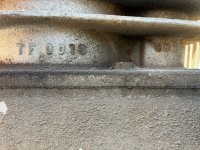
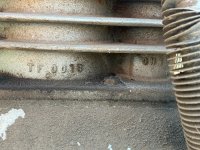
#14 shows to be a crack in the cylinder wall?
No kidding. But swagging to a 2x pressure test value can become a destructive test. So if it ruptures at 400psi (using your method) what have you proven? And then you're left with scrap and a bunch of wasted time.But filled with water, it isn't a bomb.
larry4406
Well-known member
You do know the OP has a horizontal tank from your careful reading of this thread right?
Thd tank can look pretty bad inside and still be good.
The biggest spot for rust through on a vertical tank is at the bottom so have a look at that on the outside. You could also spray some soapy water on it when it's pressurized. But if it has any pinhole leaks you'd hear it with pressure in it.
Milton Shaw
Well-known member
- Joined
- Feb 11, 2011
- Messages
- 4,857
Pressure washer pumps 2,000 psi and up. That is too much for any air tank except scuba tanks, use a grease gun filled with water instead of grease.I filled my 1957 Kellogg American with water, added a gauge and a quick coupler for the pressure washer hose. Pressurized the tank and let it set for a few hours.
You do know the OP has a horizontal tank from your careful reading of this thread right?
my bad, I meant horizontal.