To avoid these ads, REGISTER NOW!

Vises and PSI casting numbers

PT Doc

Well-known member
Joined
Nov 12, 2010
Messages
3,197
I've been looking into various vises and some provide PSI casting info. I've seen 30,000 PSI and 60,000 PSI.

Can someone explain which would be better?

Does anyone have any info on what PSI older vises were cast from?

Thanks for the information.
 
To avoid these ads, REGISTER NOW!

Steve_P

Well-known member
Joined
Sep 15, 2010
Messages
5,188
higher strength (number) is better. So, 60ksi is better than 30ksi. Typically only the "better" vises will list material properties- the cheap china ones that don't list it may be 10ksi, I don't know, but there are plenty of pics of broken ones on the net.
 

autopts

Well-known member
Joined
Jul 4, 2009
Messages
2,268
Wilton calls it tensil strength. A costs in a "Grey Iron" casting reflects their low Tensil strength which is usually rated at about 30,000 lbs per square inch. The "Malleable Casting" which obviously costs more because of the metal and chemical makeup is rated at 60,000. Old U.S.A vises with older generation steel probably could bury the tensil meter. Someone out there has probably done a hardness test on one already.
 

mjozefow

Well-known member
Joined
Apr 9, 2009
Messages
2,111
Location
Lafayette, IN
Wilton calls it tensil strength. A costs in a "Grey Iron" casting reflects their low Tensil strength which is usually rated at about 30,000 lbs per square inch. The "Malleable Casting" which obviously costs more because of the metal and chemical makeup is rated at 60,000. Old U.S.A vises with older generation steel probably could bury the tensil meter. Someone out there has probably done a hardness test on one already.

I don't think the old vises were necessarily made of iron with higher strength numbers than a good modern vise. I just think they used a lot more iron. :beer:
 

Freeborn John

Well-known member
Joined
Jul 25, 2010
Messages
353
Location
Great Britain
British made Record vices were made in two grades, the small mechanics ones were made of 'plain grey iron' while the larger fitters and engineers versions were manufactured from 'spheroidal graphite iron', these were considered unbreakable by any normal means and most abnormal ones too...
The Record factory method for testing one of their vices to destruction was to tighten it until the handle bent, then saw the handle off and replace it with a Stillson wrench so large that two men could swing on it until something broke.
Unsurprisingly, the lab wall is described as having a large dent in it where broken vice slides had tried to leave the building.
 

BanjoSavesTheDay

Well-known member
Joined
Nov 10, 2009
Messages
627
Location
Huntington, WV
British made Record vices were made in two grades, the small mechanics ones were made of 'plain grey iron' while the larger fitters and engineers versions were manufactured from 'spheroidal graphite iron', these were considered unbreakable by any normal means and most abnormal ones too...
The Record factory method for testing one of their vices to destruction was to tighten it until the handle bent, then saw the handle off and replace it with a Stillson wrench so large that two men could swing on it until something broke.
Unsurprisingly, the lab wall is described as having a large dent in it where broken vice slides had tried to leave the building.

Haha I have never heard the bit about Record testing. Sounds like fun! :lol_hitti
 
OP
P

PT Doc

Well-known member
Joined
Nov 12, 2010
Messages
3,197
Would anyone have a problem owning a 60,00 PSI vise that was not made in the USA?
 

woody 73

Well-known member
Joined
Apr 14, 2009
Messages
11,547
Location
The Great State Up North
I am sure outside of the USA you will find some very good vises, keep in mind 60,000 psi is a lot of tensil strength; one would have to ask why someone was applying a high amount of pressure in a normal day to tighten down an object.

If someone uses a six foot pipe as a cheater bar and cranks down on the handle then something has to give,either the vise fails,the handle bends,or both. Again I would want to know why the person needed that much pressure.

My old neighbor would put a part in his vise (chinese vise),tighten the part down and then grab a torch heat up the part and remove any stubborn nut or bolt; He never broke that vise.
 

autopts

Well-known member
Joined
Jul 4, 2009
Messages
2,268
Would anyone have a problem owning a 60,00 PSI vise that was not made in the USA?

Somewhere I read that China can make vises up to 65,000 PSI. and I read that a few years ago, thats why Erwin, American Vermont and alot of these HSS drill and tool MFG's have moved operations. Thats another topic.
 
OP
P

PT Doc

Well-known member
Joined
Nov 12, 2010
Messages
3,197
Craftsman has a 65,000 PSI Professional. With the regular sales that they have it's like to be had for under $100 before the holidays. Might be an option. What else is out there that for $100 that is quality?
 

Arnie C

Well-known member
Joined
Apr 17, 2010
Messages
88
Location
Wauwatosa, WI
Anyone can make a 65ksi vice as long as the metallurgy is right.

Hardness and toughness are not the same. A hard vise, such as one made with white iron (65+ Rockwell C) would be very brittle and very weak.

Malleable iron, spheroidal iron, nodular iron, etc is just another way of saying ductile iron, which is what most cast iron vehicle suspension components are made of and would be considered an "engineering grade material" vs a common material such as standard grade iron. A ductile iron vise would be superior to a gray cast iron vise, all things being equal.

Nothing really such as a "tensile meter". You would need to have a sample of the material made into a tensile bar and pulled by a lab or someone with a tensile tester to determine tensile strength.


And for $100, I would take a good used vise from Craigslist or an auction vs some new Chinese junk.
 

airbuff101

Well-known member
Joined
Oct 31, 2006
Messages
728
I am sure outside of the USA you will find some very good vises, keep in mind 60,000 psi is a lot of tensil strength; one would have to ask why someone was applying a high amount of pressure in a normal day to tighten down an object.

If someone uses a six foot pipe as a cheater bar and cranks down on the handle then something has to give,either the vise fails,the handle bends,or both. Again I would want to know why the person needed that much pressure.

My old neighbor would put a part in his vise (chinese vise),tighten the part down and then grab a torch heat up the part and remove any stubborn nut or bolt; He never broke that vise.

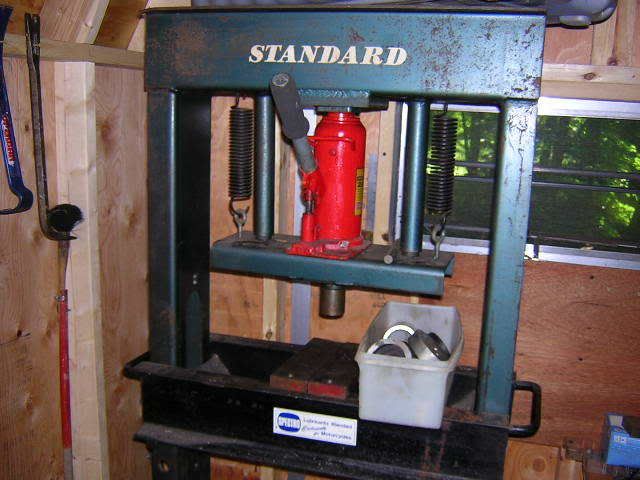
I tend to agree that most vise damage occurs when folks don't have access to a Pressy-thing:
Img15048.jpg


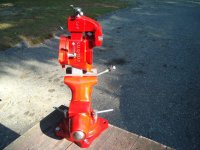
and try to do the job with a Squeezy-thing:
DSCN4927.jpg


Rob
 
OP
P

PT Doc

Well-known member
Joined
Nov 12, 2010
Messages
3,197
Anyone can make a 65ksi vice as long as the metallurgy is right.

And for $100, I would take a good used vise from Craigslist or an auction vs some new Chinese junk.

Thanks for the response Arnie.

I have a concern about used vises. Not knowing the PSI of the casting and its history makes the whole purchase questionable. If its fully painted then I can't tell if its been broken and repaired. And if its really old then its probably been beat on quite a bit a might be more likely to fail than a new 60K PSI China vise that has been used properly by the home enthusiast.

I'll still be looking around and will see how the holiday sales work out.

Thanks again.
 
To avoid these ads, REGISTER NOW!
OP
P

PT Doc

Well-known member
Joined
Nov 12, 2010
Messages
3,197
What brand vise is the bottom one that bit the smaller one?
 

Attachments

  • DSCN4927.jpg
    DSCN4927.jpg
    103.6 KB · Views: 46

airbuff101

Well-known member
Joined
Oct 31, 2006
Messages
728
What brand vise is the bottom one that bit the smaller one?

PT,
It's '95 Wilton 1760 that I refurbished for my sons shop last year.
He's got that and a much older 745 that we just mounted on a heavy bench.
We had the vises all set but ran into a 300lb wood bench just last weekend to finally stick them on.
I'll get some pics of the setup soon.
Rob
 
OP
P

PT Doc

Well-known member
Joined
Nov 12, 2010
Messages
3,197
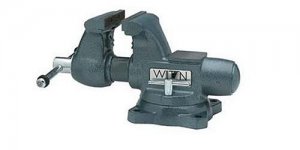
It is interesting how similar these vises are. The Wilton is lifetime warranty and the Cman is 1 year. Both are 60,000 PSI.

I have also looked into Ridgid and they use 75,000 PSI castings.

So many vises, so much money and so much confusion.
 

Attachments

  • Wilton63200.jpg
    Wilton63200.jpg
    13.1 KB · Views: 22
  • CraftsmanProVise.jpg
    CraftsmanProVise.jpg
    26.5 KB · Views: 27

alex71

Well-known member
Joined
Jan 19, 2009
Messages
2,819
Location
SE Florida
It is interesting how similar these vises are. The Wilton is lifetime warranty and the Cman is 1 year. Both are 60,000 PSI.

I have also looked into Ridgid and they use 75,000 PSI castings.

So many vises, so much money and so much confusion.

is that craftsman made by WMH or is a Chinese clone?

To me it looks like a clone, because they used Phillips head screws instead of socket heads to contain the jaw inserts, and the slide is painted...

hmmm...

Edit: never mind, I just saw that the Cman sells for $130 on the Sears website. NO way is it a rebadged Wilton.
 

123Go

Well-known member
Joined
Oct 7, 2012
Messages
200
Looking at these old threads makes me wonder about too old of a vises strength since Ductile Iron was not around until 1948 according to link below? It was a huge advancement in iron strength meaning before this, iron was inferior. Meaning a really old vise is so large because they had to have more iron so its not better iron,its just more iron.
After 50's your now talking better iron though. But' again if the vise has been maxed a few times how strong is it then? Just pondering here?

Understanding Cast Irons - Ductile Iron: Link to this below:
Ductile iron, also referred to as nodular iron or spheroidal graphite iron, was patented in 1948. After a decade of intensive development work in the 1950s, ductile iron had a phenomenal nine-fold increase in use as an engineering material during the 1960s, and the rapid increase in commercial application continues today.

http://www.atlasfdry.com/ductile-iron.htm


*
 

Dennis Leigh Henry

Well-known member
Joined
Apr 8, 2013
Messages
6,302
Location
South Central, IN USA
Looking at these old threads makes me wonder about too old of a vises strength since Ductile Iron was not around until 1948 according to link below? It was a huge advancement in iron strength meaning before this, iron was inferior. Meaning a really old vise is so large because they had to have more iron so its not better iron,its just more iron.
After 50's your now talking better iron though. But' again if the vise has been maxed a few times how strong is it then? Just pondering here?

Understanding Cast Irons - Ductile Iron: Link to this below:
Ductile iron, also referred to as nodular iron or spheroidal graphite iron, was patented in 1948. After a decade of intensive development work in the 1950s, ductile iron had a phenomenal nine-fold increase in use as an engineering material during the 1960s, and the rapid increase in commercial application continues today.

http://www.atlasfdry.com/ductile-iron.htm


*

I had the same thought.. Gray iron, Malleable iron, Ductile iron... progressively better strengths (metallurgically).. I believe that there are standard grades of ductile in the 60 and 75K PSI range.. Dang, now I need to dig out my metallurgy book and refresh my memory of the grades..
 

Fretters

Well-known member
Joined
Jan 25, 2014
Messages
4,217
Location
South Yorkshire, England
Looking at these old threads makes me wonder about too old of a vises strength since Ductile Iron was not around until 1948 according to link below? It was a huge advancement in iron strength meaning before this, iron was inferior. Meaning a really old vise is so large because they had to have more iron so its not better iron,its just more iron.
After 50's your now talking better iron though. But' again if the vise has been maxed a few times how strong is it then? Just pondering here?

As far as I recall though, from reading through some of my tomes which generally tend to predate that period, (just been and checked on Wikipedia too, though I'm generally reluctant to believe much they say), malleable iron predates that, and is merely simple cast iron which is subjected to heat treatment, so saying that old vices were merely cast iron may not apply exactly, depending on how the manufacturers produced them.

Saying that though, it's generally neither here nor there. There are enough old vices still knocking about to suggest that whatever they did, they generally did it well. :D
 

Dennis Leigh Henry

Well-known member
Joined
Apr 8, 2013
Messages
6,302
Location
South Central, IN USA
I had the same thought.. Gray iron, Malleable iron, Ductile iron... progressively better strengths (metallurgically).. I believe that there are standard grades of ductile in the 60 and 75K PSI range.. Dang, now I need to dig out my metallurgy book and refresh my memory of the grades..

Some common grades as cast ductile iron (ASTM A536 and others for ADI):

Tensile - Yield - % Elongation

65-45-12
60-40-18
80-55-06

Heat treated cast ductile iron (ASTM)

100-70-03
120-90-02

http://www.ductile.org/didata/Section12/12intro.htm

Gray iron is typically classified as classes (or grades if using SAE), e.g. class/grade 20 = 20,000 psi

As cast gray iron can be found in classes/grades 20, 30, and 40. Above 40 require specially alloying and often heat treatment. 80 is the highest gray iron grade and is very brittle (not good for a vise I suspect).

astm.org, sae.org

Hope this helps.. It did help me to recall all this... :beer:
 

BikerDad

Well-known member
Joined
Apr 24, 2014
Messages
975
Location
Utah
I am sure outside of the USA you will find some very good vises, keep in mind 60,000 psi is a lot of tensil strength; one would have to ask why someone was applying a high amount of pressure in a normal day to tighten down an object.

If someone uses a six foot pipe as a cheater bar and cranks down on the handle then something has to give,either the vise fails,the handle bends,or both. Again I would want to know why the person needed that much pressure.

My old neighbor would put a part in his vise (chinese vise),tighten the part down and then grab a torch heat up the part and remove any stubborn nut or bolt; He never broke that vise.

Well, I don't know about putting a 6' cheater pipe on one, but I broke a vise with a bicycle wheel. I was removing the cluster from the rear wheel, it wouldn't budge with a 12" Crescent, so I put the freewheel tool in the vise, dropped the wheel on it, grabbed the wheel at 3 & 9 o'clock and started twisting.

The bad news was, the moveable jaw of the vise broke. The good news is, the cluster also broke free.

One can get a lot of leverage with a 27" wheel. I was actually more worried about busting spokes, didn't even consider that the vise could break. I know better now, and replaced that vise with an American made vise.
 

123Go

Well-known member
Joined
Oct 7, 2012
Messages
200
I did machine maintenance for Whirlpool and later on was in several injection molding shops and most used Wilton regardless.
Worked on molds & inj machines and have never broke a vise, broke my share of clamps, no vise yet. In fact I never have seen a vise actually break yet and I'm 54. One small company I worked at was family owned and took almost every dime the shop made home with them. Like pulling teeth getting them to buy a few hose clamps for water lines to connect molds up..lol..no joke!! Tight arsed is an understatement here if you will?

They bought 2 China made 8" Wilton mechanic's vises (30k Grey Iron) and even with everyone beating their handles with small sledges for over a decade that I was there they never failed to hold nor broke. The handles sure bent, one vise handle was just bent all to hell and back from pipes/hammers but it still held great regardless.

What I never understood is why people alway hammered hard on them right off the bat at every use? I would give the handle all I had if need be then a few taps first.
Then' use a cheater only if needed to snug it up to beat on something, never seemed to need more than that? I saw guys beat the **** out of those poor handles, to simply drill on something...wth are guys think'n there?
I saw 200 lb guys pulling with everything they had, body off the floor with 3ft+ cheaters but those vise's never broke, but why do this to one?
I was so surprised because I mounted the vises myself so I just knew those cheaper china vises would fail in a shop within weeks or months but they never did. They had lifetime warranties and that is why they bought them. Warranties may went south after handle's bent in first week of use but idk? Why?

Because' If you read on a some vise manuals the handles are actually "designed" to bend before the casting breaks, it's a fair warning you are stressing the vise past its limits and you should stop cranking it. So any used vise with a bent handle has been over stressed as far as a vise manufacturing corp. thinks... So' imo at least buy a vise with a larger (strait if used) handle it should take more stress than a smaller handle and not been over stressed.
Warranties may very well be shot in some corps eyes if a handle is bent which is surely why the handle balls are welded on and handles are not easily replaceable like they should be imo? Why balls not threaded on?
See #2 shown on the below manual (1st link), first manual I clicked on for a reference here, I don't own it:

http://www.irwin.com/uploads/documents/76_2013_Vises_eBook.pdf

China Wiltons they bought:
http://www.wiltontools.com/us/en/p/mechanics-vise-8-jaw-with-swivel-base/21800


*
 
Last edited:

General Geoff

Well-known member
Joined
Jan 12, 2013
Messages
3,879
Location
Allentown, Pennsylvania
Nothing wrong with using a vise as a *light* press, up to 2 tons or maybe 3 with a more robust one. The main point being that if you can't get it done without a hammer or cheater pipe, then it shouldn't be stressed more and you need to use an actual press.
 
To avoid these ads, REGISTER NOW!
Top Bottom