To avoid these ads, REGISTER NOW!

Help with EMT

01Bullitt82

Member
Joined
Apr 18, 2026
Messages
5
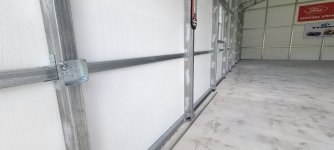
Hello Everyone, ive been looking through the journal and have learned alot. First time poster, though. I just had a 30x45x12 steel building built. I want to run EMT for my power. The problem im face is that the vertical columns on the 45' sides have double columns, and the horizontal braces are only signal. Also the front and rear 30' sides are single columan. What would be the best place to mount my boxes with the least amount of bends? while maximuming space. I currently have the boxes mounted with magnets, just to see what i was working with. If i put them on the horizontal brace, i feel like its a lot of bends to go around all the double columns. If I mount to the front of the double columans, the conduit is straight but then im losing 2.5-5" of space between the conduit and wall. I would preciate any advice from anyone who has dealt with this before. Picture for reference.
 

Attachments

  • 20260815_134617.jpg
    20260815_134617.jpg
    359.1 KB · Views: 60
  • 20260815_134837.jpg
    20260815_134837.jpg
    281.2 KB · Views: 59
To avoid these ads, REGISTER NOW!

LXCam

ALLIANCE MEMBER
Joined
Apr 23, 2013
Messages
19,351
Location
AZ
Looks like you just need to get proficient at bending saddles. Or go vertical and into another box support in the ceiling space with a run paralleling your wall but you’d need to support that box as well.

Saddles aren’t that hard. Do you know the 30 degree rule for bending an offset?
 

matt_i

Well-known member
Joined
Mar 14, 2008
Messages
10,791
Location
SE Michigan
There is also a tee (and LB and other related conduit bodies) which are made with a smooth bore for direct adaptation to EMT this no male thread adapter is needed. Not hanging out everywhere but would save some work and other parts if you are putting in quite a few tees.

The handbook which comes with the hand bender has everything you need although it takes a mild amount of study. There are 3 marks on the bender radius, notch, star and arrow to assist with lining up the various bending methods. When you lose the handbook you just look up the instructions online a few years from now.
 

JohnX14

Well-known member
Joined
Jun 2, 2014
Messages
656
Location
Boston 'burbs
I would, and do, run the EMT high, right below the kicker braces from the wall to the ceiling. Set a box wherever you want a receptacle and run a conduit down the post to that box. It will take more conduit but be faster and look a whole lot better than having 500 offsets.
I like running the EMT high and dropping down for a number of reasons. That's how I'd do it too.
 

dscheidt

Well-known member
Joined
Apr 26, 2017
Messages
2,937
Bending saddles isn’t hard. Don’t let fear of them lead you to a layout that you don’t want. You will be living with it for a long time.

Figure out where you want boxes, then figure out how to pipe them up, using the least material.

Vertical drops will likely use more pipe, more boxes, and more wire. How much depends on the layout. It would take me longer if I was working off a ladder, but it might be faster for you.
 
OP
0

01Bullitt82

Member
Joined
Apr 18, 2026
Messages
5
All good suggestions, thank you. I did think about running it high and dropping down but that seemed like alot of conduit and wire. If I make bends thats about 8 columns to go around on each side. I guess I just need to decide on if I want to use more material and save time or use less and take more time.
 

matt_i

Well-known member
Joined
Mar 14, 2008
Messages
10,791
Location
SE Michigan
The top "trunk line" is a fairly future proofed solution if you have enough diameter in the trunk. Yes this costs more now but you have the wireway 95% built for any future needs. Without sufficient diameter a person would have to start from the (sub) panel again running wireway. A building like that isn't very conducive to NM.
 

Dagny

Well-known member
Joined
Jul 25, 2014
Messages
3,047
Location
Northern Wi.
If you put more than 3 current carrying conductors you have to derate them so don't get all excited about running everything in one pipe.
 

dscheidt

Well-known member
Joined
Apr 26, 2017
Messages
2,937
If you put more than 3 current carrying conductors you have to derate them so don't get all excited about running everything in one pipe.

yes, but you derate them from table 310.16, which for most situations means THHN 10 awg and smaller carries what you expect it to be from 240 whatever.
 

WildBill

ALLIANCE MEMBER
Joined
Aug 20, 2021
Messages
2,058
Location
PNW
I also vote for running above and dropping down, that's what I did and it was fast, easy, and easy to add stuff afterwards. I also put boxes up for light receptacles and drop cords etc along the main trunk at every other roof truss. A duplex switched receptacle and a duplex always on in a double extra deep box at each location. I ran cords from them along the ceiling framing to LED strips and light fixtures, the LED strips are using one of the always on as they are app controlled. Has worked out really nice. If you look around you can buy bulk amounts of boxes for way less than Home Depot, I think I got mine from Ebay.
 
To avoid these ads, REGISTER NOW!

mm08822

Well-known member
Joined
Jan 13, 2012
Messages
6,210
Location
NJ
If you put more than 3 current carrying conductors you have to derate them so don't get all excited about running everything in one pipe.
7-9 CCC's requires derating to 70%. Using the 90C column for cu thhn derating let's #14 be ocp'd at 15a, #12 at 20a, #10 at 30a.

Above 9 CCC's is when it starts to impact ocp value.

I'd worry more about box fill.
 

mm08822

Well-known member
Joined
Jan 13, 2012
Messages
6,210
Location
NJ
I also vote for running above and dropping down, that's what I did and it was fast, easy, and easy to add stuff afterwards. I also put boxes up for light receptacles and drop cords etc along the main trunk at every other roof truss. A duplex switched receptacle and a duplex always on in a double extra deep box at each location. I ran cords from them along the ceiling framing to LED strips and light fixtures, the LED strips are using one of the always on as they are app controlled. Has worked out really nice. If you look around you can buy bulk amounts of boxes for way less than Home Depot, I think I got mine from Ebay.
Ceiling recepts even for lighting requires gfci protection.

Ceiling outlets that get hard-wired to do not.
 
OP
0

01Bullitt82

Member
Joined
Apr 18, 2026
Messages
5
You guys are talking over my head now. Lol. I do have a electrician to help me with the technial stuff, but I was trying to get a head start on the lay out. The plan was to have 4 outlet on each side wall, three on the back wall and 3 in the middle of the trusses for the 6 high bay lights to plug into. I thought when a led light goes out it would easier to replace it by unplugging it and pluging a new one in.
 

cannuck

Well-known member
Joined
Nov 30, 2021
Messages
4,701
Location
Rural SK
If you have enough room over the diagonal braces to me this is screaming for cable trays. Personally, I would have 120V 20A outlets on every column, plus 240s as needed.
 

dscheidt

Well-known member
Joined
Apr 26, 2017
Messages
2,937
You guys are talking over my head now. Lol. I do have a electrician to help me with the technial stuff, but I was trying to get a head start on the lay out. The plan was to have 4 outlet on each side wall, three on the back wall and 3 in the middle of the trusses for the 6 high bay lights to plug into. I thought when a led light goes out it would easier to replace it by unplugging it and pluging a new one in.

Unless this is just storage building, you will want more outlets, or outlets in different locations. at the least, on every column, maybe more than that. Make a plan of where you put stuff, and where you'll be working, and place outlets accordingly. Again, you're probably going to be living with the decision for a long time, and if you have to use an extension cord for everything, you'll be mad about it.

In a garage, or similar occupancy, all receptacle outlets less than 50A are required to be GFCI protected. hardwired lighting outlets do not require gfci. So if you use plug connected lights, they'll need a gfci. the gfci device has to be readily accessible (which means no tools, no ladders, no moving ****), so you're either going to need a gfci breaker or a deadfront, because you don't want your lights going out because someone did something silly. In general, cord connected lights are ****, unless you're spending commercial fixture money. They're sold to people who can't or won't, for whatever reason, install a lighting outlet for a permanent fixture. Most of those reasons boil down to "they're cheap", so the fixtures match.
 

JohnX14

Well-known member
Joined
Jun 2, 2014
Messages
656
Location
Boston 'burbs
In a garage, or similar occupancy, all receptacle outlets less than 50A are required to be GFCI protected. hardwired lighting outlets do not require gfci. So if you use plug connected lights, they'll need a gfci. the gfci device has to be readily accessible (which means no tools, no ladders, no moving ****), s
The GFI's need to be readily accessible, and I'd put them in the panel, but 'readily accessible' does not mean not moving ladders, tools , etc. It means not moving any part of the building finish. But I do agree with the rest of your post, fwiw.
 

mm08822

Well-known member
Joined
Jan 13, 2012
Messages
6,210
Location
NJ
Unless this is just storage building, you will want more outlets, or outlets in different locations. at the least, on every column, maybe more than that. Make a plan of where you put stuff, and where you'll be working, and place outlets accordingly. Again, you're probably going to be living with the decision for a long time, and if you have to use an extension cord for everything, you'll be mad about it.

In a garage, or similar occupancy, all receptacle outlets less than 50A are required to be GFCI protected. hardwired lighting outlets do not require gfci. So if you use plug connected lights, they'll need a gfci. the gfci device has to be readily accessible (which means no tools, no ladders, no moving ****), so you're either going to need a gfci breaker or a deadfront, because you don't want your lights going out because someone did something silly. In general, cord connected lights are ****, unless you're spending commercial fixture money. They're sold to people who can't or won't, for whatever reason, install a lighting outlet for a permanent fixture. Most of those reasons boil down to "they're cheap", so the fixtures match.
including 50A.
 

MongoTA

Well-known member
Joined
Mar 10, 2018
Messages
1,033
Location
CT
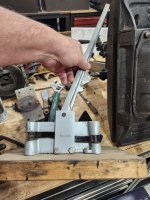
While it's always good to learn how to bend manually, once you get that down, if you have a lot of offsets semething like this Greenlee can make the installation go faster. This was a throw in at an auction lot.

Insert, press the lever, it bends the box offset perfect every time. It's so easy a Mongo can do it.

20260816_144122_resized.jpg

20260816_144155_resized.jpg
 

mm08822

Well-known member
Joined
Jan 13, 2012
Messages
6,210
Location
NJ
Deep boxes are your friend
Of course. You should first have a conductor count/gauge(s) to know what size box to buy......4"sq x 2-1/8 deep or 4-11/16" sq x 2-1/8". That would also include how you plan to pull conductors into/through the box.

Plan it on paper before running a stitch of conduit or most boxes.
 

mm08822

Well-known member
Joined
Jan 13, 2012
Messages
6,210
Location
NJ
Depending which code cycle they are on. IDK what FL follows. Here in MA we follow the current NEC, w/ MA amendments. Some states are 10-15 years prior.
Since OP doesn't have a location in profile or stated, he gets the current 2026 NEC version reqs. Local amendments is on the OP.

NEC jumped from requiring 15 & 20's on gfci to everything including 50A. So 30s were omitted in the above post, fwiw.
 

JohnX14

Well-known member
Joined
Jun 2, 2014
Messages
656
Location
Boston 'burbs
Since OP doesn't have a location in profile or stated, he gets the current 2026 NEC version reqs. Local amendments is on the OP.

NEC jumped from requiring 15 & 20's on gfci to everything including 50A. So 30s were omitted in the above post, fwiw.
Sounds good to me.

I wouldn't be putting 30 or 50 amp 240V receptacles in a workshop on GFCI's unless I had "no choice", realizing that they are required, and I have to do so for my customers, as a professional. We can't even get new Ranges and Dryers to run on a GFCI breaker. Fortunately we have a rule in MA that allowed us to document and remove the GFCI protection under certain circumstances. ("Rule 11" here in MA) It isn't 'as simple' as removing the GFCI breaker, but requires documentation. The guidelines of that rule have been bent on many occasions.
 
Last edited:
OP
0

01Bullitt82

Member
Joined
Apr 18, 2026
Messages
5
Im in Eastern North Carolina. Columns are only 5ft apart, I thought that would be to many outlets. The 4 on each side equals one about every 10ft on each wall. I was not tracking the gfi requirements, I thought only the first
receptacle in each circuit had to be protected with gfi. That makes the total cost of receptacles go up quite a bit. The shop will be used to store and work on cars.


To avoid these ads, REGISTER NOW!
Top Bottom